
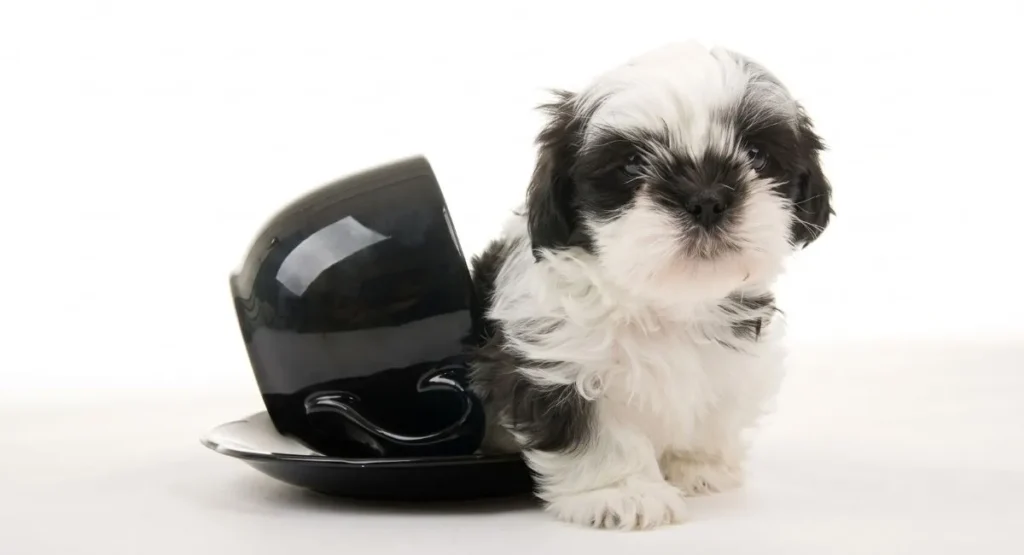
It is easy to understand why teacup dogs get so much attention. They are tiny, easy to carry, and often look like puppies even when fully grown. But once you start researching teacup dog breeds, things quickly become confusing.
What exactly counts as a teacup dog? Is “teacup” an official size? Are these dogs less healthy than other small breeds? And if you have children, is a dog this small actually a practical choice?
The most important fact comes first: “teacup” is not an official dog breed or an AKC-recognized size category. It is an informal term used for unusually small dogs, usually from breeds that are already naturally small. The American Kennel Club specifically advises buyers to ask questions when breeders market dogs outside the normal breed standard primarily for extreme size.
That does not mean every unusually small dog is unhealthy. It does mean the word “teacup” alone tells you very little about the dog’s health, genetics, temperament, or how responsibly it was bred.
If you are considering one, the goal should not be to find the smallest dog possible. A healthier approach is to understand the underlying breed first, then look carefully at the individual dog’s health and whether its needs fit your household.
What Is a Teacup Dog?
A teacup dog is generally an unusually small individual from an already-small dog breed. There is no official rule saying a teacup dog must weigh 3 pounds, 4 pounds, 5 pounds, or any other specific amount. Because the AKC does not recognize “teacup” as a size designation, there is no universal teacup weight standard.
This matters when you see advertisements for:
- Teacup Chihuahua
- Teacup Pomeranian
- Teacup Yorkie
- Teacup Maltese
- Teacup Poodle
- Micro puppy
- Pocket puppy
- Mini teacup puppy
Those labels may describe what a seller expects the dog’s size to be, but they do not create a new recognized breed.
A very small Chihuahua is still a Chihuahua. A Pomeranian marketed as a teacup Pomeranian is still a Pomeranian.
Teacup vs. Toy vs. Miniature Dogs
These words are often mixed together online, but they do not mean the same thing.
| Term | Official status | What it means |
|---|---|---|
| Teacup | Not an AKC-recognized size | Informal term used for unusually small dogs |
| Toy | Official in some contexts | Includes the AKC Toy Group and recognized Toy varieties such as the Toy Poodle |
| Miniature | Official for certain breeds | A recognized size variety in breeds such as the Poodle |
| Micro/Pocket | Usually informal | Marketing terms unless they are part of a recognized breed standard |
The Poodle is a useful example.
Poodles have recognized Standard, Miniature, and Toy varieties. The Toy Poodle is 10 inches or under at the shoulder under the AKC breed standard, while AKC weight information commonly places Toy Poodles around 4–6 pounds. There is no officially recognized fourth variety called a “Teacup Poodle.”
So when a puppy is advertised using an extreme-size label, compare that claim with the recognized breed standard, not with another breeder’s definition of “teacup.”
6 Dog Breeds Commonly Marketed as Teacup Dogs
Most dogs sold using the teacup label come from breeds that are already small. That is worth remembering because you may be able to get the size and lifestyle you want from a healthy dog that falls within its normal breed range—without specifically searching for an extremely undersized puppy.
1. Chihuahua
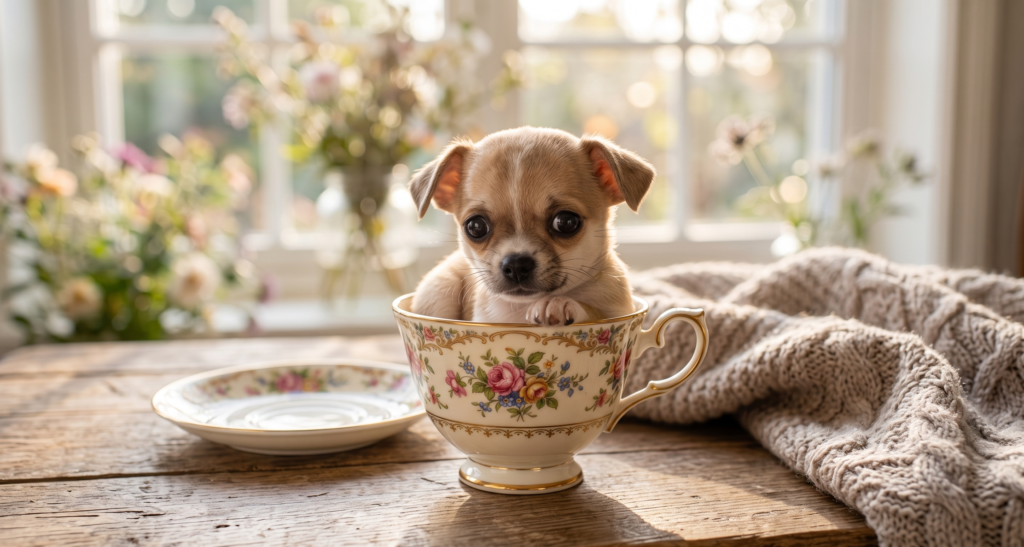
The Chihuahua is already one of the smallest recognized dog breeds. The official AKC breed standard says a Chihuahua should not exceed 6 pounds.
Despite their tiny frame, Chihuahuas tend to have confident personalities. They are alert, intelligent, affectionate with their people, and can respond well to positive training.
For families, their physical size deserves serious consideration. AKC guidance says Chihuahuas are too small for roughhousing and may not be a good choice for households where children are likely to handle them roughly.
Instead of concentrating only on how tiny the puppy may become, ask about its parents, health screening, temperament, and expected adult development.
2. Pomeranian
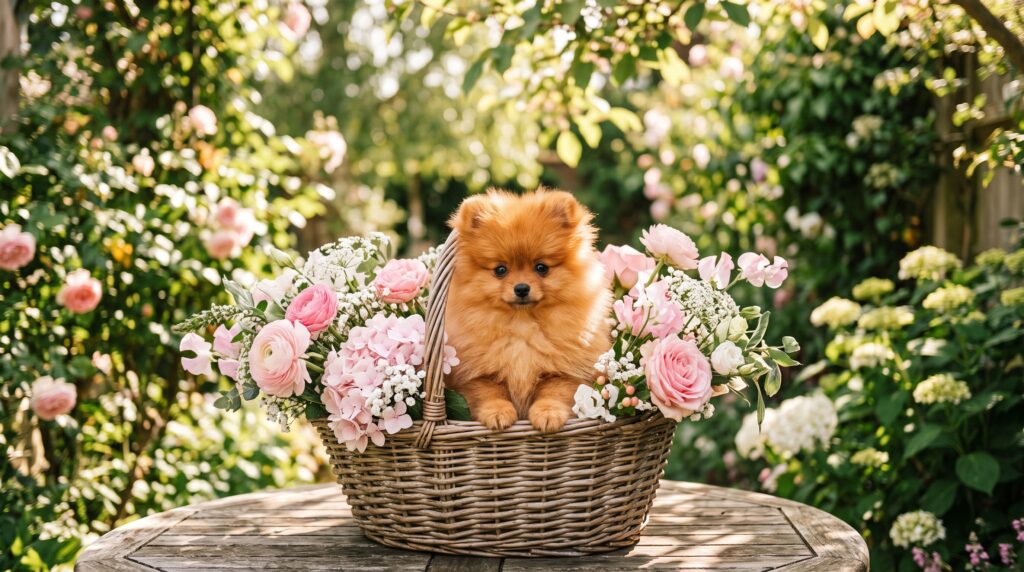
Pomeranians are also naturally tiny. The AKC lists the breed at approximately 3–7 pounds and 6–7 inches tall.
Poms are lively, intelligent dogs with much bigger personalities than their bodies suggest. Their thick double coat also requires regular grooming, so being tiny does not make them maintenance-free.
Pomeranians can be good family companions, but AKC guidance notes that they tend to suit families with older children who understand how to handle a small dog gently.
If a breeder advertises a Pomeranian specifically because it is expected to be far smaller than the breed’s usual range, health and responsible breeding should matter more than the novelty of its size.
3. Yorkshire Terrier

The Yorkshire Terrier, or Yorkie, combines a very small body with the energy and confidence of a terrier. AKC weight information places Yorkshire Terriers at up to about 7 pounds.
Yorkies can be affectionate, playful family dogs, but they still need training, mental stimulation, walks, grooming, and regular dental care. Their long coat can require considerable maintenance when kept in its traditional style.
AKC guidance says Yorkies can live successfully with children but recommends never leaving dogs unattended around young children.
4. Maltese
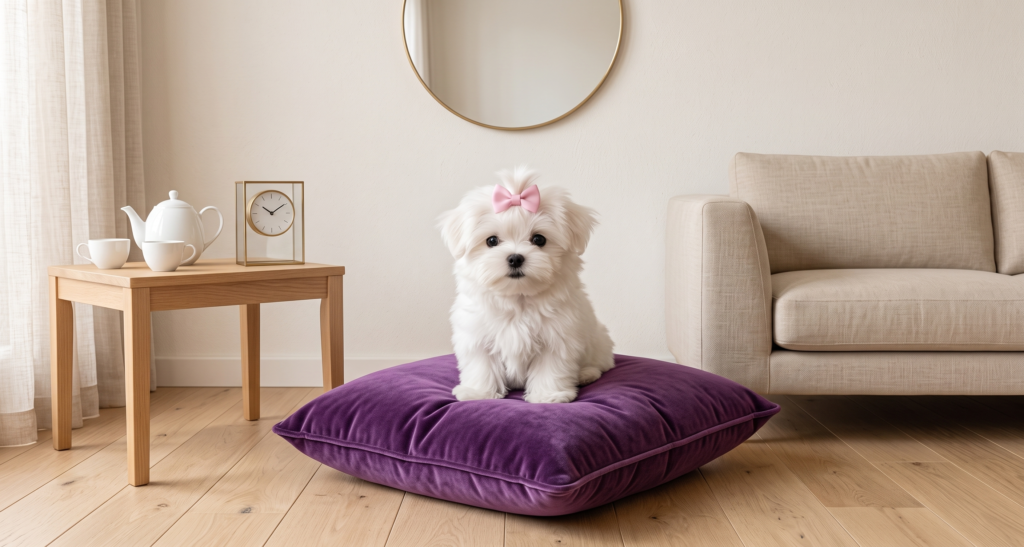
Maltese are small companion dogs even without a teacup label. AKC information places the Maltese at under 7 pounds, with a height of about 7–9 inches.
They are affectionate, playful dogs that enjoy being close to their families. Their long white coat, however, can require frequent grooming and brushing.
The breed can do well with children, but the AKC notes that Maltese generally fare better with older children because of their small size. A Maltese does not need to be bred far below its normal size to be a genuinely tiny companion.
5. Toy Poodle
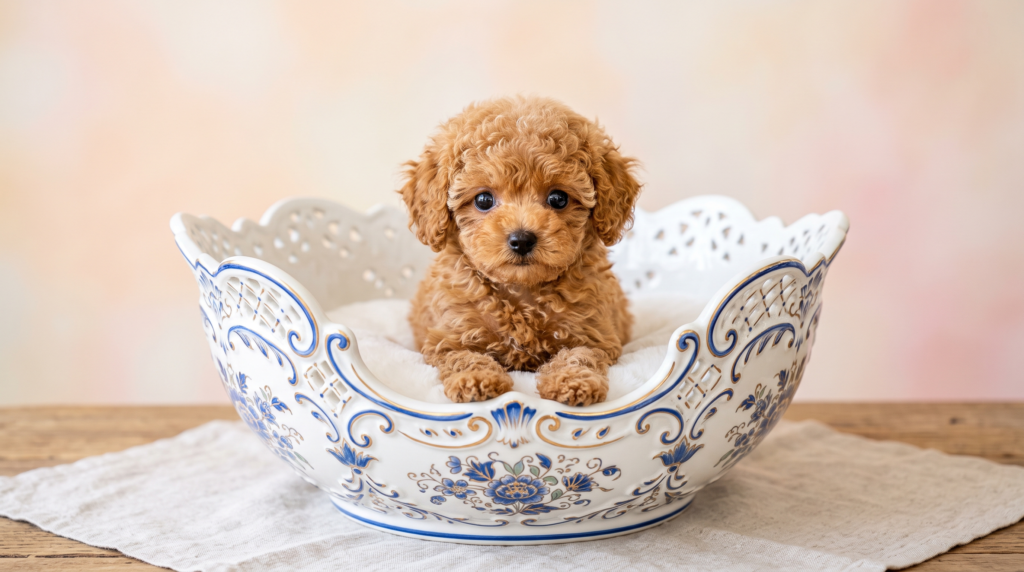
The Toy Poodle deserves special attention because “Toy” is an actual recognized Poodle size, while “teacup” is not. AKC information lists Toy Poodles at around 4–6 pounds and no more than 10 inches at the shoulder.
Poodles are highly intelligent, trainable, active dogs that usually need more mental stimulation than their elegant appearance might suggest.Their curly coats shed relatively little but require consistent grooming to prevent matting.
Someone advertising a “teacup Poodle” is therefore describing a Poodle expected to be especially small. They are not selling another officially recognized Poodle variety.
6. Shih Tzu
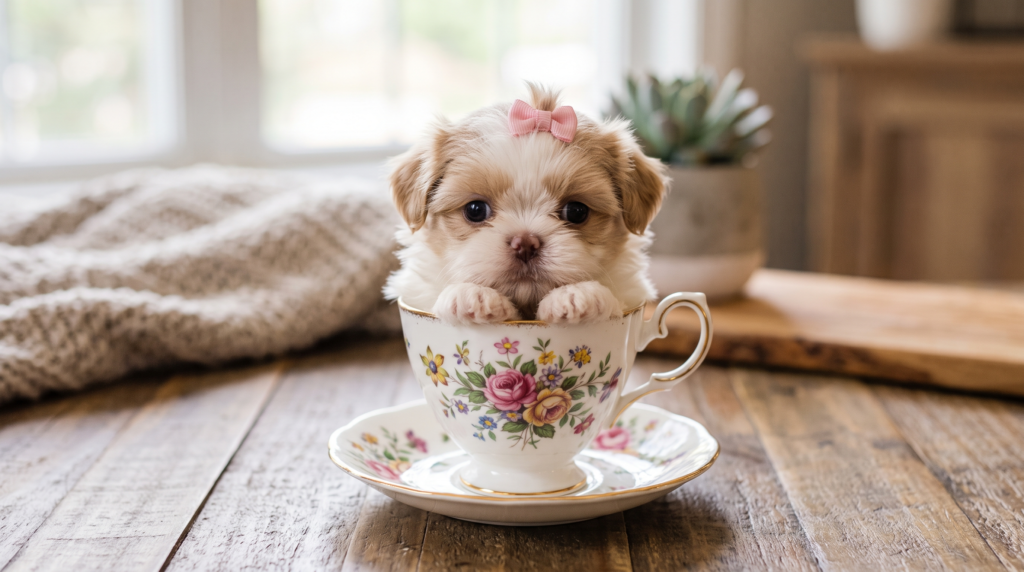
Shih Tzu are somewhat larger than the other breeds above.AKC weight information places adults at approximately 9–16 pounds.
They were developed as companion dogs and are known for being affectionate and people-oriented. Their coat requires substantial maintenance, especially when kept long.
Unlike some tiny toy breeds, Shih Tzu generally have a strong reputation as family companions. AKC guidance describes them as affectionate with children and adaptable to family life.
Still, an individual Shih Tzu bred or marketed to be unusually small should be handled with the same extra care you would give any very small dog.
Breed-Standard Sizes at a Glance
Here is the useful comparison:
| Breed | AKC-listed adult size | Is “teacup” officially recognized? | Family consideration |
|---|---|---|---|
| Chihuahua | Up to 6 lb | No | Rough handling can be risky |
| Pomeranian | 3–7 lb | No | Often better with older children |
| Yorkshire Terrier | Up to about 7 lb | No | Supervise around young children |
| Maltese | Under 7 lb | No | Often better with older children |
| Toy Poodle | About 4–6 lb | No — Toy is the recognized variety | Active, intelligent companion |
| Shih Tzu | 9–16 lb | No | Generally family-friendly |
AKC breed information supports these recognized size ranges. Notice something important: several of these breeds are already only a few pounds at their normal recognized size.
If your main goal is to own a very small companion, you may not need to search for a dog deliberately marketed as smaller still.
How Are Teacup Dogs Bred?
There is no single standardized “teacup breeding method,” just as there is no official teacup breed standard. Some breeders may selectively breed smaller dogs in an attempt to produce smaller offspring. But the word “teacup” itself does not tell you exactly how a puppy was produced, whether its parents were healthy, or whether appropriate health testing was performed.
This is an area where it is better to avoid dramatic claims.You will often read online that all teacup dogs are produced by repeatedly breeding “runts.” That is too broad to state as a rule. A dog being unusually small does not automatically prove that it was a runt or that it has a medical problem.
The more useful question is:
What was the breeder selecting for?
Responsible breeding should consider health, temperament, genetic screening, and the accepted characteristics of the breed—not only the smallest possible adult size.
The AKC specifically warns buyers to ask questions when breeders intentionally market dogs that differ substantially from their breed standard, including puppies sold as “teacup.”Extreme size should never replace health as the main breeding goal.
Are Teacup Dogs Healthy?
This question needs a careful answer. Being small does not automatically make a dog unhealthy. Many toy-breed dogs live healthy lives.At the same time, veterinary evidence shows that several medical conditions are particularly relevant to toy and small breeds.
Because “teacup” is not a scientifically defined population, research usually does not study all teacup dogs as one group. That means it would be misleading to claim that every dog carrying the label faces exactly the same risk.
A better way to understand the issue is to look at the health problems known to affect very small and toy-breed dogs and then consider the health of the individual puppy.
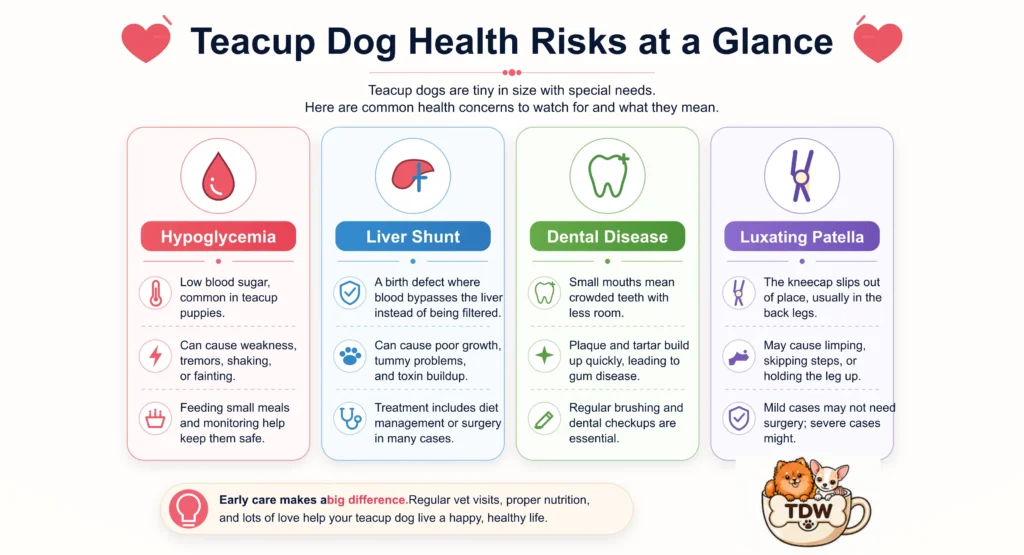
Hypoglycemia in Tiny Puppies
Hypoglycemia means abnormally low blood sugar.
The Merck Veterinary Manual states that puppy hypoglycemia occurs in toy breeds during the first six months of life and appears to be related to relative immaturity of the liver. Frequent meals are commonly used during this vulnerable period. Possible signs of low blood sugar can include weakness, unusual behavior, poor coordination, or seizures.
A tiny puppy that becomes weak, collapses, acts unusually sleepy, or shows other concerning symptoms needs veterinary attention. Owners should not rely on general internet advice to diagnose or treat an unwell puppy. Feeding requirements also vary by age, breed, weight, and health, so a veterinarian should help determine an appropriate feeding plan.
Dental and Periodontal Disease
Small dogs often need particular attention to dental health.AAHA notes that the incidence of periodontal disease is higher in smaller and older dogs, and severe periodontal bone loss in tiny dogs can have serious consequences.
Crowded teeth, retained puppy teeth, and a small jaw can make regular oral care especially important.Dental care should therefore begin before obvious problems such as bad breath or difficulty eating appear.
Tracheal Collapse
The trachea is the windpipe that carries air to and from the lungs.With tracheal collapse, the structures supporting the windpipe weaken and the airway becomes narrower.
The Merck Veterinary Manual reports that tracheal collapse is most common in toy and miniature dog breeds. Affected dogs often develop a dry, chronic “honking” cough and may have difficulty breathing.
That does not mean every tiny dog will develop the condition. It simply makes tracheal health relevant when discussing medical concerns seen more often in small breeds.Persistent coughing or breathing difficulty should be assessed by a veterinarian.
Hydrocephalus
Hydrocephalus involves an abnormal buildup of cerebrospinal fluid within the skull. VCA Animal Hospitals reports that congenital hydrocephalus appears more often in small, miniature, toy, and brachycephalic breeds, including Chihuahuas and Yorkshire Terriers.
Signs vary and can include abnormal movement, behavior changes, vision problems, circling, or other neurological symptoms.Importantly, a large fontanelle or particular head shape does not by itself prove that a puppy has hydrocephalus. A veterinarian must evaluate the individual dog.
Portosystemic Shunts
A portosystemic shunt is an abnormal blood vessel that allows blood to bypass the liver.Cornell University’s College of Veterinary Medicine notes that these congenital vascular abnormalities are most common in small dog breeds.
Affected dogs may show poor growth, gastrointestinal problems, or neurological changes, depending on the individual case.This is another condition that requires veterinary diagnosis rather than guessing based on a dog’s breed or size.
Patellar Luxation
Patellar luxation happens when the kneecap moves out of its normal position.The Orthopedic Foundation for Animals identifies forms of patellar luxation in toy and miniature breeds and notes that several forms are known or strongly suspected to be inherited.
Severity varies considerably. Some dogs show intermittent skipping or lameness, while more serious cases can affect normal movement.
Everyday Injury Risk
Not every concern requires a complicated medical explanation.A dog weighing only a few pounds simply has less body mass protecting it from an accident.
Falls from furniture, being dropped, being stepped on, or energetic play with a much larger dog deserve more attention when the dog involved is extremely small.
That physical reality becomes especially important in homes with young children or larger pets.
Are Teacup Dogs Good for Families With Children?
They can be, but size alone does not determine whether a dog is good with children.
You need to consider:
- the underlying breed
- the individual dog’s temperament
- the dog’s actual adult size
- the child’s age and behavior
- adult supervision
- training and socialization
- other animals in the home
A tiny puppy should never be chosen just because a child thinks it looks like a stuffed toy.
Younger Children vs. Older Children
Older children who understand how to sit calmly, hold a small dog gently, and respect its space are usually easier to manage around a very small animal than toddlers who naturally grab, run, climb, and play unpredictably.
Breed differences matter as well.
AKC guidance suggests Pomeranians and Maltese generally fit better with older children because of their small size, while Chihuahua guidance specifically cautions against roughhousing. Shih Tzu, on the other hand, are generally known for being affectionate family companions.
Instead of asking only:
“Are teacup dogs good with kids?”
Ask:
Can my child consistently interact safely with a dog this small?
That question is much more useful.
Other Pets Matter Too
A larger dog does not need to be aggressive to accidentally hurt a tiny companion.
Energetic chasing, wrestling, jumping, or stepping on a much smaller dog can be enough to cause an injury.
Introduce dogs carefully, supervise play where there is a large size difference, and make sure the smaller dog always has somewhere safe to retreat.
How Much Do Teacup Dogs Cost?
There is no reliable national price for a “teacup dog” because there is no standardized teacup category.Prices vary by breed, breeder, location, pedigree, demand, and how the seller markets the puppy.
More importantly:
Price does not prove quality.
An expensive puppy is not automatically responsibly bred, just as a lower price does not tell you everything about the dog’s health.
Instead of judging a breeder by price alone, look for evidence of:
- appropriate health screening
- healthy parents
- transparency about health problems within the breed
- proper puppy socialization
- veterinary care
- clean living conditions
- willingness to answer detailed questions
You should also budget for the dog’s lifetime care rather than concentrating only on purchase price.Small dogs still require veterinary visits, vaccinations, grooming, dental care, training, food, parasite prevention, and potentially emergency medical treatment.
How to Find a Responsible Breeder
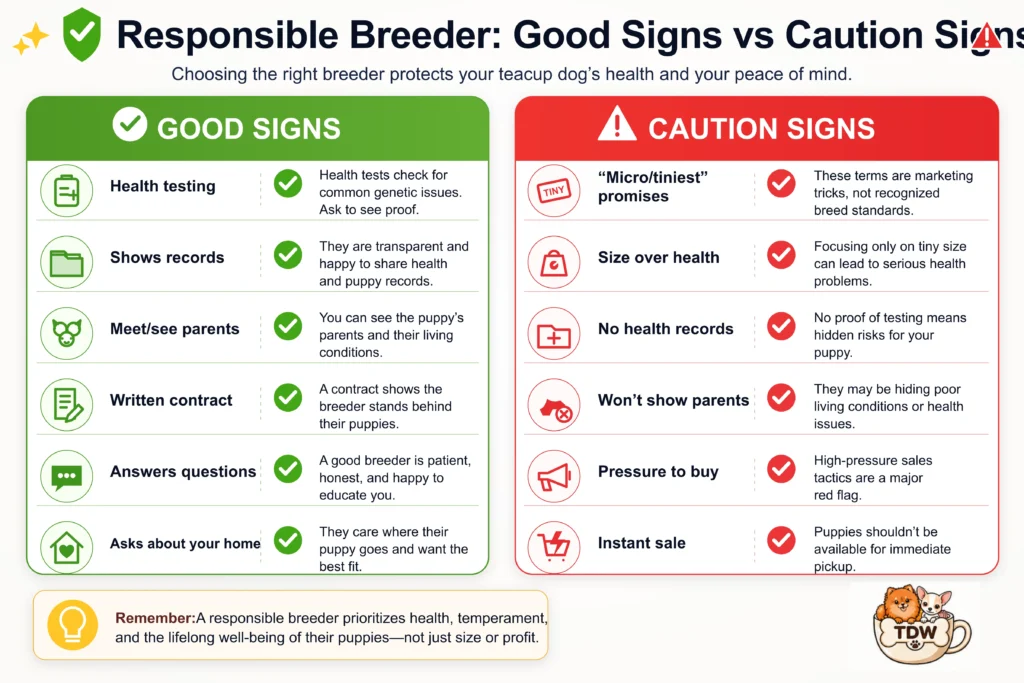
If you decide to buy a puppy, choosing the breeder carefully matters much more than finding the tiniest dog available.AKC guidance recommends visiting or otherwise carefully evaluating the breeder, learning about the puppy’s parents, asking about health problems in the breed, and requesting proof of appropriate health screening.
Questions Worth Asking
Ask the breeder:
- What health tests were performed on the puppy’s parents?
- Can I see the results?
- What are the registered names of the sire and dam?
- Can I see or meet the puppy’s mother?
- What health problems occur in this breed?
- Why did you choose these two dogs for breeding?
- What adult size do you realistically expect?
- How have the puppies been socialized?
- What happens if I can no longer keep the dog?
- Can my veterinarian examine the puppy?
A breeder should be able to discuss the breed’s weaknesses as comfortably as its strengths.
Red Flags Around Extreme-Size Marketing
Be more cautious when:
- extreme smallness is the breeder’s main selling point;
- an exact tiny adult weight is “guaranteed”;
- phrases such as “micro,” “super micro,” or “rare teacup” replace meaningful health information;
- the seller will not provide health-testing documentation;
- you cannot get useful information about the parents;
- the breeder becomes defensive when you ask about health;
- color, rarity, or size receives far more attention than temperament and health.
One marketing word does not prove that a breeder is irresponsible.
But when the entire sales pitch revolves around making an already-small breed even smaller, you have good reason to ask more questions.
Ask for Breed-Specific Health Testing
“Vet checked” and “health tested” are not necessarily the same thing.
A puppy examination by a veterinarian is valuable, but inherited health screening often involves testing the breeding parents for conditions relevant to their breed.
The Orthopedic Foundation for Animals’ Canine Health Information Center (CHIC) works with participating breed parent clubs to establish breed-specific health-screening recommendations.
There is one important detail many buyers misunderstand:
A CHIC number does not mean every test result was normal.It means the dog completed the required screenings for that participating breed and the results were made publicly available.That is why you should look at the actual results, not simply ask whether a breeder has a CHIC number
A Safer Alternative: Choose a Healthy Toy Breed Within Its Normal Size
If what attracts you to teacup dogs is simply having a small companion, you have another option.
Choose a responsibly bred dog that falls within the normal size range for an already-small breed.
Consider the difference:
- A Pomeranian can naturally weigh 3–7 pounds.
- A Toy Poodle commonly weighs around 4–6 pounds.
- A Chihuahua should weigh no more than 6 pounds under its breed standard.
- Those are already extremely small dogs.
You can get many of the practical advantages people associate with tiny dogs—compact size, easier portability, and suitability for smaller homes—without making “as small as possible” your main buying requirement.
You can also consider adoption.Small adult dogs sometimes appear in shelters and breed-specific rescues. An adult dog comes with another advantage: you already know its actual size rather than relying on a prediction about how large a puppy will eventually become.
The best dog is not necessarily the smallest one.It is the dog whose health, temperament, activity level, grooming needs, and size fit your household.
Caring for an Extremely Small Dog
A tiny dog still has full-sized responsibilities.
Feeding
Young toy-breed puppies can be vulnerable to hypoglycemia. Merck notes that frequent meals may be needed during the first months of life.But do not create one universal “teacup feeding schedule.”
A Chihuahua puppy, adult Maltese, senior Pomeranian, and Toy Poodle with a health condition may all have different nutritional needs.Ask your veterinarian how much and how often your individual dog should eat.
Dental Care
Dental health deserves attention from an early age, particularly in small dogs.Your veterinarian can recommend an appropriate home brushing routine and tell you when professional dental evaluation or cleaning is needed.Do not wait for obvious pain or difficulty eating before thinking about teeth.
Grooming
Grooming requirements come from the underlying breed, not the teacup label.
- A Pomeranian has a thick double coat.
- A Maltese may have long, silky hair.
- A Toy Poodle has a curly coat that requires clipping and brushing.
- A Yorkie’s coat can also require considerable maintenance.
Choosing a smaller version of these dogs does not make those grooming responsibilities disappear.
Training and Exercise
Tiny dogs still need to learn basic manners.Training, socialization, play, walks appropriate for the individual dog, and mental stimulation remain important.Do not treat a tiny dog as an accessory simply because it is easy to carry.
Home Safety
Look around your home from the perspective of an animal only a few inches tall.
Think about:
- high beds and couches
- open staircases
- children running through rooms
- heavy doors
- reclining furniture
- larger dogs
- busy entrances
- gaps a tiny puppy could squeeze through
A few simple changes can make daily life much safer.
Frequently Asked Questions
Are teacup dogs real?
Extremely small dogs certainly exist, but “teacup dog” is not an official AKC breed or size designation. The term is generally used to describe unusually small individuals from existing breeds such as Chihuahuas, Pomeranians, Maltese, Yorkies, and Toy Poodles.
How big do teacup dogs get?
There is no universal answer because there is no official teacup size standard. Instead, compare the dog with the recognized size of its underlying breed. For example, Pomeranians normally weigh about 3–7 pounds, Toy Poodles around 4–6 pounds, and Chihuahuas should not exceed 6 pounds under the AKC standard.
Be cautious when websites present one exact weight as though it defines every teacup dog.
How long do teacup dogs live?
There is no scientifically established lifespan for “teacup dogs” as one group because they are not a standardized breed or research population. Life expectancy depends on the underlying breed, genetics, inherited disease, individual health, veterinary care, lifestyle, and other factors.
For a realistic estimate, look at the recognized breed first rather than relying on one universal “teacup lifespan.”
Are teacup dogs unhealthy?
Not automatically. However, several conditions—including puppy hypoglycemia, dental disease, tracheal collapse, hydrocephalus, liver shunts, and patellar luxation—are relevant to certain toy and small breeds.The health of the individual dog and the quality of its breeding matter more than the marketing label alone.
Are teacup dogs good with children?
Some can live successfully with children, but extremely small dogs require gentle handling and close supervision.Breed temperament matters, but so does physical size. Families with toddlers or children who play roughly should think particularly carefully before choosing an unusually small dog.
Are teacup dogs hypoallergenic?
The word “teacup” has nothing to do with allergies.Some breeds marketed as teacup, such as Poodles and Maltese, shed relatively little. But the American College of Allergy, Asthma & Immunology explains that no dog breed is truly allergen-free because dogs produce allergens in dander, saliva, urine, and other sources.
If someone in your home has significant dog allergies, speak with an allergist rather than relying on a “hypoallergenic teacup” advertisement.
Do teacup puppies need to eat more frequently?
Some young toy-breed puppies require frequent meals because of their vulnerability to low blood sugar, particularly during the first six months of life.That does not mean every small dog needs the same schedule throughout life.
Ask your veterinarian for a feeding plan based on the puppy’s age, weight, breed, and health.
How much does a teacup dog cost?
There is no standard U.S. teacup dog price.Prices vary considerably, and paying more does not prove that a puppy is healthier or more responsibly bred.
Health documentation, parent screening, temperament, breeder transparency, and responsible care are much more useful indicators than price.
Should Your Family Get a Teacup Dog?
There is no universal yes-or-no answer.Some unusually small dogs become healthy, affectionate companions in homes that understand their needs.
But the decision should not begin with:
“How tiny can I get?”
Start with:
“Which breed actually fits my family?”
Then consider the dog’s normal adult size, temperament, grooming needs, activity level, health concerns, and compatibility with children and other pets.
If you still want an unusually small dog, pay particular attention to responsible breeding and documented health screening.And if what you really want is simply a tiny companion, remember that breeds such as Chihuahuas, Pomeranians, Maltese, Yorkies, and Toy Poodles are already remarkably small within their recognized size ranges.
Conclusion
Teacup dogs may be appealing, but the label tells you far less than the dog’s actual breed, health, temperament, and breeding history.
That distinction matters.
It means you should not judge a puppy by the label, an advertised adult weight, or a high price. Look at the actual breed, the health of the parents, appropriate health testing, the puppy’s condition and temperament, and whether such a small animal makes sense for your household.
Veterinary research supports paying particular attention to issues seen in toy and small breeds, including hypoglycemia in young puppies, dental disease, tracheal collapse, hydrocephalus, portosystemic shunts, and patellar luxation. But it is equally important not to claim that every teacup-labeled dog will develop these conditions.
For most families who simply want a very small companion, a healthy Chihuahua, Pomeranian, Maltese, Yorkshire Terrier, or Toy Poodle within its normal breed range may already provide exactly what they are looking for.
Choose health and temperament before extreme size.That is a much better foundation for bringing home a dog you can enjoy for years to come.
The TeacupDogWorld Editorial Team researches and creates practical guides about small and teacup-sized dogs, including breed characteristics, grooming, nutrition, health, training, and everyday care. Our content is developed using reputable veterinary, breed-club, and animal welfare sources to help dog owners make better-informed decisions.