
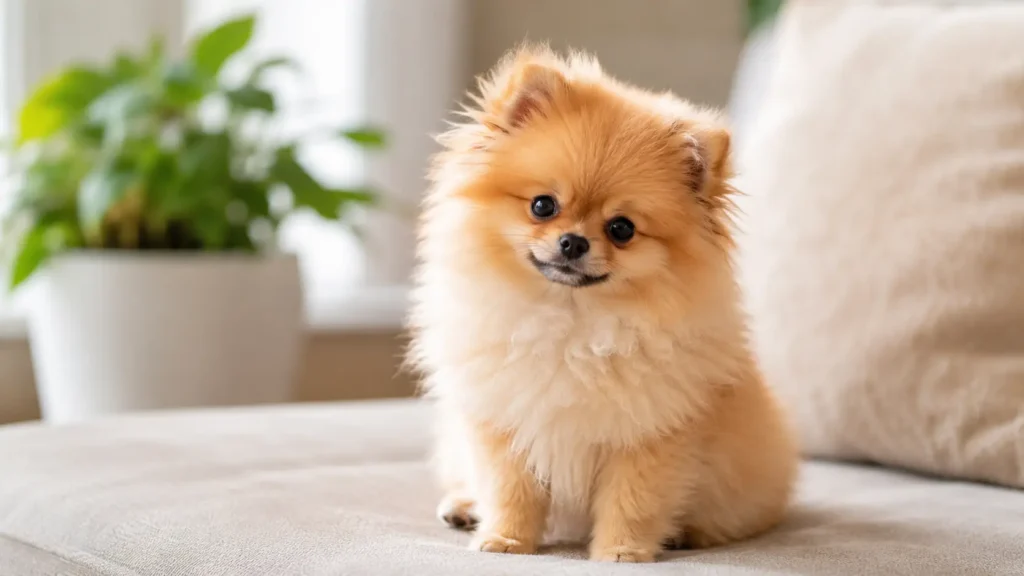
A fluffy, fox-faced puppy small enough to curl up in your hands is hard to resist. So when a seller promises a “teacup” size, it’s natural to feel excited and a little unsure about what you’re actually buying.
Here’s the short answer: a teacup Pomeranian isn’t a separate breed. It’s an informal label used for Pomeranians marketed as unusually small.
That distinction matters. It affects what families expect, what they may pay, and the questions they should ask before choosing a puppy.
This guide explains how big Pomeranians really get, their temperament and family fit, important health concerns, everyday care, lifespan, costs, and how to choose a dog responsibly.
Quick Facts
| Official breed? | No. “Teacup” is an informal label for a small Pomeranian |
| Recognized Pomeranian weight | 3–7 pounds |
| Typical lifespan | Around 12–16 years |
| Coat | Thick double coat |
| Family fit | Often better suited to adults and families with gentle children |
| Health concerns to understand | Low blood sugar in puppies, slipping kneecaps, windpipe problems, dental disease and injuries related to small size |
What Is a Teacup Pomeranian?
A teacup Pomeranian is simply a Pomeranian marketed for unusually small size.It is not another dog breed, and there is no officially recognized “teacup” Pomeranian size category.
The American Kennel Club recognizes the Pomeranian itself as a Toy Group breed. Its breed standard places adult Pomeranians in the 3–7-pound range.So a puppy advertised as a “teacup Pom” is still a Pomeranian. Its coat, temperament, health background and care needs come from the underlying breed, not from a separate teacup breed standard.
There is also no universal weight that turns a Pomeranian into a “teacup.” One seller may use the word teacup, another may say micro or mini, while another may simply describe the same dog as a small Pomeranian.
Is the Teacup Pomeranian an Official Breed?
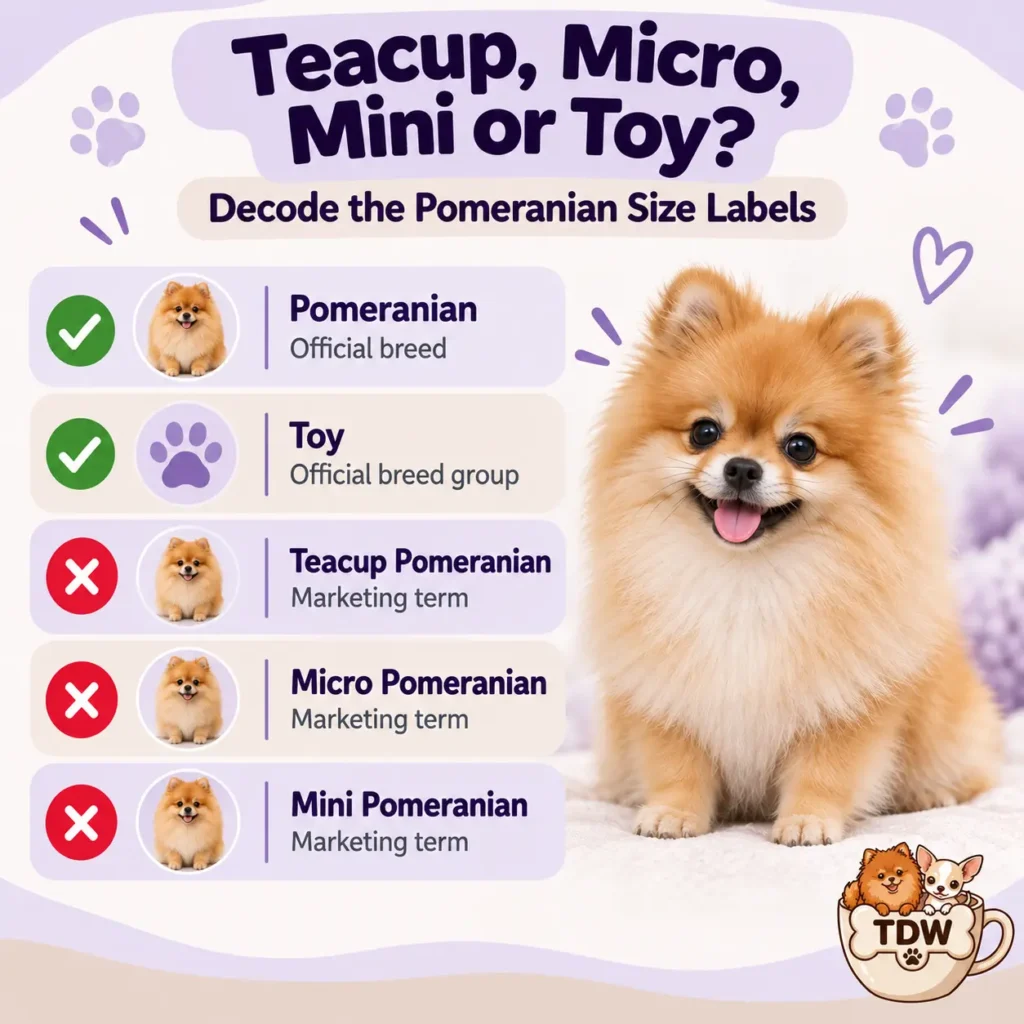
No.The recognized breed is the Pomeranian.The American Kennel Club Pomeranian standard describes one Pomeranian breed and does not establish teacup, micro or mini size varieties.
Here’s an easy way to understand the labels:
| Term | Official? | What it usually means |
|---|---|---|
| Pomeranian | Yes | The recognized dog breed |
| Toy | Yes, as a breed group | Pomeranians belong to the AKC Toy Group |
| Teacup Pomeranian | No | Informal label for a particularly small Pom |
| Micro Pomeranian | No | Seller or marketing terminology |
| Mini Pomeranian | No | Informal terminology rather than a separate size variety |
The important thing is not the label on the advertisement. Look at the individual dog, its parents, health background and reliable information about the Pomeranian breed.
How Big Do Teacup Pomeranians Get?
There is no official answer because there is no standardized teacup Pomeranian size.For a reliable reference point, use the recognized Pomeranian breed standard.Adult Pomeranians generally weigh 3–7 pounds, with 4–6 pounds considered ideal in the written AKC show standard.
That means a Pomeranian does not have to weigh two pounds to be an exceptionally small dog. Even an adult at the lower end of the recognized range is already tiny.
Adult Size Compared With the Breed Standard
| Recognized Pomeranian | “Teacup” Pomeranian | |
|---|---|---|
| Adult weight | 3–7 pounds | No official figure |
| Height | Commonly around 6–7 inches | No official figure |
| Official status | Recognized breed | Informal marketing label |
| Standardized teacup size | — | None |
Why a Tiny Puppy Doesn’t Guarantee a Tiny Adult
Adult-size predictions are still predictions.Genetics, growth, nutrition, health and individual development can all influence how large a puppy eventually becomes.Looking at the adult size of the puppy’s parents can provide useful context, but even that does not guarantee an exact final weight.
A breeder who has raised many generations of Pomeranians may have experience estimating adult size. That estimate should not be confused with an official size classification or a guarantee.
If extremely small adult size is the main selling point, ask just as many questions about the puppy’s health, parents and temperament as you do about expected weight.
Are Teacup Pomeranians Healthy?
A very small Pomeranian is not automatically unhealthy.Pomeranians have recognized breed-related health concerns, and some conditions also appear more often in toy and small dogs.That is different from saying that every Pomeranian marketed as “teacup” will develop health problems.
At the same time, buyers should be careful when unusually extreme size becomes the main feature being promoted.
A better way to evaluate a puppy is to look at three things:
- the condition and veterinary care of the individual puppy.
- the health concerns associated with the Pomeranian breed;
- the puppy’s parents and family health history;
Hypoglycemia in Toy-Breed Puppies
Hypoglycemia means low blood sugar.The Merck Veterinary Manual notes that hypoglycemia can occur in toy-breed puppies, particularly while they are very young.Possible signs can include weakness, shaking, unusual sleepiness, poor coordination or collapse.
These signs can have more than one cause, so an online article should not be used to diagnose a puppy.If a very small puppy suddenly becomes weak, poorly coordinated, unusually sleepy, collapses or otherwise seems seriously unwell, contact a veterinarian promptly.
Detailed feeding schedules, emergency treatment and medical advice should come from a veterinarian who knows the puppy’s age, weight and health history.
Luxating Patella
Patellar luxation means that the kneecap slips out of its normal position.Cornell University’s College of Veterinary Medicine describes it as a common orthopedic condition and notes that it occurs more frequently in small breeds, including Pomeranians.
Genetics can play an important role, although knee problems can also occur following injury.One possible sign is an occasional skipping motion on a hind leg. However, limping and gait changes can have several causes.
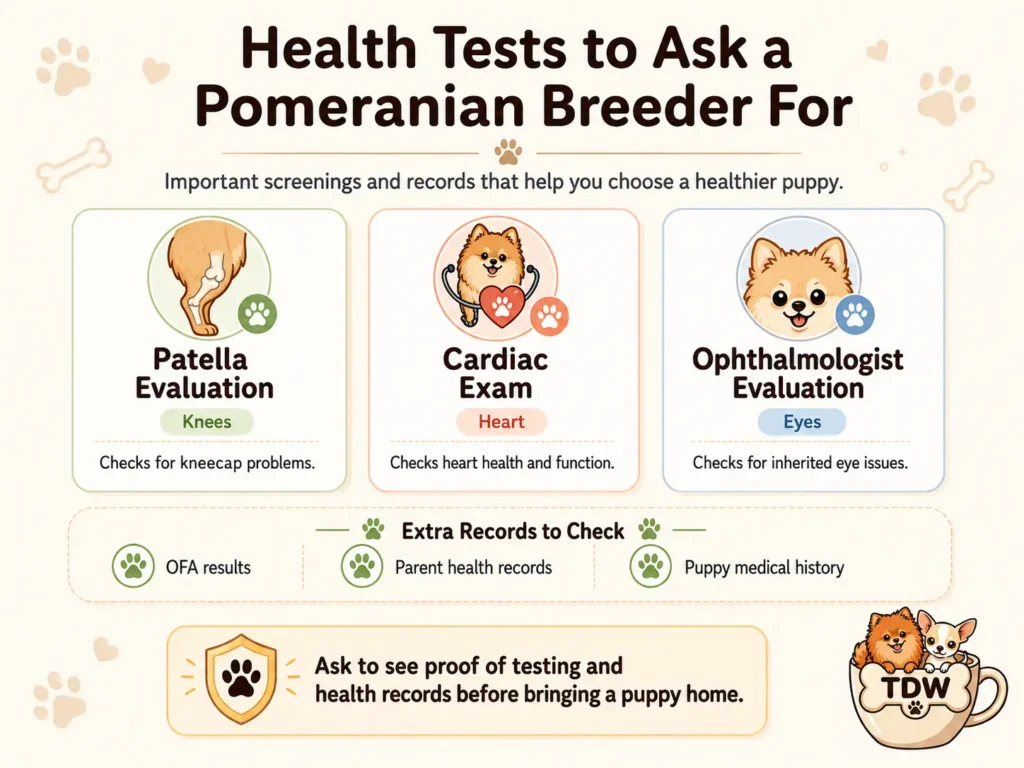
If you notice persistent limping, discomfort or unusual movement, let a veterinarian examine the dog rather than assuming the cause yourself.Patellar evaluation is also among the health screenings used for Pomeranians through the breed’s CHIC health-testing recommendations..
Tracheal Collapse
Tracheal collapse involves weakening and narrowing of the windpipe.Toy and miniature dogs are among the breeds more commonly affected.Dogs with this condition may develop a persistent dry or “honking” cough, and some may experience difficulty breathing.
This does not mean that every small Pomeranian will develop tracheal collapse.It simply makes the condition worth understanding when considering the breed.Persistent coughing or difficulty breathing should be discussed with a veterinarian. Breathing distress requires prompt veterinary attention.
Dental Disease
Dental health can be easy to overlook when the dog itself is tiny.Small and toy breeds can be more vulnerable to periodontal disease, which affects the gums and structures supporting the teeth.
Regular home dental care and veterinary dental checks are therefore worth planning from the beginning.Speak with your veterinarian about an appropriate dental routine for your dog rather than waiting until obvious problems appear.
Pomeranian Health Tests Responsible Breeders Should Complete
A routine puppy examination is useful, but it is not the same thing as screening breeding dogs for inherited or breed-associated health conditions.
The American Pomeranian Club lists specific health evaluations used for Pomeranian CHIC participation, including cardiac and patellar evaluations, along with qualifying additional tests.
The Orthopedic Foundation for Animals runs the Canine Health Information Center, or CHIC, with participating breed clubs.One detail buyers should understand is that a CHIC number does not automatically mean that every test result was normal.
It means the required health testing was completed and the results were made publicly available.Ask for the registered names of both parents and look at the actual test results rather than relying only on the presence of a CHIC number.
How Long Do Teacup Pomeranians Live?
Pomeranians are generally listed with a lifespan of around 12–16 years.There is no well-defined, officially recognized population of “teacup Pomeranians” from which researchers can calculate a separate universal teacup lifespan.
For that reason, be cautious when a breeder or website gives a very precise lifespan specifically for teacup Poms.A dog’s actual longevity can depend on genetics, health conditions, accidents, body condition, veterinary care and many other individual factors.
The recognized Pomeranian lifespan is therefore a better reference point than assuming the word “teacup” predicts how long a particular puppy will live.
Teacup Pomeranian Temperament and Family Life
Size doesn’t create a separate personality. A teacup Pom is still a Pomeranian: lively, curious, affectionate and alert, often with the confidence of a much bigger dog. Many Pomeranians bond closely with their people and enjoy being included in family life. That alertness has a flip side. Poms tend to notice everything, and they often announce it.
Are Teacup Pomeranians Good With Kids?
They can be good family companions, but their physical size matters.Very small dogs are more vulnerable to accidental injuries from rough handling, falls or being stepped on.
The problem isn’t necessarily temperament. It’s physics.A child may mean no harm but still squeeze, carry or drop a dog weighing only a few pounds.For this reason, Pomeranians often fit more comfortably into homes where children understand how to interact gently with a small animal.
There is no perfect age cutoff because children differ. A calm younger child who follows instructions may interact more safely than an older child who plays roughly. What matters most is supervision and behavior.
A few useful rules include:
- approach the dog calmly rather than chasing it;
- handle the dog gently;
- avoid letting children carry a tiny puppy without supervision;
- respect the dog’s bed, food and resting time;
- supervise play, particularly while the dog is young.
The idea isn’t to make children afraid of the dog. It is to help them understand that a tiny Pomeranian is a living animal with a delicate body, not a stuffed toy.
Barking, Other Pets and Time Alone
Barking: Pomeranians are alert dogs and may be vocal when they hear people, animals or unfamiliar noises. Early training and mental stimulation can help manage excessive barking, particularly in apartments.
Other pets: Poms can live successfully with other animals when they are properly introduced and socialized. Size differences still matter. Even a friendly large dog can accidentally injure a four-pound companion during enthusiastic play.
Time alone: Pomeranians are companion dogs that often enjoy being around people. If the household is empty for long periods each day, consider whether you can realistically provide enough interaction, activity and care.
How to Care for a Very Small Pomeranian
Being tiny does not make a Pomeranian maintenance-free.These dogs still need grooming, exercise, training, dental care, veterinary care, suitable nutrition and a home arranged with their physical size in mind.
Feeding and Nutrition
Feed a Pomeranian food appropriate for its life stage and individual needs. Very young or unusually small puppies may require more individualized feeding guidance, particularly when blood-sugar concerns exist. There is no single “teacup Pomeranian feeding schedule” that is appropriate for every puppy.
For this reason, ask your veterinarian what feeding schedule, food and portion size are suitable for your particular dog. Keep fresh water available and monitor body condition as the puppy grows.
Grooming the Double Coat
That famous Pomeranian fluff comes from a double coat: a dense undercoat beneath a longer outer coat. Regular brushing helps prevent tangles and mats and removes loose hair. Nails also need routine attention, and dental care should become part of the dog’s regular grooming and health routine.
For step by step brushing, bathing and drying tips, read our full Pomeranian grooming guide.
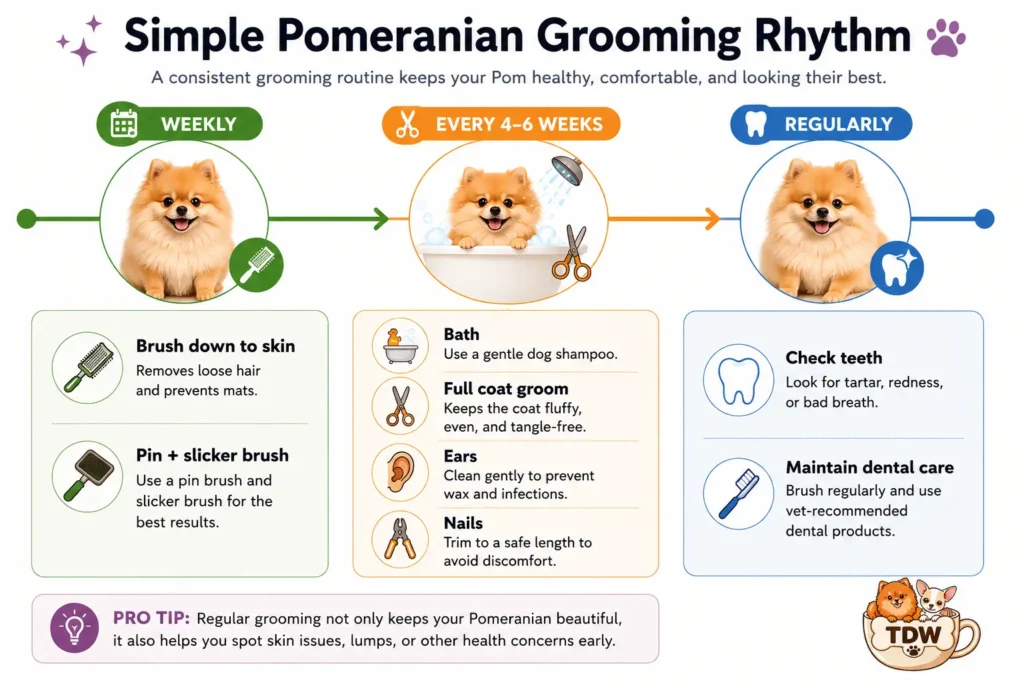
A particularly small Pom still has the basic coat and grooming needs of the Pomeranian breed. The word “teacup” does not make coat maintenance disappear.
Exercise and Training
Poms are small but energetic. Short walks, indoor games, supervised outdoor play and short training sessions can provide both physical and mental activity. Training matters even with a dog that can easily be picked up.
A tiny dog that bolts through an open door, ignores recall or reacts aggressively toward a much larger dog can quickly get into trouble. Use positive, patient and consistent training. Adjust exercise to the individual dog’s age, health and fitness level.
Making Your Home Safe for a Tiny Dog
Try looking around your home from the dog’s height. Furniture, stairs, doors, larger pets and even people’s feet become more significant when the dog weighs only a few pounds.
Simple precautions can include:
- supervising young puppies around stairs;
- discouraging repeated jumping from high beds and couches;
- keeping small objects and unsafe foods out of reach;
- checking where the dog is before moving recliners or closing doors;
- providing a quiet resting area;
- supervising interactions with much larger pets.
How Much Does a Teacup Pomeranian Cost?
The purchase price is often only one part of what a dog actually costs.For a teacup Pom, think about three separate expenses:
- buying or adopting the dog;
- everyday care;
- unexpected veterinary expenses.
How to Find a Healthy Pomeranian and Avoid Scams
This is where families can make one of the biggest differences.
Instead of asking only:
“How tiny will this puppy become?”
ask:
“How responsibly was this dog bred and raised?”
Questions to Ask a Breeder
A responsible breeder should be comfortable discussing the dog’s health as openly as its size, appearance or coat color.
Useful questions include:
- Can I meet the puppy’s mother and, if possible, learn about the father?
- What do both parents weigh as adults?
- What health screenings have the parents completed?
- Can I see or independently verify the results?
- What are the registered names of the parents?
- What veterinary records and vaccinations come with the puppy?
- Is there a written contract?
- What happens if I can no longer keep the dog?
- Why are these puppies being described as “teacup”?
If the breeder mentions OFA or CHIC testing, check the actual records rather than simply accepting the claim.
Good breeders often ask prospective owners questions too. They want to know where their puppies are going and whether the home is appropriate.
Puppy Scam Red Flags
Buying a puppy online requires some caution. Scammers may create fake puppy listings, copy information from real breeders, or take payment for puppies that do not exist.
The American Kennel Club’s guide to spotting puppy scams recommends watching for several warning signs when dealing with a breeder or puppy seller online.
Be cautious if:
- The seller avoids phone or video calls. A responsible breeder should usually be willing to speak with you directly and, when possible, arrange a video call or in-person meeting.
- The photos or listing text appear elsewhere online. Scammers may copy puppy pictures, advertisements, or breeder information from other websites.
- The seller asks for risky payment methods. Be especially careful with wire transfers, gift cards, or other payment methods that can be difficult to reverse.
- The price seems too good to be true. An unusually low price for a puppy can be a warning sign, especially when the seller pressures you to act quickly.
- The seller uses questionable breeder badges or claims. The AKC notes that it does not distribute special “breeder badges,” so such claims should be verified.
- You are pressured to send a deposit immediately. A responsible breeder should give you time to ask questions and make an informed decision.
Before sending money, speak with the breeder, ask questions about the puppy and its parents, request health records and other documentation, and verify as much information as possible.
A beautiful puppy photo and a professional-looking website are not enough on their own. Take your time and verify the seller before making a payment.
Consider Adoption
Adoption is also worth considering. Pomeranians and Pomeranian mixes can appear in shelters and breed-specific rescues. An adult rescue has one useful advantage for someone concerned about size: the dog’s adult size is already known.
Rescue staff or foster carers may also be able to tell you more about the dog’s temperament, behavior and suitability for different types of homes.
Is a Teacup Pomeranian Right for Your Family?
A small Pomeranian can be a loving companion in the right household.Instead of deciding based only on appearance, look at how the breed fits your everyday life.
| Good fit if | Think carefully if |
|---|---|
| Your children understand gentle handling | You have very young children who may handle the dog roughly |
| You have time for companionship and training | The dog would regularly spend very long periods alone |
| You can budget for veterinary and dental care | Unexpected vet expenses would be very difficult to manage |
| You are comfortable with regular grooming | You want a very low-maintenance coat |
| Some barking is manageable | You live somewhere with strict noise restrictions |
| You care about health and breeder transparency | Your main priority is finding the smallest puppy possible |
There is no perfect household formula. The individual dog’s temperament and your family’s routines matter too. The important thing is choosing a dog whose needs realistically match what your household can provide.
Teacup Pomeranian FAQs
Are teacup Pomeranians hypoallergenic?
No dog breed is completely allergy-free. Pomeranians have a double coat and shed. Dog allergens can also come from dander and saliva rather than simply the amount of hair a dog has.
If someone in your household has dog allergies, spending time around Pomeranians before getting one and discussing serious allergies with a qualified healthcare professional can be more useful than relying on the word “hypoallergenic.”
Is a 3-pound Pomeranian automatically a teacup?
No. Three pounds is already at the lower end of the recognized Pomeranian weight range. Because “teacup” is an informal marketing description, a 3-pound Pomeranian does not become a separate breed or official size category.
When is a teacup Pomeranian full grown?
Pomeranians generally reach most of their adult size during their first year, although growth differs between individual dogs. Their coats can continue developing and filling out, which may make them appear larger even when body weight changes less noticeably.
Can teacup Pomeranians live in apartments?
Yes, Pomeranians can adapt well to apartment living because of their small physical size. However, apartment suitability also depends on exercise, mental stimulation, training and barking management. A small body doesn’t mean the dog has no activity or behavioral needs.
Is a “micro” Pomeranian smaller than a teacup?
Not in any official sense.“Micro,” “mini,” “pocket” and “teacup” are marketing terms rather than standardized Pomeranian classifications.Different sellers may use them differently.
Judge the individual dog by its health, family background and breeder transparency rather than assuming one marketing label guarantees a particular adult size.
Conclusion
A teacup Pomeranian is still a Pomeranian. The recognized breed is already remarkably small, and there is no official teacup breed or standardized teacup weight. For families, the most important questions are not whether a puppy can fit into a handbag or reach a particular number on a scale.
Look at temperament, child safety, grooming and training needs, health screening, household safety, breeder transparency and whether your lifestyle suits the dog.
If you want a tiny companion, a healthy Pomeranian within the normal breed range may already be small enough. Choose the dog whose health, personality and needs fit your household rather than making extreme size the main goal.

The TeacupDogWorld Editorial Team researches and creates practical guides about small and teacup-sized dogs, including breed characteristics, grooming, nutrition, health, training, and everyday care. Our content is developed using reputable veterinary, breed-club, and animal welfare sources to help dog owners make better-informed decisions.