

Searching for a teacup Maltese? Scroll through any listing site and you’ll see the same words over and over: teacup, micro, mini, pocket. It’s reasonable to assume they mean something, and that these are rarer, smaller, more special versions of the breed.
Here’s the honest answer. The Maltese breed standard already calls for a dog under 7 pounds, with 4 to 6 pounds preferred. That makes the Maltese one of the smallest breeds the American Kennel Club recognizes, so there’s almost nothing left below it to sell you.
The word “teacup” usually adds a price tag and not much else. Below you’ll find what these labels really mean, how big a Maltese gets, what the breed’s own national club says about its health, how much grooming the coat honestly needs, and how to find a good puppy without being misled.
What Is a Teacup Maltese?
A teacup Maltese is a Maltese. It isn’t a separate breed, an official size class, or a recognized variety. What makes this label different from “teacup” labels on other breeds is the arithmetic. With Chihuahuas or Shih Tzus, a teacup is a dog bred below the breed standard. With the Maltese, the standard is already 4 to 6 pounds preferred.
In practice, sellers use “teacup” in a few different ways. Sometimes it means the smallest puppy in a litter. Sometimes it’s applied to any Maltese, since they’re all small anyway. Either way, the term doesn’t describe a distinct kind of dog.
What the AKC Maltese Standard Actually Says
The AKC breed standard is refreshingly short on this point: “Weight under 7 pounds, with from 4 to 6 pounds preferred.”
Then it adds something worth remembering: overall quality is to be favored over sizeThat single line undercuts the entire teacup pitch. The standard doesn’t reward the smallest dog. It rewards the best-built one. A well-made 6-pound Maltese beats a poorly made 3-pound one every time. So a 4-pound Maltese isn’t a teacup. It’s a textbook Maltese, sitting right in the preferred range.
“Teacup,” “Micro,” “Mini”: What the Labels Really Mean
None of these words appear in the breed standard. They’re sales terms. PetMD is blunt about it, advising readers to avoid working with breeders who advertise teacup puppies, because breeders who try to create smaller versions of an already-small breed often don’t have the dogs’ health in mind.
| Label | Official? | What it usually means |
|---|---|---|
| Maltese | Yes | The breed, in the AKC Toy Group: under 7 lb, 4–6 preferred |
| Teacup, micro, mini, miniature, pocket | No | Seller labels, often describing a dog already within the standard |
| Toy Maltese | Refers to the group, not a size | Every Maltese belongs to the Toy Group |
| Maltipoo, Malshi, Morkie | No (mixed breed) | Crosses with other breeds, not smaller Maltese |
How Big Is a Full-Grown Teacup Maltese?
There’s no official teacup size, so any weight you see quoted is a seller’s definition rather than a standard. You’ll find pages confidently listing 3 to 5 pounds, or under 4 pounds, with nothing behind the numbers.
What’s actually established: the standard calls for under 7 pounds with 4 to 6 preferred, and PetMD gives a typical height of 7 to 9 inches.
No breeder can guarantee a puppy’s adult weight. What helps instead:
- Ask for both parents’ adult weights. It’s the best predictor available.
- Ask what the breeder expects at maturity, and treat a firm guarantee as a warning sign rather than a selling point.
- Consider an adult dog if size genuinely matters to your household. What you see is what you get.
One practical note: below about 3 pounds, you’re at the edge of what’s realistic for an adult Maltese. A dog advertised as a future 2-pounder is either an unusually risky proposition or an inaccurate claim.
Teacup Maltese Quick Facts
| Fact | Detail |
|---|---|
| Breed | Maltese (“teacup” is a label, not a category) |
| AKC group | Toy |
| Standard weight | Under 7 lb, with 4–6 lb preferred |
| Height | About 7–9 inches |
| Coat | Long, silky and white; sheds little, but not allergen-free |
| Lifespan | About 12–15 years |
| Temperament | Gentle-mannered, affectionate, fearless for its size |
| Key health watch-points | Kneecaps, heart, liver, teeth, and low blood sugar in puppies |
Personality and Family Life
The breed standard describes the Maltese as gentle in manner yet lively and playful, and calls him among the gentlest mannered of all little dogs. It also offers a line that captures the breed perfectly: “For all his diminutive size, the Maltese seems to be without fear.”
That combination is the whole appeal. And it comes with a practical consequence. A confident 5-pound dog will happily march up to a Labrador, so supervision matters. Maltese bond hard to their people. They’re companion dogs by design, and most don’t do well left alone for long stretches.
Are Teacup Maltese Good With Kids?
The temperament suits families. The size is the complication. A 4-pound dog can be seriously hurt by an accidental drop, a squeeze, or a misplaced foot, even from a child who adores it. And a frightened small dog may nip to defend itself.
If you have children, a few house rules go a long way:
- Kids sit on the floor to hold the dog.
- Young children don’t carry the dog around.
- An adult supervises play.
- The dog always has a quiet place to retreat to.
Older, gentle children usually do beautifully with a Maltese. Toddlers and a tiny dog are a harder combination.
Living With Other Pets
Maltese are generally sociable with other dogs and cats. The caution is size again: supervise play with larger dogs, especially given the breed’s willingness to start something it can’t finish.
Training and House-Training
PetMD notes that Maltese have big personalities and need positive reinforcement, exercise and mental stimulation every day. They respond well to rewards and poorly to harsh correction.

House-training takes patience. Small dogs have small bladders, so puppies need frequent opportunities, and accidents are part of the process. Plenty of families use an indoor potty area alongside outdoor trips.
Grooming: The Daily Commitment
If anything decides whether a Maltese suits your family, it’s this section. PetMD puts it plainly: that long, silky coat requires near-daily upkeep, so block off time on your calendar. This isn’t an occasional weekend job.
| How often | Task |
|---|---|
| Daily | Brush (long coat), wipe the face and eye area |
| Several times a week | Brush (puppy cut); aim for daily tooth brushing |
| Every few weeks | Bath, nail trim, sanitary trim |
| Regularly | Professional grooming, whether maintaining the long coat or clipping it |
Brushing, Mats, and the Puppy Cut
Mist the coat lightly before brushing, work in small sections, and comb through to the skin afterward to check you’ve actually reached it. Pay attention to friction spots: behind the ears, armpits, the collar line, the belly and the rear.
Mats matter more than they look. A tight mat pulls on the skin and traps moisture underneath, which irritates it. Small tangles can be worked out gently; tight mats close to the skin belong to a groomer.
Many families keep their Maltese in a puppy cut, which cuts the daily workload substantially. It still needs regular professional trims, so budget for that either way.
Are Maltese Really Hypoallergenic?
No dog is, and this matters more for the Maltese than almost any breed, because the label gets attached to them constantly. PetMD addresses it directly: the white coat gives Maltese the “hypoallergenic” label, but there’s no such thing as a totally allergen-free dog.
The reason is that allergens don’t only come from shed hair. They come from skin flakes, saliva and urine too. A low-shedding coat reduces how much gets spread around your home, but it doesn’t eliminate the source. If someone in your family has allergies, spend real time around the breed before committing to a dog for the next 12 to 15 years.
Face, Eyes, and Tear Stains
White facial hair shows everything. Food, water and normal eye moisture all leave marks, and damp hair against skin can cause irritation.
Wipe the face daily with a soft, damp cloth, and keep the hair around the eyes trimmed short or tied up so it isn’t rubbing the surface of the eye .If you notice squinting, redness, cloudiness or thick discharge, that’s a vet visit rather than a grooming problem.
Teacup Maltese Health: What the Breed Club Actually Says
Here’s where this article can be genuinely reassuring, because the breed’s own national club is. Its closing note is equally positive: aside from old-age heart murmurs, old-age cataracts and possible dental work, you can expect a Maltese to behave like a playful puppy for a long time.
That’s the breed. Deliberately breeding for extreme smallness is a separate matter, and there’s very little research on dogs bred below the standard. With that framing, here’s what’s genuinely worth knowing.
Knees and Heart: The Two Tests to Ask For
The club participates in the CHIC health-testing program, and its requirements are short: an OFA patella evaluation and an OFA congenital heart base exam.
Patellar luxation means the kneecap can slip out of its normal position. PetMD notes Maltese can develop it, sometimes in one knee and sometimes both. The classic sign is a dog who skips for a few steps and then carries on normally.
The cardiac exam is mainly there to rule out patent ductus arteriosus, a blood vessel that should close shortly after birth but sometimes doesn’t.
Here’s the detail that makes this checklist so usable: the club specifically notes that both certifications can be done by a regular veterinarian. No specialist referral required. That removes the most common excuse a breeder might offer for not having them.
Liver Shunt and MVD
Two congenital liver issues turn up in the breed, and the difference between them matters. A liver shunt is a blood vessel that routes blood around the liver instead of through it, so the liver can’t do its filtering job. The club describes it as rare in Maltese.
Microvascular dysplasia (MVD) is a related issue at the cellular level. Blood does pass through the liver, just less efficiently. The club says many Maltese do have MVD, and here’s the reassuring part: it tends to be completely asymptomatic, with those dogs living long, normal lives and needing no treatment.
The club recommends bile acid testing, particularly for puppies. It’s a blood test that gives a good indication of liver health and can proactively rule out a shunt.
One small difference is worth knowing before you talk to breeders. The AKC’s breeder page lists three recommended tests: patella, cardiac and serum bile acids. The club’s own statement treats bile acid testing as a recommendation rather than a requirement. Either way, it’s a fair thing to ask about.
Teeth
The club is direct here too: as in all toy breeds, dental maintenance is important. Daily brushing and regular cleanings help a Maltese keep healthy teeth throughout life.
Small mouths mean crowded teeth, and crowded teeth trap food and plaque. The American Animal Hospital Association recommends small-breed dogs have their first full dental evaluation under anesthesia by around one year of age. Start brushing while your puppy is young, when it’s a novelty rather than an imposition.
Encephalitis
The club notes a condition seen in Maltese and several other toy breeds: encephalitis, meaning inflammation of the brain. Two forms are identified, granulomatous meningoencephalitis (GME) and necrotizing meningoencephalitis (NME).Current thinking is that these are autoimmune, where the body attacks its own central nervous system.
Be aware of the honest limitation here: studies are underway to develop a test that predicts which Maltese might develop it, but no such test exists yet. This isn’t something a breeder can screen for.The practical takeaway from the club is simple. If your Maltese ever shows neurological signs, see a veterinarian immediately.
Extra Risks for Very Small Puppies
A very small puppy carries risks that come from size rather than breed. Low blood sugar is the main one. Veterinary Partner explains that toy breed puppies can struggle to keep their blood sugar steady, so regular meals genuinely matter. Watch for weakness, trembling, wobbliness or unusual sleepiness, and get a feeding plan from your vet rather than guessing.
Falls are the other. Keep tiny puppies off high furniture, and handle them with both hands. There’s also a practical dosing issue. Medications including flea and tick preventives are dosed by body weight, and a very small dog can fall below a product’s minimum. Check the label, and ask your vet what’s appropriate.
Why 12 Weeks Matters
This is the single most useful thing to know when you’re looking at a very small Maltese puppy, and almost no article mentions it.
The American Maltese Association’s Code of Ethics commits member breeders to keeping a puppy until at least 12 weeks of age, after a veterinary exam and a first vaccination.
The reason is developmental. Toy breeds mature far more slowly than large ones. At 8 weeks, a large-breed puppy is fully weaned with all its puppy teeth and ready to go home. A Maltese at the same age is often only just starting to wean and still nursing.
The club is specific about the numbers. A Maltese should weigh about 1.5 to 2 pounds at 8 weeks, and roughly 2.5 to 3 pounds at 12 weeks. That extra month adds about a third to the puppy’s body weight.
It matters for three practical reasons:
- Hypoglycemia. The club notes that certain lines and very tiny puppies can be prone to low blood sugar from weaning until about 3 to 4 months, usually from not eating enough. By 12 weeks, most are eating regular meals and past the worst of the risk.
- Injury. A 2-pound puppy with a puppy’s coordination can be hurt by a fall off a single step.
- House-training and social skills. Bladder control matures with the puppy, and that extra month with littermates and mother teaches manners no human can.
So if a seller is offering an extremely small puppy as “ready now” at 8 weeks, that’s worth a hard question.
How Long Do Teacup Maltese Live?
PetMD gives a typical Maltese lifespan of 12 to 15 years, and the breed club’s phrasing is “well into the double digits.” By any measure, this is a long-lived breed.
There’s no reliable data specific to dogs sold as teacups. Some sites assert that teacups live shorter lives, but they don’t cite evidence for it, so treat confident claims in either direction with caution. What’s clear is that breeding and care shape a dog’s lifespan far more than a marketing label does.
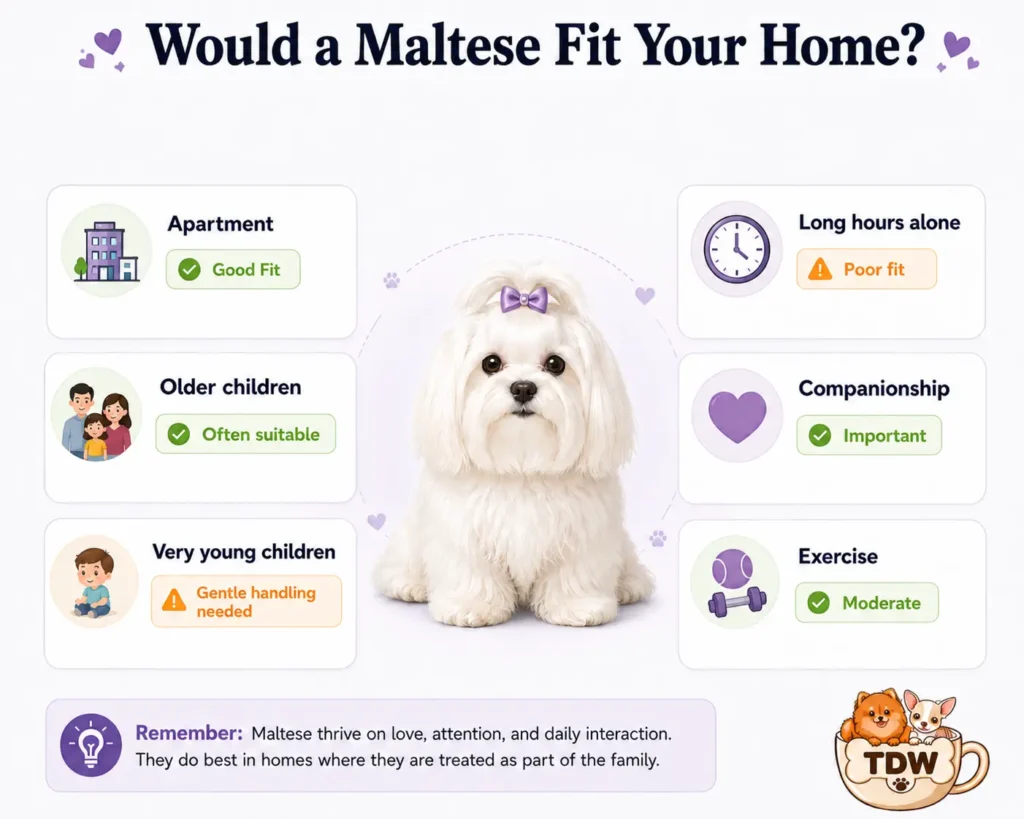
Is a Teacup Maltese Right for Your Family?
| Likely a good fit | Probably not right now |
|---|---|
| Wants a devoted lap companion | Wants an outdoorsy, rugged dog |
| Has time for near-daily grooming, or budget for a groomer | No time or budget for coat care |
| Older, gentle children | Toddlers with a 4-pound dog |
| Someone home much of the day | Long days with nobody home |
| Patient about house-training | Needs a quickly house-trained dog |
| Budget for dental and routine vet care | No room for vet bills |
If you land mostly on the left, a Maltese may be exactly right. And a well-bred Maltese within the standard already gives you the tiny companion you’re picturing, without paying extra for a word.
How to Find a Healthy Maltese
Where your puppy comes from shapes its health far more than its size does.
Questions to Ask a Breeder
A good breeder will welcome all of these:
- Have both parents had an OFA patella evaluation and an OFA congenital cardiac exam? Can we see the results? (The club notes a regular vet can perform both, so there’s no reason they shouldn’t exist.)
- Have the puppies had bile acid testing?
- Can we have both parents’ registered names, so we can look them up in the OFA database ourselves?
- What are the parents’ adult weights?
- Will you guarantee my puppy’s adult size? An honest breeder won’t.
- Can we meet the mother?
- Do you offer a written contract, a health guarantee and a take-back policy?
- At what age do puppies go home? The breed club’s own Code of Ethics says at least 12 weeks.
- Why do you use the word “teacup”? The answer tells you a lot about how the breeder thinks.
One thing to understand: a CHIC number means the required tests were completed and the results were made public, not that every result was normal. Read the actual results rather than stopping at the number.
Why “Teacup” Isn’t Worth Paying Extra For
Return to the arithmetic. The standard is already 4 to 6 pounds preferred, so a “teacup” premium is buying you a word rather than a rarer dog.
You’ll see teacup listings well above that, and the extra money isn’t buying health testing, better temperament or a longer life. Spend it on a breeder who can show you results instead.
How to Avoid Online Puppy Scams
Tiny white puppies are ideal bait for scammers. The FTC’s advice on pet scams flags clear warning signs:
- Pressure to pay a deposit immediately, before someone else takes the puppy.
- Payment by gift card, wire transfer or cryptocurrency. No legitimate seller requires these.
- Refusal to do a video call or an in-person visit.
- Borrowed photos. Run a reverse image search to see whether the pictures appear elsewhere.
- Surprise fees appearing after you’ve paid, for shipping, crates or insurance.
- A price that seems too good to be true.
If you think you’ve been targeted, report it at ReportFraud.ftc.gov.
Maltese Rescue and Adoption
Maltese do come into rescue, and the breed’s national club runs a rescue program alongside its breeder referral list. An adult dog removes the guesswork entirely. You can see their actual size, coat condition and personality before you commit.
Teacup Maltese FAQs
Is a teacup Maltese purebred?
It can be. But the word “teacup” tells you nothing about pedigree. Registration papers and the parents’ records do.
Can a teacup Maltese be AKC registered?
Only as a Maltese, and only if both parents are registered Maltese. There’s no teacup or micro registration category.
Worth knowing: being unusually small doesn’t make a dog ineligible for registration, since the standard sets no minimum weight. So “AKC registered” on a listing confirms pedigree, not that the dog is a special size.
Is a Maltipoo a teacup Maltese?
No. A Maltipoo is a Maltese crossed with a Poodle, which makes it a mixed-breed dog. The same applies to Malshis and Morkies.
Are teacup Maltese good for first-time owners?
The temperament is friendly and adaptable, which helps. The honest hesitation is the coat and the house-training, both of which need more commitment than new owners often expect.
Conclusion
The Maltese was already one of the smallest breeds the AKC recognizes before anyone thought to call one a teacup. The standard asks for under 7 pounds, prefers 4 to 6, and explicitly values quality over size.
The breed itself is a good bet: generally healthy, long-lived and devoted. What it asks of you is coat care, dental care and patience with house-training.
So ask for the patella and cardiac results, never accept a size guarantee, and put your money toward a breeder who tests rather than a word on a listing. Take the checklist above with you, or start by looking at rescue.

The TeacupDogWorld Editorial Team researches and creates practical guides about small and teacup-sized dogs, including breed characteristics, grooming, nutrition, health, training, and everyday care. Our content is developed using reputable veterinary, breed-club, and animal welfare sources to help dog owners make better-informed decisions.