

Thinking about a Pug teacup dog? It’s easy to see why. That wrinkly face, those big eyes, and that curly tail are hard to resist, and a tiny version sounds even better. But before you buy, you probably have two questions: is a teacup Pug real, and does a smaller Pug mean fewer health problems?
Here’s the honest answer. “Teacup” isn’t a recognized kind of Pug. And shrinking a flat-faced dog doesn’t shrink the breathing and heat problems that come with that face.
That doesn’t mean Pugs aren’t wonderful family dogs. It just means you’ll choose better when you know what’s behind the label. Below, you’ll learn what “mini” Pugs usually are and which health issues matter most. You’ll also see whether one suits your family, and how to find a healthy Pug without being misled or scammed.
What is a Pug Teacup Dog?
A teacup Pug is a smaller-than-average Pug, or a Pug mix, sold under a marketing label. It isn’t a separate breed or an official variety.
Here’s what surprises a lot of families: the Pug is already a toy breed. It belongs to the American Kennel Club’s Toy Group, and there’s only one Pug in the breed standard. There’s no official toy, mini, or teacup version underneath it.
What the AKC Pug Standard Actually Says
The AKC Pug standard describes a sturdy, square little dog with a large round head, a short muzzle, deep wrinkles, and big, prominent eyes. For size, it gives a weight “from 14 to 18 pounds (dog or bitch) desirable.”
Notice the word “desirable.” It’s a guide, not a cutoff. What matters is that the breed is meant to be compact and solid, not fragile and tiny.
On color, the Pug Dog Club of America, the breed’s national parent club, says the AKC recognizes only fawn with a black mask and all black.
Where “Mini” and “Teacup” Pugs Come From
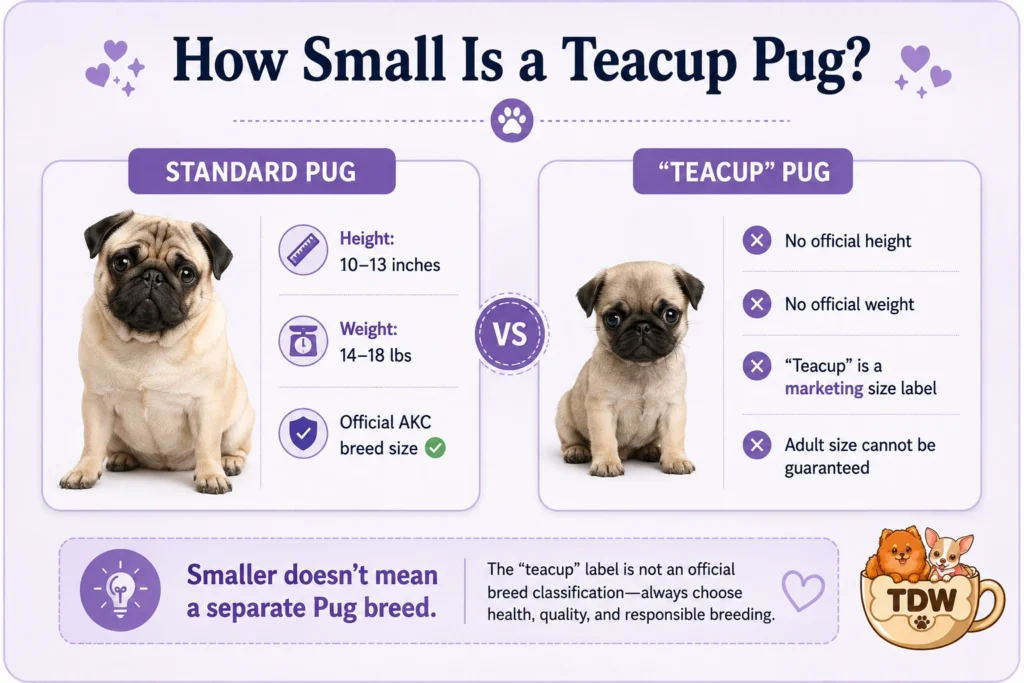
When someone sells a “mini” or “teacup” Pug, the dog is usually one of three things:
- An undersized Pug. Some Pugs are simply small, and some sellers breed small dogs together to get smaller puppies.
- A mix. Some “mini Pugs” are crosses, commonly reported to be with Chihuahuas (sometimes called a “Chug”). A mix can look Pug-like, but it’s a mixed-breed dog.
- A young puppy. Every puppy is tiny at first. A small puppy isn’t a promise of a small adult.
If ancestry matters to you, ask to see both parents’ AKC registration papers. A DNA breed test can also tell you what’s in the mix.
| Label | Official? | What it usually means |
|---|---|---|
| Pug | Yes | The breed, part of the AKC Toy Group |
| Teacup, mini, miniature, pocket, toy Pug | No | Seller labels for small Pugs or Pug mixes |
| Chug or Pug–Chihuahua mix | No (mixed breed) | A crossbred dog, sometimes sold as a “mini Pug” |
| “Rare color” Pug (white, merle, etc.) | Not AKC-recognized | Marketing; the PDCA says only fawn and black are recognized |
How Big Does a Pug Teacup Dog Get?
There’s no official teacup size, so there’s no honest number to give you. And no one can guarantee how big a puppy will be as an adult, especially if it’s a mix that could take after either parent.
What actually helps:
- Ask for both parents’ adult weights, and meet at least one parent if you can.
- Consider an adult dog. If size really matters, an adult’s size is already known.
- Treat size guarantees as a red flag. Nobody can promise how a puppy will grow.
Pug Teacup Dog Quick Facts
| Fact | Detail |
|---|---|
| Breed | Pug (“teacup” is a label) |
| AKC group | Toy |
| Standard weight | 14–18 lb desirable |
| Colors | Fawn with black mask, or black |
| Coat | Short and smooth; sheds regularly |
| Lifespan | Often cited as 13–15 years; some large studies suggest lower (see below); no teacup-specific data |
| Temperament | Affectionate, people-focused companion |
| Key health concerns | Breathing problems, heat intolerance, eye injuries, PDE, spine and joint issues, weight gain |
Pug Teacup Dog Personality and Family Life
Pugs were bred to be companions, and it shows. Most love being close to their people, follow them from room to room, and enjoy a good lap.
There’s good news on temperament, too. A large UK study found Pugs had lower odds of recorded aggression than other dogs. They generally make friendly, easygoing family members.
Are Pug Teacup Dogs Good With Kids?
Pugs are generally family-friendly, but a very small Pug is more fragile. It can be hurt if it’s dropped, squeezed, or stepped on. And no Pug, of any size, copes well with long, rough, or overheated play.
If you have kids, set a few house rules:
- An adult supervises.
- Kids sit on the floor to hold the dog.
- Young children don’t carry the dog.
- Play stays gentle, with rest breaks.
- No chasing games in warm weather.
Can Pug Teacup Dogs Live With Other Pets?
Pugs usually get along well with other dogs and pets. Just supervise play with larger dogs, since size differences can lead to accidental injuries.
Pug Teacup Dog Training, Shedding, and Daily Life
Pugs respond best to gentle, reward-based training, and treats work well because most Pugs love food. One myth to clear up: Pugs aren’t low-shedding. PetMD notes that they shed regularly, need weekly brushing, and aren’t hypoallergenic.
You’ll also hear a lot of snoring and snorting. It’s common in Pugs, but it isn’t always harmless. Loud or labored breathing can be a sign of the airway problems covered below.
Pug Teacup Dog Health Problems
Here’s the important part: most of the Pug’s health challenges come from its flat face, big eyes, and body shape. A smaller Pug still has the same face. Very small puppies then add a few extra risks of their own.
Breathing Problems (BOAS)
Pugs are brachycephalic, which means they have a short, flat face. That shape can squeeze the airway. Vets call the result brachycephalic obstructive airway syndrome, or BOAS.
BOAS can involve narrow nostrils, a soft palate that’s too long for the mouth, and a collapsed voice box. The RVC study found Pugs were almost 54 times more likely than other dogs to have BOAS.
Signs range from loud snoring and tiring quickly on walks to, in severe cases, collapse. University of Cambridge researchers describe that spectrum. The OFA notes that many owners assume these breathing noises are just normal for the breed, so mention any snoring, snorting or struggling to your vet. Surgery can help some dogs breathe more easily.
Get emergency vet care right away if your Pug is fighting for air, has blue or gray gums, or collapses.
The Pug Dog Club of America notes that not every Pug is affected. There’s also now a way to check: the AVMA reports that the OFA offers a Respiratory Function Grading scheme. It measures how well a flat-faced dog breathes. The Pug Dog Club of America was among the breed clubs that asked for it.
A trained vet listens to the dog’s breathing before and after a brisk three-minute walk. They then give a grade from 0 to III. According to the OFA, grades 0 and I mean the dog is clinically unaffected, while grades II and III mean it’s affected. Dogs must be at least 12 months old for an official result. The OFA also cautions that even unaffected parents can’t guarantee unaffected puppies, because the way BOAS is inherited isn’t fully understood.
Heat: The Everyday Danger
Dogs cool down mainly by panting. A Pug’s squeezed airway makes that harder, so Pugs can overheat quickly. The RVC’s heatstroke research found that flat-faced breeds, including Pugs, are at particular risk.
A simple heat plan:
- Walk early in the morning or late in the evening, and skip the hottest part of the day.
- Keep your home cool with air conditioning or fans, and offer shade and fresh water.
- Keep exercise short and stop at the first sign of heavy panting.
- Never leave a Pug in a parked car, even briefly.
Heavy, noisy panting, weakness, stumbling, or collapse can mean heatstroke. Move your dog somewhere cool and call your vet or an emergency clinic right away.
Eye Injuries and Ulcers
Those big, beautiful eyes sit out in the open, which makes them easy to scratch. A corneal ulcer is an open sore on the eye’s clear surface. A 2022 study of UK Pugs found Pugs had about 13 times the odds of corneal ulcers compared with other dogs.
See your vet promptly if your Pug squints, paws at an eye, or has a red, watery, or cloudy eye. Eye injuries can get worse quickly.
Pug Dog Encephalitis (PDE)
PDE, also called necrotizing meningoencephalitis (NME), is a serious inflammatory brain disease. According to the Pug Dog Club of America’s health guidance, it usually strikes young Pugs. Signs include seizures, circling, and blindness, and it’s usually fatal.
It isn’t common, though. The UC Davis Veterinary Genetics Laboratory estimates that about 1.2% of Pugs die of it.
The DNA test shows a dog’s risk, not whether it has the disease. UC Davis explains that Pugs with two copies of the risk markers (an “S/S” result) are about 12.75 times more likely to develop PDE. Even so, only about 1 in 8 of those dogs ever do. Breeders use the results to avoid producing high-risk puppies, and it’s one of the breed club’s required health tests.
Spine, Hips, and Kneecaps
The PDCA lists several structural problems in the breed:
- Patellar luxation: the kneecap slips out of place, causing a skip or limp.
- Hip dysplasia: a malformed hip joint. The club notes many Pugs live normal lives with it.
- Spinal problems: these include hemivertebrae (misshapen spinal bones) and Pug myelopathy, which causes gradual hind-leg weakness.
Discourage jumping from furniture, and use ramps or steps instead.
Weight and Skin Folds
Most Pugs adore food, and the breed club notes they’re prone to obesity. Extra weight makes breathing, joints, and heat tolerance worse, so measure meals and weigh your Pug regularly.
Those facial wrinkles also need care. Wipe them gently and keep them dry to prevent irritation.
Extra Risks for Very Small Puppies
A very small puppy carries the usual toy-puppy risks. Young toy-breed puppies can struggle to keep their blood sugar steady, as Veterinary Partner explains, so regular meals matter. They’re also easier to injure in a fall.
Ask your vet for a feeding plan, and handle a tiny puppy with extra care.
How Long Do Pug Teacup Dogs Live?
PetMD puts the average Pug lifespan at 13 to 15 years. But lifespan figures vary a lot depending on where the data comes from.
So what does that mean for you? A healthy, well-bred Pug can live well into its teens. But breathing problems and other health issues can shorten some lives. There’s no reliable data on dogs sold as “teacups.”
Caring for a Small Pug
Day-to-day Pug care comes down to a few habits:
- Follow your heat plan every warm day.
- Use a harness instead of a collar, so walks don’t put pressure on the neck and airway.
- Measure meals and weigh your dog regularly.
- Check the eyes and wrinkles daily.
- Brush weekly, and keep up with nails and teeth.
- Keep exercise short and gentle, with rest breaks.
- Use ramps or steps instead of letting your Pug jump.
- Follow a vet feeding plan for a very small puppy.
Is a Pug Teacup Dog Right for Your Family?
A Pug can be a loving, funny family companion. But it’s not the right fit for every home.
| Likely a good fit | Probably not the right time |
|---|---|
| Someone home much of the day who wants a companion dog | Looking for a running or hiking partner |
| Cool climate or reliable air conditioning | Hot climate without reliable cooling |
| Older, gentle children | Toddlers or very young kids with a tiny dog |
| Budget for vet care, including possible breathing or eye treatment | Tight budget for vet bills |
| Willing to control portions and weight | A household that free-feeds |
If you mostly land on the left, a Pug may suit you well. And a healthy, well-bred standard-size Pug, or a rescue, is usually a better choice than the smallest puppy you can find.
How to Find a Healthy Pug Teacup Dog
Where your Pug comes from matters more than its size. Here’s how to protect your family and your future dog.
Questions to Ask a Breeder
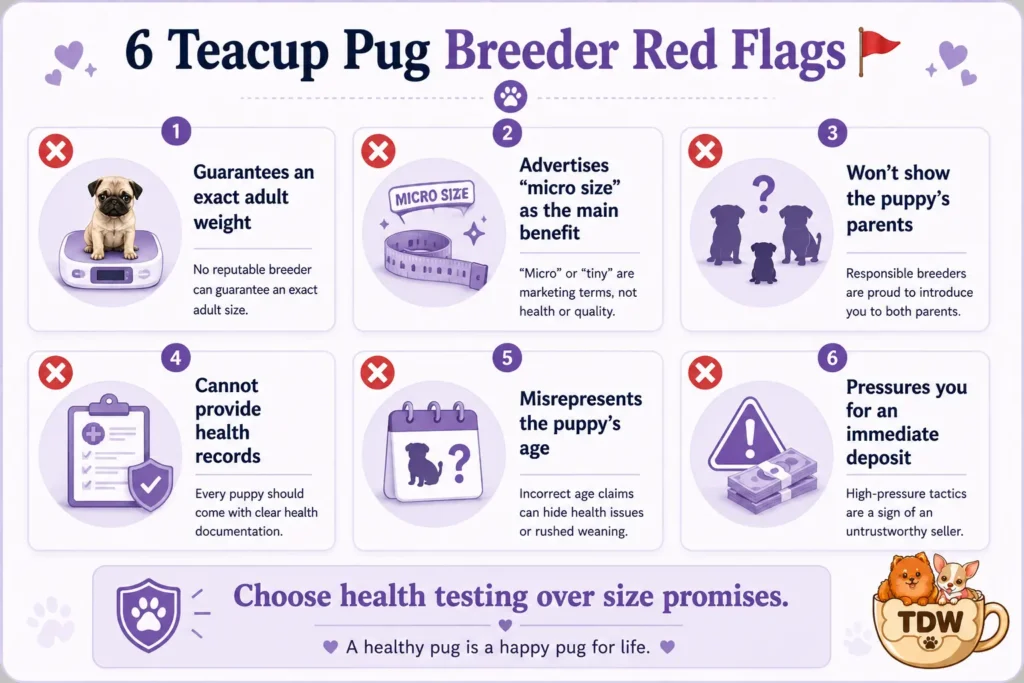
A good breeder will welcome these questions:
- Have both parents had the breed club’s required health tests? Those are a PDE DNA test, an eye exam, and a kneecap evaluation. Can we see the OFA results?
- Have the parents been graded for breathing through the OFA’s Respiratory Function Grading scheme? Grades 0 and I are posted publicly. Grades II and III are only shown if the owner allows it, so ask directly if you can’t find a result.
- Is “vet checked” all you can show us? A puppy’s vet exam is useful, but it isn’t the same as health-testing the parents before breeding.
- Can we see both parents move around? Do they snore loudly, or struggle for breath after light activity?
- Are both parents AKC-registered Pugs? If not, the puppy is a mix.
- What are the parents’ adult weights? Will you guarantee my puppy’s size? (A good breeder won’t.)
- Do you offer a written contract, a health guarantee, and a take-back policy?
- Why do you call your puppies “teacup” or “rare color”? The answer tells you a lot.
One tip: a CHIC number means a dog completed the required tests and the results are public. The PDCA points out that it doesn’t mean every test was passed. So check for yourself:
- Ask for both parents’ registered names.
- Look them up in the OFA database.
- See which tests were done.
- Read each actual result, and ask the breeder about anything you don’t understand.
Why the Pug Teacup Dog Label Is Not Worth Paying Extra For
PetMD warns that teacup Pugs are bred to be as small as possible, often without considering their health. A higher price for a “teacup” or “rare color” puppy buys you a label, not a healthier dog.
For context, PetMD says a typical Pug puppy costs roughly $1,000 to $2,500, depending on the breeder and location. The AVMA, the national veterinary association, discourages breeding animals for traits that harm their health.
How to Avoid Online Puppy Scams
Cute puppy photos are a favorite tool for scammers. The FTC’s pet-scam advice points to clear warning signs:
- Pressure to pay a deposit fast before “someone else takes the puppy.”
- Payment by gift card, wire transfer, or cryptocurrency. No legitimate seller requires these.
- No visits or video calls. The seller won’t let you see the puppy live.
- Borrowed photos. Do a reverse image search to check whether the pictures appear elsewhere.
- Surprise fees for shipping, crates, or insurance.
- Prices that seem too good to be true. The FTC warns that scam ads may offer purebred puppies for a few hundred dollars.
If you think you’ve been targeted, report it at ReportFraud.ftc.gov.
Pug Teacup Dog Rescue and Adoption
Adoption is a great option. The Pug Dog Club of America lists Pug rescue groups, and shelters often have Pugs too. An adult Pug comes with a big advantage. You can already see its size, how well it breathes, and its personality.
Teacup Pug FAQs
Is a mini Pug a Pug–Chihuahua mix?
Sometimes. Some dogs sold as “mini Pugs” are mixes, while others are undersized Pugs. Registration papers for both parents, or a DNA breed test, will tell you which.
Can a teacup Pug be AKC registered?
Only as a regular Pug, and only if both parents are AKC-registered Pugs. There’s no “teacup” category, and mixes can’t be registered as Pugs.
Are smaller Pugs healthier?
No. Size doesn’t change the flat face that causes most Pug breathing, heat, and eye problems. See the health section above.
Conclusion
A Pug teacup dog isn’t a special kind of Pug. It’s a small Pug or a Pug mix with a marketing label, and it still has the Pug’s flat face and the breathing, heat, and eye risks that come with it.
The best choice is a healthy Pug, not the tiniest one. Ask breeders for health tests and breathing grades, never trust size promises, and plan for summer heat.
Ready to start looking? Take the breeder checklist above with you, or begin with a Pug rescue. Talk to your vet before bringing your new dog home.

The TeacupDogWorld Editorial Team researches and creates practical guides about small and teacup-sized dogs, including breed characteristics, grooming, nutrition, health, training, and everyday care. Our content is developed using reputable veterinary, breed-club, and animal welfare sources to help dog owners make better-informed decisions.