

Wondering how to choose a collar for a teacup dog? Start with your dog’s neck measurement, the manufacturer’s sizing instructions, and a check of the collar’s construction and fit. A tiny neck leaves little room for error, so small details matter.
This guide shows you how to measure, which collar types suit which situations, how to test the fit, and why a harness is usually the better choice for walks. You will also learn how to keep ID on your dog and when a cough means a call to the vet. Let’s begin with the short answer.
How to Choose a Collar for a Teacup Dog
- Measure first. Use your dog’s actual neck measurement and the maker’s size chart, not a size label.
- Pick a simple flat buckle collar with smooth edges for everyday wear and ID.
- Check the fit. It should be secure and comfortable, and it must not slip over the head.
- Use a well fitted harness for leash walks. Keep the collar for ID.
- Add a microchip as a backup to the tag.
Why a Teacup Dog Needs Extra Care With Collars
A teacup dog is small in every way, so a collar that is slightly too loose or bulky matters more on a neck this narrow. “Teacup” is an informal label, not an official breed or size, so there is no standard teacup size and no chart that can tell you what fits your dog.
Every dog is different, so you measure. Very small dogs can also have extra health risks, which is why regular vet care matters. Our teacup dog guide explains the term and the health questions around very small dogs.
Should a Teacup Dog Wear a Collar or a Harness?
For leash walking, choose a well fitted body harness to reduce pressure on the neck. The collar can carry identification. Tufts’ veterinary school takes the same view: well fitted harnesses are much preferable for leash walking, and collars are best used only for holding tags.
The reason is simple. A collar puts leash pressure on the neck. A harness spreads it across the chest and body. That matters most for dogs with airway problems. Tracheal collapse is a progressive disease of the windpipe that is common in toy and small breeds.
Cornell University’s veterinary college says pressure on the neck can make the coughing worse. It also lists switching from neck collars to harnesses as one lifestyle adjustment.
Cornell describes the cause as unclear, with a possible genetic part. It does not name collars as the cause. Not every teacup dog will develop airway trouble, and a harness cannot promise to prevent it. It is a simple way to lower neck pressure.
| Situation | Suggested setup |
|---|---|
| Healthy, calm dog | Collar for ID, harness for walks |
| Dog that pulls or lunges | Harness for walks |
| Dog that slips out of its collar | Check the fit first, then ask about other designs |
| Dog that coughs on walks or when picked up | Harness, and see your vet |
| Dog diagnosed with tracheal collapse | Follow your vet’s plan |
Harnesses need measuring too. The AKC measuring guide below explains the chest and neck measurements they use.
When to Call the Vet
Seek emergency veterinary care immediately if your dog struggles to breathe, develops blue gums or tongue, or faints or collapses. For recurring coughing without breathing distress, arrange a veterinary assessment.
A collar change will not fix a medical problem.
Step 1: Measure Your Teacup Dog’s Neck
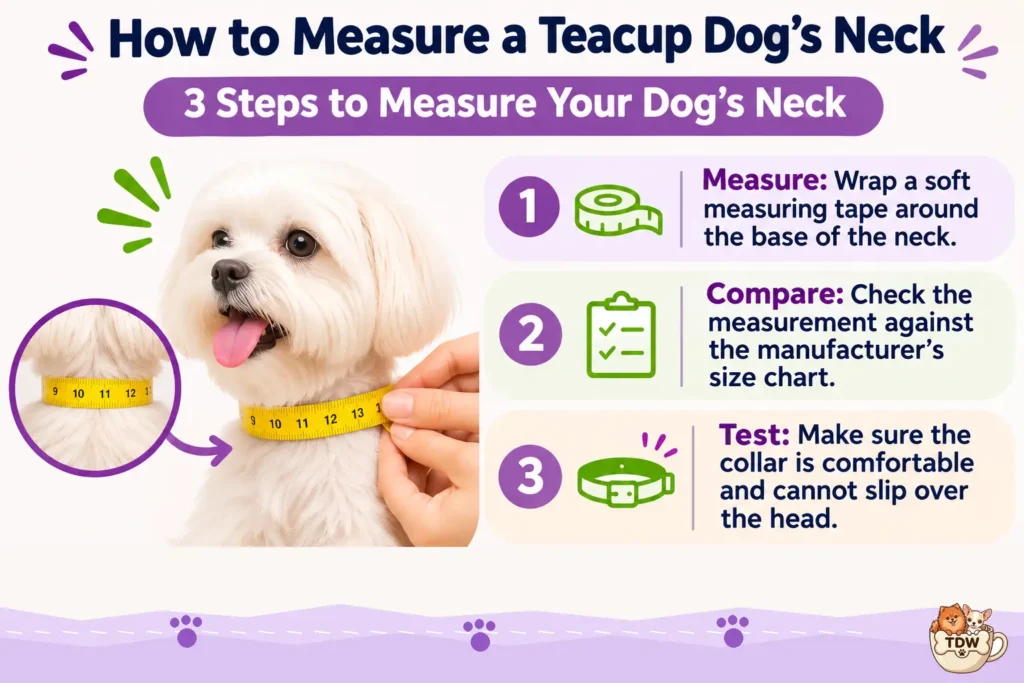
Start with neck circumference, then take any additional measurements required by the manufacturer. The American Kennel Club explains how to take the neck measurement.
How to Take the Measurement
- Let your dog stand naturally. Use a treat to keep things calm.
- Use a soft tape measure. A piece of string works too.
- Wrap it around the base of the neck, where the collar will sit. Keep it snug, but not tight.
- If you used string, mark where it overlaps, then lay it flat against a ruler.
- Write down how you measured, so the number still makes sense later.
Read the Size Chart Carefully
Size charts can describe three different things:
- Neck circumference: the distance around your dog’s neck.
- Adjustment range: the range of neck sizes the collar can fit.
- Total length: the length of the product itself, which may include parts that overlap or fasten.
These are not interchangeable. Check whether the manufacturer wants a close neck measurement or one that already includes fitting space. Do not add extra inches again if the instructions have already allowed for clearance. If the listing is unclear, ask the maker before you order.
What to Do When Your Dog Is Growing or Between Sizes
If your dog falls between sizes, check the manufacturer’s instructions. Choose the larger option only if it adjusts to a secure, comfortable fit now. Otherwise, try a different product rather than buying a loose collar for your puppy to grow into.
Check the fit whenever you put the collar on, and remeasure as your puppy grows or its body size changes. Coat changes can affect the fit too.
Step 2: Pick the Right Type of Collar
Flat Buckle Collars
A flat buckle collar is the simplest choice. It sits flat, holds a tag, and does not tighten when pulled. For most teacup dogs, this is the everyday collar.
Quick Release vs Breakaway Closures
These two names sound alike, but they work differently. Read the closure description instead of trusting the product name.
| Closure | How it works |
|---|---|
| Quick release or side release clasp | You press it by hand to open it |
| Breakaway closure | Designed to release under enough tension |
VCA Animal Hospitals warns that a dog can escape if the leash is clipped to a breakaway ring, or if the collar fits too loosely. Some models have a double ring system for walks, and the leash must be attached to both rings. Follow the maker’s exact instructions.
Martingale Collars
A martingale collar has an extra loop that tightens when the dog pulls back. It can help dogs that back out of regular collars.
A martingale limits tightening when it is fitted correctly. A wrong fit can still cause constriction or discomfort. It needs supervision, and VCA does not recommend it as a training tool, so it should not be treated as a fix for pulling.
Collars to Avoid
Avoid choke chains, prong collars, and electronic shock collars. The American Veterinary Society of Animal Behavior recommends reward based training and advises against aversive training methods.
Step 3: Choose Material, Width, and Hardware
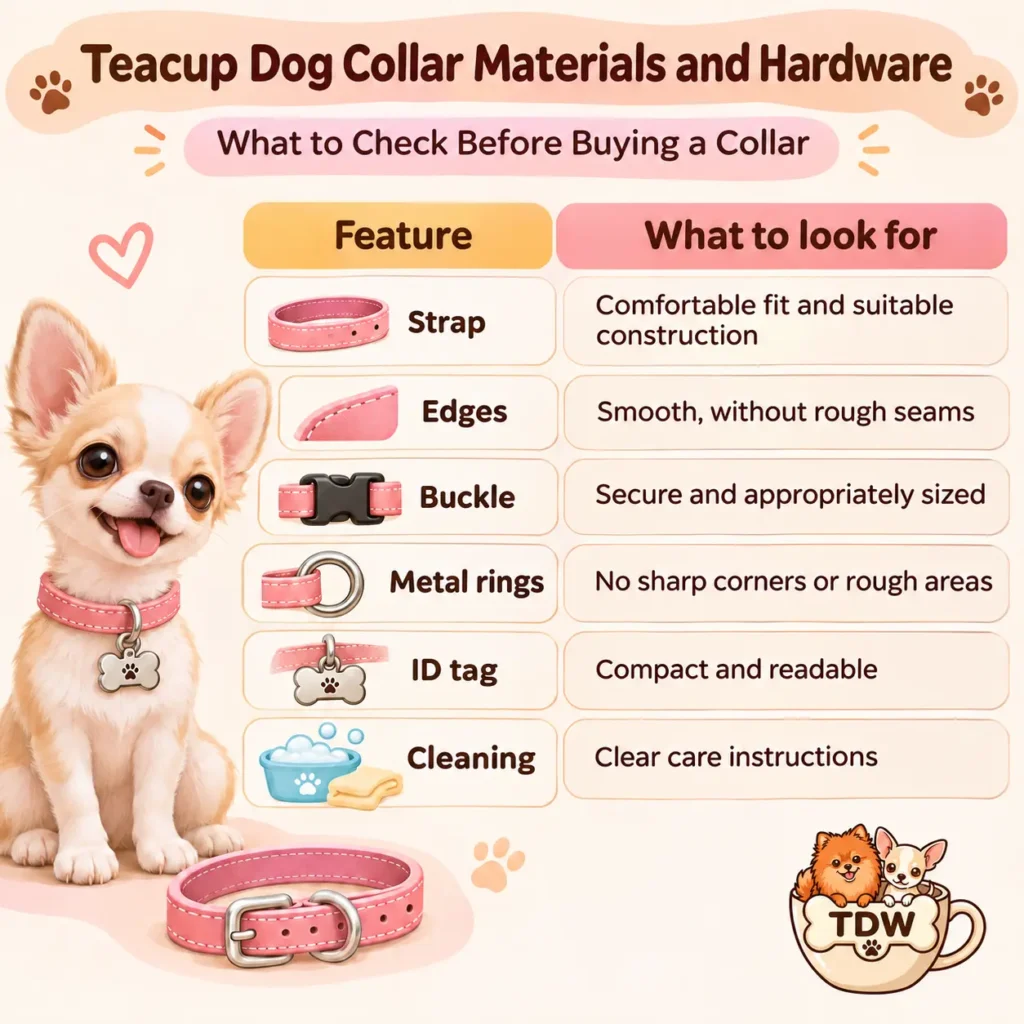
Judge the whole collar, not just the strap. Include the buckle, rings, tag, and any decoration. Hand feel is not a reliable weight test.
- Edges and seams: They should be smooth, with no loose stitching.
- Hardware: Check that the buckle and rings are not oversized for the neck and have no sharp corners.
- Fit of the parts: Look at how the buckle, tag, and strap sit together. Does the hardware crowd the jaw when your dog lowers its head?
- Cleaning: The listing should say how to clean it.
- Returns: Make sure you can send it back if the construction does not suit your dog.
Width and weight advice differs between brands, and no single number fits every teacup dog. Do not assume that leather is always more comfortable, that padding prevents irritation, or that a higher price guarantees a better fit. Check the finished collar on your dog.
Step 4: Check the Fit Before Regular Use
A secure, comfortable fit is essential. Try the collar in a safe indoor space before you rely on it.
Finger Clearance Is Only a Rough Check
Published fitting advice varies. One AKC guide recommends two fingers, while another AKC guide suggests one finger for small dogs. Treat finger clearance as a rough check alongside the manufacturer’s instructions, comfort, and resistance to slipping over the head.
The Slip Over the Head Test
With your dog calm, gently try to slide the collar up toward the ears. If it comes off, it is not secure. Check the adjustment and the maker’s directions. Do not keep tightening a collar that is too big. Try a different size or design.
Skin and Coat Checks
Look under the collar often. Redness, hair loss, matted fur, scabs, or constant scratching may point to irritation or another skin problem. Take the collar off and ask your vet if it does not clear up quickly.
ID Tags and Microchips for a Tiny Dog
A teacup dog is easy to lose. It can slip through a gap or dash out an open door. The American Veterinary Medical Association endorses microchips, but says they are not a substitute for outside ID. Microchipped pets should also wear collars with proper identification. A tag only helps if it is on the dog when it goes missing, which is why the chip is a good backup.
Keep the ID compact and current. Register the microchip and update your contact details when they change, because the chip itself holds only a number.
Collar Safety for Families
Teacup dogs are fragile, and a busy home can be hard on them.
- Adults handle the leash and harness. Young children should not walk a teacup dog alone.
- No tugging. Teach children never to pull on the collar or leash.
- Watch for snags. VCA notes that dogs can be frightened or injured when a tooth or leg gets caught in a playmate’s collar. Collars can also twist and tighten in crates. Ask your vet whether to remove the collar when you cannot supervise.
- Check after play. Look at the collar and the skin once the fun is over.
When to Replace or Resize the Collar
Replace the collar if you see:
- Frayed edges or loose stitching
- Stretched holes, or a closure that no longer works reliably
- Rough or rusty hardware
- A fit that no longer works for your dog
Replace the tag if its text is hard to read. Replace the collar too only if the collar itself needs it.
FAQ
Can I use a cat collar on a teacup dog?
Do not choose one only because it is small enough. Check that the maker says it suits your use, how the closure releases, and whether leash attachment is allowed. A breakaway mechanism can release under tension, so size alone does not make it suitable. Do not modify the closure to make it work differently.
Should my teacup dog wear a collar all day?
There is no single rule. If the collar stays on, check the fit and skin regularly. Entanglement is a risk during play or in a crate, so ask your vet whether to remove it when you cannot supervise.
Is a decorated collar okay?
It can be, if it passes the same checks as any collar: smooth edges, a secure fit, and hardware that is not bulky on your dog’s neck.
Final Thoughts
To choose a collar for a teacup dog, measure the neck, follow the maker’s size chart, and pick a simple collar that fits securely and comfortably. Use it for ID, walk on a well fitted harness, and add a registered microchip as a backup.
Your next step is simple: measure your dog’s neck today and compare it with one product’s instructions. If your dog coughs, call your vet before buying anything.
The TeacupDogWorld Editorial Team researches and creates practical guides about small and teacup sized dogs, including breed characteristics, grooming, nutrition, health, training, and everyday care. Our content is developed using reputable veterinary, breed club, and animal welfare sources to help dog owners make better informed decisions.