
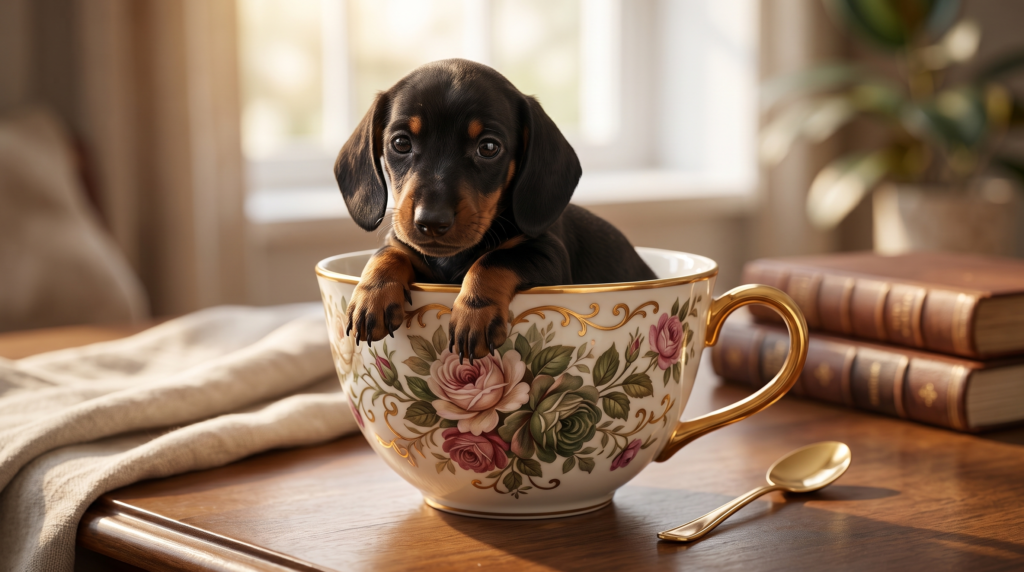
You’ve seen the photos of a Dachshund small enough to sit in a cupped hand, listed at a price that makes you blink. Then you search the term and half the internet tells you the category doesn’t even exist. Both of those things can feel true at once, and it’s genuinely confusing.
Here’s the short version: no major kennel club recognizes a teacup size, but the dogs being advertised are real, and some of them are perfectly healthy. The word tells you about the seller, not the dog.
This guide gives you what you actually need before you pay anyone. Real adult weights instead of vague promises, the health risks that matter and how common they are, the health tests a serious breeder should be able to show you, what these dogs cost over a lifetime, and the warning signs that separate a careful breeder from a listing designed to take your deposit.
Is a Teacup Dachshund a Real Breed or Size?
No. “Teacup” is a marketing term, not a breed and not a recognized size class. The American Kennel Club breed standard recognizes Dachshunds in two sizes only standard ,miniature and no US registry defines a teacup category. A dog advertised as one is nearly always a small Miniature Dachshund.
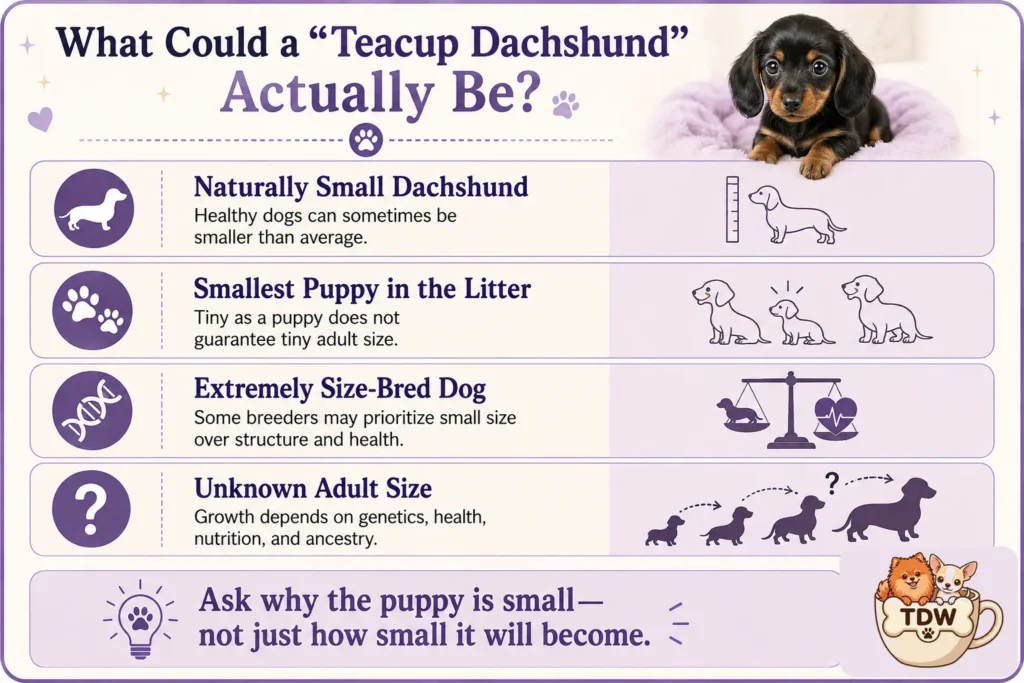
You’ll see the same dog sold under several labels: toy Dachshund, micro Dachshund, teacup miniature, teacup doxie. None of them appear in any breed standard. They’re descriptions a seller chose, and a seller can choose whichever one sounds smallest.
Here’s the important part, and it cuts both ways. The label doesn’t mean the dog is unhealthy, plenty of small minis live long, ordinary lives. It also doesn’t mean the dog is a scam. What it means is that the word carries no information. It isn’t a guarantee, a certification, or a size you can hold anyone to.
So a “teacup” puppy can’t be registered as one either. A very small purebred Dachshund with registered parents can be registered — as a Dachshund. If a seller offers papers for a teacup Dachshund specifically, they’re either registering the dog as a miniature and calling it something else in the ad, or the papers aren’t from a registry that means anything.
How Big Is a Teacup Dachshund, Really?
Most dogs sold under this label end up somewhere between 4 and 8 pounds as adults but there’s no official threshold, and that’s the whole problem. Nobody regulates the word, so one breeder’s teacup is another breeder’s small mini.
The numbers that do mean something come from the breed standard. In the US, a Miniature Dachshund is defined as 11 pounds and under at 12 months of age or older; standards usually weigh between 16 and 32 pounds. Height isn’t part of the official size definition, though minis typically stand around 5 to 6 inches at the shoulder against 8 to 9 inches for a standard.
Notice what that means in practice. A 6 pound adult Dachshund is already, by definition, a Miniature Dachshund. The standard doesn’t open a new category below 11 pounds so the dog someone is charging a premium for as a “teacup” is a dog the AKC would simply call a mini.
Dachshund Size Chart: Standard, Miniature, Tweenie and Rabbit
| Label | Officially recognized? | Typical adult size | What it actually is |
|---|---|---|---|
| Standard Dachshund | Yes (AKC) | 16–32 lb | The full-size breed |
| Miniature Dachshund | Yes (AKC class division) | 11 lb and under at 12 months | The smaller of the two US sizes |
| “Tweenie” | No | Roughly 11–16 lb | Informal term for in-between dogs |
| Rabbit / Kaninchen | Yes, under the FCI — not the AKC | Chest circumference up to 30 cm at 15 months | A genuine third size outside the US |
| “Teacup” | No | Commonly advertised at 4–8 lb | A seller’s label for a small miniature |
That fourth row is worth a moment, because it explains where some of the confusion comes from. The Fédération Cynologique Internationale, which governs breed standards across much of the world, does recognize a third and smaller Dachshund — the Kaninchen, or rabbit Dachshund. It’s sized by chest circumference measured at 15 months rather than by weight, and it was bred to fit into rabbit burrows.
So a smaller-than-mini Dachshund is a real thing somewhere. It just isn’t called a teacup, it isn’t recognized in the United States, and a US seller using the word almost certainly doesn’t mean Kaninchen.
Why a Small Puppy Doesn’t Guarantee a Small Adult
No one can promise you an adult weight. A breeder who quotes an exact number for an eight week old puppy is promising something outside their control growth varies with parentage, sex, nutrition and plain individual difference.
The best available predictor is simple: ask what both parents weigh as adults, and ask to see them. A small puppy at eight weeks can catch up considerably. Plenty of families who paid a premium for a guaranteed three pound dog now have a healthy nine-pound one.
If exact size genuinely matters to you, an adult dog solves the problem completely. You can see what you’re getting.
Where Teacup Dachshunds Actually Come From
There are three realistic routes, and knowing which one you’re looking at matters far more than the number on the scale.
The benign route. Some Dachshunds are simply at the small end of normal. Two healthy minis at 8 or 9 pounds can produce puppies that mature around 6 or 7. If the breeder health-tests, doesn’t advertise size as the product, and is honest that adult weight varies, this is an ordinary small dog.
The compressed route. Some breeders repeatedly pair the smallest dog in each litter the runt to push size down over generations. Selecting hard for one trait in a small pool tends to concentrate whatever else those dogs carry, and there’s no screening built into the process. This is where the health concerns around tiny dogs genuinely come from.
The medical route. Sometimes a puppy is small because something is wrong. A portosystemic shunt a liver shunt, where blood bypasses the liver through an abnormal vessel can leave a puppy failing to thrive and prone to low blood sugar. Poor early nutrition or a heavy parasite burden can do something similar. A puppy that is unusually small and unusually quiet deserves a vet’s opinion before money changes hands, not after.
One explanation you’ll see repeated in teacup articles is worth setting aside: that these dogs result from pituitary dwarfism. That condition is real, but according to the Merck Veterinary Manual it’s documented mainly in German Shepherd Dogs and a handful of other breeds, and affected dogs are visibly unwell they keep a puppy coat, lose hair in symmetrical patches, and have multiple hormone deficiencies. It doesn’t describe the puppies in these listings.
Teacup Dachshund Health Problems Worth Knowing About
Small size doesn’t create new Dachshund problems. It removes some of the margin for the ones the breed already has, and adds a few that come with being a very small puppy.
Back and Disc Disease (IVDD) the One Every Owner Must Understand
Intervertebral disc disease is the condition that shapes a Dachshund’s life more than any other. The cushioning discs between the vertebrae harden and degenerate early, and a degenerated disc can rupture into the spinal canal — causing pain, weakness in the back legs, and sometimes paralysis.
Now the part almost every article gets wrong. It isn’t caused by the long back. As Cornell’s Riney Canine Health Center explains, Dachshunds are chondrodystrophic,a body type of relatively short legs for the body length, driven by an extra copy of a growth factor gene called an FGF4 retrogene.
In these breeds the soft center of each disc hardens prematurely, often within the first year of life. The back isn’t unusually long so much as the legs are unusually short, and the same genetics that produce the shape produce the disc problem.
That distinction matters for anyone shopping by size. Breeding a Dachshund smaller doesn’t reduce this risk. The genetics come with the breed shape, not with the pounds.
How likely is it? Estimates vary by study, which is itself worth knowing. Figures around 18 to 24% of Dachshunds developing disc problems are commonly reported, while a survey of 2,031 Dachshunds found 15.7% overall, ranging from 7.1% in standard wire-haired dogs up to 24.4% in standard smooth-haired ones. So: a real risk, not a certainty, and not evenly spread across the breed.
What Careful Breeders Actually Screen For
This is where a good breeder separates themselves from a size-focused one, and it’s more nuanced than “we DNA test.”
X-ray screening for disc calcification in breeding dogs is currently the most useful tool. A Danish study comparing breeding schemes found that dogs with five or more calcified discs on X-ray had roughly fourteen times the risk of disc herniation compared with dogs below that threshold — a genuinely useful signal for choosing breeding stock. The screening is done between about 24 and 48 months of age.
The DNA test is the part people get wrong in both directions. The same study found the FGF4 variant is close to universal in smooth and long haired Dachshunds so a positive result doesn’t distinguish one dog from another, and the researchers concluded it isn’t a valid risk indicator on its own. A favorable DNA result is not an IVDD-free guarantee, and the test isn’t useless either; it just can’t carry the weight breeders sometimes put on it. If a breeder tells you their line is “IVDD-free,” that’s a claim nobody can currently make.
Low Blood Sugar in Tiny Puppies
Know these signs. A very small puppy that becomes listless, wobbly, cold, or unresponsive may have dangerously low blood sugar. Offer food immediately; if the puppy won’t eat or doesn’t perk up, treat it as an emergency and get to a veterinarian. Seizures or loss of consciousness mean go now, not in the morning.
Hypoglycemia is the acute risk in the first months, and it’s the one that catches new owners off guard. Veterinary guidance on toy-breed puppies explains why: very small puppies cut their baby teeth late and struggle with hard food, they lose body heat easily, and they have almost no energy reserves to fall back on. Skipped meals stack up fast.
Practically, that means frequent small meals several a day through the early months and someone around to notice if a meal gets missed. It’s a genuine commitment, not a formality. The good news is that most puppies grow out of the fragile window.
Other Risks Worth Knowing About
A few more to keep on your radar. Some are specific to Dachshunds. Others come from what we know about very small dogs in general, and I would rather say so than present them as measured facts about this breed.
- Slipping kneecaps, known as patellar luxation, are common across small breeds. It is one of the tests the national breed club recommends for breeding dogs.
- A weakening windpipe, called tracheal collapse, causes a honking cough. It is a good reason to walk a small dog on a harness rather than a collar.
- Crowded teeth are common, because small jaws still hold normal sized teeth. Baby teeth may not fall out on time, and gum disease is a known problem in the breed.
- Falls cause more damage than you would expect. A jump off the sofa is a much longer drop for a five pound dog than it looks.
- Anaesthetic and medicine doses need extra care in very small patients, even for routine procedures.
Teacup Dachshund Temperament: Are They Good Family Dogs?
Shrinking a Dachshund does not shrink the personality. These are scent hounds bred to go underground after badgers, and what is left of that is a bold, opinionated and surprisingly loud little dog with strong views about the mail carrier.
Expect some stubbornness about toilet training, a real talent for digging, and a dog that bonds hard and dislikes being left alone. They are affectionate and funny, and they are not low effort just because they are small.
There is no separate teacup personality either. Genetics, early socialising and training shape the dog far more than the label on the advert.
The fragility is the part families underestimate. A smaller frame does not make a dog calmer. It makes the same excitable dog easier to injure.
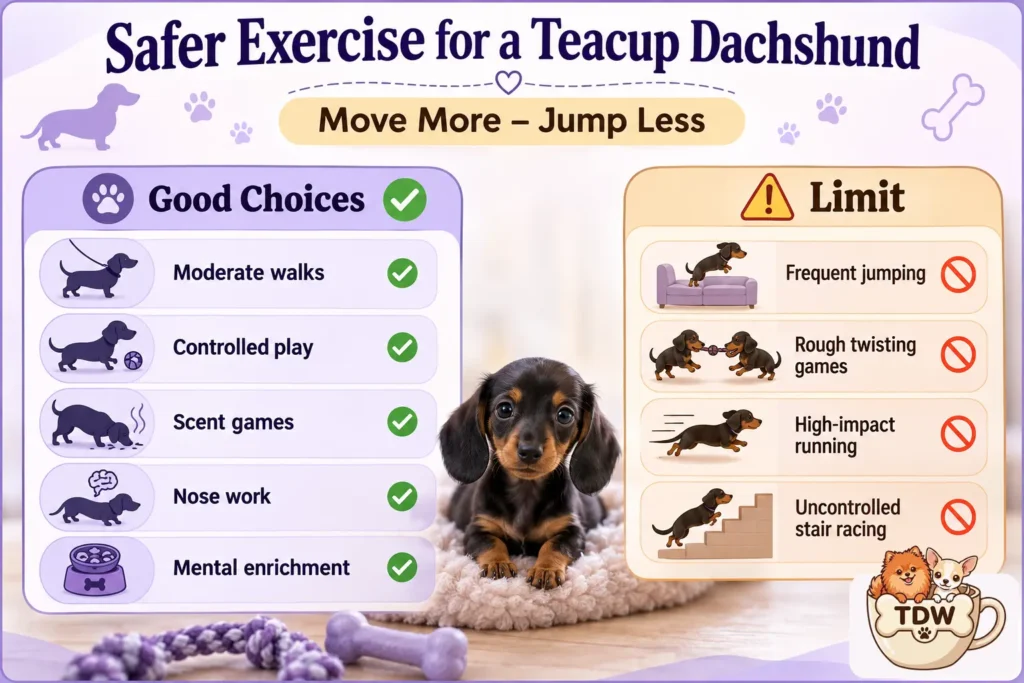
Living With One Around Young Children
- A tiny dog and an excited five year old is a real problem to manage, and it is solved with rules everyone follows from day one.
- Petting happens sitting on the floor. Young children do not carry the dog, ever.
- Adults lift with two hands, supporting the chest and the back end together, never under the front legs alone.
- No jumping on or off sofas and beds. Use ramps or pet steps instead.
- The dog gets a bed or crate that children are not allowed to touch, and it is respected.
- Teach children what “leave me alone” looks like in a dog. Turning away, going stiff, or walking off.
- Small Dachshunds generally do better with school age children than with toddlers, and how the child behaves matters more than the child’s birthday.
What a Teacup Dachshund Costs to Buy and to Keep
Sellers who use the word teacup almost always charge more than a breeder selling a normal Miniature Dachshund. You are paying extra for the word. The higher price does not mean the puppy is healthier, and it does not mean the parents were health tested.
The price of the puppy is also the smallest part of what you will spend.
In the first year, plan for vet visits and vaccines, spaying or neutering, a microchip, food, a crate, a harness, ramps, and a puppy training class. After that first year you still pay every year for check ups, food, and dental care.
Then there is the cost nobody plans for. If your dog gets a disc problem in the back, treatment may mean rest and medicine, or it may mean surgery. Surgery is expensive. Call a vet near you and ask what it usually costs in your area, so you learn that number before you need it.
Here is the most useful money tip in this guide. If you want pet insurance, buy it before your dog shows any sign of a problem. Insurance will not cover a condition your dog already has. The first time your dog cries getting off the sofa, it may already be too late.
Buying a Teacup Dachshund Safely: Red Flags and Questions to Ask
This is the section I would read twice. The Better Business Bureau’s puppy scam research reports that more than half of pet scams start with a website found through a search engine or social media. Which is, most likely, exactly how you found the listing you are thinking about.
And here is the uncomfortable part. The BBB lists the word teacup in an advert as a warning sign in itself. It is not proof of fraud, but it shows up often enough in fake listings to be worth naming.
Warning Signs in a Listing
- The seller won’t meet in person or do a live video call with the puppy.
- The puppy must be shipped, and shipping is arranged by someone else.
- New fees appear after the deposit — crate, insurance, vaccines, a delay.
- Payment is by wire transfer, gift card, or a peer-to-peer app only.
- The photos show up elsewhere in a reverse image search.
- The price is far below the market, or wildly above it with no explanation.
- There are no veterinary records, or the “records” are unsigned images.
- Puppies are offered before eight weeks old.
- Guarantees are about size rather than health.
Pay by credit card where you can, and never send money for a dog you haven’t seen alive on a video call at minimum.
The Health Tests to Ask About by Name
“Vet checked” describes the puppy. It says nothing about the parents, which is where inherited problems come from. The AKC’s breed health testing requirements, which reflect the Dachshund Club of America’s recommendations, list three evaluations for Dachshund breeding dogs:
- Patella evaluation — the knees
- Cardiac exam — the heart
- Ophthalmologist evaluation — the eyes
Ask which of the three each parent has had, and ask for the results rather than a yes. Many breeders record them with the Orthopedic Foundation for Animals, where you can look a dog up by its registered name yourself. Add the disc X-ray screening to your list of questions too. It is not on the AKC’s recommended list, but it is the most useful thing a Dachshund breeder can do about the breed’s biggest problem.
Eight Questions to Send a Breeder
Copy these into a message. The answers tell you more than the website does.
- Can I visit and meet the puppy’s mother?
- What do both parents weigh as adults?
- Have the parents had patella, cardiac and eye evaluations and can I see the results?
- Have either of the parents been X-ray screened for disc calcification?
- At what age do your puppies go home?
- What does your health guarantee cover, and for how long?
- Will you take the dog back at any point in its life if I can’t keep it?
- What questions do you have for me?
A good breeder answers directly, has opinions about their dogs’ health, and asks you plenty in return. A bad answer sounds like deflection. The mother “is not available right now”, screening is “not needed in our lines”, or the guarantee turns out to be about size. Silence on question eight tells you something on its own.
One extra note if you are looking at a dapple puppy, since “rare” and “teacup” tend to appear in the same adverts. Dapple is the Dachshund word for merle, and breeding two dapples together can produce puppies with serious hearing and eye problems. Ask whether either parent is dapple.
The Rescue Route
Breed specific Dachshund rescues and local shelters regularly have small minis, often already seen by a vet, neutered and tested around children. It usually costs a fraction of the price, and the adoption coordinator will tell you honestly what the dog’s back and personality are like.
You may not get an eight week old puppy. You will get a known quantity.
Already Have a Teacup Dachshund? Start Here
If the deposit is paid, or the dog is asleep on your lap right now, none of the above is a criticism. Here is what actually helps, starting today.
Keep the dog lean and fit. Body condition is the risk factor most within your control. You should be able to feel the ribs easily under a light covering. With a dog this small, a few extra treats is a big share of the day’s calories. Fitness matters too. A well muscled Dachshund that gets regular walks is in better shape to protect its own spine than one that is carried everywhere.
Be sensible about jumping, without wrapping the dog in cotton wool. Ramps or pet steps at the sofa and bed, no repeated trips up and down stairs, two handed lifts, and a harness instead of a collar are all reasonable steps. Be aware, though, that the evidence here is messier than the internet suggests.
The survey of 2,031 dogs mentioned earlier found some results that ran opposite to the usual advice, including lower odds of IVDD in more active dogs. Those results are observational, and the researchers described them as a starting point for more research rather than proof. The honest summary is this. Keep your dog fit, avoid pointless high impact leaps, and do not expect a ramp to cancel out something in the genes.
Feed to the age. Small meals often while the puppy is tiny, moving to a normal schedule as they grow. A complete small breed food, measured by how the dog looks and feels rather than by the chart on the bag. Never hold food back to keep a dog under an advertised teacup weight.
Start dental care early. Small mouths get crowded, and brushing a few times a week from puppyhood is far easier than starting at four years old.
Know the early warning signs. Not wanting to jump, an arched back, shivering, yelping when lifted, wobbly or dragging back legs, or loss of bladder control. Sudden weakness in the back legs is an emergency. Find your nearest out of hours clinic now, not while it is happening.
Is a Teacup Dachshund Right for Your Family?
A small Dachshund is likely a good fit if you want a small companion and can be flexible about the exact adult weight, you can cover an emergency vet bill or you will insure early, your household will actually stick to the no jumping rules, and you are willing to buy from someone who health tests and lets you visit.
It is probably not the right choice if you are set on a specific tiny number on the scale, you are buying without seeing the dog, young children cannot be supervised consistently, or the budget has no room for a back emergency.
If you are in the first group, here is the honest alternative worth thinking about. A well bred Miniature Dachshund at the small end of normal gets you the same dog, from someone who screens, for less money and with fewer unknowns. You lose the word. You do not lose anything else.
Frequently Asked Questions
Do teacup Dachshunds really exist?
The dogs exist. The category does not. No major registry recognises a teacup size. What is being sold is a Miniature Dachshund at the small end of the range, or occasionally a puppy that is small for a medical reason.
Is a 6 pound Dachshund a teacup Dachshund?
Not officially. A 6 pound adult already falls inside the AKC’s Miniature Dachshund definition. There is no recognised category underneath it, so the word is the seller’s choice rather than a classification.
How much does a teacup Dachshund cost?
There is no standard price, because there is no standard size. Sellers using the label generally charge more than they would for a comparable Miniature Dachshund, and that extra reflects demand for the word rather than any added health testing or quality.
How long do teacup Dachshunds live?
Miniature Dachshunds commonly live well into their teens. A very small dog from an unscreened line has more that can go wrong, but there is no reliable published lifespan figure for teacup marketed dogs specifically.
Are teacup Dachshunds healthy?
It depends entirely on how the dog was bred. A small mini from health tested parents can be perfectly healthy. One produced by pairing runt to runt over several generations carries more risk. The word itself predicts nothing.
How big do teacup Dachshunds get?
Usually 4 to 8 pounds as adults, though no definition exists and results vary. The parents’ adult weights are your best guide.
Are teacup Dachshunds good with kids?
They can be, with rules. They are bold and affectionate but physically fragile, so they suit households that can supervise handling. Generally better with school age children than toddlers.
Can I register a teacup Dachshund with the AKC?
Not as a teacup. A purebred puppy from registered parents can be registered as a Dachshund, but registration says nothing about size and no registry recognises the label.
Is a teacup Dachshund the same as a rabbit Dachshund?
No. The Kaninchen, or rabbit Dachshund, is a genuine FCI size defined by the measurement around the chest. It is not recognised in the US, and American sellers using teacup are not referring to it.
Do teacup Dachshunds need less exercise?
Less distance, not less activity. They still need daily walks and something to think about, and a fit, well muscled dog is better off than one that is carried everywhere.
Is it wrong to buy a teacup Dachshund?
Wanting a small dog is not wrong. What is worth avoiding is paying extra for extreme smallness, because that is what pays breeders to keep pushing size down. Buy the dog and the breeder, not the adjective.
Conclusion
A teacup Dachshund is not a breed, a size, or a promise. It is a word somebody put in an advert. The dog behind it might be a healthy small mini from a careful home, or a puppy produced by chasing size with no screening at all, and the label will not tell you which.
So judge the breeder instead. Ask to meet the mother, ask for the knee, heart and eye results, insist on seeing the dog before you pay, and budget for a back problem you hope never comes.
If you are still deciding, talk to a vet in your area about what care for a very small Dachshund really costs where you live. It is the most useful half hour you can spend before making this decision.

The TeacupDogWorld Editorial Team researches and creates practical guides about small and teacup-sized dogs, including breed characteristics, grooming, nutrition, health, training, and everyday care. Our content is developed using reputable veterinary, breed-club, and animal welfare sources to help dog owners make better-informed decisions.