
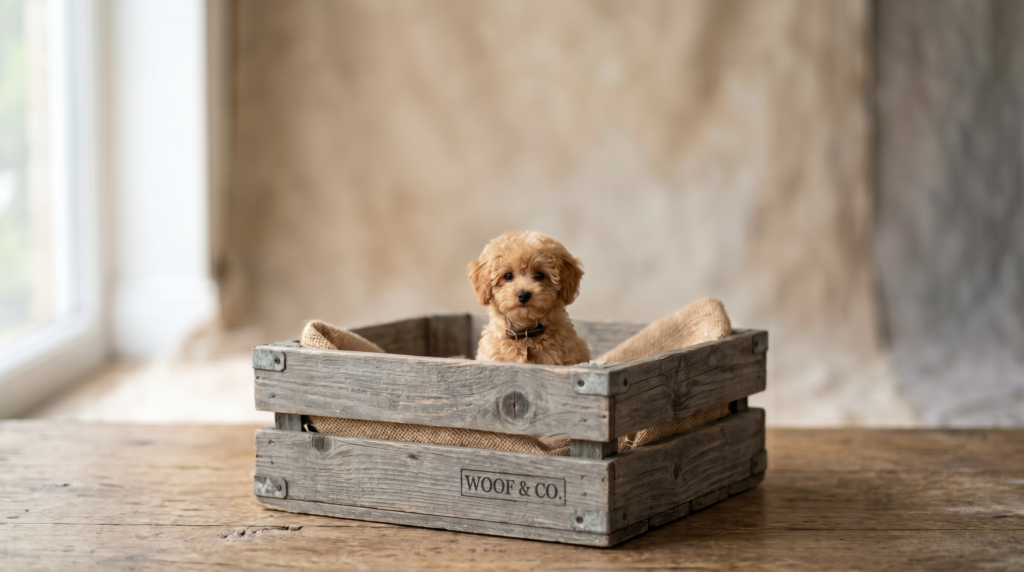
If you have seen a poodle the size of a coffee mug and wondered whether “teacup” is a real thing, here is the short answer. A teacup poodle is simply a poodle bred to be smaller than the toy poodle. It is a seller’s label, not a breed and not an official size, and no kennel club defines what it means.
That single fact changes everything about how you shop for one, so this guide starts there and stays practical from that point on.
You will find out how big these dogs actually get, which health problems come with a body this small, what to watch for in the first few weeks, how to check a breeder’s health testing instead of trusting a claim, and how to decide whether a dog like this fits your family. Some of it is good news. Some of it is not, and we say so.
What Is a Teacup Poodle?
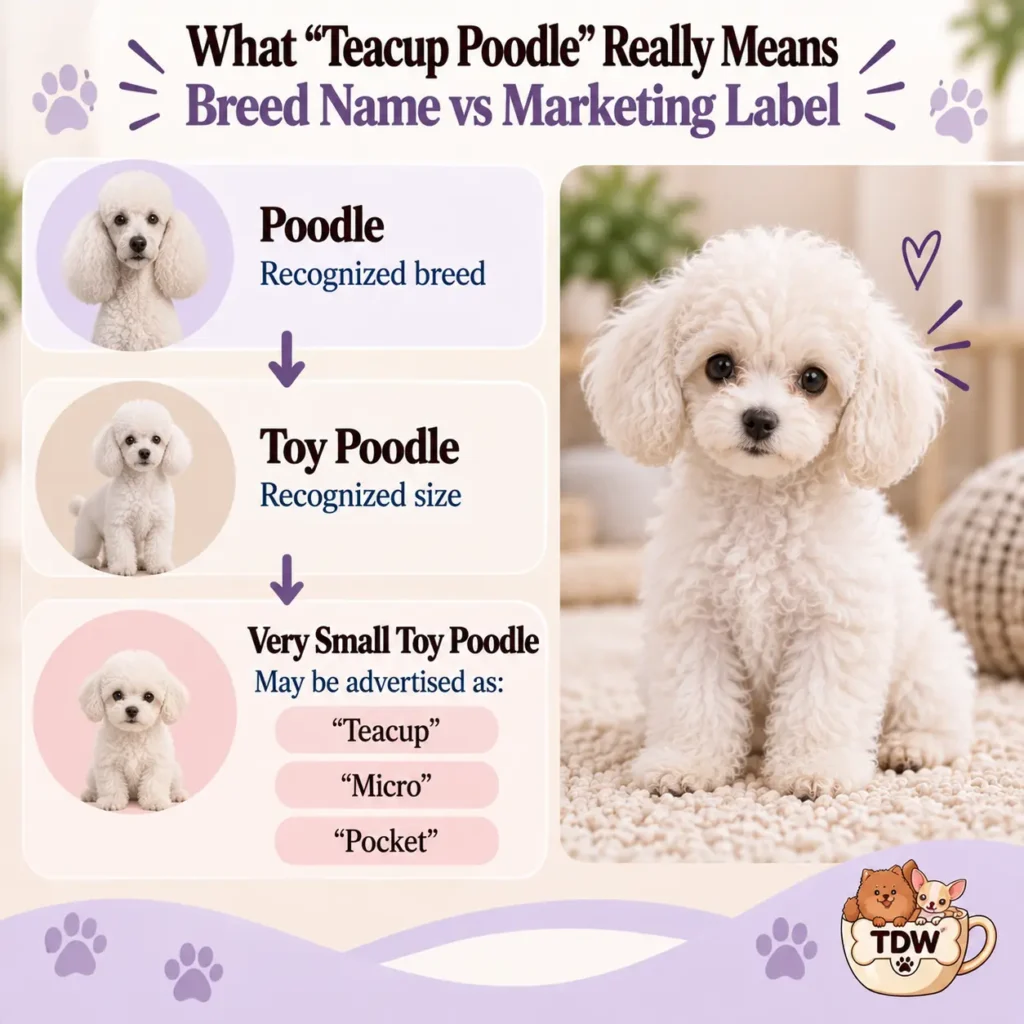
A teacup poodle is a poodle that has been bred to be smaller than the smallest size the breed officially comes in. The dog itself is a poodle. The word “teacup” is a description sellers use, and it is attached by the person selling the puppy, not by any registry or club.
Poodles started out as water retrievers in Europe and were later bred down into smaller companion sizes. That is where the toy poodle came from, and it is the real starting point for everything sold as a teacup today.
So when a listing says teacup, what you are usually looking at is a poodle from toy poodle lines, chosen because it is unusually small. Sometimes the puppy is from parents who were both very small. Sometimes it is just the smallest puppy in an ordinary litter.
Here is why that matters. A breed name tells you what to expect. A marketing word does not. Two puppies advertised as teacups by two different sellers can grow into noticeably different adult dogs, because there is no shared rule either seller is following.
Is the Teacup Poodle a Recognized Breed?
No. The poodle is recognized in three sizes only: standard, miniature and toy. That comes from the breed standard published by the Poodle Club of America, which is the breed’s parent club for the American Kennel Club.
There is no fourth size, and no teacup category, on that list.
That said, a very small poodle can still be a registered purebred. Registration follows the parents, not the adult weight. If both parents are registered toy poodles, their unusually small puppy is registered as a toy poodle too. It just cannot be shown in the ring as something called a teacup, because that variety does not exist.
So a seller who shows you registration papers is not proving the dog is a teacup. The papers say poodle.
Why There Is No Official Teacup Poodle Standard
Because no organization created one. A breed standard is written and maintained by a parent club and adopted by a registry. Nobody did that for teacups, so there is no published height, no published weight, and nobody to enforce either.
You will still see numbers quoted everywhere, usually around nine inches tall and under six pounds. Those figures come from the people selling the puppies. They are a rough convention in the market, not a specification you can hold anyone to.
The practical move is to stop asking about the label and start asking about the dogs. What do the mother and father weigh as adults? Can you see them, or at least see the mother? Parents give you a far better idea of adult size than any word in an advertisement.
Teacup Poodle Size Compared With Toy and Miniature Poodles
Most dogs sold as teacups are advertised at around nine inches tall and under six pounds as adults. Compare that with the official sizes and you can see exactly where the label sits.
| Size | Height at the shoulder | Who defines it |
|---|---|---|
| Standard poodle | Over 15 inches | Breed standard, Poodle Club of America |
| Miniature poodle | Over 10 inches, up to 15 inches | Breed standard, Poodle Club of America |
| Toy poodle | 10 inches or under | Breed standard, Poodle Club of America |
| “Teacup” poodle | Commonly advertised around 9 inches and under 6 pounds | Nobody. This is a seller convention with no registry behind it |
The breed standard is strict about the official sizes. A poodle measuring more than 10 inches at the shoulder cannot compete as a toy, and one measuring 15 inches or less cannot compete as a standard. Those are real lines with real consequences in the show ring.
One thing the standard does not do is set a weight. It measures height at the shoulder only. The weight figures you see quoted for toy poodles, most often around four to six pounds, come from general breed guides rather than from the standard, and those guides do not all agree with one another. Treat any weight number, for a toy or a teacup, as a rough guide rather than a rule.
The teacup row has none of that. It is in the table so you can see the gap, not because it carries the same weight.
Notice something else while you are looking at the table. The distance between a toy poodle and a teacup is small on paper and large in practice. A pound or two of difference is a big share of the body when the whole dog weighs about as much as a bag of sugar.
How Small Is a Full Grown Teacup Poodle?
Smaller than a toy poodle, but you cannot know how much smaller until the dog is grown.
Puppies are not finished growing when they go home, and small breeds keep filling out for months afterward. A puppy that looks tiny at eight weeks may simply be an ordinary toy poodle having a slow start. That happens often, and it is not dishonest on the breeder’s part if they never promised otherwise.
What is dishonest is a guarantee. If a seller promises your puppy will finish under a specific weight, treat that as a sales line rather than a fact. Nobody can guarantee an adult size, and honest breeders will tell you the same thing, usually by pointing at the parents instead.
Teacup Poodle Appearance and Coat
A teacup poodle looks like a toy poodle in miniature. Dark eyes, a long straight muzzle, ears that hang flat against the head, and a curly coat that keeps growing instead of falling out.
That coat is the reason poodles are so popular in homes where someone has allergies. Because the hair keeps growing rather than shedding out in cycles, far less of it ends up on your sofa.
But here is the part that gets oversold. Low shedding is not the same as allergy free. No dog is truly hypoallergenic. People react to proteins in dander, saliva and urine, not to hair itself, and every dog produces those. A poodle may bother an allergic person much less than another breed would, or it may not. The only way to know is to spend real time around one first.
White Teacup Poodles and Other Colors
White is one of the solid colors described in the breed standard, along with black, cream, apricot, brown, silver and others. A white teacup poodle is not a different kind of dog. Color has nothing to do with temperament, health or how long a dog lives.
What white does change is how much you notice. Grass, mud and food show up on a pale coat straight away, and so do tear stains, those reddish brown marks under the eyes.
Tear stains happen because of porphyrins, which are pigments the body releases in tears. According to MedVet, a specialty and emergency veterinary group, every dog has some porphyrin in its tears. Light coated breeds simply show the result.
So a little staining on a white dog is usually cosmetic. What is not cosmetic is a change. If the staining appears suddenly, gets worse quickly, or comes with a red eye, squinting or thick discharge, that is a reason to see a vet rather than to buy a whitening product.
Do Teacup Poodles Shed?
Very little. You will not find drifts of hair on your clothes.
What you will find is that the coat mats. Hair that keeps growing and does not fall out has to go somewhere, and without regular brushing it knots against the skin, which is uncomfortable and can lead to sore spots.
So think of it as a trade. You give up vacuuming and take on brushing several times a week plus a professional clip on a regular cycle. Low shedding and low maintenance are two very different things.
Teacup Poodle Temperament and Personality
Poodles of every size are bright, affectionate and closely bonded to their people. The American Kennel Club describes the toy poodle as an elegant companion with a lively, people focused character, and a very small poodle is the same dog in a smaller package.
Expect a dog that follows you from room to room, learns fast, and would rather be on your lap than anywhere else.
That closeness has a flip side. A dog this attached can struggle when left alone for long stretches, and distress shows up as barking, chewing or accidents rather than as sulking.
There is one more pattern worth naming, because it is the most common behavior problem in tiny dogs and it is almost entirely made by owners. When a dog is small enough to pick up, people pick it up instead of teaching it anything. It never learns to meet a stranger, walk past a bigger dog, or handle a vet exam on its own feet. Then it starts growling or snapping, and everyone decides it has a bad personality.
It does not. It was never given the chance to learn. Early socialization, gentle handling practice and normal training prevent almost all of it.
Are Teacup Poodles Good With Children?
Sometimes, and the honest answer depends on the ages of your children. These dogs are affectionate with kids who have learned to be gentle. Older children, roughly school age and up, often do beautifully with them.
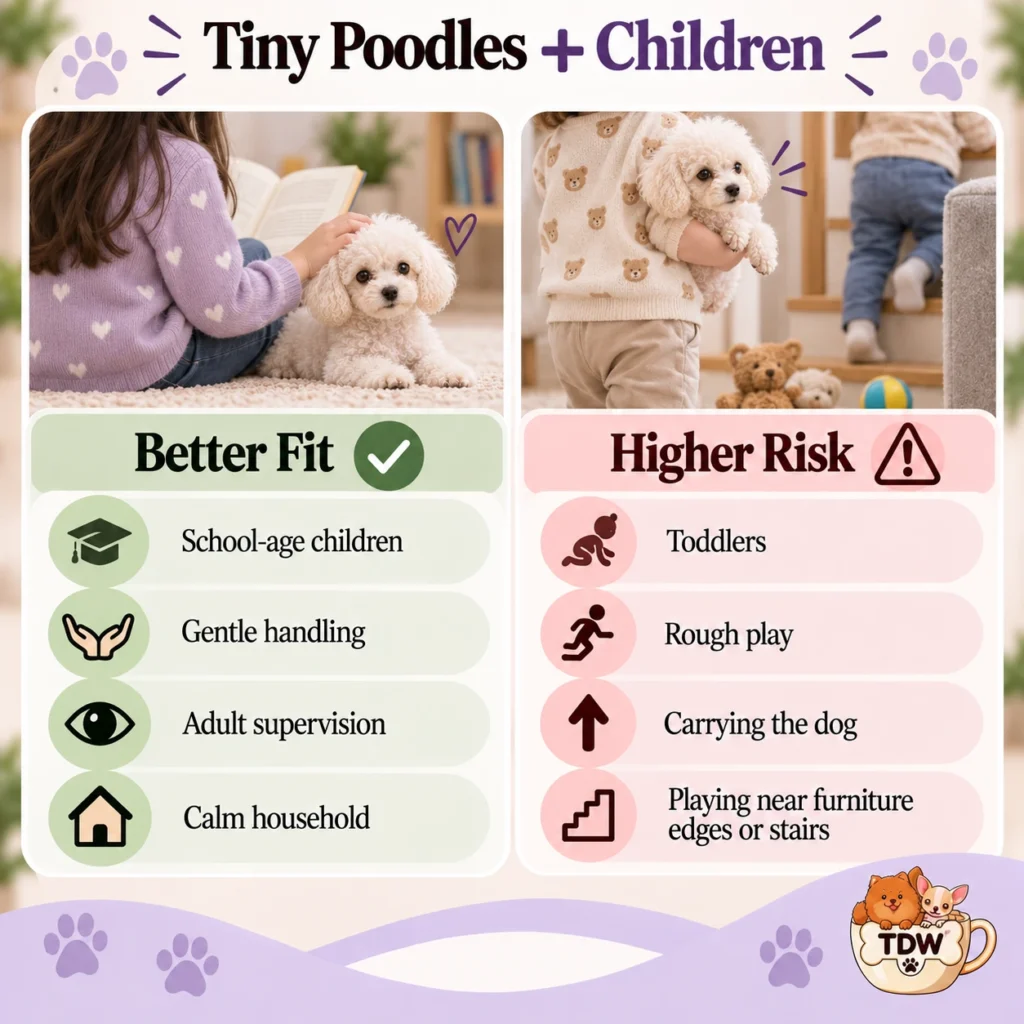
Toddlers are a different matter. A dog that weighs a few pounds can be seriously hurt by ordinary household accidents: a fall from the couch, a grip that slips, a door swinging shut, a child tripping over it in the hallway. And a dog that has been hurt or frightened learns to defend itself, which puts the child at risk too. The danger runs both ways.
If you have very young children and you still want this dog, these rules do most of the work:
- No carrying by anyone under about ten years old. Petting happens with the dog on the floor or on a lap while the child is sitting.
- Adults supervise all contact with toddlers, every time, with no exceptions for a quick moment in another room.
- The dog gets a safe place, such as a crate or a pen, that children are not allowed to reach into.
- Feet and doors are the real hazards. Everyone learns to check before they step or close anything.
- Play happens at floor level, away from furniture edges and stairs.
And the plain version: if your children are very small, a sturdier little dog of ten or twelve pounds gives you the same companionship with far less risk.
Are Teacup Poodles Good With Other Pets?
Usually yes, with calm animals and proper introductions. Poodles are sociable and not naturally quarrelsome.
The risk is not temperament, it is size. A friendly large dog can injure a three pound dog without meaning to, simply by bouncing into it during play. That applies to your own dogs at home and even more at a dog park, where you have no control over who runs up.
Many owners of very small dogs stick to small dog play areas or skip the dog park entirely, and that is a reasonable choice rather than an overprotective one.
Do Teacup Poodles Bark a Lot?
They can, especially if nobody teaches them otherwise. Poodles are alert and quick to comment on the doorbell, the hallway, the delivery driver and the neighbor’s cat.
This is the trait most likely to cause you trouble in an apartment, so it is worth working on from the first week rather than the first complaint.
The good news is that they respond well to training a quiet cue and being rewarded for settling. And while they will certainly announce a visitor, no dog this size is a guard dog. Alerting is the whole of the job.
Training a Teacup Poodle
This is the easy part. Poodles are one of the most trainable breeds there is, and a tiny one is no less clever than a big one. If you use rewards and keep sessions short, you will be surprised how quickly things stick.
A few things matter more for a dog this size than they would for a labrador.
Start socialization early. Every new sound, surface and visitor your puppy meets calmly in the first few months is one it will not be frightened of later. Keep it gentle and keep the puppy’s feet on the ground where it is safe to do so.
Teach handling on purpose. This dog will be brushed, clipped, have its nails done and be examined by a vet many times over its life. Practice touching paws, ears, mouth and belly at home, paired with a treat, and all of that becomes routine instead of a fight.
Use a harness rather than a collar for walking. Small breeds are prone to windpipe trouble, and VCA Animal Hospitals notes that pressure on the neck can set off coughing in affected dogs. A harness spreads the pressure across the chest instead. It is a small change that costs nothing.
House Training a Very Small Puppy
Expect this to take patience. A bladder this size simply cannot hold on for long, so accidents are a plumbing problem rather than a discipline problem.
What works is frequency and routine. Out after every nap, every meal and every play session, then praise the moment the puppy finishes in the right place. Feeding on a schedule makes the timing predictable.
If you live in an apartment or somewhere with hard winters, an indoor option such as a pad or an indoor grass tray is genuinely useful for a dog this small. Cold and wet are harder on a three pound body than on a big one, and a long trip down in the elevator is not always possible in time.
Exercise and Life in an Apartment
Their physical needs are modest. A couple of short walks a day and some play indoors covers it, which is why these dogs suit apartments and small homes so well.
Their mental needs are another story. A bored poodle invents its own entertainment, and you will not like the results. Puzzle feeders, scent games and five minutes of trick training do more for a clever dog than an extra lap of the block.
A few practical notes for tiny dogs. Heat and cold both hit them faster than bigger dogs, so shorten walks in extreme weather. Stairs and steep curbs are a lot of work for very short legs. And in an apartment, barking rather than exercise is what strains relations with the neighbors, so put your effort there.
Teacup Poodle Health Problems
This is the section that should shape your decision, so here is the honest frame. Very small poodles face the health problems common to toy breeds generally, and breeding deliberately for extra smallness can make some of them more likely.
That does not mean every tiny poodle is sick. Plenty live long, comfortable lives. It means the risks are real, they are worth understanding before you buy rather than after, and a careful breeder reduces some of them while a careless one does not.
Here is the quick version, then each one explained.
| Problem | What it is | What you would notice | What to do |
|---|---|---|---|
| Low blood sugar | The puppy runs out of usable sugar | Sleepy, wobbly, trembling, pale gums | First aid, then a vet the same day |
| Slipping kneecap | Kneecap slides out of its groove | A skip or hop, one back leg held up briefly | Vet check, ranges from monitoring to surgery |
| Collapsing windpipe | Airway cartilage weakens and flattens | Dry honking cough, worse with excitement | Vet visit, use a harness, keep the dog lean |
| Liver shunt | Blood bypasses the liver | Poor growth, confusion after meals | Vet, blood tests |
| Fluid on the brain | Pressure inside the skull | Domed head, unsteadiness, seizures | Vet, urgently |
| Dental disease | Crowded teeth in a small mouth | Bad breath, tartar, sore mouth | Home brushing, professional cleaning |
| Inherited eye disease | Retina degenerates over time | Bumping into things in dim light | Vet, and check the parents were DNA tested |
| Fractures | Bones break easily | Limping, crying, refusing to bear weight | Emergency vet |
Low Blood Sugar in Teacup Poodle Puppies
If you read one part of this guide twice, make it this one. Low blood sugar, or hypoglycemia, is the emergency most likely to meet you in the first weeks with a very small puppy.
Why it happens is simple. A young puppy cannot yet store and release sugar the way an adult dog can, and a tiny body has almost no reserve to draw on. The Merck Veterinary Manual describes puppy hypoglycemia as a syndrome seen in toy breeds during the first six months of life, linked to the relative immaturity of the young dog’s liver, and usually managed by feeding frequent meals. Stress, cold, a missed meal, a long car journey or a stomach upset can tip a puppy over.
What it looks like: unusually sleepy and hard to wake, wobbly or uncoordinated, trembling, weak, gums that look pale rather than pink. In a severe episode the puppy may have a seizure or become unresponsive.
What to do first: rub a small amount of corn syrup on the puppy’s gums. It absorbs through the gum tissue, so the puppy does not have to swallow it. Then wrap the puppy up warm and go to a veterinarian the same day, even if it perks up on the way. This is first aid to get you to help, not a treatment. Veterinary Partner, written by veterinarians for pet owners, is clear that a puppy which does not fully return to normal needs hospital care.
How to prevent it: small meals often rather than one or two big ones, keep the puppy warm, and do not let a new puppy skip breakfast because it is excited or unsettled in its new home. Your vet will tell you when your dog is old enough to move to a normal schedule.
The American Kennel Club’s guidance on hypoglycemia notes that toy breed puppies turn up at emergency clinics with this problem and that owners often have no idea what is happening. Knowing the signs is most of the battle.
Slipping Kneecaps (Patellar Luxation)
Patellar luxation means the kneecap slips out of the shallow groove it is meant to ride in. It is one of the most common orthopedic problems in small dogs.
How common? Research summarized in the veterinary literature puts the rate in small breeds at roughly twelve times that of large breeds. The Cornell University College of Veterinary Medicine notes that the inward slipping form shows up most often in small dogs and that signs usually appear early in life.
The classic sign is easy to spot once you know it. The dog is trotting along, then skips a step or hops with one back leg lifted, then carries on as though nothing happened. That is the kneecap popping out and sliding back.
Mild cases are sometimes managed with weight control, sensible exercise and monitoring. More severe ones may need surgery. Left alone, the repeated slipping wears the joint and leads to arthritis, and the Merck Veterinary Manual describes the skipping gait as the characteristic finding.
The useful part for a buyer: breeding dogs can be examined and the result recorded, which is one of the checks covered further down this page.
Collapsing Windpipe (Tracheal Collapse)
The windpipe is held open by rings of cartilage. In some small dogs those rings weaken over time and flatten, narrowing the airway.
Cornell lists tracheal collapse as common in toy and small breeds including toy poodles, usually appearing in middle aged and older dogs.
The sound is distinctive and owners often describe it as a goose honk. A dry, harsh cough that gets worse with excitement, exercise, heat and humidity, or when something presses on the neck.
That last point is the practical one. Pressure from a collar can trigger the cough, which is why a harness is the better choice for these dogs from day one. Keeping your dog lean and away from cigarette smoke also helps. If you hear that cough, see your vet rather than waiting to see if it settles.
Liver Shunts, Fluid on the Brain and a Soft Spot on the Skull
These three are grouped together because they are the congenital problems most associated with very small dogs. Congenital means present from birth.
A liver shunt, or portosystemic shunt, is an abnormal blood vessel that lets blood skip past the liver instead of being filtered by it. Waste products then circulate around the body. Affected puppies often grow poorly and can seem dazed or unsteady, particularly after eating.
Hydrocephalus is fluid building up inside the skull and pressing on the brain. Signs can include a domed head, clumsiness, vision problems and seizures.
An open fontanelle is a soft spot where the skull bones have not fully closed, much like a human baby’s. Some small dogs have one and stay perfectly healthy. Others have one alongside other problems. It is worth your vet’s opinion rather than your worry.
All three are reasons to have a new puppy examined by your own veterinarian within the first few days, not weeks.
Dental Disease
Small dogs have the same number of teeth as big dogs, in a much smaller jaw. Teeth end up crowded and rotated, which traps food and plaque, and baby teeth sometimes fail to fall out and crowd things further.
The result is tartar, gum disease and lost teeth earlier than you would expect, along with pain that dogs are very good at hiding.
The answer is boring and effective. Brush the teeth at home, starting while the dog is young enough to think of it as a game, and have your vet check the mouth at every visit. Professional cleanings under anesthesia will be part of this dog’s life. Retained baby teeth usually need removing, and that is often done at the same time as spaying or neutering.
Eye Disease
Toy and miniature poodles are affected by progressive retinal atrophy, a group of inherited diseases where the retina slowly degenerates and vision fades, often ending in blindness. The Poodle Club of America explains that one form, known as prcd, predominates in the smaller poodle varieties.
The first thing owners usually notice is trouble in dim light, or a dog that bumps into furniture after dark.
There is a DNA test for it. That is why the parents’ results matter so much, and why it appears in the checklist later in this guide. A breeder who has tested can show you; a breeder who has not is asking you to take a chance.
Broken Bones and Everyday Accidents
This is not a disease, and it may be the risk you meet first.
A dog weighing three or four pounds can be badly hurt by things that would not bother a beagle. Jumping down from a bed or a sofa. Being stepped on in the kitchen. Slipping out of a child’s arms. A door closing. A recliner footrest. A bigger dog landing on it during play.
Broken legs in tiny dogs are common enough that most veterinarians see them regularly. It is not scaremongering to say this, it is just the daily reality of owning a dog this size, and it is manageable once your household is set up for it. The practical checklist is further down under home safety.
Anesthesia and Medication in a Very Small Dog
This rarely comes up until your dog needs a dental cleaning, and then it comes up suddenly.
Very small patients lose body heat quickly under anesthesia and need doses calculated precisely, because the margin between too little and too much is narrow when the whole dog weighs a few pounds. Many veterinary practices handle this routinely with warming support and careful monitoring.
What you can do is choose a veterinarian who is comfortable with toy breeds, ask how they monitor small patients, and never split or estimate medication doses at home. Ask your vet instead. It is a short conversation that prevents a serious mistake.
How Long Do Teacup Poodles Live?
Nobody can tell you, and any website that gives you a confident number for teacup poodles specifically has made it up.
That sounds unhelpful, so here is what we do know.
Poodles are a long lived breed, and small dogs generally outlive large ones. A large study of veterinary records in the United Kingdom, published as life tables for companion dogs, found an average life expectancy of about 11 years across all dogs, with big differences between breeds. Small breeds sat at the higher end of that range.
What does not exist is data on teacups. Researchers track breeds and recognized varieties, because those are defined categories. Teacup is not a category anybody records, so there is no population of teacup poodles to study and no median lifespan to report.
So what actually decides how long your dog lives? Inherited health from the parents, staying at a healthy weight, dental care, protection from injury, and access to a veterinarian when something goes wrong. Those are the levers you control, and they matter more than any number on a breed page.
Daily Care and Grooming
Grooming and Coat Care
Plan on brushing several times a week and a professional groom on a regular cycle, usually every month or two depending on the clip you choose.
A short puppy clip is far easier to maintain than a long coat and is what most pet owners settle on. Between appointments, the trouble spots are behind the ears, under the legs and around the collar area, where mats form first.
The face needs attention too. Hair grows into the eyes, so it needs trimming, and the area under the eyes should be wiped clean, especially on a white dog. Ears need checking and cleaning as your vet or groomer shows you, and nails need regular trimming because a dog this light does not wear them down on walks.
One honest note on money. Grooming is the biggest predictable ongoing cost of owning a poodle of any size, and it lasts for the dog’s whole life. Budget for it before you buy, not afterwards.
Feeding a Teacup Poodle
For puppies, the rule is small meals often. This connects directly to the blood sugar section above, and it is the reason breeders send tiny puppies home with a feeding schedule rather than a bag and a shrug.
Do not quietly drop the routine because the puppy seems fine. Ask your vet when your individual dog is ready for fewer meals a day.
For adults, the challenge flips. When a dog weighs a few pounds, a single biscuit is a meaningful share of its daily food. Weight creeps on fast and puts strain on knees, back and windpipe, all of which are already vulnerable in this breed.
So measure meals rather than filling a bowl, count treats as part of the total, and ask your veterinarian to show you how to check your dog’s body condition with your hands. It takes ten seconds and tells you more than the scale.
Keeping a Tiny Dog Safe at Home
Most injuries in very small dogs are preventable with a few household habits. This is the list worth putting on the fridge for the first month.
- Add pet steps or a ramp to the sofa and bed, and teach the dog to use them instead of jumping.
- Look before you step, especially in the kitchen and doorways. These dogs love to be underfoot.
- Check recliners and rocking chairs before you move them. Every time.
- Take care on stairs, and use a gate if your dog is very small or very young.
- Walk on a harness rather than a collar.
- Give the dog a safe spot, a crate or pen away from the busiest part of the house, where it can sleep undisturbed.
- Keep it warm in cold weather. A small body loses heat quickly.
- Watch the front door. A dog this size can slip out unnoticed.
The Ethics Behind Teacup Poodle Breeding
Plenty of readers arrive at this question and feel slightly guilty for asking it. It deserves a straight answer, so here it is, even though this is a site about teacup dogs.
To produce puppies smaller than the toy standard, a breeder has to select for smallness. In practice that often means breeding from the smallest dogs available, sometimes the runt of a litter, generation after generation. Some sellers also market puppies as teacups simply because they happen to be small, which is less concerning but still tells you nothing about the dog’s health.
Veterinarians who speak about this publicly tend to treat the word teacup as a signal about the seller rather than a description of the dog. Their concern is straightforward. A breeder whose headline feature is extreme smallness is optimizing for size, and health testing, temperament and sound structure are not what is being advertised. That is a professional opinion rather than a research finding, and it is worth weighing as one.
There is also a practical reason to be cautious about breeding from very small or underdeveloped dogs. Pregnancy and whelping are physically demanding, and a dog chosen for being the smallest in the litter may not be the healthiest breeding candidate.
Now the fair part, because the picture is not all one color.
Not every very small poodle is unhealthy or badly bred. Some come from breeders who screen for inherited disease, raise puppies properly, and are honest that a small puppy may not stay small. Others come from people who worked out that the word teacup raises the price.
You cannot tell these two apart from a website. You can tell them apart from health testing records, which is what the next section is about.
How to Buy a Teacup Poodle Safely
If you decide to go ahead, this is where you protect yourself and the dog. The good news is that most of it is verifiable, so you do not have to rely on whether someone sounds trustworthy.
Health Testing to Ask For
This is the single most useful thing in this guide, and almost nobody tells buyers about it.
The Poodle Club of America sets out the screening a toy poodle should have before being bred. For a toy poodle that means:
- A DNA test for progressive retinal atrophy, the prcd form
- An eye examination by a board certified veterinary ophthalmologist
- An evaluation for patellar luxation
- A hip evaluation
- One additional health test from an approved list, such as a thyroid or cardiac evaluation
Here is the part that changes everything. Those results are recorded with the Orthopedic Foundation for Animals, and their database is open to the public. You can look up a dog by its registered name or registration number and see what was actually done.
So ask the breeder for the parents’ registered names, then check them yourself before you pay anything. A breeder who tests will hand those names over happily. One who changes the subject, says the vet checked them over, or tells you testing is unnecessary in their lines has answered your question.
Questions to Ask a Breeder
Keep it simple and listen to how they answer as much as what they answer.
- May I meet the mother with the puppies, in person or on a live video call?
- What do both parents weigh as adults?
- Which health tests have the parents had, and what are their registered names so I can look them up?
- At what age do your puppies go home?
- What happens if the puppy turns out to be unwell in the first weeks?
- Would you take this dog back at any point in its life if I could no longer keep it?
That last question is the one that separates breeders from sellers. Someone who cares where their puppies end up will say yes without hesitating.
If you do not know where to start looking, the Poodle Club of America runs a breeder referral service covering registered toy, miniature and standard poodles. Read their own disclaimer carefully though. The club is clear that a referral is not an endorsement or a guarantee of any breeder or puppy, so the checks above still belong to you.
Puppy Scam Red Flags
Before you send money to anyone, know that fake puppy sellers are a large and organized problem. The Better Business Bureau’s study of puppy scams reports that more than half of pet scams begin on a website the buyer found through a search engine or social media, and that fraudulent sellers rely on getting the buyer to pay repeatedly.
The warning signs are consistent:
- You cannot meet the dog, and there is always a reason why a live video call is impossible
- Payment is requested by wire transfer, gift card or a payment app with no buyer protection
- New fees appear after the deposit, for shipping, insurance, a special crate or a vaccination
- The price is noticeably lower than everything else you have seen
- The photos appear elsewhere online, which a reverse image search will show you
- You are pushed to decide today
Two habits protect you. Insist on seeing the specific puppy live, moving, with the seller present. And use a payment method you can dispute.
What a Teacup Poodle Costs to Buy and to Keep
Dogs sold as teacups are usually priced well above ordinary toy poodles, because the label itself sells. That premium buys you a word, not a guarantee.
The purchase is also the smallest part of what you will spend. Over the dog’s life you are committing to routine veterinary care and vaccinations, professional grooming on a repeating cycle, food, parasite prevention, and dental cleanings that most small dogs eventually need.
Then there is the part nobody budgets for. If your dog develops knee, airway or dental problems, treatment can be significant, and orthopedic surgery is not a small expense.
If you are considering pet insurance, look into it before you bring the puppy home or very soon after. Insurers do not cover conditions that already exist, and a dog diagnosed with a slipping kneecap at eight months will not be covered for that knee if you buy the policy at nine.
Can You Adopt a Teacup Poodle?
Yes, more often than people expect.
Poodle breed rescues, small dog rescues and ordinary shelters regularly take in very small poodles and poodle mixes. Some arrive because an owner’s circumstances changed, some because a tiny dog turned out to be harder work than the family expected, and some from breeding operations that closed down.
Adopting an adult has one clear advantage over buying a puppy. The dog is already grown, so its adult size, coat and temperament are known rather than promised. For a family worried about ending up with a dog too fragile for their household, that certainty is worth a great deal.
Start with poodle specific rescue groups in your state, then check shelter listing sites and tell local shelters what you are looking for. Small dogs move quickly, so it may take patience rather than luck.
Teacup Poodle Myths, Corrected
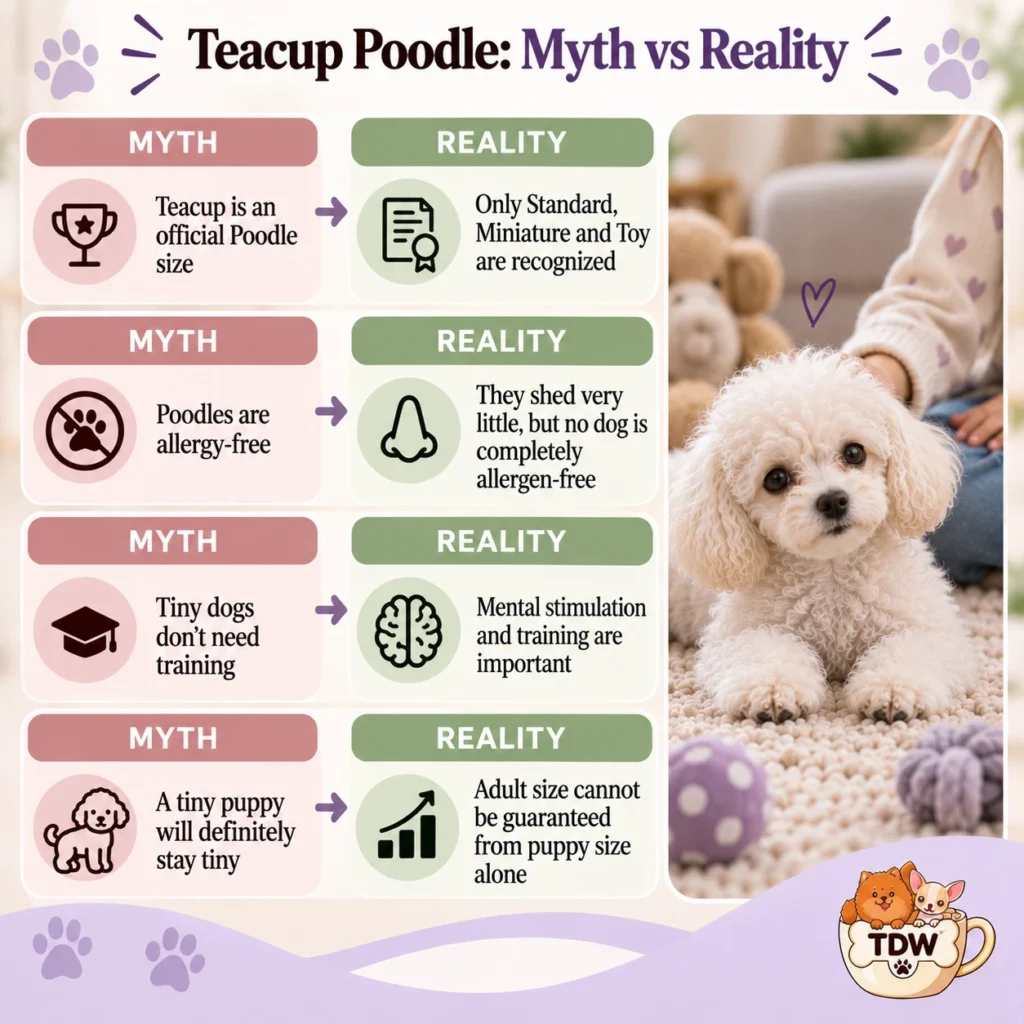
Myth: teacup is an official size. It is not. The poodle comes in three recognized sizes and teacup is not one of them. Nobody publishes a teacup height or weight, and nobody enforces one.
Myth: poodles are hypoallergenic. They shed very little, which helps a lot of allergy sufferers, but no dog is allergen free. People react to dander, saliva and urine, and every dog produces those.
Myth: smaller always means longer lived. Small dogs do tend to outlive large ones as a general pattern. That pattern is about ordinary small breeds, not about dogs bred to extremes, and there is no data showing teacups share the advantage.
Myth: a runt is just a small, healthy dog. Sometimes it is. But the smallest puppy in a litter may be small for a reason, and repeatedly choosing the smallest dogs to breed from is what veterinarians raise concerns about.
Myth: tiny dogs do not need training or exercise. They need both. A poodle that gets no mental work becomes noisy and difficult, and the barking problem in apartments is almost always a training gap.
Myth: a small puppy will stay small. Puppies keep growing for months after they go home. A tiny eight week old may simply be a toy poodle taking its time, and no honest breeder will guarantee an adult weight.
Is a Teacup Poodle Right for Your Family?
Here is the summary you can actually use.
| A good fit if | A poor fit if |
|---|---|
| Your children are school age or older, or you can supervise closely every time | You have toddlers or very young children |
| Someone is home for much of the day | The dog would be alone for long working days |
| Your home is calm, and you are willing to add ramps and adjust habits | Your household is busy, fast moving and crowded |
| You have budgeted for regular grooming and veterinary care | You are looking for a low cost, low maintenance pet |
| You want a companion dog that stays close | You want a dog that can play rough, hike far or live outdoors |
| You are prepared to check health testing before buying | You want a puppy quickly, from whoever has one available |
If most of your answers landed in the left column, a very small poodle could be a wonderful match. They are charming, clever, deeply affectionate dogs and people who love them tend to love them for life.
If several landed on the right, that is worth listening to. It is much easier to change your mind now than to manage a fragile dog in a household that cannot accommodate it.
A Better Option for Many Families
There is a middle path that gets very little attention, and for a lot of families it is the right one.
A toy poodle at the smaller end of the standard gives you the same curly low shedding coat, the same clever affectionate character and the same apartment friendly size, with a body that copes better with ordinary life. Health tested parents are easier to find, and you are buying a recognized variety rather than a marketing word.
A rescue dog is the other good route, especially an adult, where what you see is what you get.
Neither choice asks you to give up what drew you to a tiny poodle in the first place. They just remove some of the risk.
Teacup Poodle FAQs
Can a teacup poodle be registered with the American Kennel Club? The dog can be, but not as a teacup. Registration follows the parents, so a very small puppy from two registered toy poodles is registered as a toy poodle. There is no teacup category on any registration paperwork.
Are teacup poodles hypoallergenic? No dog is. Poodles shed very little and often suit allergy households better than other breeds, but allergens come from dander, saliva and urine rather than hair. Spend time with one before you commit.
Can a teacup poodle be left alone during a work day? A full working day is a lot to ask. These dogs bond closely and can become distressed when left for long stretches, and a puppy also needs frequent meals and toilet trips. If everyone in your home is out all day, plan for a dog walker or daycare.
What is the difference between a teacup and a micro or pocket poodle? Nothing official. All of them are seller terms for very small poodles, with micro and pocket usually meaning smaller still. None is defined or recorded by a registry, and the smaller the claim, the more carefully you should check the breeder.
Do teacup poodles need a lot of exercise? Not physically. Two short walks and some indoor play covers it. Mentally is a different matter, since a bored poodle becomes a noisy one, so plan for training games and puzzle toys.
Are teacup poodles hard to house train? They are clever and learn quickly, but a very small bladder means more accidents along the way. Frequent trips outside on a schedule fix most of it, and an indoor option helps in apartments and cold weather.
Are white teacup poodles more delicate or harder to care for? Not more delicate. Color has no effect on health or temperament. A white coat simply shows dirt and tear staining more, so it needs more wiping and more frequent grooming to look clean.
Do teacup poodles need more vet visits than other dogs? Often yes, though it varies by individual. Dental care, weight checks and watching for knee and airway problems tend to bring small dogs in more regularly, and a very small puppy should be seen soon after coming home.
Conclusion
A teacup poodle is a poodle bred below the toy size, sold under a word that no kennel club defines. The dogs can be delightful company. They can also be fragile, prone to the health problems toy breeds carry, and expensive to care for properly.
If you want one, the decision that matters most is not which puppy you pick. It is who you buy from. Ask for the parents’ registered names, look up their health test results yourself, meet the mother and the puppy live, and walk away from anyone who makes that difficult.
And if, after reading this, a slightly sturdier toy poodle or a rescue dog sounds like the better fit for your household, that is not settling. That is the same dog with fewer worries attached.
When you have a shortlist, take it to a veterinarian in your area and ask what they see in very small poodles locally. It is a free conversation that will tell you a great deal.

The TeacupDogWorld Editorial Team researches and creates practical guides about small and teacup-sized dogs, including breed characteristics, grooming, nutrition, health, training, and everyday care. Our content is developed using reputable veterinary, breed-club, and animal welfare sources to help dog owners make better-informed decisions.