

You saw the photo: a Yorkie small enough to curl up in the palm of a hand, and a listing calling it a teacup Yorkshire Terrier. It’s hard not to fall for that face.
Before you put down a deposit, here’s the straight answer. “Teacup” isn’t a breed or an official size. It’s a sales label for a Yorkshire Terrier that is (or is promised to be) unusually small. And the smaller a Yorkie is bred to be, the more health and safety trade-offs your family takes on.
This guide explains what the labels really mean and how big these dogs actually get. It also covers the health problems to watch for, including one emergency every owner should recognize. Then it looks at whether a tiny Yorkie suits a home with kids, what it costs, and how to find a healthy small dog without getting scammed.

Teacup Yorkie at a Glance
| Official breed? | No. The dog is registered as a Yorkshire Terrier |
| Breed standard weight | Must not exceed 7 pounds (there’s no minimum) |
| What sellers usually mean by “teacup” | A dog expected to stay well under the standard, often under 4 pounds (definitions vary) |
| Typical Yorkie height | About 7–8 inches at the shoulder |
| Standard Yorkie lifespan | 11–15 years (AKC) or 12–15 years (YTCA). No reliable teacup-specific data exists |
| Biggest health watch-outs | Low blood sugar, liver shunts, collapsing trachea, dental disease, fractures |
| Best fit | Adults or families with older children who can supervise closely |
What Is a Teacup Yorkshire Terrier?
A teacup Yorkshire Terrier is a small Yorkshire Terrier, commonly promoted as weighing less than four pounds when fully grown. There is no single official definition because the American Kennel Club recognizes only the Yorkshire Terrier, not teacup, micro, miniature, pocket, or purse varieties.
Is “Teacup” an Official Breed or Size?
No. The Yorkshire Terrier breed standard sets a single weight rule: an adult must not exceed seven pounds. The standard is kept by the Yorkshire Terrier Club of America (YTCA), the breed’s national parent club recognized by the American Kennel Club (AKC).
The standard has no minimum weight and no size divisions. Some breeds do come in official sizes; the Poodle, for example, has Standard, Miniature, and Toy varieties. The Yorkie has none of these divisions.
The breed club goes a step further. The YTCA code of ethics states that members’ advertising shall not use terms such as “teacup,” “tiny specialists,” “doll faced,” or similar terminology. In other words, the people most dedicated to the breed actively discourage the label.
Teacup vs. Toy vs. Mini vs. Standard Yorkie: What the Labels Mean
Puppy ads use these words as if they’re official categories. They aren’t. Here’s how to decode them:
| Label | Official? | What it usually signals in an ad | What to ask instead |
|---|---|---|---|
| Yorkshire Terrier (“standard”) | Yes. It’s the only recognized Yorkie | A dog bred to the standard (7 lb or less) | Parents’ adult weights and health testing |
| Toy Yorkie | Partly. All Yorkies belong to the AKC Toy Group, so every Yorkie is technically a “toy” | Often used to hint at a smaller-than-average dog | Same as above |
| Mini or miniature Yorkie | No | Smaller than average, with no fixed definition | Puppy’s weight history and estimated adult size |
| Teacup, micro, or pocket Yorkie | No. YTCA members can’t advertise with “teacup” or similar terms | A dog expected to be very small, often under 4 lb | Why the dog is so small, and what health screening was done |
Any two sellers may use the same label to mean completely different sizes. The numbers and the health records tell you far more than the label does.
How Very Small Yorkies Are Produced
Very small Yorkies usually come about in one of two ways, and the difference is important.The first is deliberate. Veterinarian Jennifer Coates explains on PetMD that teacup breeders typically pair the smallest females with the smallest males to produce tiny puppies that sell for high prices. When size is the main goal, health often takes a back seat, and inherited problems pass more easily from parents to puppies.
The second is chance. Normal litters from health-focused breeders occasionally produce a pup that’s smaller than its littermates. PetMD notes that reputable breeders look for good homes for these smaller puppies, typically on the condition that they’re never bred.
So a small Yorkie from a breeder who health-tests and breeds to the standard is a very different prospect from a puppy produced by a program designed to make dogs tinier.
How Big Does a Teacup Yorkie Get?
There’s no fixed answer, because “teacup” has no official size. For context, a Yorkshire Terrier must not exceed 7 pounds under the breed standard. According to PetMD, most Yorkies fall around 4–7 pounds and stand about 7–8 inches tall at the shoulder.
Dogs sold as teacups are usually expected to stay well below that range.
Typical Adult Weight and Height
| Yorkshire Terrier (standard) | Yorkie sold as “teacup” | |
|---|---|---|
| Adult weight | Up to 7 lb; commonly 4–7 lb | Often promised under 4 lb; no set definition |
| Height | About 7–8 inches at the shoulder | Varies; not defined |
| Recognized by breed club? | Yes | No |
Height is measured at the withers, the top of the shoulder blades. Interestingly, the official standard doesn’t set a height requirement at all, only a maximum weight.
Why No Breeder Can Guarantee Adult Size
Here’s the part many buyers don’t hear: a puppy’s adult weight is an estimate, not a promise. Genes from further back in the family tree, nutrition, and health can all push a dog’s final size up or down.
That cuts both ways. A puppy sold as a teacup may grow well past the weight you were quoted. And a Yorkie that stays extremely small isn’t always small by nature. The American College of Veterinary Surgeons lists small body size among the signs of a congenital liver shunt, a condition covered below.
Instead of relying on a label, ask the breeder for:
- Both parents’ adult weights
- The puppy’s weight record since birth
- Their estimate of adult size, and how they arrived at it
One more thing: never restrict a puppy’s food to keep it small. Tiny puppies need reliable nutrition, and underfeeding can put their health at serious risk.
Teacup Yorkie Health Risks Every Family Should Know
This is the section to read most carefully. Many of the conditions below show up in Yorkies and other toy breeds of every size. What “teacup” breeding changes is the odds: selecting for tininess while ignoring health makes it easier for problems to pass down.
Honesty matters here, too. PetMD notes that research is still ongoing into whether these problems become more common the smaller a dog is bred. So no one can tell you exactly how much risk each lost ounce adds. The concern is real, but it hasn’t been precisely measured.
Low Blood Sugar (Hypoglycemia)
Hypoglycemia means blood sugar has dropped too low. It’s the most time-sensitive risk for tiny puppies because the brain runs almost entirely on sugar.
According to Veterinary Partner’s guide to hypoglycemia in toy breeds, very small puppies struggle to stay warm and may cut their teeth late, making kibble hard to chew. Both problems can reduce how much they eat. Missed meals and stress make things worse.
Signs to watch for: weakness, trembling, wobbly walking, unusual sleepiness or dullness, seizures, and collapse. PetMD warns that untreated hypoglycemia can be fatal.
Prevention: Frequent meals and warmth. PetMD notes that some teacup puppies may need to eat every two hours, even overnight, until about a year old. Your veterinarian should set the exact feeding schedule for your puppy.
If your puppy suddenly goes limp, wobbly, or starts shaking:
- If the puppy is alert and can swallow, offer a tempting food right away.
- If the puppy won’t eat or seems too weak, rub a small amount of corn syrup (such as Karo) on the gums. It absorbs through the gums, so the puppy doesn’t need to swallow. Never pour liquid into the mouth of a weak puppy.
- Keep the puppy warm by wrapping it in a towel or blanket.
- Call your veterinarian or an emergency clinic immediately, even if the puppy seems to perk up.
Ask your vet before your puppy comes home what emergency supplies to keep on hand.
Liver Shunts
A portosystemic shunt, often called a liver shunt, is an abnormal blood vessel that lets blood from the intestines bypass the liver. That means toxins the liver would normally filter out can reach the rest of the body.
The American College of Veterinary Surgeons lists Yorkshire Terriers among the breeds affected. PetMD describes signs such as poor growth, behavior changes or seizures that get worse after eating, vomiting, diarrhea, and fluid buildup in the belly.
A bile acid blood test can suggest a shunt, while diagnostic imaging confirms it, according to the YTCA’s health statement. Some shunts can be treated surgically. However, PetMD notes that many shunts in teacup puppies involve numerous tiny vessels that can’t be closed with surgery. Those are managed with medical treatment rather than cured.
For perspective, a study of 11,061 Yorkshire Terriers at one veterinary hospital found congenital shunts in about 0.8% of them, most often diagnosed in young dogs. It’s not common, but it’s serious when it happens.
Collapsing Trachea
The trachea (windpipe) is held open by C-shaped rings of cartilage. In a collapsing trachea, those rings weaken and flatten, narrowing the airway.
The telltale sign is a dry, harsh cough that sounds like a goose honk. VCA Animal Hospitals notes it may worsen with excitement, hot or humid weather, eating or drinking, or pressure from a collar.
Cornell University’s College of Veterinary Medicine describes the condition as progressive and common in toy breeds like Yorkies, usually in middle age or later. There’s no cure, but ongoing management can help. Cornell recommends:
- Switching from a neck collar to a harness
- Avoiding cigarette smoke and other airway irritants
- Avoiding hot, humid conditions
Severe cases may need a surgical stent placed by a specialist. In the same one-hospital study, about 6.7% of Yorkies had severe tracheal collapse, typically diagnosed around age 10.
Hydrocephalus and Open Fontanels
Hydrocephalus is a buildup of fluid inside the brain that creates pressure. The Merck Veterinary Manual notes it’s most common in toy and flat-faced breeds.
According to VCA’s guide to hydrocephalus in toy breed puppies, warning signs include:
- A dome-shaped head
- A large soft spot on top of the skull
- Eyes that seem to gaze downward (called the “setting sun” sign)
- Circling or pressing the head against walls
- Vision problems
- Trouble with house-training
That soft spot is called an open fontanel, an area where the skull bones haven’t fully joined. VCA notes that not every puppy with a large fontanel develops hydrocephalus, so a vet exam is the only way to know. If your puppy has one, handle its head gently and take extra care to prevent falls.
Crowded Teeth and Dental Disease
A tiny jaw has to fit a full set of teeth. PetMD explains that this often causes crowding and baby teeth that don’t fall out on schedule. Both trap plaque and tartar, raising the risk of periodontal disease, an infection of the gums and the tissue that holds teeth in place.
The YTCA’s health statement stresses dental care for all toy breeds, recommending daily or weekly brushing. Ask your vet to check for retained baby teeth at puppy visits. Keep in mind that professional cleanings require anesthesia, which carries its own challenges in very small dogs (more on that below).
Kneecap and Hip Problems
Patellar luxation means the kneecap slips out of its normal groove. You might notice your dog skipping or briefly holding up a back leg mid-walk.
Legg-Calvé-Perthes disease occurs when the top of the thigh bone loses part of its blood supply and starts to break down, causing hip pain and limping.
PetMD notes both are common in teacup dogs. Surgery may become necessary when pain relief and physical therapy aren’t enough. This is also why the YTCA recommends kneecap screening for breeding dogs, a question you’ll want to ask any breeder.
Fragile Bones, Cold Sensitivity, and Harder Vet Care
Everyday life carries more risk for a very small dog. PetMD notes that even jumping off a bed can fracture a teacup dog’s bones, and a single misstep by a person or a drop from a child’s arms can cause serious injury.
Tiny dogs also lose body heat quickly. PetMD notes they can develop hypothermia and may need a sweater even in fairly mild weather.
Veterinary care gets trickier too:
- Medications: PetMD notes that most common heartworm, flea, and tick preventives are labeled for dogs weighing 5 pounds or more. Very small dogs may need compounded (custom-made) medications, which cost more, or off-label dosing.
- Anesthesia and surgery: Placing an IV line, keeping a dog warm under anesthesia, and repairing a broken bone are all harder at this size.
- Illness: PetMD observes that teacup puppies seem to get sick faster than bigger dogs, and stress alone can sometimes land one in the hospital.
Quick reference: health watch-outs
| Condition | What it is | Warning signs | Why tiny size matters |
|---|---|---|---|
| Hypoglycemia | Blood sugar drops too low | Trembling, weakness, wobbling, seizures | Small energy reserves; trouble eating and staying warm |
| Liver shunt | Blood bypasses the liver | Poor growth, symptoms worse after meals, vomiting | Yorkies are a predisposed breed |
| Collapsing trachea | Windpipe rings weaken | Honking cough, breathing trouble | Common in toy breeds; collars add pressure |
| Hydrocephalus | Fluid pressure in the brain | Domed head, soft spot, circling, vision loss | More common in toy breeds |
| Dental disease | Crowded teeth trap plaque | Bad breath, red gums, tooth loss | Tiny jaw, retained baby teeth |
| Patellar luxation / LCP | Kneecap slips; hip bone breaks down | Skipping, limping | Common in small breeds |
| Fractures and chilling | Physical fragility | Limping, pain; shivering | Thin bones; loses heat fast |
How Long Do Teacup Yorkies Live?
Nobody has reliable lifespan data for teacup Yorkies specifically. Yorkshire Terriers in general live about 11–15 years, according to the AKC. The YTCA health statement gives a range of 12–15 years.
The health risks above could shorten a very small dog’s life, but you’ll find no trustworthy “teacup lifespan” number. If a website gives you one, ask where it came from.
Temperament and Daily Care
Health is only part of the picture. Here’s what life with a very small Yorkie actually looks like day to day.
Personality: A True Terrier in a Tiny Body
Yorkies may look like lapdogs, but according to the AKC breed profile, they worked as ratters in mines and mills before becoming companions. That history still shows. Most Yorkies are bold, curious, affectionate, and quick to bark at anything unusual.
That confidence can be a problem for a very small dog, because many Yorkies don’t seem to realize how little they are. A Yorkie that challenges a bigger dog can be badly hurt in seconds.
Early socialization helps a lot. Gently introduce your puppy to new people, sounds, and calm, vaccinated dogs. Reward-based training works best, and short, upbeat sessions suit this breed’s quick mind.
Grooming, Shedding, and the “Hypoallergenic” Myth
The Yorkie coat is single-layered and silky, closer to human hair than to fur. YTCA grooming guidance includes:
- Daily brushing for a long coat, working out tangles gently
- A bath every week or two
- Cleaning the eye corners daily if your dog’s eyes water
- Trimming the hair on the ear tips and between the paw pads
- Nail trims at least every two weeks
- Daily tooth brushing
Many pet owners choose a short clipped trim to make coat care easier. Because Yorkies shed little, they’re often called hypoallergenic. But the AKC is clear that no dog is 100% hypoallergenic. Dander and saliva still carry allergens. If someone in your family has allergies, spend time around Yorkies before committing.
Feeding, Exercise, and Keeping a Tiny Dog Safe at Home
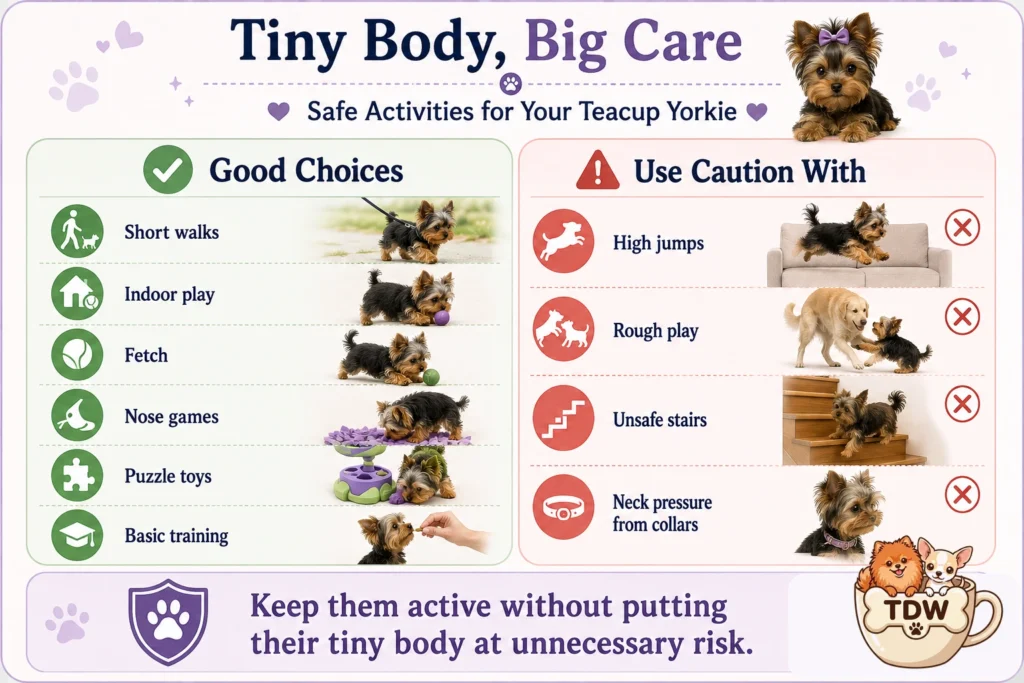
Feed small, frequent meals on a schedule your vet recommends, especially during puppyhood. Exercise needs are modest — short walks and indoor play are usually enough.
The bigger job is safety. A quick checklist:
- Use a harness instead of a collar for walks
- Add ramps or pet steps to beds and couches
- Check where the dog is before you sit, step, or close a door
- Watch recliners — they can trap a small dog Supervise every interaction with larger pets
- Use a sweater in cold weather
- Secure the dog in a carrier during car rides
Is a Teacup Yorkie a Good Family Dog?
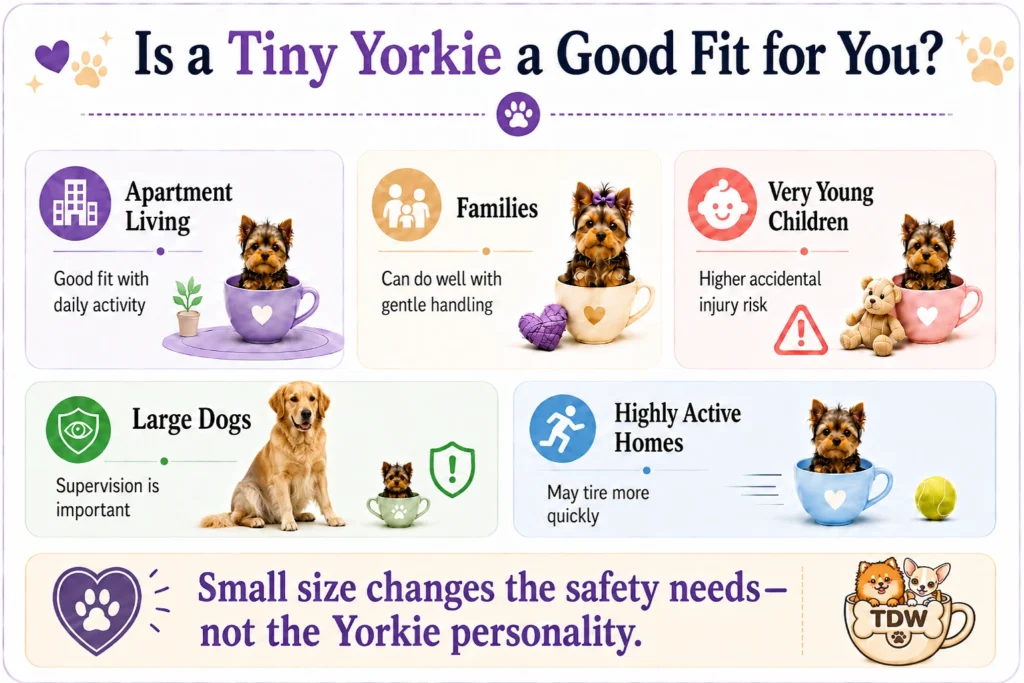
It can be, in the right home. But a very small Yorkie is usually a better fit for adults and families with older children than for households with toddlers.
Teacup Yorkies and Young Children
With a very small dog, the physical risk runs mostly toward the dog. Young children can easily drop, squeeze, or step on a pet that weighs a few pounds. A frightened or hurt dog may also snap, which isn’t good for anyone.
If your family does bring home a small Yorkie, these house rules help:
- Sit on the floor to hold the dog. A fall from a child’s arms can break bones.
- No carrying by young children, even when the dog seems relaxed.
- Adults supervise all play, especially with visiting kids.
- Give the dog a safe retreat, such as a crate or gated area that children stay out of.
- Teach gentle hands: petting, not hugging or grabbing.
There’s no official age cutoff for children. Still, if you have toddlers, a Yorkie at the upper end of the standard size range, or a sturdier breed, is often the safer choice for everyone.
Who a Very Small Yorkie Suits and Who It Doesn’t
| Likely a good fit | Likely a poor fit |
|---|---|
| Adults or families with older, gentle children | Homes with toddlers or very young kids |
| Someone home most of the day, especially during puppyhood | Long workdays with the dog alone |
| A calm household | Large or boisterous dogs in the home |
| Room in the budget for emergency vet visits | No savings for unexpected vet bills |
| Willingness to groom daily and brush teeth | Wanting a low-maintenance dog |
| Mostly indoor, close-to-home lifestyle | Wanting a rugged hiking or outdoor companion |
How Much Does a Teacup Yorkie Cost?
Puppies advertised as teacups are often priced higher, but there’s no reliable data on typical teacup prices, and asking prices vary widely. A bigger price tag doesn’t mean a healthier dog. Often you’re paying extra for the label itself, and it’s the same label the breed club bars its members from using.
On the flip side, a tiny Yorkie offered at a surprisingly low price is a classic scam warning sign (more below).
Ongoing and Health-Related Costs
Before you buy, budget for:
- Food, treats, and supplies (harness, ramps, sweaters, carrier)
- Grooming tools or regular professional grooming
- Dental cleanings, which require anesthesia
- Compounded medications, if standard products don’t fit your dog’s size
- Emergency visits for problems like hypoglycemia or fractures
- Diagnostic tests such as bile acid testing or imaging if a liver shunt is suspected
- Pet insurance, if you choose it. Compare policies before any health issues arise, since many plans exclude pre-existing conditions.
A simple step: call a local vet clinic and ask what an exam, a bile acid test, and a dental cleaning cost in your area. Those numbers will tell you more than any national average.
How to Find a Healthy Small Yorkie (and Avoid Scams)
If your heart is set on a small Yorkie, where it comes from matters more than almost anything else. Here’s how to protect both your family and the dog.
Red Flags in “Teacup” Puppy Listings
Be cautious if a seller:
- Makes size the main selling point or “guarantees” an adult weight
- Promotes “rare” or “exotic” colors such as chocolate or parti. The standard calls for blue and tan adults, and the YTCA’s code of conduct says members won’t sell dogs of non-standard colors as exotic or rare.
- Offers puppies younger than 12 weeks. YTCA members keep puppies until at least 12 weeks for proper development and socialization.
- Won’t let you meet the puppy or its mother, in person or by live video
- Can’t provide vet records or health-testing results
- Pressures you to pay a deposit quickly
- Asks for payment by gift card, wire transfer, or payment app
- Adds surprise fees after you pay, for things like shipping, a special crate, or “insurance”
Questions to Ask a Breeder
These questions are based on the YTCA’s health recommendations and code of ethics:
- What do both parents weigh as adults?
- Have the parents had kneecap (OFA patella) and eye (OFA eye) screenings, and do they have CHIC numbers? The Orthopedic Foundation for Animals (OFA) records health screenings, and a CHIC number shows a dog completed its breed’s recommended tests.
- Were the parents DNA-tested for inherited eye diseases like PRA-prcd and primary lens luxation (PLL)?
- If there’s any concern about the puppy’s growth or health, has a bile acid test been done?
- How old will the puppy be when it comes home?
- Will I get a written contract, including written disclosure of any known health problems?
- If I can ever no longer keep the dog, will you help rehome it or take it back?
- Can I visit, meet the mother, and see where the puppies are raised?
A good breeder will also have questions for you. The YTCA expects its members to screen buyers carefully. If a seller only wants to know when you can pay, take that as a warning.
Adopting a Small Yorkie Instead
Adoption has one big advantage: with an adult dog, you already know its size and personality. There’s no guessing.
The YTCA’s Yorkie rescue network can connect you with rescue groups, and small adult Yorkies do come through breed rescues and shelters. Tell the rescue what size range and temperament would suit your family, and ask them to keep you in mind.
Teacup Yorkshire Terrier FAQs
Can a teacup Yorkie be AKC registered?
Yes, if both parents are registered Yorkshire Terriers, but it’s registered as a Yorkshire Terrier, not a teacup. There’s no teacup category on registration papers. Keep in mind that registration records a dog’s parentage. It doesn’t prove the dog is healthy.
Is a Biewer Terrier the same as a teacup Yorkie?
No. The Biewer Terrier is a separate breed that the AKC fully recognized in 2021 as part of the Toy Group. Biewers look similar to Yorkies but have a tricolor coat that includes white, and they typically weigh about 4–8 pounds.
Is it wrong to buy a teacup Yorkie?
Wanting a small dog isn’t wrong. The welfare concern is with breeding programs that chase extreme smallness at the expense of health. If you want a small Yorkie, look for a health-testing breeder who breeds to the standard, or adopt, rather than paying a premium for the “teacup” label.
I already have a very small Yorkie. What should I do?
Focus on prevention. Schedule regular vet checkups and ask your vet for a low-blood-sugar emergency plan. Use a harness, add ramps to furniture, keep up with tooth brushing, and watch for the warning signs described in the health section above. Plenty of small Yorkies live happy lives with attentive care.
Conclusion
“Teacup” describes a marketing label, not a kind of dog. Every teacup Yorkie is a Yorkshire Terrier, and the smaller one is bred to be, the more health risk, safety planning, and vet cost your family takes on.
If you love the breed, focus on what actually protects a dog: health-tested parents, known parent sizes, a written contract, and a breeder who asks you questions too. If you have young children, lean toward a sturdier Yorkie or another breed. And consider adoption, where you’ll know exactly how big your new family member will be.
Your next step: take the breeder question list above to every seller you talk to, and book a quick chat with a local vet before you commit.
The best Yorkie is not the one that fits into the smallest bag. It is the one that has the best chance to live safely, comfortably, and grow into the spirited little terrier it was meant to be.

The TeacupDogWorld Editorial Team researches and creates practical guides about small and teacup-sized dogs, including breed characteristics, grooming, nutrition, health, training, and everyday care. Our content is developed using reputable veterinary, breed-club, and animal welfare sources to help dog owners make better-informed decisions.