
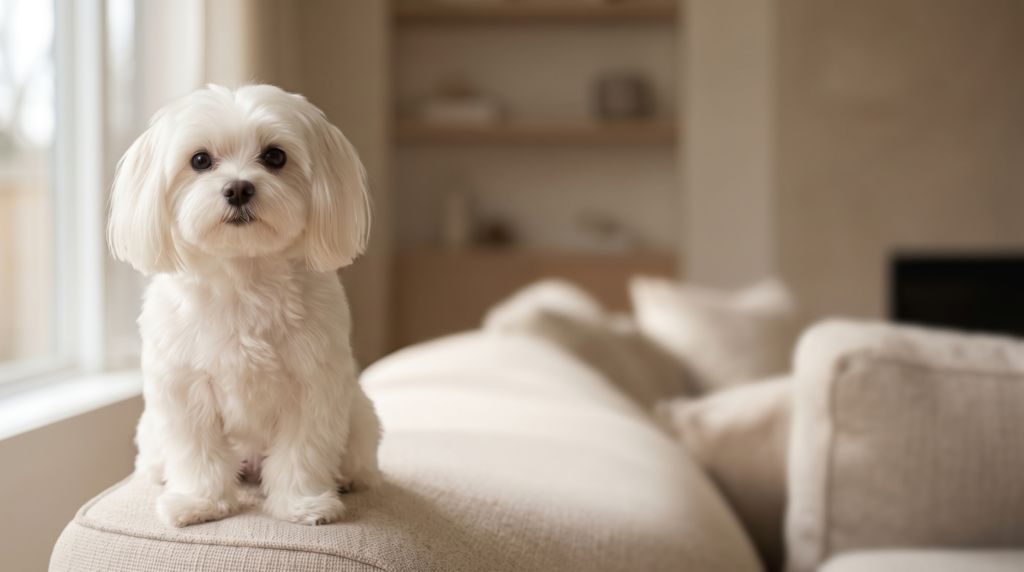
If you have seen a tiny white puppy online labeled a “teacup” dog, it is easy to assume that teacup is an official size or breed. It isn’t. The American Kennel Club (AKC) says “teacup” is not a recognized size designation for any AKC recognized breed.
That doesn’t mean the tiny white dogs you see aren’t real. Several recognized breeds, including the Maltese, Pomeranian, Toy Poodle, and Chihuahua, are already very small at their normal adult size.
The important part is separating established breed standards from marketing terms used to advertise unusually small puppies.
Below, we will look at five small white dogs commonly associated with the “teacup” look, how big they normally grow, what their coats require, and what families should consider before bringing one home.
What Is a White Teacup Dog?
A white teacup dog isn’t a separate dog breed. The phrase is usually used for a very small, white dog from an already small breed. You may also see terms such as micro, pocket, mini, or teacup in puppy advertisements. These words can sound like official size categories, but that isn’t necessarily the case.
The AKC advises buyers to ask questions when Toy breed puppies are marketed as “teacup.” Responsible breeding should focus on health and the established breed standard rather than simply producing the smallest puppy possible.
That distinction matters because you don’t need an unusually undersized dog to get a genuinely tiny companion. A normal Pomeranian can weigh 3 to 7 pounds, while a Maltese weighs under 7 pounds.
Our guide to teacup dog sizes and what the label means covers the size question in full. This page is about the colour.
Is “Teacup” an Official Dog Size?
- No. “Teacup” is not an official AKC size category.
- Some breeds do have formally recognized size varieties. The Poodle, for example, has Standard, Miniature, and Toy varieties.
- The Toy Poodle is the smallest recognized variety. “Teacup Poodle” is not another official size below Toy.
- This is why checking the established size of a breed is more useful than relying on words such as “micro” or “teacup” in an advertisement.
White Teacup Dogs at a Glance
Here is how five dogs commonly associated with the white teacup look compare at their normal breed size.
| Dog | Typical Adult Size | White Coat? | Important Point |
|---|---|---|---|
| Maltese | Under 7 lb, about 7 to 9 in | Yes | Naturally tiny with a long white coat |
| Pomeranian | 3 to 7 lb, about 6 to 7 in | Yes | Already a very small Toy breed |
| Toy Poodle | Under 10 in, typically 4 to 6 lb | Yes | Toy is the recognized smallest Poodle variety |
| Chihuahua | No more than 6 lb under the standard | Yes | One of the smallest recognized breeds |
| Shih Tzu | 9 to 16 lb, about 8 to 11 in | Yes | “Teacup Shih Tzu” is not a recognized variety |
These measurements come from AKC breed information and official breed standards.
The table also shows why the label can be confusing. A Maltese, Pomeranian, Toy Poodle, or Chihuahua is already genuinely tiny without being deliberately bred below the normal size for its breed.
1. Maltese
If the picture in your mind is a tiny white lapdog with dark eyes and a silky coat, the Maltese is probably one of the closest matches. Adult Maltese weigh under 7 pounds and stand around 7 to 9 inches tall. Their long, straight, silky white coat is one of the breed’s defining characteristics.
A normal Maltese is already extremely small. You do not need to search specifically for an unusually undersized “teacup Maltese” to get a tiny companion.
Maltese are affectionate companion dogs, but their coat requires commitment. A long coat needs gentle daily brushing and combing to prevent tangles and mats. Keeping the hair in a shorter trim can make maintenance more manageable, although regular grooming is still necessary.
Their small frame also matters in a family home. Rough play from young children can be intimidating or dangerous for such a little dog, so Maltese may fit better in homes where children understand how to handle a small animal gently.
Read more in our Maltese guide.
2. White Chihuahua
The Chihuahua proves that a dog does not need a “teacup” label to be extraordinarily small. According to the official AKC standard, a Chihuahua should weigh no more than 6 pounds. White Chihuahuas can occur naturally within the breed.
Chihuahuas come in both Smooth Coat and Long Coat varieties, so grooming requirements can differ noticeably from one dog to another. Smooth coated dogs generally need less brushing, while longer coats need more attention to avoid tangles.
Their size deserves serious consideration in a family home. Chihuahuas aren’t ideal for rough play with young children because such a small dog can be easily injured by overly excited handling.
They can still make affectionate family companions in the right environment. The key is supervision, gentle handling, early socialization, and realistic expectations about their vocal nature.
See our Chihuahua guide.
3. White Pomeranian
A white Pomeranian gives you a very different look. Instead of the flowing silky coat of a Maltese, the Pomeranian has a thick, fluffy double coat and a fox like face.
Pomeranians normally weigh 3 to 7 pounds and stand around 6 to 7 inches tall. They are already among the smallest recognized Toy breeds. Their breed standard permits a wide variety of colors and patterns, including white.
Poms are lively, curious, and intelligent dogs. They can live comfortably in apartments or larger homes as long as their exercise and mental stimulation needs are met.
That fluffy coat does require regular care. The dense undercoat and longer outer coat are quite different from the Maltese’s silky hair, so don’t assume that all small white dogs have identical grooming needs.
Families should also take their size seriously. Pomeranians generally fit better with older children who understand that a small dog isn’t a toy.
Our Pomeranian guide has the detail.
4. White Toy Poodle
The Toy Poodle is another naturally tiny breed that can have a solid white coat. This breed is important because the terminology often causes confusion.
The AKC recognizes three Poodle size varieties: Standard, Miniature, and Toy. Toy Poodles are under 10 inches tall and usually weigh around 4 to 6 pounds. White is one of the recognized colors.
So, when you see a puppy sold as a “teacup Poodle,” remember that Toy Poodle is the established smallest Poodle variety. “Teacup” does not represent a fourth recognized size.
Toy Poodles have curly coats that shed very little, but low shedding doesn’t mean low maintenance. Their coat needs regular brushing and clipping to prevent matting, particularly when it is kept long.
They are also known for intelligence and trainability, which can appeal to families willing to provide both mental stimulation and consistent grooming.
5. White Shih Tzu
The Shih Tzu belongs on this list for a slightly different reason. Shih Tzu can certainly have white in their coats, and all colors and markings are accepted within the breed standard.
However, a normal adult Shih Tzu weighs approximately 9 to 16 pounds. This makes the breed noticeably heavier than a Maltese, Chihuahua, or Pomeranian. More importantly, the American Shih Tzu Club states that there is no AKC recognized “imperial” or “teacup” Shih Tzu.
That doesn’t mean every smaller than average Shih Tzu is unhealthy. Individual dogs naturally vary. It does mean that buyers should be cautious about advertisements presenting “teacup Shih Tzu” as though it were an established breed variety.
Shih Tzu are affectionate companion dogs that can adapt well to smaller homes, but their long coat needs frequent brushing and grooming. If you’re mainly attracted to the tiny size advertised online, compare that claim with the normal 9 to 16 pound breed standard before making a decision.
Which White Tiny Dog May Suit Your Family?
There isn’t one tiny white dog that is automatically right for every family. Your household matters more than the word “teacup.”
Instead of choosing by appearance alone, think about how the dog’s size, coat, energy level, and physical delicacy fit your daily life.
Families With Young Children
Tiny dogs and toddlers can be a difficult combination. Young children may grab, squeeze, drop, chase, or accidentally step on a dog without understanding how easily a small animal can be hurt.
Even well meaning children need close supervision around dogs. Children should also be taught to respect a dog’s space rather than treating the animal like a toy.
If your home includes young children, consider not only temperament but also physical size and fragility. Older children who understand gentle handling may be easier companions for particularly small breeds such as Maltese, Chihuahuas, and Pomeranians.
Families With Other Pets
- A small dog can live successfully with other animals, but size differences matter.
- A playful 60 pound dog can accidentally injure a six pound companion even without showing aggression.
- Introductions should be controlled, interactions should be supervised, and every dog should have somewhere safe to retreat.
- Early socialization can help, but it cannot completely remove the physical risk created by a large size difference.
Apartment and Small Home Living
- Small size can make all five breeds practical for compact homes, but small doesn’t automatically mean quiet or effortless.
- Chihuahuas can be quite vocal. Pomeranians are alert little dogs. Toy Poodles still need exercise and mental stimulation. Shih Tzu and Maltese often want plenty of companionship. If you live in an apartment, think beyond floor space.
- Consider barking, training, exercise, grooming, and how long the dog may be left alone.
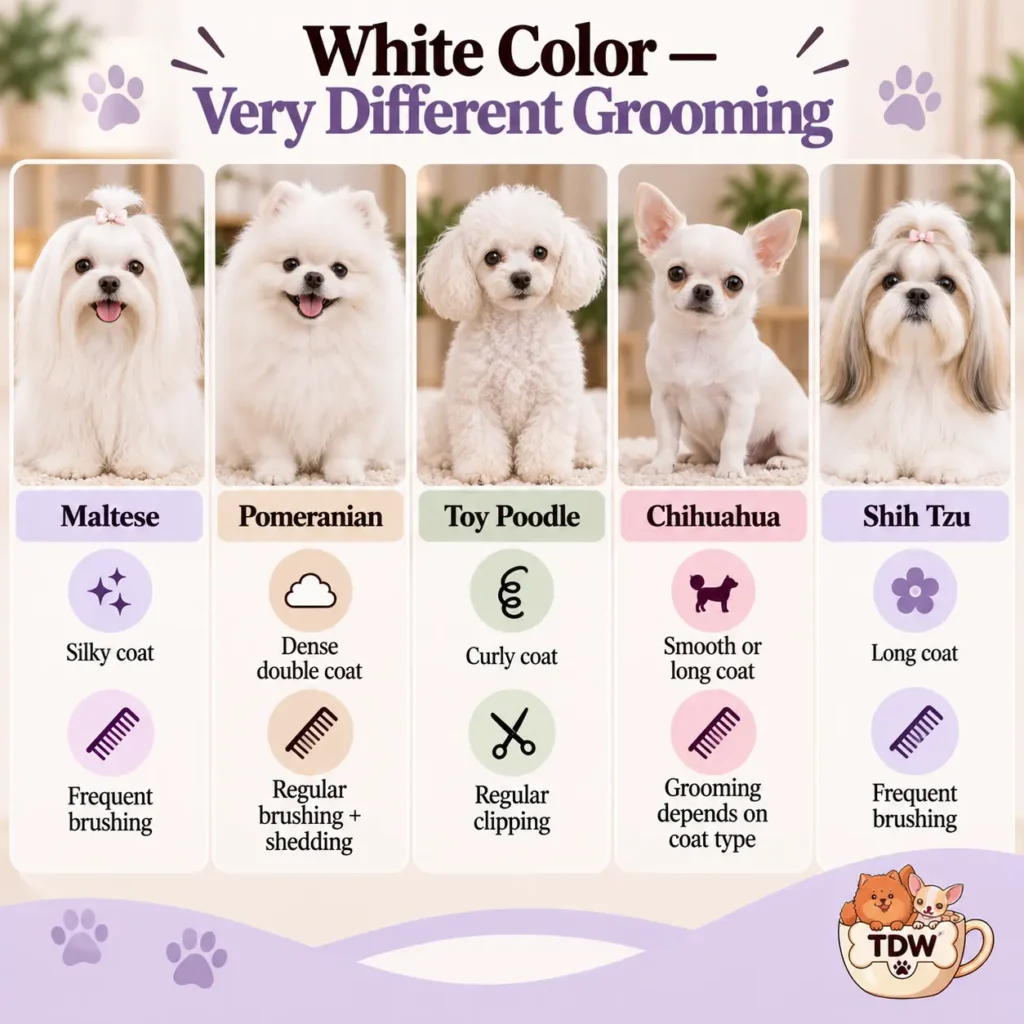
Grooming Commitment
- The color white doesn’t determine grooming needs. The coat type does.
- A Maltese has long, silky hair. A Pomeranian carries a dense double coat. A Toy Poodle has a curly coat that usually needs clipping.
- A long coat Chihuahua needs more brushing than a smooth coat Chihuahua, while Shih Tzu coats need regular attention to avoid matting.
- If you love the fluffy white look, make sure you also like, or can afford, the grooming routine that comes with it.
Health Considerations With Extremely Small Dogs
Being a small Toy breed does not automatically make a dog unhealthy. The bigger concern is breeding specifically for extreme smallness without giving enough attention to health and body structure.
Veterinary guidance notes that dogs bred far below their normal breed size can face concerns involving blood sugar regulation, fragile bones, dental crowding, orthopedic problems, liver abnormalities, temperature regulation, and injury.
These problems should not be presented as guaranteed. Every dog is different, and health depends on genetics, breeding practices, veterinary care, and many other factors.
Low Blood Sugar in Tiny Puppies
Hypoglycemia means abnormally low blood sugar. The Merck Veterinary Manual notes that puppy hypoglycemia can occur in Toy breeds during the first months of life.
Very young puppies have limited energy reserves compared with adult dogs, which can make blood sugar problems more serious. Possible signs include weakness, unusual tiredness, disorientation, shaking, seizures, or collapse. These symptoms need prompt veterinary attention rather than home diagnosis.
Fragility and Injury Risk
A very small body can make ordinary accidents more serious. Falling from furniture, being stepped on, being dropped, or rough play with a larger dog can cause significant injuries in an extremely small dog.
This is one reason adult size should be treated as a practical family consideration rather than simply a feature that makes a puppy look cuter.
Dental and Orthopedic Concerns
Small mouths can leave less room for teeth, and Toy breeds can also be affected by orthopedic conditions such as patellar luxation. Patellar luxation simply means that the kneecap can move out of its normal position.
These conditions are not exclusive to teacup dogs, and a tiny dog is not guaranteed to develop them. What matters is understanding the health concerns seen within the specific breed and checking whether the puppy’s parents received the recommended health screening.
Does a White Coat Need Special Care?
A white coat doesn’t automatically require completely different care from every other color, but it can make dirt and staining much more visible.
The bigger issue is coat structure. A silky Maltese coat, fluffy Pomeranian double coat, and curly Toy Poodle coat all need different grooming routines even though each dog can be white.
Regular brushing, bathing when appropriate, dental care, nail trimming, and attention around the eyes can help keep a small white dog comfortable and clean.
Tear Staining
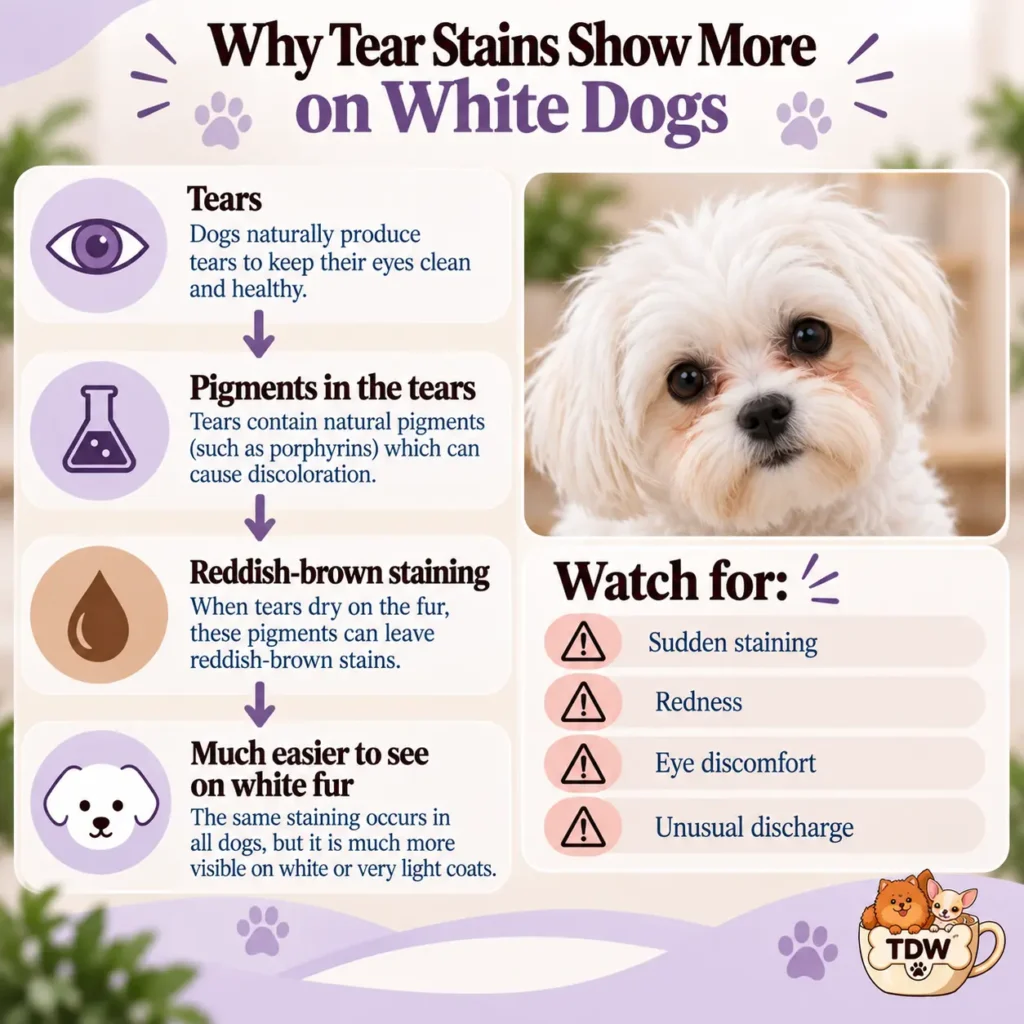
Those reddish brown marks beneath the eyes are known as tear stains. They are especially noticeable against white or very light fur. Breeds such as Maltese, Poodles, and Shih Tzu can be more prone to visible tear staining.
Tears normally drain through small ducts near the eyes, but facial anatomy, excessive tearing, blocked ducts, or other eye problems can contribute to staining. Don’t assume every tear stain is purely cosmetic.
If staining appears suddenly, becomes excessive, or comes with redness, discomfort, unusual discharge, or other eye changes, a veterinarian should check for an underlying cause.
White Fur Does Not Automatically Mean a Health Problem
You may have heard that white dogs are automatically deaf. That is too broad. Veterinary research shows an association between congenital deafness and certain pigmentation genetics, particularly piebald and merle patterns in some breeds.
However, coat color alone isn’t enough to conclude that an individual white dog has a hearing problem. If hearing is a concern in a puppy or breed with a known risk, a veterinarian can discuss appropriate hearing testing.
How to Choose a Healthy Small Dog
If your main goal is a dog that stays small, start with breeds that are already small within their recognized standards.
Don’t assume that smaller always means better.
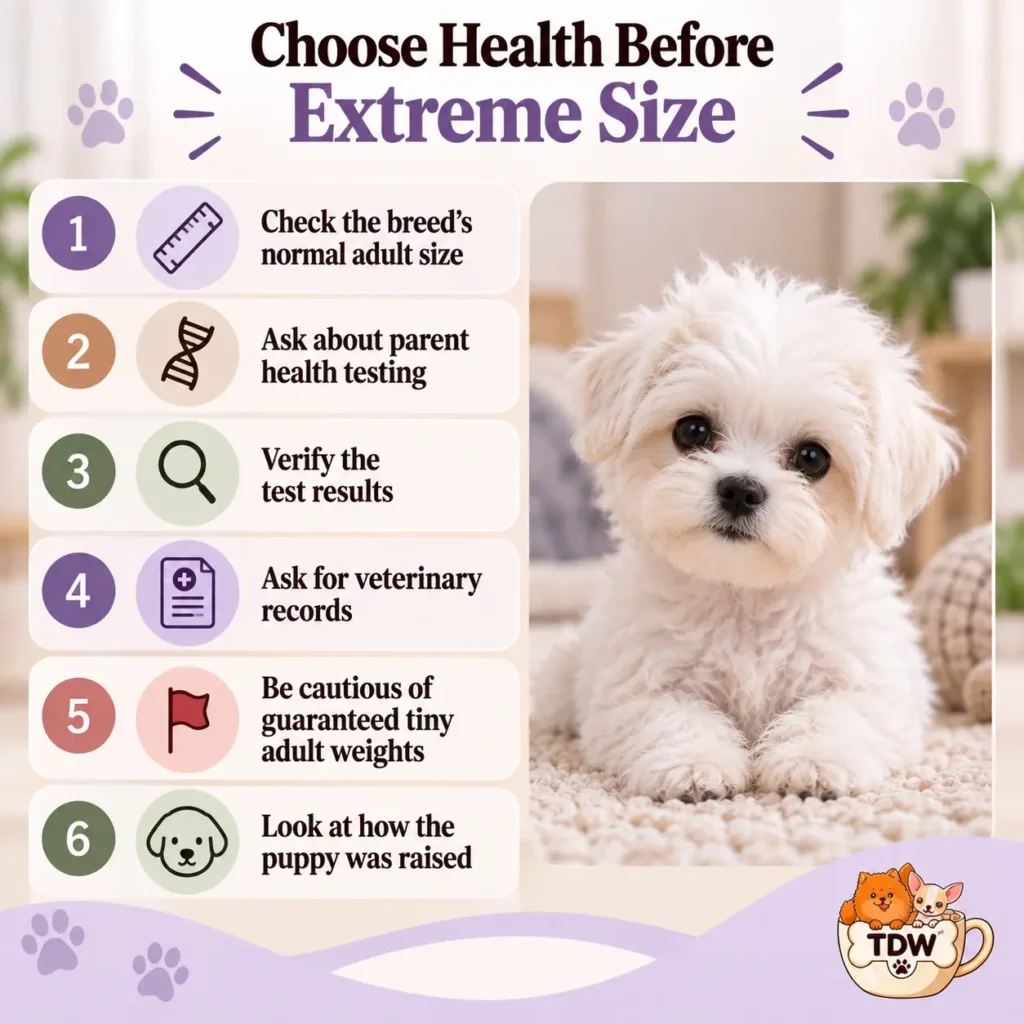
Before choosing a puppy, check these points:
- Look up the normal breed size first. A 3 to 7 pound Pomeranian or an under 7 pound Maltese is already genuinely tiny.
- Ask what health tests were performed on the parents. Recommended tests can differ between breeds.
- Verify health testing where possible. The Orthopedic Foundation for Animals (OFA) provides searchable health information and supports breed specific screening programs.
- Ask for veterinary records and information about the parent dogs. A responsible breeder should be willing to discuss health, temperament, and family history rather than talking only about size and color.
- Be cautious with guaranteed extreme adult weights. Puppy growth can vary, so claims such as a “guaranteed 2 pound adult” deserve extra scrutiny.
- Pay attention to how the puppy was raised. Health, behavior, socialization, and the condition of the parent dogs matter more than a fashionable label.
One useful detail about the OFA Canine Health Information Center program is that receiving a CHIC number means the required breed specific tests were completed and made public.
It does not automatically mean that every test result was normal. You should still check the actual results.
You can also consider breed rescue organizations if your main goal is finding a small companion rather than purchasing a puppy of a particular advertised size.
Frequently Asked Questions About White Teacup Dogs
Are white teacup dogs a real breed?
No. White teacup dogs are not one recognized breed. The phrase generally describes very small white dogs, often from Toy breeds, that are marketed or casually described as teacup.
The AKC does not recognize “teacup” as an official size designation.
What is the smallest white dog breed?
There isn’t one simple answer because individual dogs vary. Several recognized breeds are naturally extremely small. Chihuahuas have an AKC maximum weight of 6 pounds. Pomeranians normally weigh 3 to 7 pounds, while Maltese weigh under 7 pounds.
Toy Poodles are under 10 inches tall and commonly weigh around 4 to 6 pounds.
Which white tiny dogs are naturally within Toy breed size?
Maltese, Pomeranians, Chihuahuas, and Toy Poodles are already very small within their normal recognized breed or variety standards. White coats are possible in each.
The Shih Tzu is also a Toy breed, but its normal adult weight of 9 to 16 pounds makes it larger than the other dogs listed here.
Are white teacup dogs good with children?
They can live happily in family homes, but extremely small dogs need gentle handling and close supervision around young children. Temperament varies by breed and individual dog, but physical size alone makes accidental injury a bigger concern.
Families with older children who understand how to handle dogs carefully may find managing a tiny breed easier.
Is a white teacup Maltese different from a Maltese?
Not as an officially recognized breed or size variety. A normal Maltese is already a very small dog weighing under 7 pounds with a long white coat.
“Teacup Maltese” is an informal term rather than a separate AKC recognized Maltese variety.
Choosing Tiny Without Chasing Extreme Size
The appeal of white teacup dogs is easy to understand. A tiny body, bright white coat, and companion dog personality can be hard to resist. But the label in an advertisement matters far less than the dog behind it.
Maltese, Pomeranians, Toy Poodles, and Chihuahuas are already genuinely tiny within established breed sizes. The Shih Tzu also shows why “teacup” terminology needs extra scrutiny.
Start with the breed’s normal size, grooming needs, temperament, family fit, and health screening recommendations. If a seller’s main promise is simply that a puppy will be unusually small, ask more questions before making your decision.

The TeacupDogWorld Editorial Team researches and creates practical guides about small and teacup-sized dogs, including breed characteristics, grooming, nutrition, health, training, and everyday care. Our content is developed using reputable veterinary, breed-club, and animal welfare sources to help dog owners make better-informed decisions.