

There is no such thing as a teacup Cavalier King Charles Spaniel. The breed comes in one size, around 13 to 18 pounds, and its own breed club treats an undersized dog as a fault rather than a feature.
If you have fallen for that gentle face and wanted a smaller version, you are in good company. But this is one breed where smaller is a genuine health concern, not just a cute size, and the reason is backed by veterinary research.
This guide explains what is really being sold under the teacup name, why the Cavalier’s two biggest health problems matter so much here, why there is no white Cavalier, and exactly which health checks to ask a breeder for. By the end, you will know how to find a Cavalier that is likely to stay healthy.
Is There Such a Thing as a Teacup Cavalier?
No. There is no teacup, mini or toy Cavalier recognized by any breed club or registry in the United States.
The Cavalier King Charles Spaniel is already classed as a toy breed by the American Kennel Club, which recognized it in 1996. So when you see “toy Cavalier” in a listing, that just describes the normal breed. When you see “teacup” or “mini”, that describes something a seller has decided to call smaller than normal.
Those words have no standard behind them. Nobody measures a teacup Cavalier against anything, because there is nothing to measure it against.
How Big a Cavalier Is Supposed to Be
The American Kennel Club breed standard describes a Cavalier as 12 to 13 inches tall at the withers, which is the top of the shoulder blades, and 13 to 18 pounds, with weight in proportion to height.
Here is the detail that says the most. The Cavalier King Charles Spaniel Club, USA writes in its standard that a “weedy” dog, meaning a thin or undersized one, should be penalized just as much as an oversized one.
In other words, the people who wrote down what a Cavalier is supposed to be decided that too small is a flaw. A teacup Cavalier is not a special edition of the breed. By the breed’s own definition, it is a fault being sold as a feature.
Here is how the real breed compares with what the teacup label actually tells you:
| Standard Cavalier | Dog sold as a “teacup Cavalier” | |
|---|---|---|
| Recognized by the AKC | Yes | No |
| Official height | 12 to 13 inches | None |
| Official weight | 13 to 18 pounds | None |
| Colors | Four recognized colors | No extra colors, including white |
| Adult size you can count on | The standard gives a clear benchmark | Only an estimate, with nothing official behind it |
What Is Actually Sold as a Teacup Cavalier
If the breed does not come in a teacup size, what are sellers offering? In practice, it is almost always one of three things.
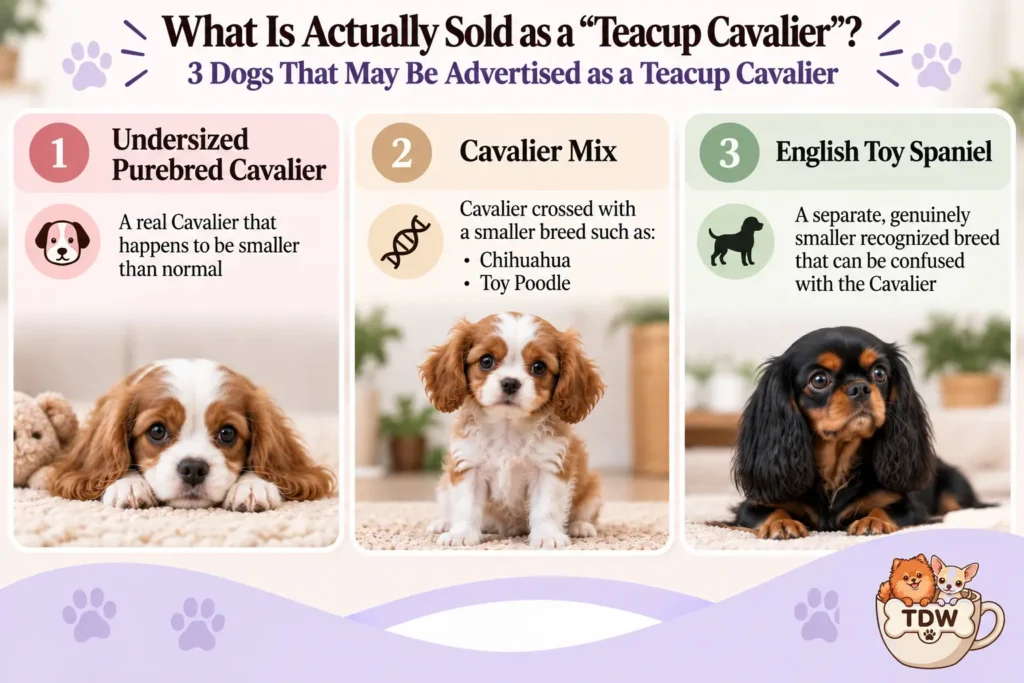
An Undersized Purebred Cavalier
Sometimes it really is a purebred Cavalier that is small. Occasionally that is just the smallest puppy in an ordinary litter, and there is nothing sinister about it.
The problem comes when small size is the goal. Breeding Cavaliers to be deliberately smaller means selecting against the breed standard, in a breed whose most serious skull condition is linked to smaller size. That link is explained in the health section below, and it is the main reason this matters more for Cavaliers than for many other breeds.
A Cavalier Mix With a Smaller Breed
This is very common. A Cavalier is crossed with a smaller dog, such as a Chihuahua or a toy poodle, and the puppies are sold with “Cavalier” in the name.
Two things are worth knowing. First, the puppy is not a purebred Cavalier, so its adult size, coat and personality are harder to predict. It may take after either parent.
Second, a mix is not automatically the healthier choice. Veterinary research on the Cavalier’s skull condition has specifically found that Cavalier crosses can be affected too, especially when the other parent is a smaller dog.
An English Toy Spaniel
Now and then, a “teacup Cavalier” turns out to be a different breed altogether. The English Toy Spaniel looks similar, shares a history with the Cavalier, and is genuinely smaller.
Sometimes this is an honest mix up. The two breeds are confused all the time, partly because of their names. Either way, it is a separate breed with its own standard, and it is worth understanding the difference before you buy.
Cavalier vs English Toy Spaniel
They are two different breeds. The Cavalier is the bigger of the two, with a flatter head and a longer nose. The English Toy Spaniel is smaller and rounder, with a domed head and a short, upturned face.
| Cavalier King Charles Spaniel | English Toy Spaniel | |
|---|---|---|
| Typical weight | 13 to 18 pounds | 8 to 14 pounds |
| Head | Flat on top | Domed |
| Face | Longer muzzle | Short, upturned face |
| AKC recognition | 1996 | 1886 |
| Name in the UK | Cavalier King Charles Spaniel | King Charles Spaniel |
The name is where most of the confusion comes from. In Britain the English Toy Spaniel is called the King Charles Spaniel, so people often assume a “King Charles” and a “Cavalier King Charles” are the same dog. The English Toy Spaniel Club of America is clear that they are separate breeds with separate standards, even though they share the same coat colors and a common history.
So if what you really want is a smaller spaniel, the English Toy Spaniel is a real, recognized option.
But there is a catch, and it matters. The English Toy Spaniel is also one of the breeds most prone to the same skull condition that affects Cavaliers. It is a genuinely smaller breed, but it is not a way around the health problem. If you go this route, the same careful health questions apply.
Teacup Cavalier Colors, and Why There Is No White Cavalier
Cavaliers come in exactly four colors. Not five, and not white.
| Color | What it looks like |
|---|---|
| Blenheim | Rich chestnut markings on a pearly white background, often with a chestnut spot on top of the head |
| Tricolor | Black markings on a white background, with tan over the eyes, on the cheeks and under the tail |
| Ruby | Solid rich red all over |
| Black and tan | Black with tan markings on the face, chest, legs and under the tail |
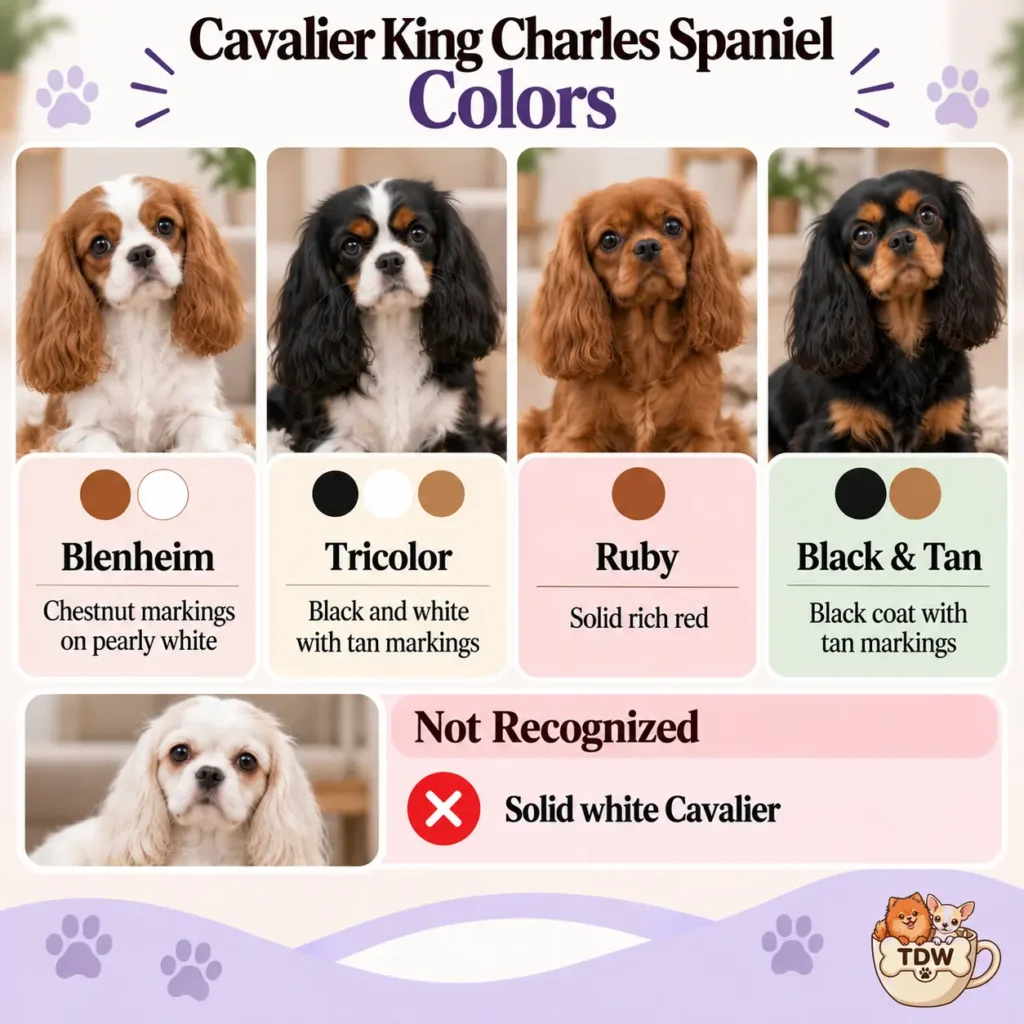
That little chestnut spot on some Blenheims has a name. It is called the Blenheim spot, or the lozenge, and it is prized but not required.
The breed standard allows only these four. A dog of any other color is disqualified in the show ring, and the American Cavalier King Charles Spaniel Club lists them in detail.
So, do Cavaliers come in white? No. Blenheim and tricolor Cavaliers have plenty of white, but always with colored markings on the head and body. Ruby and black and tan Cavaliers are actually faulted for having white patches.
If you see a listing for a white teacup Cavalier, one of two things is going on. Either it is a Blenheim or tricolor that has been described loosely, or the puppy is not a purebred Cavalier at all. Either way, it is worth asking questions before going any further.
Teacup Cavalier Health: Why Smaller Is a Bigger Concern in This Breed
Cavaliers are loving, wonderful dogs, and they also carry two serious inherited health problems. A 2024 study in the Journal of Veterinary Internal Medicine describes both as highly common in the breed.
One affects the heart. The other affects the skull and spinal cord, and that is the one where size really matters.
Heart Valve Disease
Mitral valve disease is a slow wearing out of one of the heart’s valves. Over time the valve stops closing tightly, and a little blood leaks backward with each beat.
The first sign is usually a heart murmur, which is a whooshing sound a vet hears through a stethoscope. It often shows up years before the dog seems unwell.
In Cavaliers, it is very common, and it becomes more common with age. In one US study of 394 Cavaliers, 56% of dogs aged four or older had a murmur, and every dog in the study aged ten or older had one. The same study found Cavaliers reached the stage of needing specialist care at a much younger average age than other breeds.
The disease runs strongly in families. That is why the heart results of a puppy’s parents matter so much, and why the buying section below starts there.
Signs that the disease may be getting worse include tiring more easily on walks, coughing, and breathing faster than usual while resting or asleep. Any of these is a reason to see your vet.
Size is not the main driver of heart disease. But every Cavalier buyer needs to know about it, teacup or not.
A Skull Too Small for the Brain
This is the part of the article that matters most, so here it is in plain words.
Many Cavaliers have a condition called Chiari-like malformation. It means the back of the skull is too small for the brain inside it. The brain gets crowded, and that crowding can block the normal flow of fluid around the brain and spinal cord.
When that happens, fluid can build up and form pockets inside the spinal cord itself. That is called syringomyelia. Some dogs with it show no signs at all. Others live with real, ongoing pain.
How common is it? A 12 year screening program in the Netherlands, published as a peer reviewed study, scanned more than a thousand Cavaliers. The skull malformation was found in every single one. Syringomyelia was found in 39% of them, and it became more common as the dogs got older.
Now the part that connects to size. Clare Rusbridge, a veterinary neurologist who has studied this condition for many years, has written in the veterinary journal In Practice that shortening of the skull combined with miniaturization of the whole body can predispose dogs to it. She also notes that it is most common in Cavaliers and their crosses, especially when the cross is with a smaller dog than a Cavalier. Earlier research from her team, published in PLoS ONE, describes the malformation as associated with miniaturization in the same way.
That does not mean every small Cavalier will be affected. It does mean that making a Cavalier smaller pushes in the wrong direction for the breed’s biggest neurological problem. That is the honest reason a teacup Cavalier worries vets more than, say, a small poodle.

Signs to mention to your vet:
- Scratching at the neck or shoulder, often in the air without actually touching the skin
- Yelping when picked up, or when the neck is touched
- Seeming sensitive around the head, ears or neck
- Reluctance to be stroked in places the dog used to enjoy
- Rubbing the face on the floor or furniture a lot
These are signs to report, not a diagnosis. An MRI scan is how vets confirm the condition.
Other Conditions Worth Knowing
Cavaliers can also have slipping kneecaps, known as patellar luxation, where the kneecap slides out of place and causes a skip in the step. Hip problems and eye conditions also occur, which is why breeders are asked to screen for them.
There are also two inherited conditions in the breed with DNA tests available: episodic falling, which causes episodes of muscle stiffness, and a syndrome that causes both dry eye and a curly, rough coat. A careful breeder can tell you whether the parents were tested.
On top of the breed’s own conditions, any unusually tiny dog faces a few extra challenges simply because of its size. Very young toy breed puppies are prone to low blood sugar, which the Merck Veterinary Manual links to an immature liver in the first six months of life. Tiny dogs also lose body heat quickly, their teeth can be crowded in a small jaw, and anesthesia and medicine doses need extra care. None of these is unique to Cavaliers, but they add to the picture when a Cavalier is bred well below its normal size.
How Long Do Cavaliers Live?
It depends on who you ask, and the honest answer is that sources differ.
The American Kennel Club lists a life expectancy of 12 to 15 years for the breed. Other published sources give a shorter typical range. The gap exists partly because heart disease is so common in Cavaliers, and it is the main thing that limits how long many of them live.
For teacup Cavaliers there is simply no data. Nobody tracks a size that does not officially exist, so any lifespan figure you see for a teacup is a guess.
What you can influence is the starting point. A puppy from parents with good heart results, kept at a healthy weight and checked by a vet every year, gives itself the best chance.
Temperament and Family Life
This is where the Cavalier shines. They are gentle, affectionate and deeply people focused. Most are friendly with strangers, easygoing with other dogs, and happiest curled up next to whoever is home.
They are not guard dogs, and they are not built to be left alone for long stretches. A Cavalier wants company, and a lonely one can become anxious.
If your family is looking for a sweet natured companion, the breed’s reputation is well earned. That is exactly why it is worth getting a healthy one.
Are Cavaliers Good With Children?
A standard sized Cavalier is often a lovely family dog, as long as children are taught to be gentle and adults keep an eye on things.
A very small Cavalier is a different situation. A smaller body is easier to hurt if it is dropped, stepped on or squeezed. And a dog living with neck or head pain from the skull condition may not enjoy being picked up or cuddled, however sweet its nature.
A few simple rules help with any Cavalier:
- Young children sit on the floor to hold or pet the dog, rather than carrying it around
- An adult supervises play with toddlers
- The dog has a quiet place to retreat to where children do not follow
- Everyone learns to notice if the dog flinches or pulls away when touched, and tells an adult
The same thinking applies to other pets. Cavaliers are usually friendly with other dogs, but a much smaller Cavalier can be hurt by a big, playful dog that means no harm at all. Introduce them slowly and supervise their play until you know how they get along.
Everyday Care
Cavaliers are fairly easy to live with day to day.
They shed a moderate amount and have a silky coat with feathering on the ears, chest and legs, so brushing a few times a week keeps tangles away. Their long, heavy ears can trap moisture, so check and clean them regularly.
They need moderate exercise, such as daily walks and play, and usually adapt well to apartments. Keeping them at a healthy weight matters more than it might seem, because extra pounds put more strain on a heart that may already be under pressure later in life.
[INTERNAL LINK OPPORTUNITY: article about Cavalier grooming]
How to Find a Healthy Cavalier
The good news is that you can check a lot of this before you pay anything. Here is what to ask for.
Health Clearances to Ask For
The Cavalier King Charles Spaniel Club, USA recommends that, before any Cavalier is bred, it should have:
- A heart clearance from a board certified veterinary cardiologist. That means a heart specialist, not a general vet, listening for a murmur. The club recommends this at a minimum of two and a half years old, because a heart that is clear at that age tells you more than one checked at a year.
- An eye exam from a board certified veterinary ophthalmologist, which is an eye specialist.
- A knee evaluation from a licensed vet, checking for slipping kneecaps.
- A hip X-ray submitted to the Orthopedic Foundation for Animals.
Ask for the parents’ registered names, then look up their results yourself using the Orthopedic Foundation for Animals search. A breeder who has done the testing will be glad to share it.
You may also hear a breeder mention a CHIC number, which comes from the Canine Health Information Center, a database run with the OFA. It sounds like a stamp of approval, but it is not quite that. A CHIC number means the required tests were done and the results were made public. It does not mean every result was normal. So always ask to see the actual results, not just the number.
One more question worth asking: have the parents had an MRI scan for the skull condition? It is not required, and many good breeders do not do it. But a breeder who has, and who can talk to you about the results, is showing you a level of care that is hard to fake.
Red Flags in a Teacup Cavalier Listing
Be careful if you see any of these:
- A promised adult size well below 13 pounds
- The words teacup, mini or micro used as if they were official sizes
- A “white” Cavalier, or any color outside the four
- No heart clearances on the parents, or a heart check by a general vet instead of a cardiologist
- Parents who are too young for their heart results to mean much
- No chance to meet the puppy and its mother, in person or on a live video call
- Pressure to pay a deposit quickly
One red flag alone is a reason to ask more questions. Several together is a reason to walk away.
Better Options for Your Family
If a teacup Cavalier is not the answer, what is? Here are three honest routes, depending on what matters most to you.
If you love the Cavalier itself, look for a standard sized Cavalier from a breeder whose dogs have current heart clearances from a cardiologist, and ideally MRI screening too. You get the same gentle nature and the same beautiful face, from parents chosen for health rather than size.
If you want a dog whose health is already known, consider a rescue Cavalier. Many are adults, so their size, temperament and any health issues are already clear. Breed specific rescue groups exist across the United States.
If small size is truly the priority, it may be worth looking at a different small breed that does not carry the Cavalier’s heart and skull history. That is not a knock on Cavaliers. It is just choosing the right dog for what your family actually needs.
Teacup Cavalier King Charles Spaniel FAQs
Is there a mini Cavalier King Charles Spaniel?
No. Mini, teacup and micro are marketing words, not recognized sizes. The breed has one size, 13 to 18 pounds, and a dog sold as a mini is either an undersized Cavalier, a mix, or a different breed.
Do Cavaliers come in white?
No. The four allowed colors are Blenheim, tricolor, ruby, and black and tan. Blenheims and tricolors have a lot of white, but always with colored markings, so a solid white Cavalier is outside the breed standard.
Is a Cavalier the same as a King Charles Spaniel?
No. In the UK, King Charles Spaniel is the name for the breed Americans call the English Toy Spaniel. It is smaller than the Cavalier, with a domed head and a shorter face, and it is a separate breed.
How small can a healthy Cavalier be?
The breed standard describes 13 to 18 pounds as ideal and treats undersized dogs as a fault. A Cavalier at the lower end of that range can be perfectly healthy, but deliberately breeding well below it raises concern because of the breed’s skull condition.
Are Cavalier mixes healthier?
Not automatically. Veterinary research has found that Cavalier crosses can still have the skull malformation, particularly when the other parent is a smaller breed. A mix also makes adult size and temperament harder to predict.
What should I do if my small Cavalier scratches its neck a lot?
Book a vet appointment and mention it specifically. Scratching at the neck or shoulder, especially without touching the skin, can be a sign of syringomyelia, and only a vet can tell you what is going on.
Can I adopt a Cavalier?
Yes. Cavalier rescue groups operate across the United States, and many rescue dogs are adults whose size, personality and health are already known. It is one of the best ways to find the right Cavalier for your family.
Conclusion
A teacup Cavalier King Charles Spaniel is not a real size. It is usually an undersized Cavalier, a mix with a smaller breed, or an English Toy Spaniel with a borrowed name.
And for this breed in particular, smaller is not just a matter of looks. Cavaliers already face a skull condition that research links to smaller size, along with a heart condition that becomes more common every year a Cavalier lives.
If the Cavalier’s gentle nature is what drew you in, you do not need a teacup to get it. Look for a standard sized Cavalier with a cardiologist’s heart clearance on both parents, or give a rescue Cavalier a home. Ask the questions in this guide, check the answers yourself, and you will be giving your family the best chance of many happy years together.

The TeacupDogWorld Editorial Team researches and creates practical guides about small and teacup-sized dogs, including breed characteristics, grooming, nutrition, health, training, and everyday care. Our content is developed using reputable veterinary, breed-club, and animal welfare sources to help dog owners make better-informed decisions.