
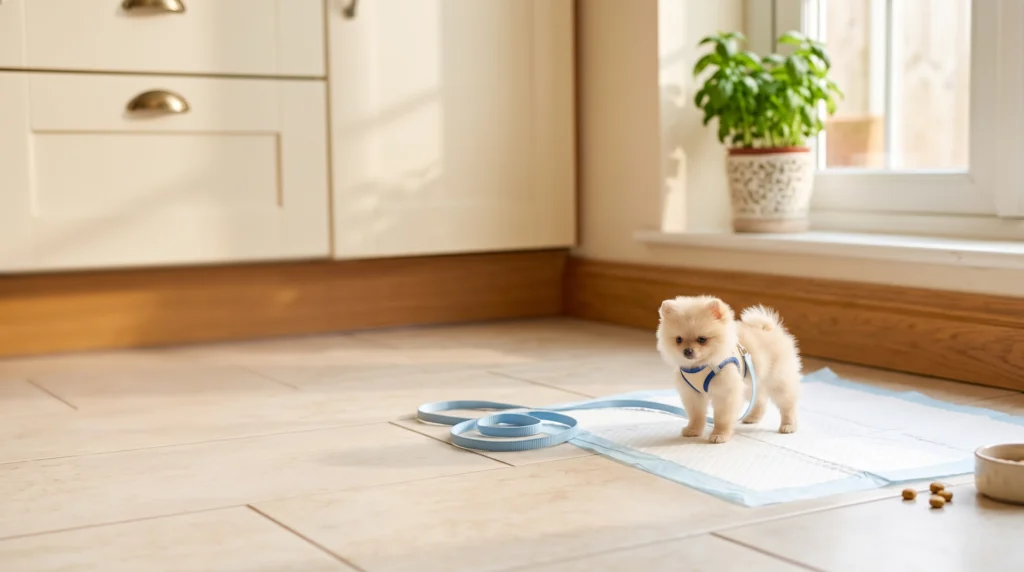
You look away for one minute, and there’s another tiny puddle behind the couch. If your new puppy seems to need the bathroom all the time, you are not imagining it. And you are not failing. Very small puppies often need more potty breaks and closer watching than bigger ones.
The good news is that learning how to potty train a teacup puppy comes down to a handful of simple habits. Your whole family can follow them, starting today.
Below, you’ll find a clear routine, a daily schedule, and a plan for accidents. You’ll also see how to choose between pee pads and outdoors, and when to call your vet.
Quick Answer: How to Potty Train a Teacup Puppy
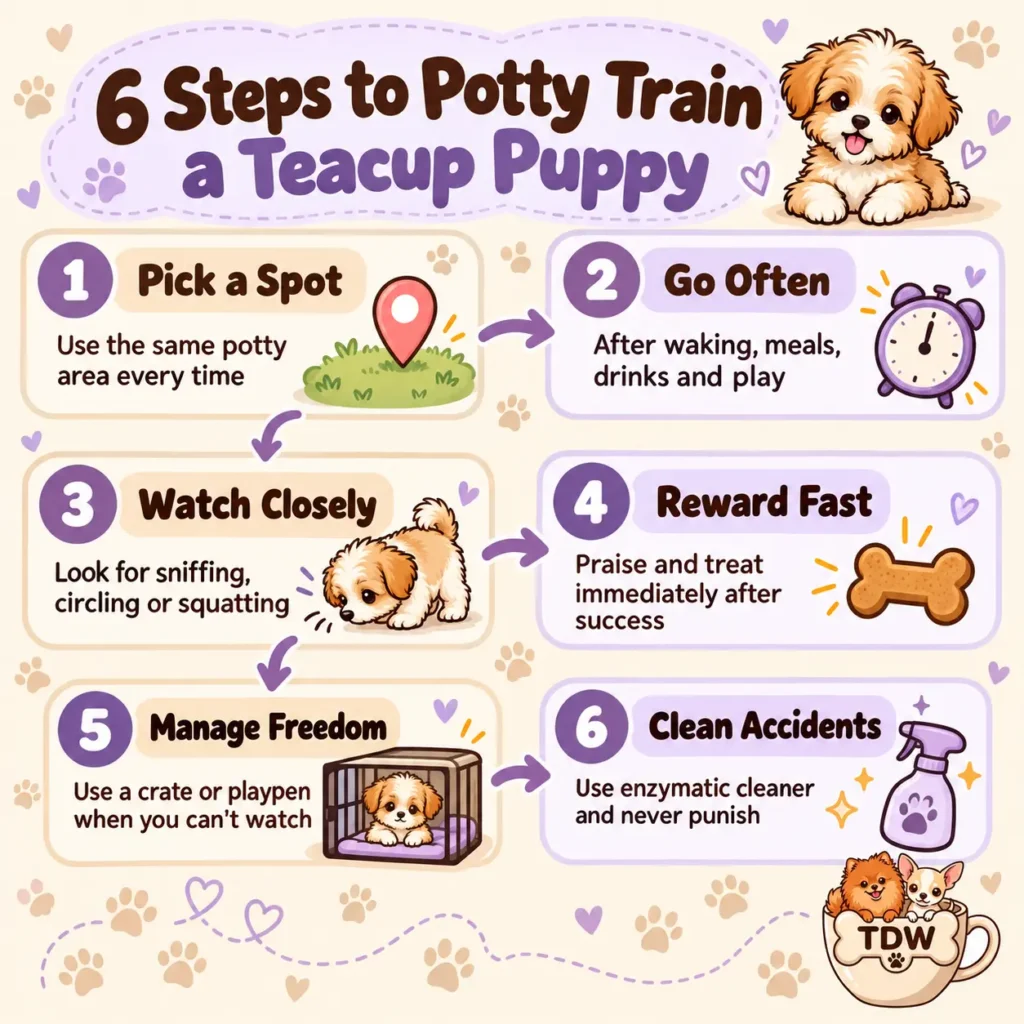
- Pick one potty spot and use one cue word, like “go potty.”
- Take your puppy there often: after waking, eating, drinking, and playing, and about every hour while awake.
- Keep your puppy where you can see them.
- Praise and give a tiny treat the moment they finish.
- Use a crate or playpen when you can’t watch.
- Clean accidents with an enzymatic cleaner, and never punish.
Why Teacup Puppies Need Extra Help
“Teacup” is not a breed or an official size. US breed registries such as the American Kennel Club do not recognize teacup dogs. The word usually describes dogs bred to weigh less than about 4 to 6 pounds. If your puppy is a Teacup Pomeranian or Teacup Maltese, our Teacup Pomeranian and Teacup Maltese guides cover more about their care.
The American Kennel Club notes that toy breeds may need more frequent potty breaks because of their fast metabolism and very small bladder. Tiny accidents are also easy to miss under a chair or behind a curtain. Any dog’s accidents can go unnoticed, but a puddle the size of a coin is especially easy to overlook.
Research gives some context too. In one owner survey, 67 percent of small dogs were fully house trained, compared with 95 percent of large dogs. That study, published in the Journal of Veterinary Behavior, didn’t look at teacup dogs on their own and can’t explain why the gap exists. Every puppy is different. The study also found that small dogs with more formal training were more likely to be fully house trained, which is good news for families willing to stay consistent.
Pee Pads, Outdoors, or Both? Choosing a Potty Method
There is no single right choice. Veterinary behavior experts at VCA Animal Hospitals say dogs can learn to go outdoors, indoors on absorbent pads, or in any other chosen area. Pick the method someone in your home can keep up every day.
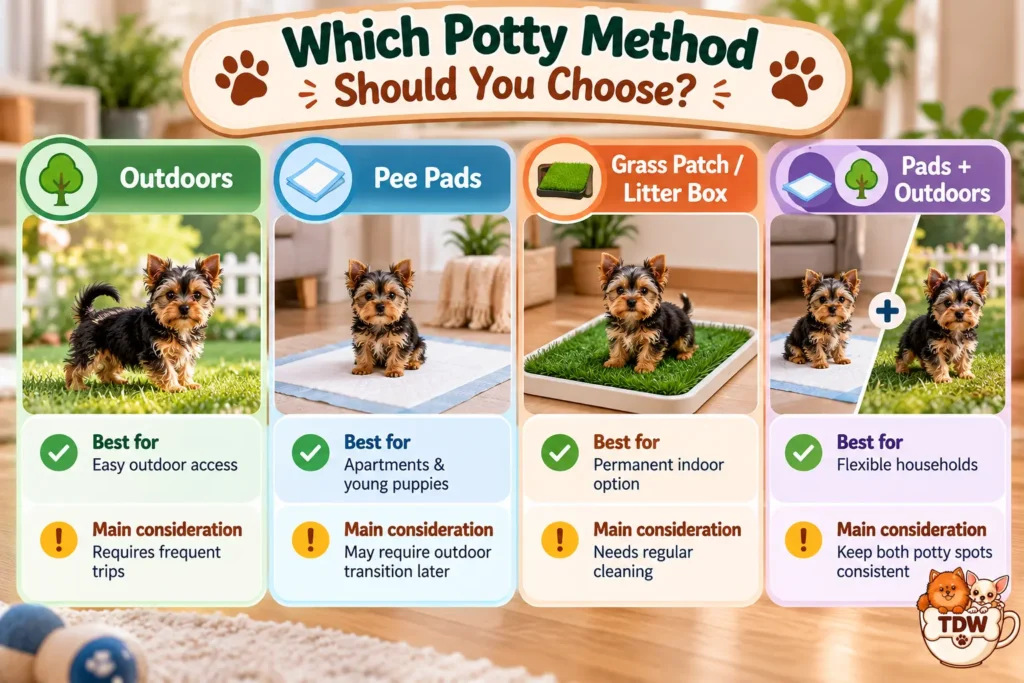
| Method | Best for | Upsides | Things to plan for |
|---|---|---|---|
| Outdoors | Homes where someone can reach a potty spot quickly, many times a day | One habit to learn and no indoor mess to manage | Bad weather, night trips, and vaccine safety |
| Pee pads | Apartments, very young puppies, longer workdays | The potty spot is always close | Frequent changing, and extra teaching if you move outdoors later |
| Litter box or grass patch | Families who want a lasting indoor spot | A neat, fixed indoor toilet | Daily cleaning and a low side your puppy can step over |
| Pads plus outdoors | Families who want outdoor training with an indoor backup | Flexible for weather and busy days | Keeping each spot in a fixed place |
Whatever you choose, keep the spot in one place. The American Kennel Club advises against moving the potty pad while your puppy is still learning, because it can lead to more accidents. Its guide to potty pad training explains the pad method in more detail.
Potty Training a Teacup Puppy Before Vaccines Are Done
Parvovirus, often called parvo, is a serious virus that sick dogs can leave behind on the ground. That’s why the outdoor spot matters before your puppy’s shots are finished.
PetMD says puppies can potty outside before they are fully vaccinated, as long as it is in a private area. It also advises keeping puppies out of public places until their vaccines are complete. Ask your vet about the exact spot you plan to use. Until then, pads or a grass patch can work well.
Get Ready: What You Need Before Day One
- A crate or small playpen. The crate should be just big enough for your puppy to stand, turn around, and lie down.
- Pee pads or a grass patch, if you plan to use an indoor spot.
- An enzymatic cleaner. This cleaner breaks down the smell of pee and poop, not just the stain.
- Tiny, soft treats that you can break into crumbs.
- A light harness and leash.
- Baby gates to close off rooms.
- A potty log for the fridge. There’s a template further down.
Step by Step: How to Potty Train a Teacup Puppy
These six steps work together, so start them all on day one. They follow house training advice from VCA Animal Hospitals, written by veterinary behavior experts.
Step 1: Pick One Potty Spot and One Cue Word
Go to the same spot every time. If it’s outdoors, VCA suggests using the same door for each trip.
Once you know the signs that your puppy is about to go, calmly say a cue such as “go potty” just as they get into position. Over time, your puppy links the word with the action. Make sure everyone at home uses the same word.
Step 2: Offer Frequent Potty Breaks
Take your puppy to the spot after waking up, after eating or a big drink, during and after play, and before bed. Between those times, the American Kennel Club suggests taking very young puppies or toy breeds out about once every hour whenever you can. The schedule below shows how this fits into a normal day.
Step 3: Keep Your Puppy in Sight
VCA says a puppy in training should be watched by someone within about 10 feet, or safely confined in a space where an accident is okay. Baby gates and a leash clipped to your belt make this much easier.
Learn your puppy’s warning signs. Many puppies suddenly stop and squat, while others sniff, circle, or get restless first. When you see these signs, take your puppy to the spot right away, even if the last trip was recent.
Step 4: Reward Right Away
Always go with your puppy. VCA warns that puppies sent outside alone often get distracted and then go once they’re back inside.
Stand quietly at the spot. If nothing happens within about 5 minutes, go back inside, watch closely, and try again soon.
When your puppy does go, praise them softly and give a treat right there, before heading inside. Treat crumbs are enough for a tiny dog. Save play for after potty time.
Step 5: Use a Crate or Playpen When You Can’t Watch
Most dogs don’t like to soil the place where they sleep, so a crate helps when you can’t watch your puppy. VCA says crating usually works for absences of no more than 3 hours. Treat that as an upper limit, not a promise. Many tiny puppies need a break sooner.
For longer absences, ask a friend, family member, or pet sitter to stop by for potty breaks. You can also set up a playpen with a separate resting area and potty area. Never stretch crate time to fit a work or school day, and never use the crate as punishment.
In the first weeks, it can help to carry your puppy from the crate to the potty spot. A small bladder may not last the walk to the door.
Step 6: Handle Accidents Calmly and Clean Them Well
If you catch your puppy starting to go in the wrong place, make a gentle sound to interrupt without scaring them. Then guide them to the right spot and praise them if they finish there.
If you find the mess later, just clean it up quietly. Never rub your puppy’s nose in it or hit your puppy. Punishment can teach a puppy that it isn’t safe to potty when people are around, so they start hiding accidents.
Use an enzymatic cleaner every time. Leftover smell acts as a signal that invites your puppy to go in the same place again.
Teacup Puppy Potty Schedule
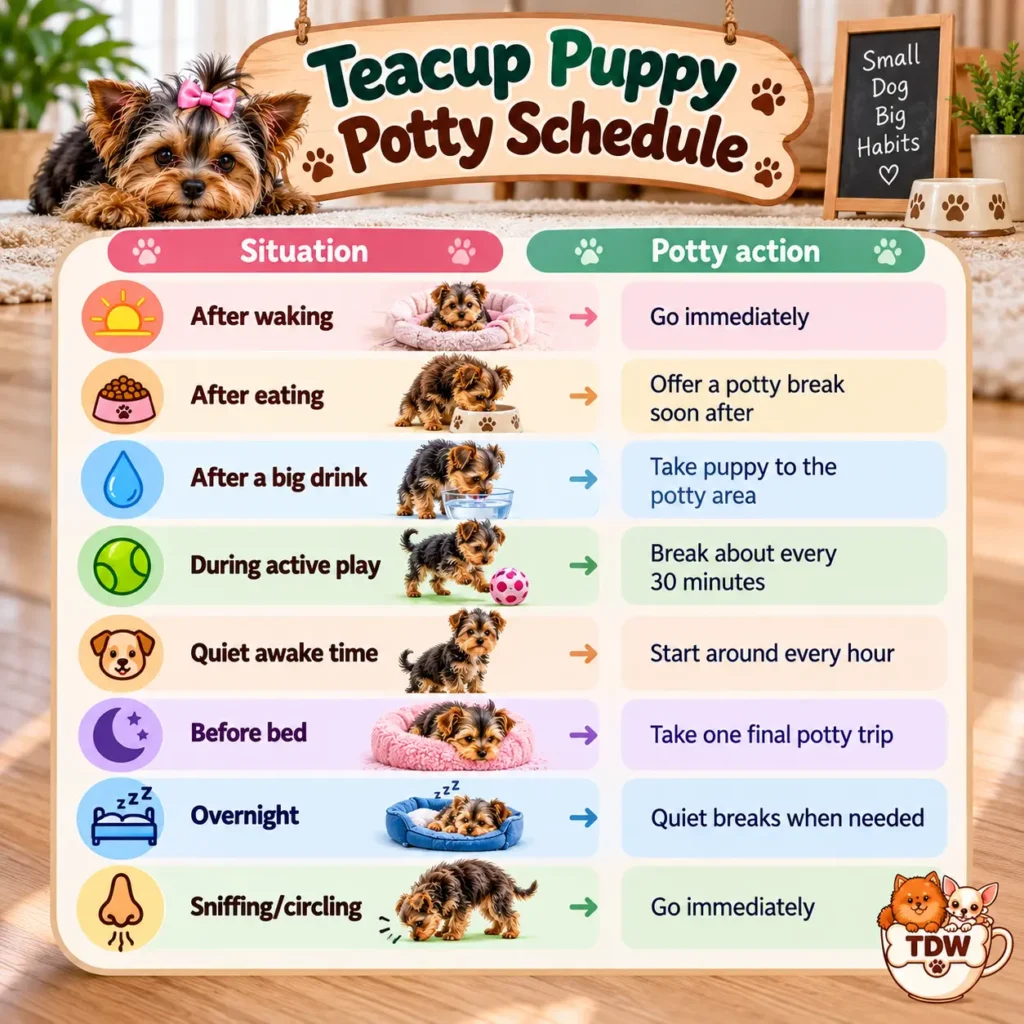
The easiest schedule follows your puppy’s day, not the clock. Use these moments as your reminders, then adjust to what your puppy actually needs.
| When | What to do |
|---|---|
| Waking up in the morning or after a nap | Go to the potty spot right away |
| After a meal or a big drink | Offer a break soon after |
| During busy play | Pause for a break about every 30 minutes |
| Quiet awake time | Start with about every hour |
| Before bed | Offer a last potty break |
| Overnight | Quiet trips as needed |
| Any time you see warning signs | Go right away, even if the last trip was recent |
You may see charts that link bladder control to a puppy’s age in months. Treat these as rough upper limits, not a plan. Your puppy’s real needs matter more than any chart.
Nighttime Potty Breaks
Young puppies usually can’t make it through the whole night. VCA notes that puppies may need overnight potty breaks until they are about 5 months old.
Keep your puppy’s bed close enough that you’ll hear them wake or whine. Decide ahead of time who handles night trips. Keep the trips calm and boring: dim lights, few words, and no play. As your puppy grows, you can slowly stretch the time between them.
Food, Water, and Low Blood Sugar: A Teacup Safety Rule
Food and water both matter during potty training, but for different reasons.
Don’t Skip Meals to Reduce Poop
Very small puppies are prone to hypoglycemia, which means low blood sugar. VCA explains that they should be fed often, with frequent small meals. Skipping meals to cut down on poop is not safe. Ask your vet about the right feeding plan for your puppy.
Know the warning signs. According to PetMD, the four most common signs of low blood sugar in dogs are weakness or low energy, vomiting, seizures, and fainting. If you notice any of these, call your vet or an emergency vet right away. You can read more in PetMD’s guide to hypoglycemia in dogs.
Cold weather can add to the risk. Small breed puppies can get cold more easily, and being chilled can make them eat less, which can lead to low blood sugar. On cold or wet days, keep outdoor trips short and choose a sheltered spot.
Don’t Cut Water to Prevent Puddles
Puppies need regular water to stay healthy. Cutting daytime water to prevent puddles is not a safe shortcut.
A better plan is to offer a potty break soon after your puppy has a big drink. Ask your vet before changing water access at night, especially for a very small puppy.
How the Whole Family Can Help With Potty Training
Puppies learn fastest when everyone uses the same spot, the same cue word, and the same quick reward.
Give each family member a job that fits their age:
- Adults: night trips, crate and pen setup, cleaning accidents, and vet calls.
- Older kids: taking the puppy to the spot with an adult nearby, giving the treat, and filling in the log.
- Younger kids: quiet praise, and adding stickers to the log after each success.
When one person hands the puppy to another, share two things: when the puppy last went, and when the next break is due. This stops the classic mix up where everyone thinks someone else took the puppy out.
Tiny puppies are fragile. Kids should sit on the floor when holding the puppy, because a fall from arms can hurt a small dog.
A Simple Potty Log for Your Fridge
Copy this template onto paper or a whiteboard.
| Time | What just happened (woke up, ate, played) | Where we went | Result (pee, poop, or nothing) | Who helped |
|---|---|---|---|---|
| ______ | ______ | ______ | ______ | ______ |
| ______ | ______ | ______ | ______ | ______ |
| ______ | ______ | ______ | ______ | ______ |
The “nothing” choice matters. A trip outside is not the same as a success, so write down what really happened. Record accidents too, including where they happened. After a few days, you’ll see your puppy’s pattern and the busy times when accidents slip through.
Common Mistakes When Potty Training a Teacup Puppy
- Too much freedom too soon. Open up new rooms slowly.
- Moving the pad around while your puppy is still learning. Keep the spot in one place.
- Putting the pad right next to the bed or food. Give the potty area its own space.
- Leaving dirty pads too long. Many puppies avoid a soaked pad and go next to it.
- Sending the puppy out alone. Be there to see the success and reward it.
- Punishing accidents or trying to be the “pack leader.” The American Veterinary Society of Animal Behavior recommends only training methods based on rewards.
Teacup Puppy Potty Training Problems and Simple Fixes
An accident doesn’t mean your puppy is being naughty. It usually means something in the routine needs a small change. These are ideas to check, not a diagnosis.
| What you see | What to check | What to try |
|---|---|---|
| Your puppy pees inside right after a trip out | Did you see your puppy finish, or did they mostly sniff around? | Stay a few minutes longer next time, then watch closely once inside |
| Your puppy pees next to the pad, not on it | Is the pad big enough for their whole body, and easy to reach? | Try a bigger pad in the same spot |
| Accidents start in a room you just opened up | Did the puppy get that freedom before they were ready? | Close the room again and open it slowly later |
| Your puppy goes in the crate | Is the time between breaks too long? Is your puppy upset or unwell? | Shorten crate time and talk to your vet if it keeps happening |
| Accidents happen at the same busy time each day | Does everyone think someone else is watching? | Put one person in charge during that time, or use the pen |
| Sudden accidents after weeks of doing well | Any big changes at home, or signs of illness? | Go back to the basics and call your vet |
Don’t fix crate accidents by keeping your puppy in the crate longer or by using a smaller crate. That usually makes things worse.
Moving From Pee Pads to Going Outside
Going outside is a new lesson, even for a puppy who uses pads well. You don’t need to wait for perfect pad use to start, but check with your vet that your outdoor spot is safe first.
- Use your potty log to find times when your puppy usually needs to go, like right after waking up.
- At those times, take your puppy to the outdoor spot. Keep it quiet, and reward right away when they go.
- Keep the indoor pad in its usual place as a backup while outdoor trips become a habit.
- As outdoor success grows, slowly rely less on the pad. If you choose to move the pad closer to the door, do it gradually.
- If accidents increase, go back to the last setup that worked, then try again more slowly.
How Long Does It Take to Potty Train a Teacup Puppy?
There’s no set number of weeks. Every puppy learns at their own pace.
A better question is when your puppy is ready for more freedom. VCA says that once a puppy has gone about 8 to 12 weeks without mistakes, they are probably ready for more freedom. Even then, open up the house one room at a time.
Setbacks are common after big changes, like moving, travel, or new family schedules. If accidents return, go back to more frequent trips and closer watching for a while. Once your vet says it’s safe, a puppy training class may also help.
When Potty Problems Mean a Vet Visit
Sometimes accidents aren’t a training problem at all. A board certified veterinary behaviorist writing in Today’s Veterinary Practice notes that house soiling is reported in about 20% of pet dogs. She advises that a vet should check any dog with this problem, because medical conditions can cause it.
Emergency: If your puppy strains to pee but nothing comes out, get help right away. PetMD says a dog who can’t pee may have a blockage and needs to see a vet immediately.
Call your vet soon if you notice:
- Straining to pee or poop.
- Peeing very often in tiny amounts. This can be a sign of a urinary tract infection, which is an infection of the bladder.
- Blood in the pee.
- Diarrhea.
- Accidents along with weakness, extra sleepiness, or not eating.
- Sudden accidents in a puppy who was doing well.
Some puppies dribble pee when greeting people because they feel excited or nervous. VCA notes this is not a lapse in house training. Your vet or a qualified behavior professional can help.
FAQs About Potty Training a Teacup Puppy
Can we potty train a teacup puppy without a crate?
Yes. A puppy safe playpen or a gated area works too, as long as you watch closely and offer frequent potty breaks. The crate is just a tool, not the lesson.
Can a teacup puppy use a litter box for life?
Yes. A litter box or grass patch can be your puppy’s long term potty spot. Choose one with a low side so your puppy can step in easily, and keep it clean.
Will my puppy learn to tell us when they need to go?
Some puppies do. VCA explains that once a puppy can hold their bladder well, they may learn to ask, for example by going to the door. Until then, keep offering breaks instead of waiting for a signal.
Final Thoughts
Learning how to potty train a teacup puppy isn’t about being perfect. It’s about being consistent.
Pick one spot and one cue word. Take your puppy out often, watch closely, and reward every success right away. Keep a simple log so the whole family stays on the same page, and never cut meals or water to make training easier.
Be patient with your tiny puppy and with yourself. If something feels off, from a sudden change in potty habits to signs of low blood sugar, call your vet.

The TeacupDogWorld Editorial Team researches and creates practical guides about small and teacup-sized dogs, including breed characteristics, grooming, nutrition, health, training, and everyday care. Our content is developed using reputable veterinary, breed-club, and animal welfare sources to help dog owners make better-informed decisions.