
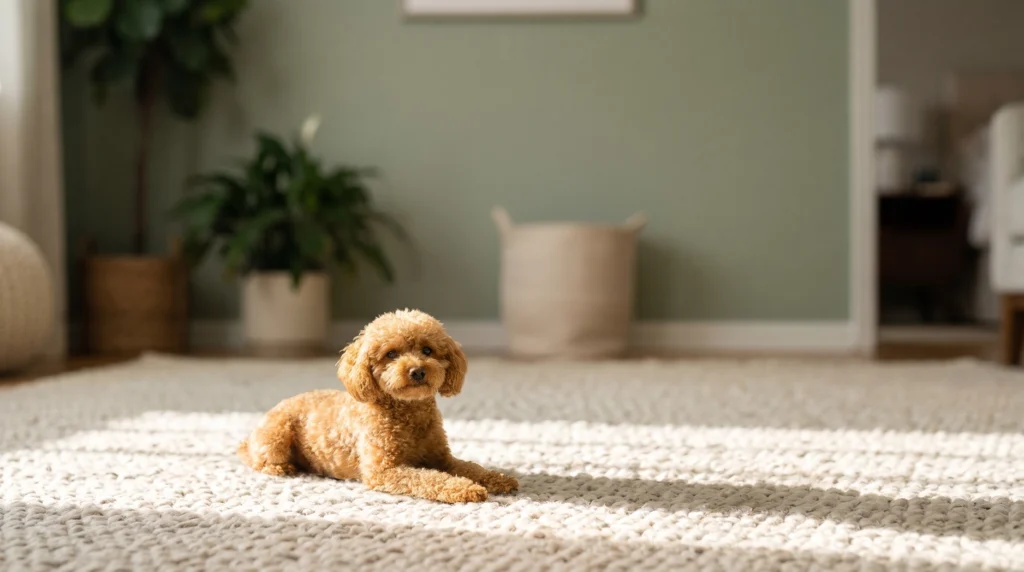
You want the sweetest small dog breeds that stay tiny for life, and you want to know which ones really do. Here is the honest answer. Start with five breeds that fit both wishes: the Maltese, Toy Poodle, Pomeranian, Yorkshire Terrier and Papillon. Their breed standards call for a very small size, and all five are loved as companions.
But no dog comes with a promise. Adult size can vary a little, sweetness depends on the individual dog, and very small dogs need extra care. Below you will find real American Kennel Club sizes, an honest downside for each breed, and plain advice on children, health and the word “teacup.” Then you will learn how to choose a healthy dog for your family.
Learn more in our guide to what “teacup” really means.
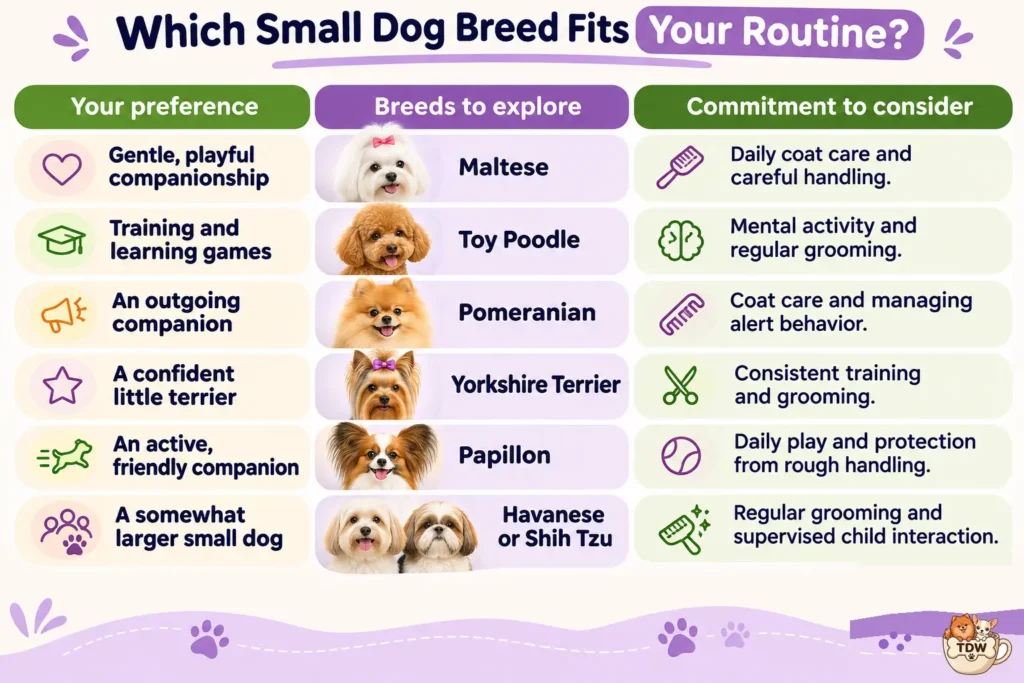
Quick Answer: The Sweetest Small Dog Breeds That Stay Tiny for Life
The best place to start is the Maltese, Toy Poodle, Pomeranian, Yorkshire Terrier and Papillon. All five belong to the American Kennel Club (AKC) Toy Group, and each breed standard sets a small adult size. A breed standard is the written description of the ideal dog for a breed.
| Breed | AKC size | What the standard says about its nature | Watch out for |
|---|---|---|---|
| Maltese | Under 7 pounds, with 4 to 6 pounds preferred | Gentle mannered, lively and playful | Alert barking and daily brushing |
| Toy Poodle | 10 inches or under at the shoulder | Active, intelligent and proud. Shyness and sharpness are faults | Needs mental work and regular grooming |
| Pomeranian | 3 to 7 pounds, with 4 to 6 ideal for the show ring | Extroverted, with great intelligence and a vivacious spirit | A big personality and a thick coat |
| Yorkshire Terrier | Must not exceed 7 pounds | Confident, with an air of vigor and self importance | Terrier spirit and a long silky coat |
| Papillon | 8 to 11 inches tall, with weight in proportion | Happy, alert and friendly, never shy or aggressive | Fine bones, so play must stay gentle |
These sizes come from the AKC breed standards. The Poodle standard sets height only, so no weight is listed for the Toy Poodle here. Havanese and Shih Tzu are lovely too, but they are small rather than tiny, so they get their own section below.
What “Stays Tiny for Life” Really Means
Mostly yes, but it is not a guarantee. A breed standard describes the size that breeders aim for. Your own dog can end up a little above or below that goal.
Breed Standard Size vs Your Own Dog
The standards themselves leave room. The AKC breed standard for the Maltese says overall quality is favored over size. The Pomeranian standard calls a dog over or under its weight limits objectionable, yet it also says quality should come before size. In plain words, the numbers describe an ideal, and real dogs do not always match them.
Weight matters too. Extra pounds make a small dog look bigger, and they are hard on a small body. The health section below explains why.
Poodles show how a size rule works. A Toy Poodle is 10 inches or under at the highest point of the shoulders. A Miniature Poodle is taller than 10 inches and up to 15 inches. So a Poodle that is taller than 10 inches counts as a Miniature Poodle, not a Toy.
Why “Teacup” Is a Warning, Not a Size
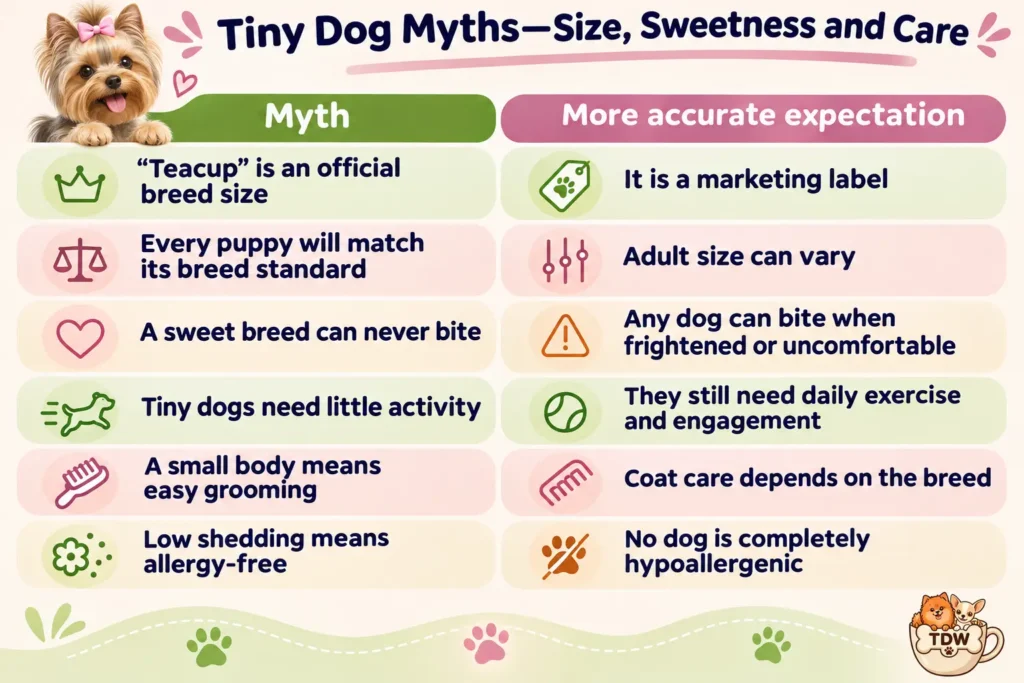
Teacup is a sales word. It is not a breed, and it is not an official size.
Best Friends Animal Society, a large animal welfare group, says no dog registry recognizes teacup dogs, and that includes the AKC. The group also says puppies sold this way are often much younger than advertised, or they come from breeding the smallest dogs together. Either one can lead to fragile bones and a lifetime of health problems.
There is a second problem. Many of these puppies are already small breeds, and a puppy sold as a teacup may still grow up to be a normal size adult. So a seller who promises a tiny adult is promising something nobody can know.
The Chihuahua Club of America makes the same point for its own breed. It calls terms such as teacup, pocket size and tiny toy incorrect and misleading, and it warns buyers not to be misled by them.
If a seller promises that a puppy will stay under a certain weight or fit in a teacup, treat that as a red flag and keep looking.
Sweetest Tiny Dog Breeds, One by One
Each breed below gets its AKC size, what its standard says about its nature, and one honest downside. Sweetness is a matter of personality, so any single dog can differ from its breed.
Maltese
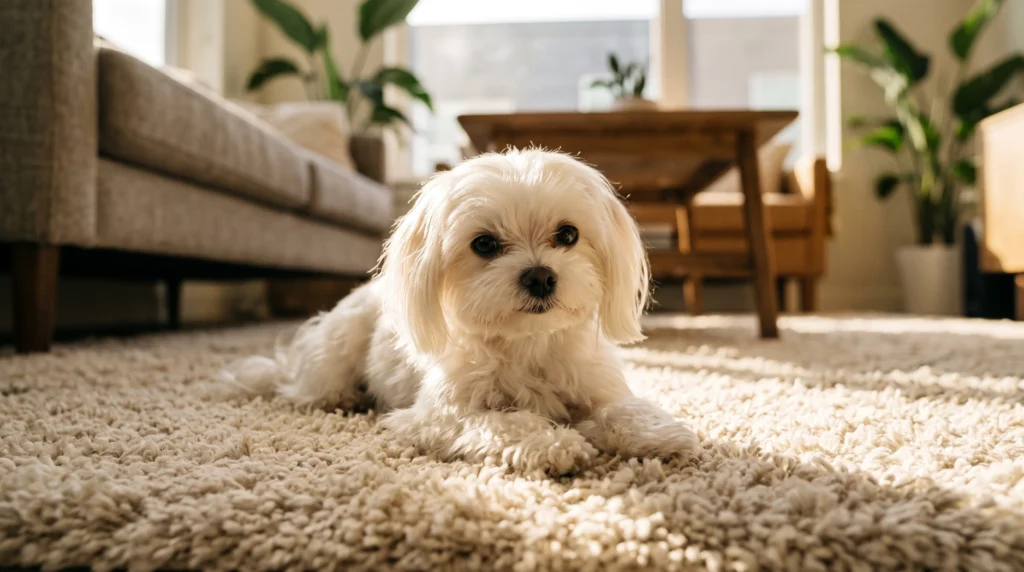
The Maltese is the clearest match for tiny and gentle. The AKC standard calls for a weight under 7 pounds, with 4 to 6 pounds preferred. It describes a dog that is “among the gentlest mannered of all little dogs,” yet lively and playful too. The AKC also says the breed is people focused and trains well with treats and praise.
The downside is alertness. The AKC warns that a Maltese can bark too much, and it may even bite someone it sees as a danger if it is not trained. The long white coat needs daily brushing to prevent mats. As with any dog, young children need supervision around a Maltese.
Toy Poodle
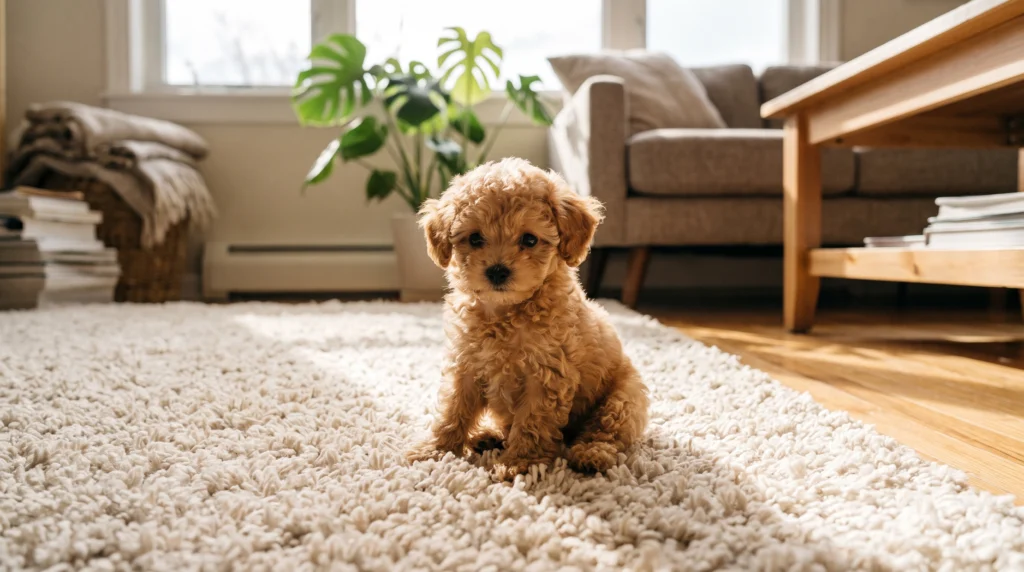
The AKC standard sets the Toy Poodle at 10 inches or under at the highest point of the shoulders. It does not set a weight. Many breed guides list 4 to 6 pounds as typical, but treat that as a common range, not a rule.
The standard describes a very active, intelligent dog that carries itself proudly. It also names shyness or sharpness as a major fault, which is a good sign for a family dog.
The downsides are brains and coat. The AKC calls the Poodle exceptionally smart and active, with a need for daily exercise and regular professional grooming. A large veterinary study from Banfield Pet Hospital also found that Toy Poodles were among the extra small breeds with the highest chance of gum disease.
Pomeranian
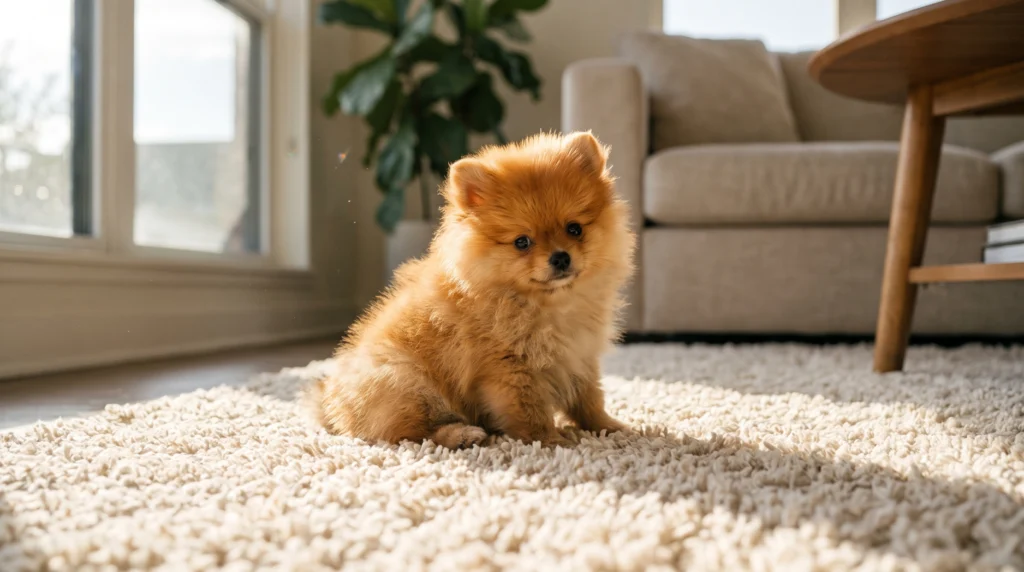
The AKC standard gives the weight as 3 to 7 pounds, with 4 to 6 pounds ideal for show dogs. It calls the Pomeranian an extrovert with great intelligence and a vivacious spirit.
The downside is a big personality in a very small body, plus a thick double coat that needs regular brushing. Cornell University’s veterinary college also names Pomeranians among the toy breeds where windpipe collapse is common in middle age and later.
Yorkshire Terrier
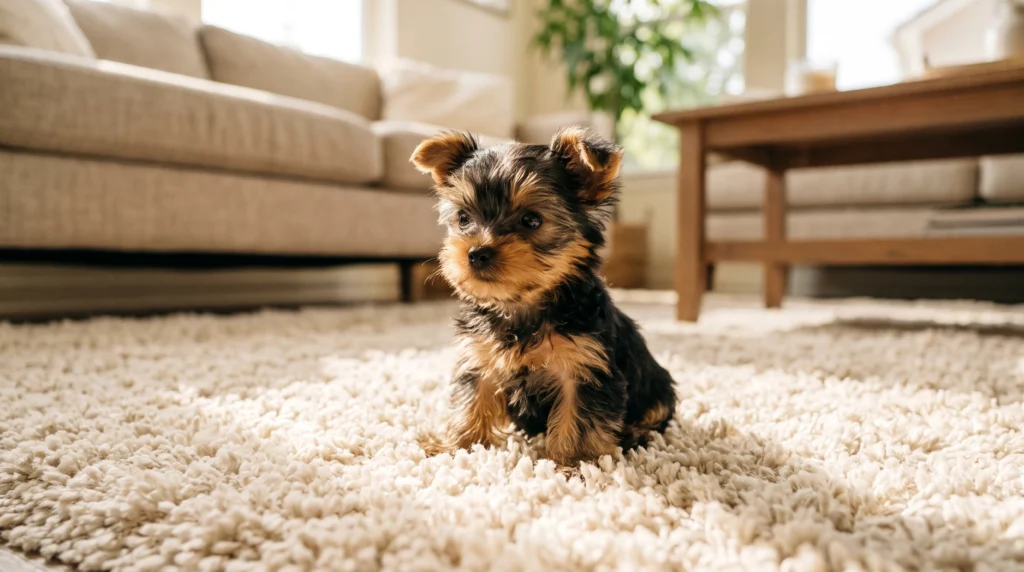
The AKC standard says a Yorkshire Terrier must not weigh more than 7 pounds. It gives a top limit and no bottom one, so nothing in the standard says smaller is better.
The standard describes a neat, compact toy terrier with a confident manner that gives an impression of vigor and self importance. In daily life, think sweet but bold. This is a terrier, so expect spirit.
The downside is care. Cornell names Yorkshire Terriers among the breeds where windpipe collapse is common, and the standard calls the long silky coat of prime importance, which means regular coat care.
Papillon
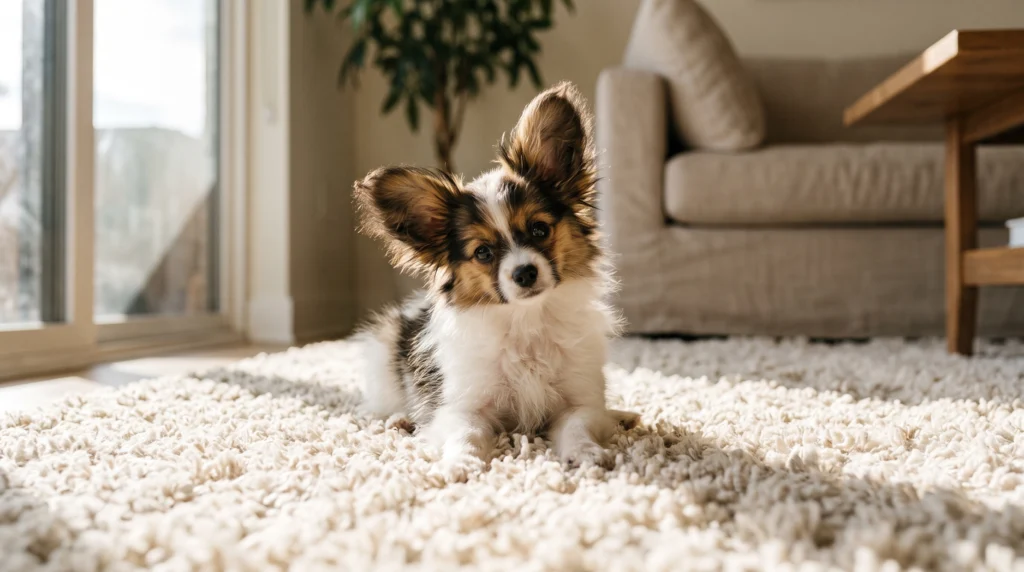
The AKC breed standard describes the Papillon as a small, friendly, elegant toy dog of fine bone structure. Height is 8 to 11 inches, and weight is in proportion to height. Its temperament is happy, alert and friendly, and it should not be shy or aggressive. The AKC also points to its upbeat athleticism.
The downside is that fine bones mean rough play and falls can hurt. It is also a lively dog, so plan on daily play and things to do.
The Chihuahua is another very small breed. Best Friends Animal Society calls it the smallest breed the AKC recognizes, and many Chihuahuas wait in shelters and rescue groups, so adoption is worth a look if you love the breed.
Small but Not Quite Tiny: Havanese and Shih Tzu
These two are lovely family dogs, but they are small rather than tiny.
The AKC standard for the Shih Tzu gives an ideal weight of 9 to 16 pounds for mature dogs and an ideal height of 9 to 10.5 inches. It opens by calling the Shih Tzu a sturdy, lively, alert toy dog, and it lists outgoing, affectionate, friendly and trusting among its traits.
The Havanese standard sets height at 8.5 to 11.5 inches. Most adults weigh about 7 to 13 pounds, but that is a typical range rather than a limit in the standard. Its temperament is described as friendly, playful, alert and intelligent, and not quarrelsome.
Families who worry about a fragile dog sometimes feel better with a sturdier small dog, and that is why these breeds are here. Even so, both are still small, both have long coats that need regular care, and young children still need supervision.
Are Tiny Dogs Safe With Children?
They can be wonderful family dogs, but no dog is safe on its own. A tiny dog is easy to hurt, and any dog can bite.
What Experts Say About Supervision
The American Veterinary Medical Association (AVMA) says in its dog bite guidance that any dog can bite, whatever its breed. In its April 2026 news release, the AVMA adds that young children should never be left alone with a dog, even a familiar family pet. It also notes that children account for at least half of dog bite injuries in the United States.
Bites usually happen when a dog feels stressed, scared or uncomfortable. Everyday moments can set that off, such as a hug, a poke, or waking a sleeping dog.
A 2016 study from the University of Veterinary Medicine Vienna, published in the Journal of Veterinary Behavior, surveyed caregivers of children up to age six. Most of them underestimated the risk from smaller dogs. The researchers also noted that many bites happen right in front of adults.
Tiny dogs face a different risk. A very small body is easy to hurt with a drop, a squeeze or a misplaced step. The AKC gives the same advice for the Maltese that applies to every tiny dog: supervise any time it is with young children.
Simple Rules That Protect the Dog and the Child
Most of these rules come from AVMA guidance. They lower risk. They do not remove it.
- An adult stays with the child and the dog every time.
- Teach gentle petting on the back or shoulders, and keep small hands away from the face, tail and ears.
- Have young children sit on the floor to cuddle instead of carrying a tiny dog.
- Never disturb a dog that is sleeping or eating.
- Give the dog a quiet bed or room that children cannot enter, so it can rest alone.
- Teach children the warning signs: growling, a stiff body, or moving away. Young children often mistake a growl for a smile.
- Keep up with vet visits, because pain or illness can make a dog more likely to bite.
Health Needs of Dogs That Stay Tiny
Small bodies come with a few predictable health risks. Knowing them early helps you spot trouble and plan vet care. None of this replaces your own veterinarian.
Teeth
Periodontal disease means disease of the gums and the tissue around the teeth. Banfield Pet Hospital studied more than three million records from 60 breeds. It found that smaller breeds were 2 to 3 times more likely to be diagnosed than larger breeds, and extra small breeds, including Toy Poodles, had the highest chance.
The researchers point to crowded teeth, more plaque, and less bone around the teeth in small dogs. Older and overweight dogs were also more likely to be diagnosed. Ask your vet how often to check your dog’s mouth and how to brush.
Kneecaps
Patellar luxation means the kneecap can slip out of its normal position. The Merck Veterinary Manual says it is more common in small and miniature breeds, and signs usually start before the age of 1.
The classic sign is a skipping step. The dog may hop on one back leg for a few strides and then walk normally. Mild cases may be managed with weight control and limited exercise, while moderate to severe cases often need surgery. Tell your vet if you see skipping.
Windpipe
Tracheal collapse means the rings of cartilage that hold the windpipe open grow weak. Cornell University’s veterinary college says it is common in toy and small breeds, such as Yorkshire Terriers, Pomeranians and Toy Poodles, that are middle aged or older.
The main sign is a harsh, dry cough that can sound like a goose honk. There is no cure, but many dogs do well with treatment. Cornell advises using a harness instead of a neck collar and avoiding smoke, heat and humidity. Trouble breathing, blue gums or tongue, or fainting is an emergency, so see a vet right away.
Low Blood Sugar in Tiny Puppies
Hypoglycemia means low blood sugar. The AKC says very young and very small puppies, especially toy puppies, can use up their energy between meals, particularly if they are active, cold or stressed.
Signs include drowsiness, trembling, weakness, collapse and seizures. If a tiny puppy is limp, shaky or hard to wake, treat it as an emergency and call a vet. The AKC’s advice for young puppies is small, frequent meals, as directed by a veterinarian.
Healthy Weight
Extra weight makes several of these problems worse. Cornell says obesity can add to windpipe trouble, Banfield found more gum disease in overweight dogs, and Merck lists weight control as part of care for kneecap problems.
One extra pound is a big share of a dog that weighs five pounds. Ask your vet what a healthy weight looks like for your dog.
How to Choose a Healthy Tiny Dog
Look at the seller and the health history first, and the size second.
The AKC explains that each breed’s parent club sets its own health testing recommendations. Many parent clubs take part in the Canine Health Information Center (CHIC) program, run with the Orthopedic Foundation for Animals. A dog earns a CHIC number when its test results meet the parent club’s requirements. Not every breed is in the program, so ask the parent club what tests it recommends.
Questions to ask a breeder:
- Which health tests did the parents have, and may I see the results?
- May I meet the mother and see where the puppies are raised?
- How much did the parents weigh as adults?
- What will the puppy eat, and how often?
- Will you take the dog back if I cannot keep it?
Parent weights are the best clue to adult size, but they are still not a guarantee. Be careful with any seller who uses the words teacup, micro or pocket.
Adoption is a real option. Best Friends Animal Society says toy breeds are waiting in shelters now, and breed rescue groups have tiny dogs of every age. An adult dog also has the advantage that its size and nature are already known.
Which Tiny Breed Fits Your Family?
No breed is best for everyone. Use this table to narrow your list, then read each breed’s AKC page and meet adult dogs if you can.
| Your situation | Breeds to look at first | Why | Keep in mind |
|---|---|---|---|
| A toddler or preschooler at home | Havanese or Shih Tzu | Both are bigger than the tiniest breeds, and the Shih Tzu standard calls the breed sturdy | A bigger dog still needs an adult watching every moment |
| Older children who can be gentle | Maltese or Papillon | Their standards describe a gentle or friendly nature | Both are easy to hurt, and the Papillon has fine bones |
| The smallest adult size | Maltese, Pomeranian or Yorkshire Terrier | Each standard sets a top weight of 7 pounds or less | Smaller dogs have less room for error with health |
| A smart dog that likes games and jobs | Toy Poodle or Papillon | The AKC calls the Poodle exceptionally smart and the Papillon athletic | Both need daily play and mental work |
| Little time for grooming | No tiny breed is truly low upkeep | The Maltese needs daily brushing and the Poodle needs regular professional grooming, per the AKC | The Papillon has a single coat with no undercoat, but it still needs brushing |
| Allergies in the family | Maltese or Toy Poodle | The AKC lists both among breeds often recommended for people with allergies | The AKC says no dog is completely hypoallergenic, so spend time with the dog first |
Frequently Asked Questions
Are tiny dogs hypoallergenic?
No. The AKC says no dog breed is completely hypoallergenic, because all dogs produce allergens. Some breeds shed less and may cause fewer symptoms for some people. If allergies matter in your home, spend time with the actual dog before you commit.
Are tiny dogs a good first dog?
They can be, if you are ready for the work. Tiny dogs need gentle handling, dental care, and often regular grooming. Choose a breeder or rescue that is honest about health, and ask your vet what to expect.
Do tiny dogs need much exercise?
Most enjoy short daily walks and play. Smart, active breeds such as the Toy Poodle and the Papillon also want games that make them think. Use a harness for walks, which Cornell recommends for dogs with windpipe trouble.
Final Thoughts
The Maltese, Toy Poodle, Pomeranian, Yorkshire Terrier and Papillon are the best answer to the sweetest small dog breeds that stay tiny for life. The Havanese and Shih Tzu suit families who want a sturdier small dog. Whichever you pick, choose by nature and by your home, not by size alone.
Watch every moment between children and a tiny dog, and look for a breeder or rescue that puts health first.
Your next step is simple. Read the AKC page for your top two breeds, meet adult dogs of those breeds if you can, and ask a veterinarian what care a tiny dog will need.
The TeacupDogWorld Editorial Team researches and creates practical guides about small and teacup sized dogs, including breed characteristics, grooming, nutrition, health, training, and everyday care. Our content is developed using reputable veterinary, breed club, and animal welfare sources to help dog owners make better informed decisions.