
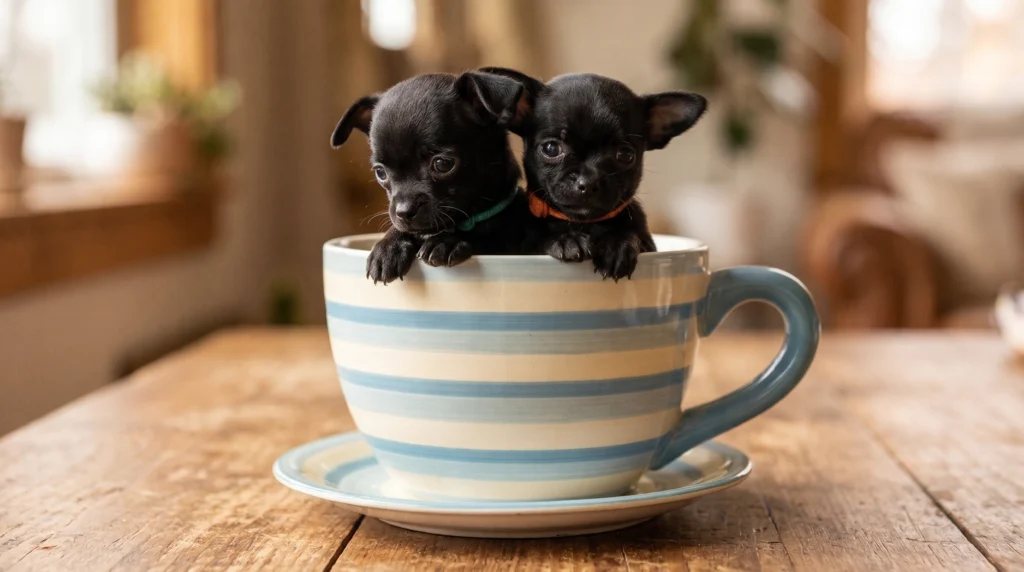
A puppy small enough to sit in a coffee cup is hard to resist. But if you are thinking about buying one, you probably want to know how a dog ends up that small in the first place, and whether it is safe.
This guide explains how teacup dogs are bred. It covers what the word “teacup” really means, how dogs end up extra small, and the health and welfare concerns vets raise. You will also find a list of red flags, questions to ask any breeder, and safer ways to bring home a very small dog.
How Are Teacup Dogs Bred?
There is no special teacup breed. Dogs sold as teacups are usually toy breed dogs that are smaller than most of their breed. The main way sellers try to produce them is by choosing the smallest dogs they can find and breeding them together, then keeping the smallest puppies and repeating the process. Vets and welfare groups warn that putting size ahead of health can raise the risk of medical problems.
Some very small puppies also appear naturally in ordinary litters. And some “teacup” claims come from how puppies are sold, not how they were bred. Both are explained below.
What “Teacup” Really Means
“Teacup” is a sales label, not a breed. Best Friends Animal Society notes that the American Kennel Club does not recognize “teacup” as an official size designation within any recognized breed. You may also see similar dogs sold as “micro” or “pocket.”
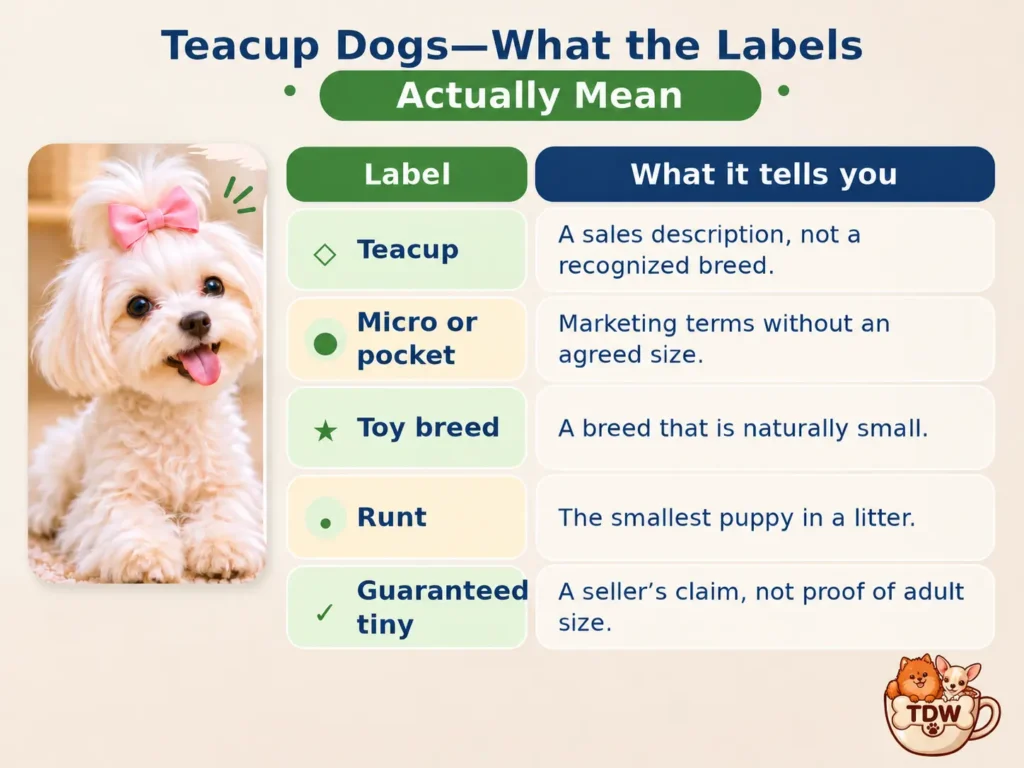
There is no agreed weight that makes a dog a teacup.
Most dogs sold as teacups come from breeds that are already small, such as the Chihuahua, Yorkshire Terrier, Pomeranian, Maltese, Toy Poodle and Shih Tzu. Our guides to the teacup Pomeranian and teacup Maltese cover those breeds in more detail.
Teacup Size vs Breed Standards
Breed standards describe the characteristics of individual breeds. Their size requirements vary from breed to breed, and meeting a standard does not guarantee an individual dog’s health.
| Breed | Size in the breed standard |
|---|---|
| Chihuahua | Weight “not to exceed 6 pounds” (Chihuahua Club of America) |
| Yorkshire Terrier | Weight “no more than seven pounds” (United Kennel Club) |
| Toy Poodle | Height “10 inches or under” at the shoulder, with no weight given (Poodle Club of America) |
A small Chihuahua that fits its standard is simply a Chihuahua. Calling it a teacup is a marketing choice, not a separate size category.
How Teacup Dogs Are Bred
There is little data on how often each practice is used, so this section explains what each one is and why experts raise concerns, without claiming any is typical of every seller.
Selecting for Small Size Over Generations
This is the main explanation given by vets. A seller chooses the smallest dogs available, breeds them together, keeps the smallest puppies, and breeds those to other very small dogs. Over generations, selecting smaller parents may produce smaller offspring, but individual puppies can vary in adult size.
Some sellers use runts for this. A runt is the smallest puppy in a litter. The UK animal charity Blue Cross points out that runts can be small because of birth defects or other medical conditions, which may make them a poor choice for breeding.
The concern is not smallness itself. It is what can happen when size becomes the top priority. Vets at PetMD explain that sellers focused on size may pay less attention to health, so inherited problems can be passed from parents to puppies.
Natural Size Variation
Not every small puppy comes from deliberate extreme-size breeding. Puppies in the same litter can grow to different sizes, and an ordinary litter may include one that stays on the small side.
That is why the label alone cannot tell you a dog’s history. A puppy described as a teacup may be the result of years of breeding for tininess, a naturally small puppy, or simply a young puppy that has not finished growing.
Inbreeding and Crossbreeding
These two practices are sometimes mentioned in connection with teacup dogs, but neither one makes a dog small on its own.
Inbreeding means breeding closely related dogs, such as siblings or a parent and offspring. A seller may use it to keep traits, including small size, within a line. It also raises the chance that puppies inherit the same harmful gene from both parents, which can increase the risk of inherited disease.
Crossbreeding means mixing two breeds. Some sellers cross a breed with a smaller one and sell the puppies as a teacup version of the larger breed. Mixing breeds is not harmful by itself, but a mixed puppy can inherit conditions common in either parent breed. Responsible breeders test parents for the conditions that affect each breed in the mix.
Other Practices and Misleading Sales Claims
The practices below are not breeding methods. They are ways a puppy can be kept small, or made to look smaller, at the point of sale. Vets and welfare groups have described them, but how common they are is not known.
Reports of Underfeeding
Some veterinarians report that certain sellers limit food to keep puppies small. This is a warning sign, not an accepted practice. Very small puppies store little energy, and going too long without food can cause low blood sugar, called hypoglycemia. That can lead to weakness, seizures and, without treatment, death.
Selling Puppies Very Young
A younger puppy may appear unusually small if its age is misrepresented. Best Friends Animal Society reports that some puppies sold as teacups are younger than advertised, and many keep growing into normal-sized toy dogs.
Puppy-sale rules, including the minimum age a puppy can be sold, vary by location. Check the rules where you live before you buy.
Health and Welfare Concerns Around Extreme-Size Breeding
Vets raise concerns about both the puppies and the mothers when dogs are bred to be extremely small.
For puppies, very small size is linked to a higher risk of certain problems. Low blood sugar is a key concern in tiny puppies. Liver shunts, where blood bypasses the liver so toxins are not filtered properly, are also more common in some toy breeds such as the Yorkshire Terrier and Maltese, according to the Merck Veterinary Manual. Veterinarians at PetMD list several other conditions, including fragile bones, collapsing trachea and heart disease, and note that medicine dosing and anesthesia can be harder in very small dogs.
Not every teacup dog will have these problems. But a tiny body leaves less room for error, and treatment can be costly.
For mothers, carrying and delivering puppies can be harder for a very small female. That is a welfare concern worth asking any breeder about.
Can a Teacup Dog Come From a Responsible Breeder?
It depends on the breeder’s goals and practices, not the label. Breeding to push dogs as small as possible raises the health concerns above, which is why vets and welfare groups urge caution. But the word “teacup” on its own does not prove how a puppy was bred. Some sellers use it for a puppy that is simply on the small side.
So treat the label as a reason to look more closely, then judge the breeder by what you can check:
| What to check | Reassuring sign | Warning sign |
|---|---|---|
| Goal | Aims for healthy dogs that fit the breed standard | Promotes being as tiny as possible |
| Health screening | Shows parents’ screening results for conditions common in the breed | Does not provide relevant parental health-screening results |
| Puppy age | Keeps puppies until they are old enough to leave | Offers very young puppies |
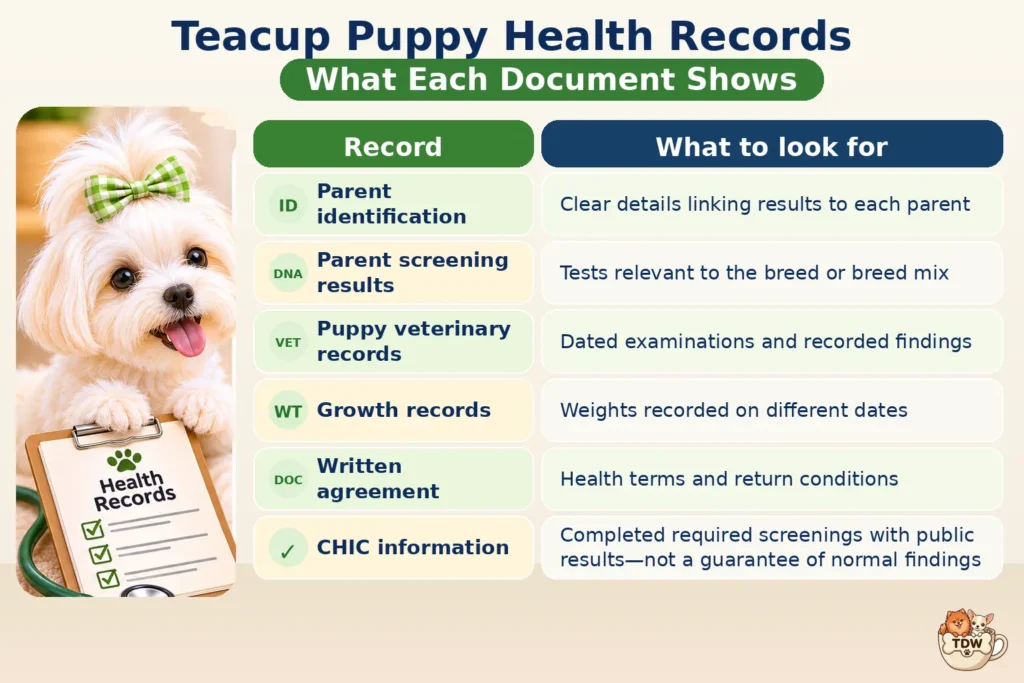
| Parents | Lets you meet the mother and provides identifying information and relevant health records for both parents | Will not let you meet the mother or share details about the parents |
| Questions | Asks about your home and lifestyle | Focuses on a fast sale |
A note on health screening: some breeders mention a CHIC number. CHIC is the Canine Health Information Center, run by the Orthopedic Foundation for Animals (OFA). According to the OFA’s CHIC program page, a CHIC number shows that a dog completed its breed’s required health screenings and the results were made public. It does not mean the results were normal. Ask to see the actual results.
If you already own a teacup dog, there is no reason to feel guilty. Good food, gentle handling and regular vet checkups matter most, and knowing the risks helps you spot problems early.
How to Spot a Risky Teacup Seller
Red Flags in Teacup Puppy Listings
Be cautious if a seller:
- Promises an adult weight far below what is normal for the breed
- Charges more because the puppy is smaller
- Will not share current photos or video of the actual puppy
- Is vague about the puppy’s age
- Only sells by shipping, with no option to visit
- Pushes you to pay a deposit quickly
A high price is not a sign of better health.
Questions to Ask Any Small Dog Breeder
- How much do the mother and father weigh?
- What health screenings have the parents had, and can I see the results?
- How many litters has the mother had?
- At what age do your puppies go home?
- How do you help prevent low blood sugar in young puppies?
- Can I see the puppy’s vet records?
- What happens if the puppy has a health problem, or if I can no longer keep it?
A responsible breeder will be glad you asked.
Safer Ways to Get a Very Small Dog
Many toy breeds are already very small at their normal size. A healthy Chihuahua, Yorkshire Terrier, Pomeranian or Maltese from a breeder who screens for health is still easy to carry and cuddle. Your vet or a breed club can often point you to responsible breeders.
Adoption is another good option. Shelters and breed rescue groups often have small adult dogs, whose adult size is clearer and whose observed behavior a rescue can discuss.
FAQs About How Teacup Dogs Are Bred
Will a teacup puppy stay small?
Not always. Some puppies sold as teacups are younger than the seller says and keep growing. The parents’ sizes give useful context, but they cannot guarantee how much a puppy will weigh as an adult.
Are all teacup dogs unhealthy?
No. Many live happy lives, but extreme smallness raises the risk of some health problems. Regular vet checkups help catch issues early.
Final Thoughts
So, how are teacup dogs bred? Breeders may try to produce unusually small dogs by selecting the smallest dogs, sometimes including runts, over several generations. Some small puppies also occur naturally, and some are simply sold young. Because the label alone does not reveal a puppy’s history, the breeder’s practices matter far more than the word on the listing.
If you love tiny dogs, look for a healthy toy breed dog from a breeder who shares real health-screening results, or consider a small dog from a rescue. And talk to your vet before you bring any puppy home.
The TeacupDogWorld Editorial Team researches and creates practical guides about small and teacup sized dogs, including breed characteristics, grooming, nutrition, health, training, and everyday care. Our content is developed using reputable veterinary, breed club, and animal welfare sources to help dog owners make better informed decisions.