
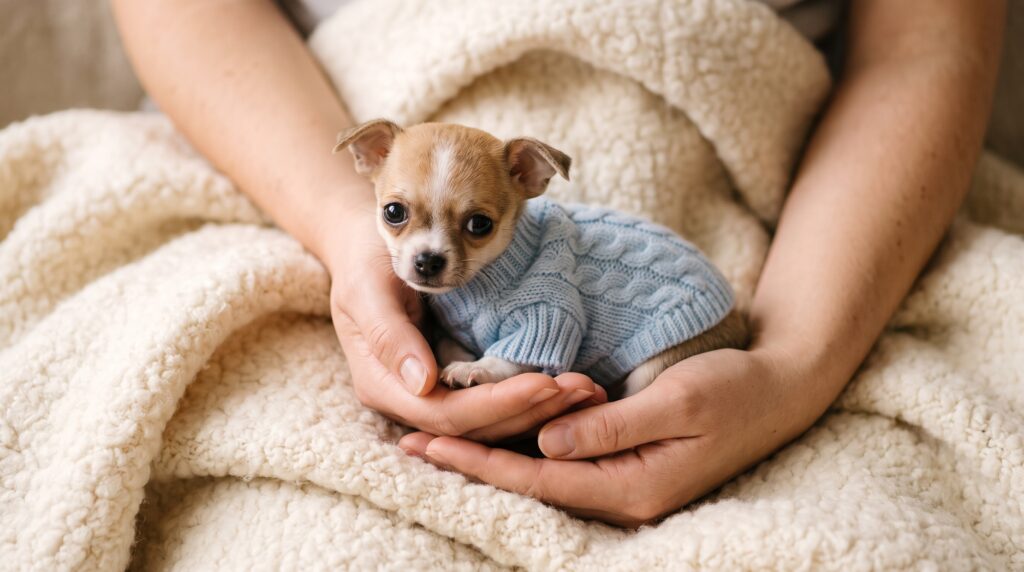
Your tiny dog shivers on a chilly walk, and suddenly every cute sweater online looks like a good idea. But which clothes actually help a dog this small, and which ones just get in the way?
The good news is that the right clothes can keep a teacup dog warm, dry and comfortable. The catch is that fit and safety matter even more on a dog that weighs only a few pounds, because a loose strap, a small button or a too-warm coat affects them quickly.
Below, you will learn when clothes for teacup dogs really help, how to measure your dog in a few minutes, which features to look for and avoid, and how to help your dog feel relaxed wearing them.
Quick answers:
- Many small dogs benefit from a sweater or coat in cold or wet weather, but most do not need clothes in a warm home.
- Measure the neck, chest and back, following each seller’s instructions. Chest size usually matters most.
- Avoid small buttons, beads, long ties and anything that covers the eyes or ears.
- Never leave your dog alone while it is wearing clothes.
- Avoid unnecessary layers in warm weather, and replace wet clothing with a dry item when warmth is needed.
- Watch your dog’s body language and go slowly if it seems stressed.
Do Teacup Dogs Need Clothes?
Many do, at least some of the time. The American Kennel Club (AKC) explains that small and toy breeds often benefit from coats in cold weather because their small bodies struggle to hold on to heat. Young puppies and senior dogs are also more sensitive to the cold.
That said, clothes are a tool, not a must. “Teacup” is a nickname for very small dogs rather than an official size, and the same common sense applies to any tiny dog: dress for the weather and the dog in front of you.
Cold, Wet and Windy Days
The dogs most likely to need a layer are those with short or thin coats, such as a smooth coated Chihuahua, dogs with clipped coats, such as a Toy Poodle in a short trim, hairless dogs, and young or senior dogs.
The American Veterinary Medical Association (AVMA) suggests a sweater or coat if your dog has a short coat or seems bothered by the cold. Its cold weather safety tips also recommend keeping a few on hand so your dog always has a dry one, because a wet layer can leave a dog colder. A few more habits help:
- Shorten walks when it is very cold.
- After walks, wipe your dog’s feet, legs and belly to remove snow, salt and de-icing chemicals.
- Call your vet if your dog keeps shivering or seems very tired after being out in the cold.
Warm Days and Strong Sun
In warm weather, avoid unnecessary layers. The AVMA’s warm weather safety advice is to avoid walks during the hottest part of the day, keep off hot surfaces that can burn paws, and ask your vet how to spot heat stress.
Hairless and very thin coated dogs need a different kind of protection. The AKC notes that hairless breeds such as the Chinese Crested need sun protection when they are outside for long periods, and suggests clothing designed for sun protection along with plenty of shade. Ask your vet what is best for your dog, because an ordinary thin shirt may not block much sun.
Whatever the season, skip clothes in a warm home, swap anything that gets wet, and leave an item off if your dog is unhappy and does not truly need it.
Types of Clothes for Teacup Dogs
Start with one item that solves a real problem, such as a chilly morning walk, rather than buying a full wardrobe. Here is what each common item is good for.

| Item | Best for | Watch out for |
|---|---|---|
| Sweater | Cool days, and chilly homes for hairless or very short coated dogs | Loose knits can snag nails; swap it if it gets wet |
| Insulated coat | Cold winter walks | Can be too warm indoors; check the fit around the chest |
| Raincoat | Wet walks | An unlined raincoat mainly keeps rain off; insulated versions may also add warmth |
| Booties | Ice, salt and hot pavement | Must fit well; most dogs need time to get used to them |
| Sun protective shirt | Hairless or thin coated dogs in strong sun | Choose clothing made for sun protection, and still use shade |
| Reflective vest | Walks at dawn, dusk or after dark | Make sure it does not rub under the front legs |
How to Measure a Teacup Dog for Clothes
Most clothes are sized by three measurements: the neck, the chest and the back. According to the AKC’s guide to measuring dogs for gear, chest girth is usually the most important one, because it is the widest part of the body. Always follow the individual product’s measuring instructions, since brands measure in slightly different ways.
The Three Measurements
- Neck: wrap a soft tape around the base of the neck, where a collar sits.
- Chest girth: measure around the widest part of the rib cage, just behind the front legs.
- Back length: measure along the spine from the base of the neck, where the collar sits, to the base of the tail.
Measure while your dog is standing. A helper with a few small treats makes this much easier. Measure twice, write the numbers down, and measure again every few weeks if your puppy is still growing.
Reading Size Charts

Sizes are not the same from brand to brand, so one company’s extra small can be another’s small. Ignore the letter on the label and compare your numbers to each brand’s chart. Then check what the chart is measuring. Some charts list your dog’s body measurements, while others list the finished garment, which may already include extra room. The seller’s instructions should say whether to add any room or not.
If your dog falls between sizes, follow the specific product’s guidance. Ask the seller if the chest and back measurements suggest different sizes, and reject a fit that slips or restricts movement.
Signs of a Good Fit
- The neck and chest openings sit snugly without pressing into the skin.
- Your dog can walk, sit, lie down and lift each leg easily.
- Nothing rubs under the front legs.
- The eyes, ears and mouth are clear.
- The belly area is short enough that your dog can go to the toilet without soiling the clothes.
- The garment stays in place without sliding to one side.
What to Check Before You Buy Clothes for Teacup Dogs
Product photos rarely show how something fits a dog this small. Before you buy, look for these details on the product page:
- Exact measurements: neck, chest and back length in inches or centimeters, not just a letter size.
- What the chart measures: whether the numbers are your dog’s body or the finished garment.
- Closures: a step-in design, snaps or hook and loop strips that are easy to fasten on a wriggling dog.
- Belly clearance: a short enough underside that your dog can go to the toilet without soiling the clothes.
- Harness compatibility: room to wear over or under a harness, or an opening for the leash.
- Washing instructions: machine washable or hand wash, and how to dry it.
- Returns: whether you can exchange it if the size is wrong.
Always supervise your dog in clothes. The AKC warns that dogs can get tangled in sweaters when no one is watching, even dogs that are used to wearing them.
Good Features for a Tiny Dog
- Soft, light fabric with a little stretch.
- Wide openings or a step-in design, to make dressing easier.
- Reflective trim for darker walks.
Features to Avoid
- Small buttons, beads, sequins or bows that could be chewed off and swallowed.
- Long ties, cords or drawstrings that can catch on furniture or wrap around a leg.
- Hoods or headpieces that cover the eyes or ears.
- Tight elastic around the neck, legs or belly.
- Heavy, stiff fabric that weighs down a tiny frame.
Clothes, Collars and Harnesses
Choose clothes that work with a properly fitted harness, or an integrated harness system specifically designed for leash attachment. Do not clip a leash to decorative rings on clothing.

Helping Your Teacup Dog Get Used to Clothes
Most dogs need a little time to accept clothes. Going slowly and using rewards makes the whole thing feel safe instead of strange.
- Let your dog sniff the item while you give a small treat.
- Lay it gently over your dog’s back for a moment, then reward.
- Put it on for a few seconds, reward, and take it off.
- Slowly build up to a few minutes indoors while you play or give treats.
- Try a short walk once your dog is relaxed in it at home.
Keep an eye on your dog’s body language the whole time. The AKC lists common signs of stress in dogs such as lip licking, yawning, showing the whites of the eyes, pinned back ears and a tucked tail. Freezing in place is another clue. If you see these, go back a step or try a different item.
Some dogs never enjoy wearing clothes, and that is okay. If your dog truly dislikes a sweater, keep cold weather walks short and let it warm up at home instead.
Matching Clothes to Your Dog’s Coat
Your dog’s coat type changes what it needs. Here is a quick guide.
| Coat type | Example breeds | What to think about |
|---|---|---|
| Long, silky coat | Maltese, Yorkshire Terrier | Clothes can rub the coat and cause tangles, so brush after wearing and choose smooth linings |
| Thick double coat | Pomeranian | Usually needs less help with warmth; watch closely for overheating |
| Short, smooth coat | Chihuahua (smooth coat) | Often feels the cold first; a sweater on chilly walks can help |
| Curly coat kept clipped | Toy Poodle | A short trim means less natural warmth, so a coat may help in winter |
| Hairless | Chinese Crested (hairless) | Needs protection from both cold and sun |
If you share your home with one of these breeds, our teacup Pomeranian guide and teacup Maltese guide cover these breeds in more detail.
Caring for Your Dog’s Clothes
Clean, well kept clothes are more comfortable and safer to wear. The AKC recommends washing dog sweaters regularly; many are machine washable, while others need hand washing and air drying.
- Follow the care label, and rinse well so no soap is left in the fabric.
- Make sure each item is completely dry before your dog wears it again.
- Check for loose threads, holes, and buttons or trims that are coming off.
- After taking clothes off, look over your dog’s skin and coat for redness, rubbing or tangles.
- Refit clothes whenever your dog grows or its weight changes.
Costumes and Special Occasions
Costumes can introduce extra risks through dangling decorations, headpieces and restricted movement. The ASPCA’s Halloween safety tips advise against putting a pet in a costume unless you know it enjoys it, and say any costume should not limit movement, sight, breathing or barking.
For a tiny dog, a simple festive bandana is often a happier choice than a full costume. Try anything new on before the big day, keep wear time short, and take it off at the first sign of stress.
Teacup Dog Clothes FAQs
Can my teacup dog sleep in a sweater?
It is safer not to. Clothes can twist or tangle when no one is watching. If your dog feels cold at night, offer warm bedding and a cozy spot away from drafts instead.
Do teacup dogs need shoes?
Only when the ground is the problem, such as ice, snow, de-icing salt or hot pavement. Booties must fit well to be comfortable. On many days, simply wiping your dog’s paws after a walk is enough.
Should a teacup dog wear clothes indoors?
Usually not, if your home is warm. Hairless dogs, older dogs or dogs your vet has said feel the cold may benefit from a light layer indoors. Watch for panting or restlessness, which can mean your dog is too warm.
Final Thoughts
The best clothes for teacup dogs are the ones that solve a real problem, like a cold walk or a sunny afternoon for a hairless dog, and fit well enough that your dog forgets it is wearing them.
Measure carefully, choose simple and safe designs, introduce new items slowly, and always stay nearby when your dog is dressed. Just as important, take clothes off when the weather warms up or your dog tells you it has had enough.
If you are unsure whether your dog needs extra warmth or sun protection, ask your vet at your next visit. They can look at your dog’s coat, age and health and help you decide.

The TeacupDogWorld Editorial Team researches and creates practical guides about small and teacup sized dogs, including breed characteristics, grooming, nutrition, health, training, and everyday care. Our content is developed using reputable veterinary, breed club, and animal welfare sources to help dog owners make better informed decisions.