
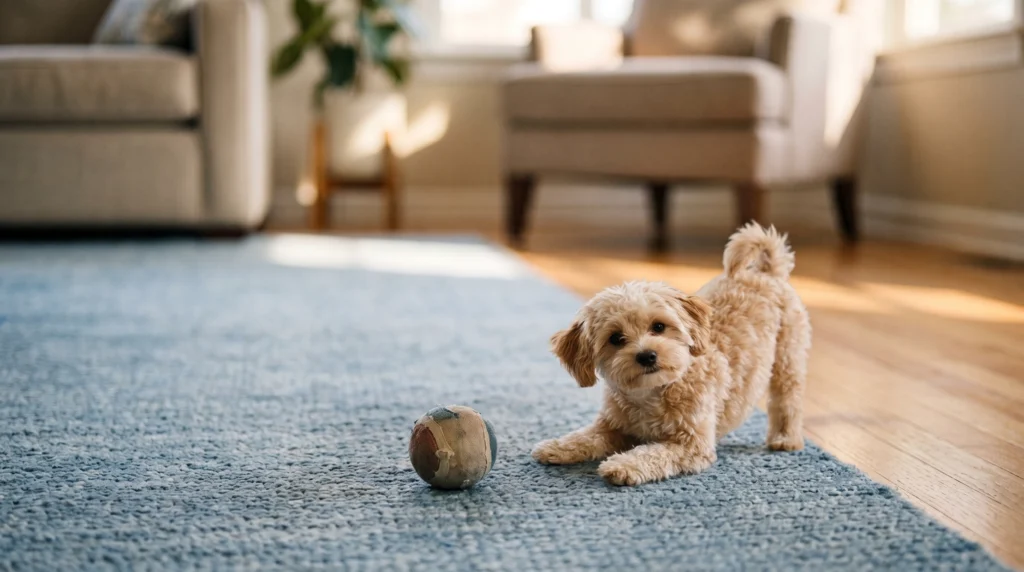
You saw a tiny, fluffy Maltipoo online, small enough to sit in two cupped hands, and now you are wondering if one could join your family. That is a big decision, and you deserve straight answers before you fall in love with a puppy photo.
Here is the short version. A Maltipoo is a dog with Maltese and Poodle ancestry, and “teacup” is an informal label used to market an especially small one. That label is not an official size, so it tells you very little about how big the dog will grow or how healthy it will be.
Below, you will learn how big these dogs really get, which health problems to watch for, what daily care looks like, whether they suit homes with children, and how to check a puppy’s health records and avoid scams.
Quick answers:
- “Teacup” is a marketing label, not an official size.
- The Maltipoo is a Maltese and Poodle mix, so it cannot get AKC purebred registration.
- Adult size depends on the parents, and no one can guarantee it.
- Very small dogs need extra care: frequent meals when young, gentle handling and a safe home.
- No dog breed is proven to be hypoallergenic.
- Ask for the parents’ health test results and the puppy’s vet records, and watch for scam red flags.
What Is a Teacup Maltipoo Dog?
A Maltipoo is a dog with Maltese and Poodle ancestry. “Teacup” is an informal label used to market an especially small Maltipoo.
Because the Maltipoo is a mix, it is not a recognized American Kennel Club (AKC) breed, and it is not eligible for AKC purebred registration as a Maltipoo. The AKC does run a separate program for mixed breed dogs, called AKC Canine Partners, which lets enrolled dogs take part in AKC sports and activities. So if a seller mentions AKC paperwork, ask exactly what document or program they mean.
That does not make a Maltipoo a worse pet. It simply means no official standard describes how one should look, how big it should be, or how it should be bred. If you want to get to know the Maltese side of the family, our teacup Maltese guide covers that parent breed in depth.

Why “Teacup” Is a Sales Label, Not a Size
Teacup is not an official size for any dog. The AKC breed standards for the Maltese and the Poodle do not include a teacup size at all. When a seller calls a puppy “teacup,” they are predicting that it will stay very small. You may also see words like micro or tiny used the same way.
The label can also be a warning sign. The Better Business Bureau’s 2025 puppy scams update lists the word “teacup” in an advertisement among the red flags of a pet scam. The word alone does not prove fraud, and plenty of honest sellers use it, but it should make you slow down and ask more questions.
How Big Does a Teacup Maltipoo Get?
There is no official answer. Sellers often advertise teacup Maltipoos as dogs that will stay around 5 pounds or less as adults, but no breed standard sets that number. A teacup Maltipoo’s real adult size depends mostly on the size of its parents, and puppies from the same litter can grow up quite differently.
What the Parent Breeds Tell You
Parent breed standards provide background; the actual parents’ measurements and the puppy’s dated growth records offer more individual context.
| Parent breed | What the AKC breed standard says about size |
|---|---|
| Maltese | Weight under 7 pounds, with 4 to 6 pounds preferred |
| Toy Poodle | 10 inches or under at the highest point of the shoulders; no set weight |
| Miniature Poodle | Over 10 inches and up to 15 inches at the shoulder |
The Maltese and the Toy Poodle are both naturally small dogs. That is why a Maltipoo from these two parents is small to begin with, even without the teacup label.
Teacup vs Toy vs Mini Maltipoo
These three names are seller terms, not official sizes, and none of them tells you how sturdy or healthy a particular puppy is. When you see one in a listing, here is what to check.
| Label in a listing | What to verify |
|---|---|
| Teacup Maltipoo | Current age and weight, growth history, and what the adult size estimate is based on |
| Toy Maltipoo | Actual parentage and measurements, and what the seller means by “toy” |
| Mini Maltipoo | The Poodle parent’s variety and documented size, and the individual dog’s care needs |
If your home is busy or you have young children, it may make sense to look at a larger individual dog. Judge that dog on its own health records, behavior and fit with your family, not on the label in the ad.
Why No One Can Promise Adult Size

A tiny puppy does not always become a tiny adult. Mixed litters vary, and no seller can know for sure how big a puppy will grow.
Before you trust any size estimate, ask for evidence:
- The puppy’s exact age and current weight, with the date it was weighed.
- A record of its weight over the past few weeks.
- The adult weights of both parents, and a chance to meet at least the mother.
- What the seller’s adult size estimate is based on.
- Vet records from a recent checkup.
A puppy that looks unusually small may simply be younger than claimed, or it may have a health problem that slowed its growth. Veterinary records can provide useful context, but unexplained small size or poor growth needs a veterinarian’s assessment.
You may also see generation labels such as F1 (one Maltese parent and one Poodle parent) or F1b (usually a Maltipoo bred back to a Poodle). Puppies in the same litter can still grow quite differently, so no label guarantees adult size, coat or health.
Teacup Maltipoo Temperament
Most Maltipoos are affectionate, people focused little dogs that want to be close to their family. The AKC standard describes the Maltese as gentle mannered, affectionate, lively and playful, and the Poodle as very active and intelligent. A Maltipoo can take after either parent, so personalities vary from dog to dog.
A few traits are worth planning for. A dog bred for companionship usually does best when someone is home for much of the day. Many small dogs also bark to alert you to visitors or noises, so early, gentle training helps keep the barking in check.
Is a Teacup Maltipoo Good for Families?
A teacup Maltipoo can be a loving family pet, but it is usually best with adults or older, calm children. A dog this small can be badly hurt if a toddler drops it, squeezes it or steps on it.
Children, Other Pets and Safe Handling
A few simple house rules protect both the dog and your kids:
- Children sit on the floor to hold the dog, so a wriggle never turns into a fall.
- Young children do not carry the dog around.
- An adult watches whenever children and the puppy play.
- Bigger dogs meet the puppy slowly, on a leash, with an adult close by.
- Everyone looks down before walking through a room.
Older children can be wonderful helpers with feeding, gentle brushing and short training games. Those small jobs also teach them how to treat a tiny dog with care.
Whatever the children’s ages, the dog is an adult’s responsibility. Decide before you buy who will handle meals, potty breaks, grooming and vet visits, and who will cover care during work and school hours. A young puppy may need several meals a day, so someone has to be home or you need to arrange help.
Are Teacup Maltipoos Hypoallergenic?
No. There is no good evidence that any dog breed is hypoallergenic. A 2012 study of dog allergen levels found that breeds sold as hypoallergenic, including Poodles, did not have lower levels of the main dog allergen in their coats, and levels in the air of their homes were similar to other dogs.
Maltipoos do tend to shed less hair, which many owners love. But dog allergens come from skin, saliva and dander, not just loose hair. If someone in your home has dog allergies, talk with an allergist before you commit. Spending time with the specific dog can help, but a short visit cannot guarantee how that person will react once the dog lives with you.
Teacup Maltipoo Health Problems
A teacup Maltipoo can live a happy life, but its very small size and its parent breeds bring some health risks you should know about before you buy. Here is a calm, plain look at each one.
Risks That Come With Very Small Size
Low blood sugar. Low blood sugar, called hypoglycemia, is a real danger for tiny puppies. According to the AKC’s guide to hypoglycemia, it is most common in very young toy puppies, often under 12 weeks old. A puppy can use up its energy between meals, especially when it is cold, very active or stressed. Warning signs include extreme tiredness, wobbling, passing out or seizures. Treat any of these as an emergency and call a vet right away.
Falls and injuries. A jump off the sofa or a slip from someone’s arms can hurt a tiny dog far more than a bigger one. Much of a teacup Maltipoo’s safety comes down to how carefully the people around it handle it.
Cold. Very small dogs can get chilly quickly. A well fitted sweater can help on cold walks, and a warm bed away from drafts helps at home.
Health Conditions to Discuss With Your Veterinarian
These conditions are linked to the parent breeds or to small dogs in general. Not all of them have a proven inheritance pattern in Maltipoos, but each is worth discussing with your vet and the breeder.
| Condition | What it means in plain words | Where it shows up | What to ask about |
|---|---|---|---|
| Patellar luxation | The kneecap slips out of place, which can cause skipping or limping | Common in small breeds | Kneecap exams on both parents |
| Portosystemic shunt | A blood vessel lets blood skip the liver, so the body is not cleaned properly | The Maltese is one of the breeds affected | Liver test results for the Maltese parent and the puppy’s vet records |
| Shaker syndrome | Sudden tremors through the head and body, usually in young adult dogs; the cause is unknown | Seen most often in small white dogs such as the Maltese and Poodle | Family history |
| Progressive retinal atrophy (PRA) | An inherited eye disease that slowly causes vision loss | Poodle | A PRA-prcd DNA test on the Poodle parent |
Patellar luxation is one of the most common joint problems in small dogs, according to the American College of Veterinary Surgeons. Mild cases are often just monitored, while more serious ones may need surgery.
The American College of Veterinary Surgeons also lists the Maltese among breeds affected by portosystemic shunts, often called liver shunts, and notes that affected dogs may be small for their age. That is one more reason to ask for a vet check if a puppy seems unusually tiny.
Shaker syndrome sounds scary, but VCA Animal Hospitals reports that the outlook is excellent and most dogs respond well to treatment from a vet. Its cause is still unknown. Tremors often get worse with excitement and ease when the dog rests.
Are Mixed Breeds Healthier?
Not automatically. Some sellers say a mix like the Maltipoo is healthier because of “hybrid vigor,” but the evidence is more complicated.
A 2013 study from the University of California, Davis compared 24 inherited conditions in mixed breed and purebred dogs. About half of them, including patellar luxation, showed up just as often in mixed breed dogs.
In simple terms, crossing two breeds does not erase the health risks each parent carries. Health testing the parents matters far more than the word “mix.”
How Long Do Teacup Maltipoos Live?
There is no reliable lifespan figure specifically established for dogs marketed as teacup Maltipoos. General Maltipoo estimates you see online should not be treated as a prediction for an individual dog.
Research on dog breed lifespans does suggest that small breeds tend to live longer than large ones, but that work did not focus on extra small dogs bred down in size. What you can control is choosing health tested parents, keeping your dog at a healthy weight, caring for its teeth and keeping up with regular vet visits.
Caring for a Teacup Maltipoo
Daily care requires a consistent routine, with extra planning for young or especially small puppies. Young, very small puppies may need frequent meals; ask your veterinarian to set a schedule for your dog’s age and health. Every teacup Maltipoo also needs regular grooming and a home set up with its size in mind.
Feeding a Very Small Dog
Young toy puppies need small meals several times a day so their blood sugar stays steady. The AKC advises small, frequent meals as directed by your vet, so ask yours to set a schedule that fits your puppy’s age and weight.
Choose a complete and balanced food labeled for growth while your dog is a puppy, then one labeled for adult maintenance once your vet says it is grown. Small kibble makes eating easier, but size alone does not make a food suitable. Keep treats small too, because a few extra bites add up fast in a dog this size.
Grooming the Coat
A Maltipoo’s coat can be silky like the Maltese, curly like the Poodle, or somewhere in between. Either way, it keeps growing and tangles easily. Plan on:
- Brushing several times a week, and daily if the coat is kept long.
- A professional trim every few weeks.
- Wiping around the eyes, checking the ears and trimming nails.
- Brushing teeth regularly, because dental care matters a lot in small dogs.
Maltipoos usually shed very little hair, which keeps floors and furniture cleaner. Low shedding still means regular brushing, though, and it does not mean low allergens. Grooming is an ongoing cost, so include it in your budget from the start.
Exercise and Training
Plan walks, play and training around your dog’s age, health and response to activity, and ask your veterinarian about suitable exercise. Avoid rough play with bigger dogs.
Maltipoos often learn quickly. Use rewards like tiny treats and praise, keep sessions short, and be patient with house training. A tiny bladder means frequent trips outside or to a potty pad.
Making Your Home Safe
A few small changes make a big difference for a dog this size:
- Add pet steps or ramps to the sofa and bed, and discourage jumping down.
- Use baby gates to block stairs and busy areas.
- Walk your dog on a well fitted harness.
- Watch outside doors, since a tiny dog can slip out unnoticed.
- Keep small objects and cords off the floor.
- Ask visitors to look down before they sit or step.
Costs to Plan For
The price of the puppy is only the start. Here is what to budget for over your dog’s life.
| Cost area | What to plan for |
|---|---|
| Getting your dog | The purchase price from a breeder, or an adoption fee from a rescue or shelter |
| Supplies | A small bed, crate or pen, harness and leash, pet steps, gates and toy breed food |
| Grooming | Regular professional trims, plus brushes and combs for home care |
| Routine vet care | Puppy vaccines, checkups, parasite prevention and dental care |
| Unexpected vet bills | Injuries, illness or emergency visits; an emergency fund or pet insurance can help |
| Backup care | A pet sitter, dog walker or boarding when you work or travel |
To make this real, request local quotes from a veterinarian, a groomer and a pet sitter or dog walker, then separate one time costs from recurring expenses.
Choosing a Maltipoo: Health Records and Breeder Checks
Where your puppy comes from matters more than almost anything else. A careful breeder health tests the parents, tells you the truth about size, and lets you see where the puppies are raised.
Health Tests to Ask For
Ask to see results for both parents, not just a promise. These are the tests the breed clubs recommend:
- Maltese parent: a kneecap (patella) exam, a heart exam, and serum bile acids, a blood test that checks how well the liver works. These are listed on the AKC’s health testing page for toy breeds.
- Toy Poodle parent: a PRA-prcd DNA test, an eye exam by a veterinary ophthalmologist, and a kneecap exam, as recommended by the Poodle Club of America.
These are recommendations for the parent breeds, not an official Maltipoo testing standard. If the Poodle parent is a Miniature Poodle, its recommended screening may differ, so ask the breeder which tests apply.
Many breeders record results with the Orthopedic Foundation for Animals (OFA), which keeps a public online database. A dog that has finished its breed’s recommended tests and made the results public can earn a CHIC number from the Canine Health Information Center. A CHIC number does not mean every result was normal, though. Read the individual results, and confirm the records belong to the correct parent by checking its registered name.
Questions to Ask the Breeder
- How much do the mother and father weigh as adults?
- Can I meet the mother and see where the puppies live?
- How old is this puppy exactly, and can I see its vet records?
- Which health tests have the parents had, and where can I see the results?
- What happens if the puppy has a health problem, or if I can no longer keep it?
- Why do you breed for such small size?
A good breeder will be glad to answer. Many will ask you questions too, because they care where their puppies go.
Red Flags and Puppy Scams
Small, popular dogs attract scammers. The BBB’s 2025 puppy scams update lists these red flags:
- The word “teacup” in the ad.
- A price that seems far too low.
- A seller who will not meet in person or do a video call.
- Surprise charges for crates, vaccinations or shipping.
- Pressure tactics, such as claims the puppy will be harmed if you do not pay more.
One red flag on its own does not prove a seller is dishonest, but each is a reason to check everything else carefully. To protect yourself, see the puppy in person or on a live video call, run a reverse image search on the photos, and avoid payments you cannot get back, such as gift cards or wire transfers.
Adoption and Rescue
Adopting is a real option. Maltipoos and other small mixes sometimes turn up at shelters and small breed rescues. An adult dog has one big advantage: its current size is measurable, and carers may be able to share useful observations about its behavior. Our guide to teacup dogs for adoption explains where to look and what to ask.
Is a Teacup Maltipoo Right for Your Family?

Use this quick check to see how well a teacup Maltipoo fits your home.
A good fit if:
- Someone is home for much of the day.
- Your household is mostly adults or older, calm children.
- You enjoy regular brushing and grooming.
- You have room in your budget for grooming, routine vet care and emergencies.
- You want a cuddly companion more than an adventure buddy.
Think twice if:
- You have toddlers or very young children.
- Everyone is out of the house most of the day.
- Someone at home has dog allergies and has not discussed dog exposure with an allergist.
- You want a dog for long hikes or rough play.
- An unexpected vet bill would be hard to manage.
A higher price does not mean a healthier dog. If several “think twice” points fit your family, consider whether a larger individual dog with good health records and a calm temperament would suit you better.
Teacup Maltipoo FAQs
Is a teacup Maltipoo smaller than a Maltese?
Not always. The AKC standard calls for a Maltese under 7 pounds, with 4 to 6 pounds preferred, so many purebred Maltese are already about the size sellers advertise for teacup Maltipoos. A Maltipoo’s size depends on its own parents.
Can a teacup Maltipoo be left alone during the workday?
A long day alone is hard on most small companion dogs, and young puppies need several meals a day. If no one is home for long stretches, plan for a dog walker, a pet sitter or a family member who can check in.
Final Thoughts
A teacup Maltipoo can be a sweet, devoted little companion. But small size is not a measure of health, and no label can promise how big a puppy will grow.
If you decide this dog is right for your family, look for the healthiest puppy, not the smallest one. Meet the mother, check the parents’ health test results, ask for vet records, and walk away from any seller who rushes you. And if your home is busy or full of little hands, a slightly larger dog with good health records and a calm nature may suit everyone better.
Before you bring a puppy home, talk with a local vet about feeding, vaccines and safety for a very small dog. A good start makes a big difference.
The TeacupDogWorld Editorial Team researches and creates practical guides about small and teacup sized dogs, including breed characteristics, grooming, nutrition, health, training, and everyday care. Our content is developed using reputable veterinary, breed club, and animal welfare sources to help dog owners make better informed decisions.