
Small dogs need dental care just as much as big dogs, and often more. But a tiny mouth makes brushing tricky. The lips are small, the teeth sit close together, and many owners worry about hurting the gums or getting nipped.
With the right tools and a slow, patient approach, most small dogs can learn to accept brushing. This guide explains how to brush a small dog’s teeth safely at home. You will learn how to check the mouth first, which brush and toothpaste to use, the steps from first touch to full brushing, how often to brush, and what to do if your dog refuses.
Quick Answer: How to Brush a Small Dog’s Teeth
Before starting, check for signs of mouth pain, red or swollen gums, bleeding, or broken teeth. If you notice any of these, ask your veterinarian before brushing.
- Use dog toothpaste only, never human toothpaste.
- Choose a soft brush that fits your dog’s mouth comfortably.
- Gently lift your dog’s lip so you can see the teeth and gums.
- Brush along the gumline in small, gentle strokes, starting with the outside of the teeth.
- Start with just a few seconds. Once your dog is comfortable, work up to about 30 seconds on each side of the mouth.
- Brush every day if you can, and end each session on a calm, happy note.
Move to each new stage only when your dog is relaxed. Some dogs settle in quickly, while others need much longer, and both are normal.
Why Small Dogs Need Extra Dental Care
The American Veterinary Medical Association says most dogs already show some signs of gum disease by age three. It starts with plaque, a soft, sticky film of germs on the teeth. If plaque stays put, it hardens into tartar, a rough yellow or brown crust that only a vet can remove. The germs also make the gums red and sore, which vets call gingivitis.
Small breeds face a higher risk. A 2021 study in The Veterinary Journal looked at more than three million records from dogs of 60 breeds seen at Banfield Pet Hospital clinics in the United States. Extra small breeds, under about 14 pounds, were up to five times more likely to be diagnosed with gum disease than giant breeds. The Papillon, Toy Poodle, Pomeranian, Maltese and Yorkshire Terrier were among the small breeds with the highest rates.
The researchers suggest small dogs may have teeth that are large for their jaws, so the teeth crowd together and trap plaque. Small dogs also have less bone around each tooth root. That does not mean every small dog will get gum disease, but it does mean daily care matters. If you have a teacup Pomeranian or a teacup Maltese, brushing is worth building into your routine early.
“Teacup” is a marketing term, not an officially recognized breed size. This guide applies to any small or toy dog.
Check Your Dog’s Mouth Before You Start Brushing
Before you brush for the first time, gently lift your dog’s lips and take a look. Healthy gums are usually pink and smooth, although some dogs have natural dark patches. The teeth should not have a thick crust along the gumline.
See your vet before brushing if you notice:
- Red, swollen or bleeding gums
- Broken or loose teeth
- Brown or yellow crust on the teeth
- Trouble eating, dropping food or chewing on one side
- Pain when you touch the mouth
- Bad breath that does not go away
The American Animal Hospital Association advises against brushing gums that are already inflamed. It hurts, and it can make your dog dislike brushing for a long time. Your vet can treat the problem first, often with a cleaning under anesthesia that reaches below the gumline. After that, home brushing helps keep the mouth healthy.
What You Need to Brush a Small Dog’s Teeth
You need a soft toothbrush that fits your dog’s mouth, a dog toothpaste, and some small treats. Good light helps you see what you are doing.
Picking a Toothbrush for a Tiny Mouth
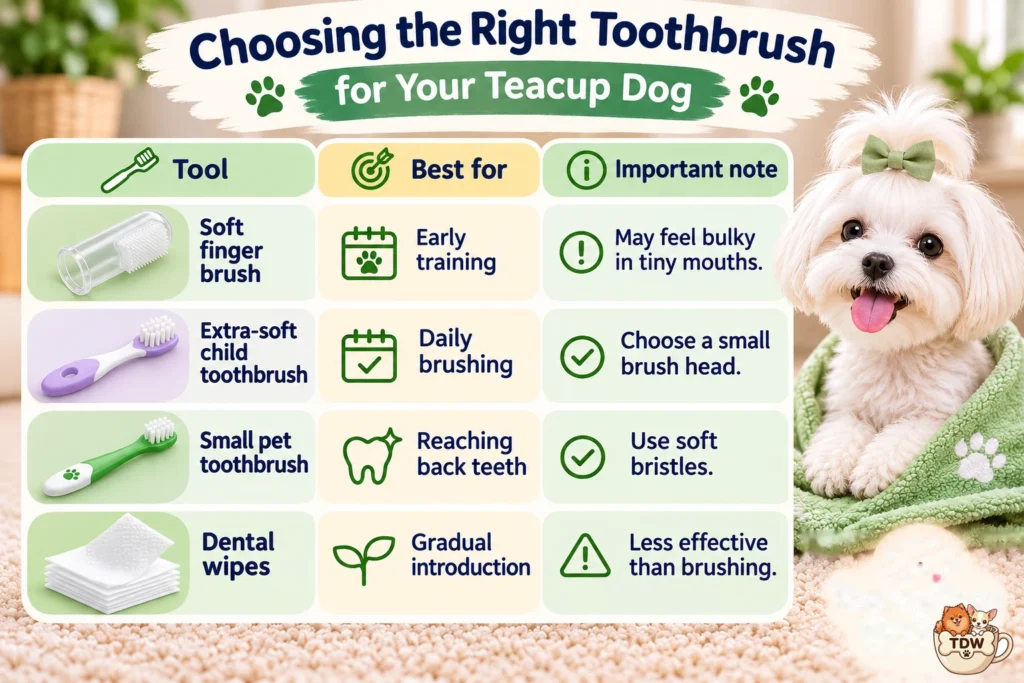
The right brush is the one that fits comfortably in your dog’s mouth. Brush heads and finger sizes vary, so try what feels easy for both of you.
| Tool | When it can help | Things to know |
|---|---|---|
| Finger brush (soft rubber or silicone cap) | Some dogs accept it more easily while getting used to brushing | Your covered finger can feel bulky in a very small mouth, and short bristles clean less well |
| Extra soft child or toddler toothbrush | Many toy dogs once they are used to brushing | Choose the smallest, softest head you can find |
| Small pet toothbrush | Dogs that need a small head and a longer reach | Check that the bristles are truly soft |
| Gauze or a dental wipe around a finger | Early practice, or days when brushing is not possible | Cleans less thoroughly than a brush |
You may read that human toothbrushes are too hard for dogs. That is not quite right. The Veterinary Oral Health Council reviews evidence submitted by companies and awards its Seal of Acceptance to dental products that meet its standards. Its brushing guidance uses a soft, flat head human toothbrush and says small dogs can use a child-size version.
Give each dog their own brush. Board certified veterinary dentist Kristin Scott suggests replacing it about once a month, since dog teeth wear down bristles quickly.
Why You Must Use Dog Toothpaste
Never use human toothpaste on your dog. Dogs swallow toothpaste, and some human toothpastes contain xylitol, a sweetener that is toxic to dogs.
The U.S. Food and Drug Administration advises owners to only use pet toothpaste and to keep human toothpaste out of reach. Signs of xylitol poisoning include vomiting, weakness, stumbling and seizures. If you think your dog ate xylitol, call your vet, an emergency clinic or an animal poison control center right away.
VCA Animal Hospitals also advises against using baking soda. Dog toothpaste is made to be swallowed and comes in flavors like chicken or beef, which many dogs enjoy. For a toy breed, a small dab is enough.
How to Brush a Small Dog’s Teeth Step by Step
Treat this as training. Move to the next step only when your dog is relaxed with the current one. If your dog pulls away, go back to the last step they were comfortable with.
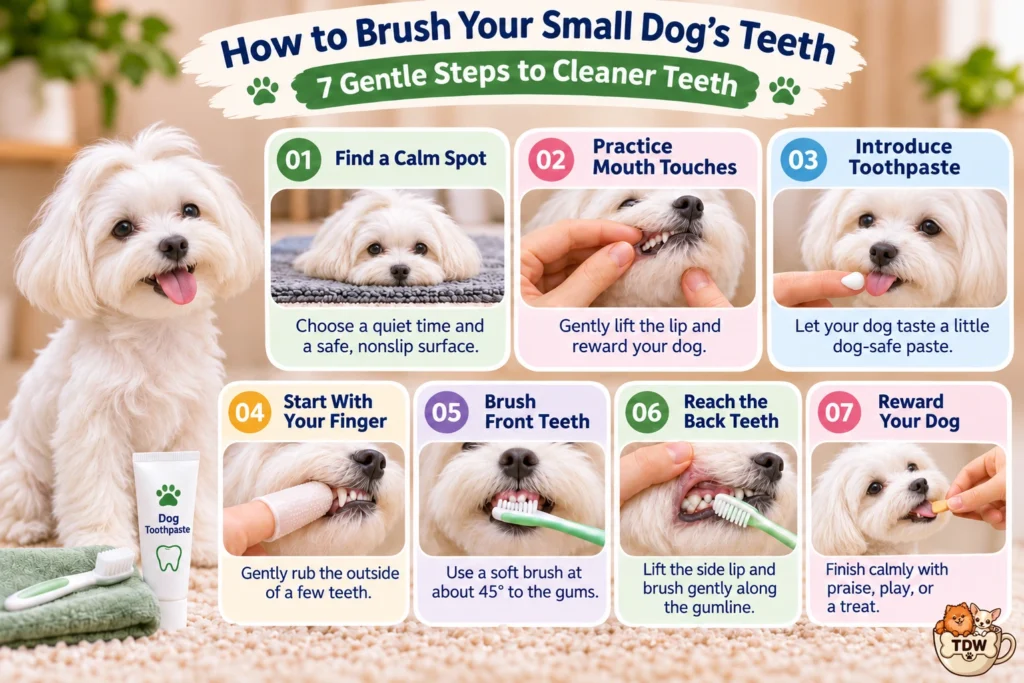
Step 1: Choose a Calm Time and a Safe Spot
Pick a time when your dog is already calm, such as after a walk. Sit on the floor with your dog on a nonslip mat or on your lap. Staying low means a wriggling dog cannot fall from a couch or table.
One adult should handle the dog and give the rewards. Children can help in other ways, such as ticking off each brushing day on a calendar.
Step 2: Get Your Dog Used to Mouth Touches
Start with no brush or paste. Touch the outside of your dog’s lips for a second, then reward. Over the next sessions, lift the lip a little and run a clean fingertip along the gums. Keep each touch short.
Step 3: Let Your Dog Taste the Toothpaste
Put a small dab of dog toothpaste on your fingertip and let your dog lick it off. Keep doing this until your dog looks interested when the tube comes out.
Step 4: Rub the Teeth With Your Finger
Put a little paste on your finger or a finger brush. Lift the lip and gently rub the outside of a few front teeth. Add more teeth over time as your dog stays relaxed.
Step 5: Brush the Front Teeth and Canines
Now switch to the toothbrush. Lift the upper lip and start with the front teeth and the long canine teeth (the fangs).
Hold the brush so the bristles point toward the gums at about a 45 degree angle. Brush with small, gentle strokes along the gumline, where the teeth meet the gums. The Colorado State University veterinary team advises light pressure. If the bristles flatten or spread out, you are pressing too hard.
The outside of the teeth is the easiest place to start. Ideally, all surfaces get cleaned once your dog accepts it, including the inside. Never force your dog’s mouth open to reach them.
Step 6: Reach the Back Teeth in a Small Mouth
You can reach the back teeth without opening the mouth. Gently pull the lip back at the corner of the mouth and slide the brush in along the side teeth. Work from the back toward the front, then repeat on the other side.
If your dog only allows a little brushing, the Veterinary Oral Health Council suggests focusing on the cheek side of the upper teeth, where plaque and tartar build up fastest.
Flat-faced breeds like the Shih Tzu and Pekingese can be harder to brush. Veterinary dentist Kristin Scott notes that a straight brush can miss parts of the curved upper back teeth in these breeds. If you have trouble reaching them, ask your vet to show you a technique that suits your dog’s mouth.
Step 7: Finish With a Reward
Stop while your dog is still calm, even if you only brushed a few teeth. Then give a treat, a cuddle or a short game. Ending well makes the next session easier.
How Often Should You Brush a Small Dog’s Teeth?
Aim to brush once a day. Brushing every other day still helps, but brushing only once a week does very little to control plaque.
Plaque builds back up quickly after brushing, which is why the American Animal Hospital Association says brushing needs to be daily to be of real benefit. A controlled study of beagles, published in the Journal of Veterinary Dentistry in 2015, compared different schedules. Daily brushing reduced plaque, tartar and gum inflammation the most, every other day also helped, and weekly brushing had little effect.
A monthly brush at the groomer is not enough on its own. Tie home brushing to something your family already does every day, like the evening walk or bedtime.
When you are just starting, let comfort set the pace rather than the calendar:
- Your dog stays relaxed with lip and gum touches
- Your dog happily licks toothpaste from your finger
- Your dog accepts finger rubbing on several teeth
- Your dog accepts the brush on the front teeth, then the back teeth
- Your dog stays calm for a full brushing session
What to Do When Your Dog Won’t Let You Brush
If your dog resists, slow down rather than give up. Resistance may mean your dog is uncomfortable with handling, the training moved too quickly, or their mouth hurts.
Watch for signs your dog is uneasy, such as lip licking, yawning, turning the head away, going stiff or trying to wriggle off. Stop for the day when you see them. Next time, go back to an earlier step.
Small changes can help:
- Brush just three or four teeth at a time
- Try a different toothpaste flavor
- Use a dental wipe for a while
- Try a calmer time of day
Never pin a small dog down. Forcing a tiny dog to hold still can frighten them and lead to bites. If your dog growls, snaps or keeps fighting brushing, talk to your vet. Mouth pain is a common hidden reason, and your vet can also suggest a qualified behaviorist if fear is the problem.
Brushing Teeth for Small Puppies and Older Dogs
Any age is a good time to start. Puppies tend to learn quickly, and older dogs can still build the habit with more patience.
Starting With a Puppy
Start gentle mouth handling soon after you bring your puppy home. Even though baby teeth fall out, brushing them teaches your puppy that mouth care is normal.
Adult teeth usually replace baby teeth by about six months of age. VCA Animal Hospitals notes that small breeds are more likely to keep some baby teeth while the adult teeth grow in beside them. If you see two teeth crowded into one spot, especially the fangs, ask your vet. These extra teeth can trap plaque and may need to be removed.
Starting With an Adult or Senior Dog
It is never too late to start. Do the mouth check described earlier first, since older dogs are more likely to have tartar or sore gums that need a vet. Then work through the steps more slowly.
Can Chews, Wipes or Water Additives Replace Brushing?
No. These products can help, but they work best alongside brushing, not instead of it. If you use them, look for the Veterinary Oral Health Council seal, which shows a product met the council’s standards for reducing plaque or tartar.
| Option | How it helps | Keep in mind |
|---|---|---|
| Dental chews | Chewing scrapes some plaque off the back teeth | Pick the size made for your dog’s weight and always supervise |
| Dental wipes | Useful for nervous dogs or busy days | Less thorough than a brush |
| Water additives | Added to the water bowl each day | Do not remove tartar that is already there |
| Dental diets | Special food designed to help clean teeth as your dog chews | Only some carry the seal; ask your vet if one suits your dog |
Size matters a lot for toy breeds. A chew that is too hard or too large can damage a small tooth, and one that is too small can be a choking risk. Check the weight range on the package and ask your vet if you are unsure.
FAQs About Brushing a Small Dog’s Teeth
Can I use a baby toothbrush on my small dog?
Yes, as long as it is extra soft and the head fits your dog’s mouth. Keep it just for your dog, replace it regularly, and use it only with dog toothpaste.
Does dry food keep my dog’s teeth clean?
Regular dry food is not made to clean teeth, so it does not replace brushing. A few special dental diets carry the Veterinary Oral Health Council seal, but even those work best alongside daily brushing.
Are anesthesia-free teeth cleanings safe for small dogs?
The American Veterinary Dental College does not support them. Scraping teeth while a dog is awake can make the teeth look cleaner, but it cannot clean below the gumline, where gum disease does its damage. That can give owners a false sense that the mouth is healthy.
My dog’s gums bled during brushing. What should I do?
Stop the session. Do not assume the bleeding is only from brushing too hard. Red or sore gums often bleed when touched, and VCA Animal Hospitals lists unusual bleeding during brushing as a sign to raise with your vet. Contact your vet if bleeding happens again, or if you also see redness, swelling or signs of pain.
A Small Daily Habit That Protects Your Dog
Your small dog cannot tell you when a tooth hurts. Many dogs keep eating through mouth pain, so gum disease can grow quietly until it needs a vet to fix. A minute of brushing each day is one of the simplest ways to stop that from happening.
You do not have to get it perfect. Check the mouth first, use dog toothpaste and a soft brush that fits, and let your dog set the pace. A few teeth today and a few more tomorrow still counts as progress. Before long, brushing becomes just another part of your day together.
Start tonight with a dab of dog toothpaste on your fingertip, and book a dental check with your vet if anything looks red or sore.
For more breed care tips, read our teacup Pomeranian and teacup Maltese guides.

The TeacupDogWorld Editorial Team researches and creates practical guides about small and teacup sized dogs, including breed characteristics, grooming, nutrition, health, training, and everyday care. Our content is developed using reputable veterinary, breed club, and animal welfare sources to help dog owners make better informed decisions.