
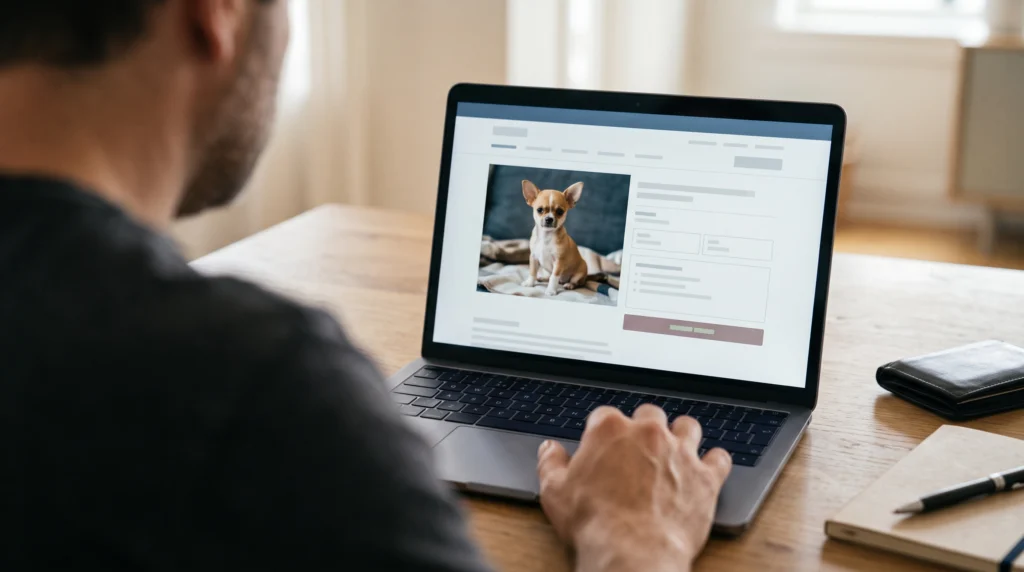
You found the perfect tiny puppy online. The page says “adopt,” the seller sounds kind, and your kids are already picking out names. But something feels a little off, and now you’re wondering if it’s real.
That feeling is worth listening to. Teacup puppy adoption scams are common, and they’re built to look caring and safe.
This guide shows you how these scams work and the red flags to watch for. You’ll learn how to check any seller or rescue before you pay. And if you’ve already sent money, you’ll find clear steps to take right now.
Quick Answer: Signs of a Teacup Puppy Adoption Scam
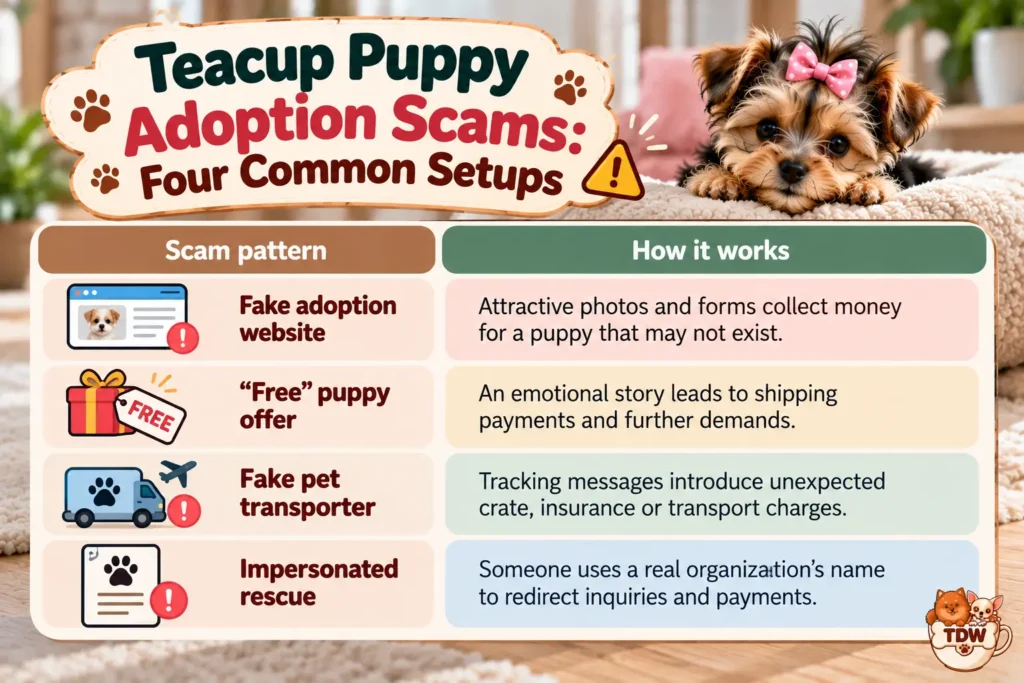
Be careful if a seller or rescue:
- Pushes you to pay fast.
- Insists on gift cards, wire transfers, payment apps, or cryptocurrency.
- Won’t let you meet the puppy.
- Uses photos found elsewhere under other names.
- Offers a “free” puppy if you pay for shipping.
- Keeps adding new fees.
- Says a very young puppy is coming from overseas.
How Scammers Use Teacup Puppy Adoption Offers
“Teacup” isn’t an official breed or size. That means anyone can use the word, and scammers do. The American Pomsky Kennel Club warns that scammers use the teacup label to sell sick or underage puppies, or simply disappear once they’re paid.
Scammers also use the word “adoption” on purpose. It sounds caring, cheap, and safe, like a rescue. Some scam websites even put “teacup” and “adoption” right in their web address. One site exposed by Petscams.com asked buyers for a “refundable deposit” and had an “adoption form.”
The lesson is simple. A kind word on a website proves nothing. Every offer needs to be checked, no matter how friendly it sounds.
Common Teacup Puppy Adoption Scams
Here are four patterns to watch for.
Fake Breeder and “Adoption” Websites
These sites look professional. They have puppy photos, glowing reviews, a “health guarantee,” and an adoption form. But the puppies may not exist.
The American Kennel Club warns that scammers often pose as real breeders by stealing their information. They copy photos and text from real websites, and the reviews can be fake too.
The AKC also points out that it doesn’t give breeders “badges.” So a badge on a website isn’t proof of anything.
“Free to a Good Home, Just Pay Shipping”
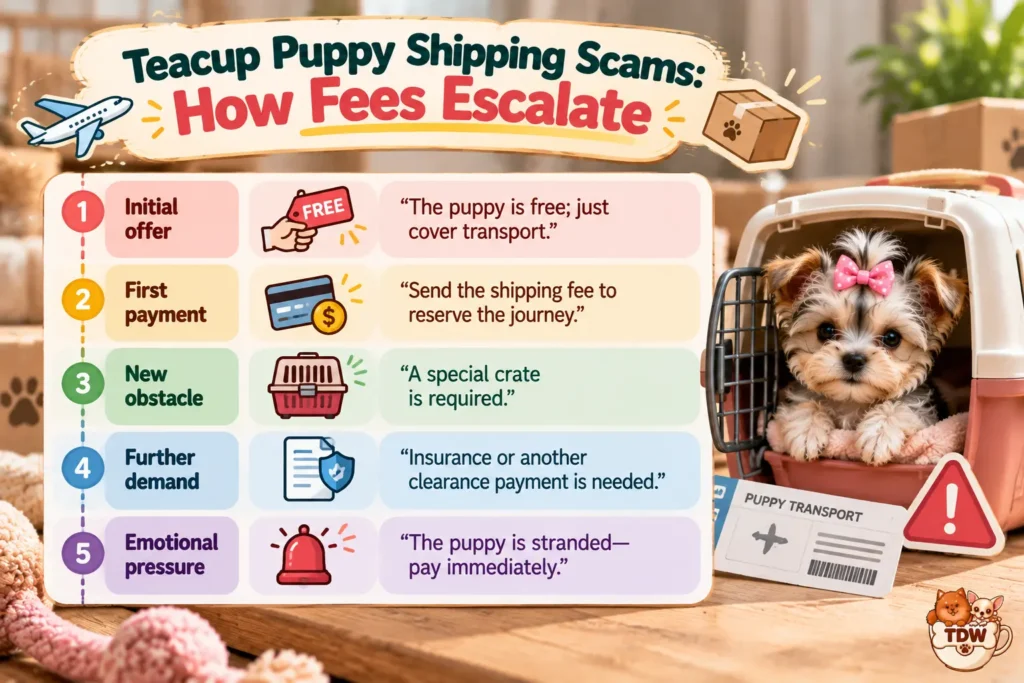
This one comes with a sad story. Someone says they must rehome their tiny puppy because of a move, an illness, or a death in the family. The puppy is “free.” You just need to cover shipping.
Then the fees start. The International Pet and Animal Transportation Association (IPATA) is a trade group for professional pet shippers. It explains that after the first shipping payment, scammers add more costs, like extra shipping, customs fees, vaccinations, and insurance.
Fake Pet Shipping Companies and Surprise Fees
Many puppy scams use a fake shipping company or a fake airline. After you pay, you get an official looking email with a tracking number. Then comes the bad news: the puppy is “stuck” and needs a special crate, insurance, or a customs fee before it can travel.
IPATA says scammers create websites and email accounts that look like airlines or shipping companies. Some even claim to be IPATA members. You can check that claim in IPATA’s “Find a Pet Shipper” directory. IPATA also says it doesn’t ship pets, and no real pet shipping company has “ipata” in its name. Learn more on IPATA’s pet scams page.
Fake Rescues and Stolen or AI Photos
Scammers also borrow the trust people have in animal shelters. In a June 2026 alert, the Federal Trade Commission (FTC) warned that scammers steal and edit pet photos and videos, and even use AI to create fakes. It also warned that scammers pretend to be real shelters, building fake pages with stolen or AI images to collect donations. You can read the full FTC pet scam alert.
The FTC suggests a reverse image search to check whether photos are stolen. That’s smart advice for any listing, because the same photo tricks can make a fake adoption page look convincing. A beautiful, perfect photo isn’t proof that a puppy exists.
Teacup Puppy Scam Red Flags Checklist
Use this table to check any listing. One red flag means slow down. Several together mean walk away.
| Red flag | Why it matters | What to do |
|---|---|---|
| Pressure to pay fast | Scammers want you to act before you think | Take your time before paying anything |
| Only text or email contact | It’s easy to hide who you really are | Ask for a phone call and an in-person visit |
| Won’t let you visit | You can’t confirm the puppy exists | Don’t pay for a puppy you haven’t seen |
| Payment by gift card, wire, crypto, or app only | This money is very hard to get back | Walk away if they insist |
| Very low price or “free, just pay shipping” | A common way to hook buyers | Treat it as a warning sign |
| New fees after you pay | Fees keep growing until you stop paying | Stop paying and check the shipper yourself |
| Photos show up under other names or places | The photos may be stolen | Ask why, and be very careful |
| Breeder “badges” or seals on the site | The AKC doesn’t give these out | Don’t treat badges as proof |
| A very young puppy coming from overseas | The CDC requires imported dogs to be at least six months old | Ask for details, and be very careful |
| A sad story that rushes you | It’s designed to pull at your heart | Pause and talk to someone you trust |
How to Check a Seller or Rescue Before You Pay
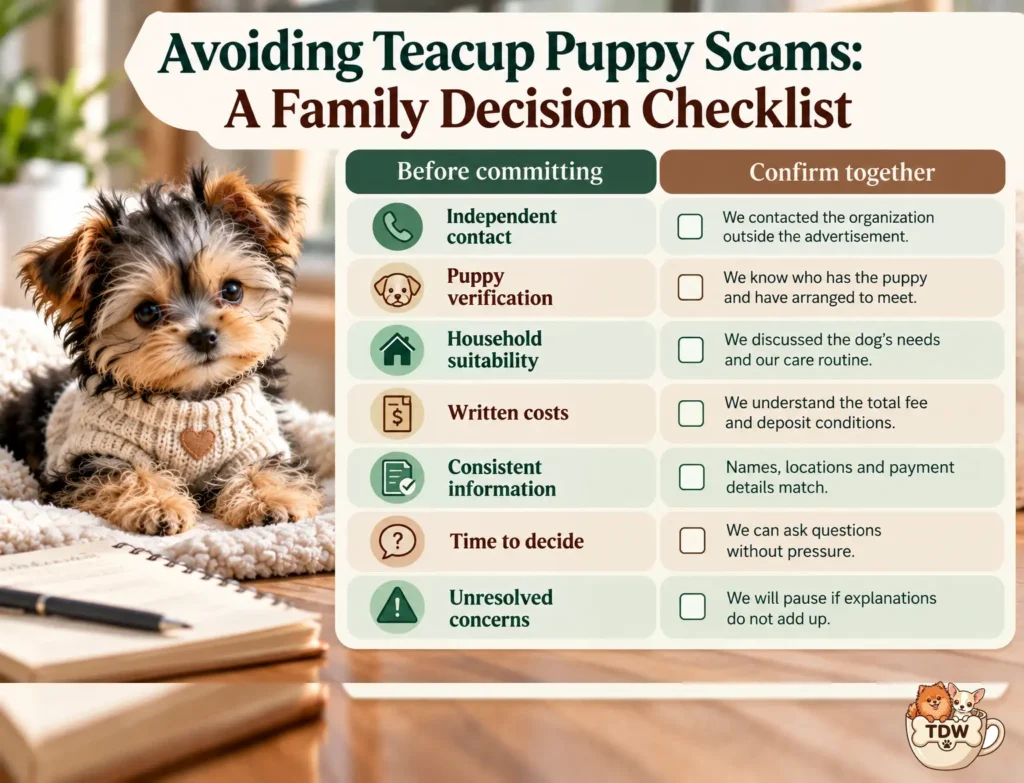
No single check proves a seller is real. Use several together, and stop if anything doesn’t add up.
- Find the contact details yourself. Look up the group’s real website and phone number on your own. Don’t trust the number in the ad. Then ask the rescue or breeder you contacted to confirm this puppy listing, this contact person, and these payment instructions.
- Search their name. Add words like “review,” “scam,” or “complaint” and see what others have said. Remember that reviews on the seller’s own site can be fake.
- Do a reverse image search. This is a free tool that shows where else a photo appears online. A real rescue may post the same dog on a few sites. But if the same puppy shows up under a different name, place, or group, that’s a serious warning.
- Ask for a live video call. It’s a useful check, but it isn’t proof. Scammers can show someone else’s puppy, and AI can fake images. Use it together with the other steps.
- Visit in person. This is the strongest check. Meet the puppy and see where it lives before you pay.
- Check any shipper yourself. Look up the shipping company on your own and contact it directly. Check IPATA’s directory if the shipper claims to be a member.
- Ask about age and origin. The CDC says dogs coming into the US must be at least six months old, have a microchip, and look healthy. A seller offering a very young puppy from another country is a red flag.
Safer Ways to Pay
The FTC says only scammers tell you that you must pay with gift cards, a payment app, cryptocurrency, or a wire transfer, because that money is hard to get back.
The AKC says paying by credit card or PayPal Goods and Services is typically the safest choice. These methods may let you dispute a charge, which means asking the company to reverse it. But that isn’t guaranteed, so don’t count on it.
The safest plan is to pay only after you’ve checked the seller carefully, and ideally after meeting the puppy in person. Always get a receipt.
What to Do If You Think You’ve Been Scammed
First, stop sending money. If you’re asked for new fees for crates, insurance, or shipping problems, don’t pay further charges while you investigate.
Then act quickly. The sooner you contact your bank or payment company, the better your chances.
Scams are designed to fool smart, caring people. If this happened to you, it’s not your fault.
How to Try to Get Your Money Back
The FTC’s guide on what to do if you were scammed explains the next steps based on how you paid:
- Credit or debit card. Contact the company or bank that issued the card.
- Gift card. Contact the company that issued the gift card. Keep the card and the receipt.
- Wire transfer. Contact the wire company or your bank. Ask them to reverse the transfer.
- Payment app. Report it to the app and ask them to reverse the payment. If the app is linked to a card, tell your card company too.
- Cryptocurrency. Contact the crypto exchange or crypto ATM operator you used right away. Tell them it was fraud and ask if they can help. Getting crypto back can be very hard, so act fast.
Save everything, including screenshots of the listing, messages, receipts, and phone numbers. If you shared personal details like your bank login or Social Security number, change your passwords and watch your accounts closely.
Be careful of a second scam. If someone contacts you out of the blue and offers to recover your money for an upfront fee, don’t pay. Real help won’t ask you to pay first to get your money back.
Where to Report a Puppy Scam
Reporting helps stop scammers and warns other families. You can report to:
- The Federal Trade Commission at ReportFraud.ftc.gov.
- The BBB Scam Tracker, which lets other shoppers see the scam.
- The FBI’s Internet Crime Complaint Center at ic3.gov.
- The website or app where you saw the ad, so it can be taken down.
Petscams.com also accepts reports and tracks fake pet sites.
Helping Your Kids Through It
If your kids were excited about the puppy, this part can hurt. Keep it simple and honest. You might say: “We couldn’t trust this arrangement, so we stopped. We’ll keep looking carefully.”
Let them know it isn’t their fault. When you’re ready, make a safe plan together, like visiting a local shelter or rescue as a family.
Safer Ways to Find a Teacup Puppy
The FTC suggests looking at local rescues and shelters, where you can usually adopt for a small fee. Breed rescues focus on one breed, such as the Chihuahua or Maltese, and many keep dogs in foster homes first.
Wherever you look, meet the dog in person before you pay anything. Search by breed name and size, not just “teacup,” since rescues don’t always use that word. Our teacup puppy adoption guide walks you through the full process step by step.
FAQs About Teacup Puppy Adoption Scams
Is a deposit always a scam?
No. Some real breeders and rescues ask for a deposit. The risk is paying a deposit before you’ve checked the seller and met the puppy. If you do pay one, use a method that gives you some protection, and get the terms in writing.
Can a real rescue ask for payment through an app?
Yes, some real rescues accept payment apps. The red flag is a seller who insists that an app, gift card, wire, or crypto is the only way to pay, especially before you’ve met the puppy.
Can scammers pretend to be a real breeder or rescue?
Yes. The AKC warns that scammers steal real breeders’ information, and the FTC warns that scammers impersonate real shelters. That’s why it’s important to contact the group yourself and confirm the listing and payment details directly.
Final Thoughts
Teacup puppy adoption scams work because they target your heart. The best protection is to slow down. Check the seller yourself, search the photos, and never pay for a puppy you haven’t met in person. Avoid sellers who insist on gift cards, wires, crypto, or app payments, and pause the moment new fees appear.
If something feels off, trust that feeling and pause. Taking your time is always the safer choice.

The TeacupDogWorld Editorial Team researches and creates practical guides about small and teacup-sized dogs, including breed characteristics, grooming, nutrition, health, training, and everyday care. Our content is developed using reputable veterinary, breed-club, and animal welfare sources to help dog owners make better-informed decisions.