
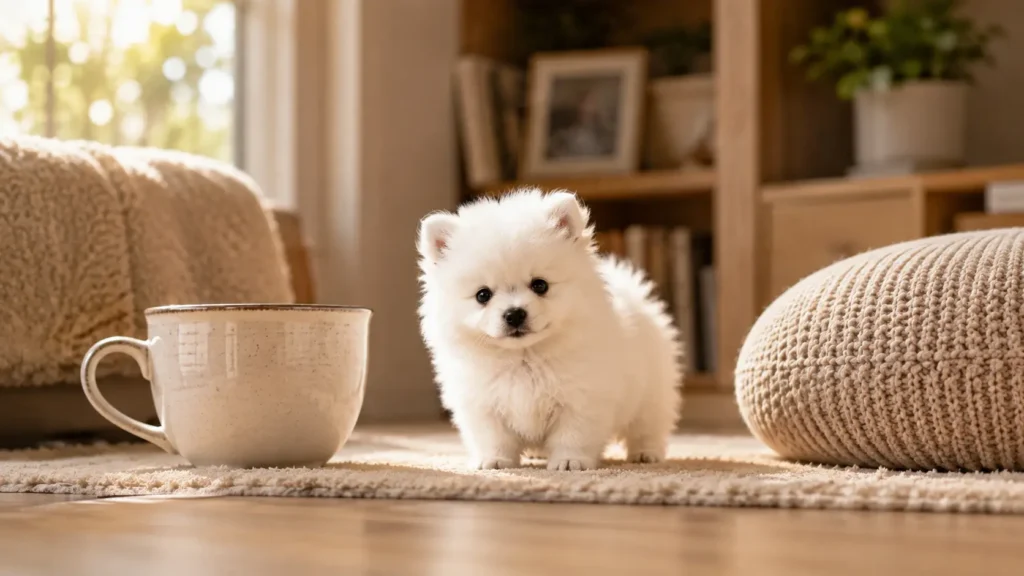
You have seen the photos. A small white ball of fluff with dark eyes and a permanent smile, advertised as a teacup Samoyed or a miniature Samoyed. Then you open an official breed page and the word is not there at all.
Here is the short answer, and it goes further than you might expect. No registry recognises a teacup or mini Samoyed, and a Samoyed is not a small breed to begin with. The smallest adult female under the breed standard stands about 19 inches at the shoulder. So the little dog in that listing is usually not a Samoyed at all.
This guide tells you what it probably is instead, how to check before you pay, and where to find a genuinely small white fluffy dog that you can actually buy.
Are Teacup Samoyed Dogs Real?
No. Teacup Samoyed and miniature Samoyed are seller words. No major kennel club recognises either one as a breed, a variety or a size.
But there is a second half to that answer, and it matters more. With some breeds, teacup at least describes a small example of a small dog. Not here. The Samoyed is a medium sized working dog that was bred to pull sleds and herd reindeer in Siberia. There is no small version of it to shrink.
You will see the same listings using micro Samoyed, pocket Samoyed, even toy Samoyed. That last one is worth a moment, because the Samoyed sits in the AKC Working Group and not in any toy group. A toy Samoyed is a contradiction, not a size.
None of this means the dog in the photo is a bad dog, or that every seller is lying on purpose. It means you are probably looking at a different breed, and you deserve to know which one before money changes hands.
How Big Is a Samoyed, Really?
Bigger than most people expect from the photos. The AKC breed standard gives height at the withers, which simply means the top of the shoulder, as 21 to 23.5 inches for males and 19 to 21 inches for females. Adults are commonly reported at roughly 45 to 65 pounds for males and 35 to 50 pounds for females.
Now the part nobody explains, and it is the whole reason this page exists. The standard does not set a weight at all. It says only that weight should be in proportion to height. Then it says something more pointed: a Samoyed that is oversized or undersized should be marked down according to how far outside the range it falls.
Read that again if you are considering a mini. In some breeds the standard simply says nothing about small dogs, which leaves a quiet gap that sellers fill. In this breed, being undersized is written down as a fault. Breeding deliberately for a smaller Samoyed is not slipping through a gap in the rules. It is going against them.
Samoyed Size Chart and What the Standard Says
| Dog | Recognised by the AKC? | Typical adult height | Typical adult weight |
|---|---|---|---|
| Samoyed, male | Yes | 21 to 23.5 inches | About 45 to 65 lb |
| Samoyed, female | Yes | 19 to 21 inches | About 35 to 50 lb |
| Teacup or mini Samoyed | No | No defined size | No defined weight |
The height figures come from the breed standard. The weights are what you will meet in practice, not a rule.
Can a Purebred Samoyed Be Smaller Than the Standard?
Yes, and that deserves saying plainly, because the rest of this page is about mislabelled dogs and an honest answer has to include the exception.
Individual dogs vary. A purebred Samoyed can grow up below the preferred height range, just as some grow above it. The accurate word for that dog is undersized. It describes one animal, not a new size class, and it does not turn the dog into a miniature Samoyed.
You will also find websites giving a mini Samoyed weight as twenty, twenty five or thirty five pounds. A dog could weigh any of those. The problem is that no such standard exists anywhere, so those numbers are somebody’s invention rather than a measurement against anything real.
So the useful question is not whether a puppy hits a teacup weight. It is why this particular dog is smaller than the breed normally runs, and what the breeder can show you about both parents.
Why Samoyed Puppies Look Like Teacup Dogs
A Samoyed puppy at eight weeks fits in two hands. It is white, round, and photographs beautifully, and it looks exactly like the tiny dog people are hoping to find.
Some teacup listings are simply young puppies. Nobody has to lie for this to happen. A buyer who has never met an adult Samoyed sees a photo, imagines that size is permanent, and gets a surprise around the first birthday.
There is one question that settles it faster than any promise about adult weight. Ask to meet both parents. A grown Samoyed in the room tells you more than a page of text.
What a “Teacup Samoyed” Usually Turns Out to Be
Here is where the confusion starts to make sense. The AKC’s own comparison of Samoyeds and American Eskimo Dogs makes the point neatly: the smallest a Samoyed can be is around 19 inches, and the largest American Eskimo Dog is around the same. Below that line you have left the breed entirely.
All of these dogs belong to the spitz family, which is the group of thick coated, pricked eared, curl tailed northern breeds. The resemblance is real and not a trick of the camera. That is exactly why a smaller white spitz can be sold as a mini Samoyed and nobody in the transaction notices.
Four things are usually behind a teacup Samoyed listing.
Japanese Spitz
The closest match by looks. A pure white spitz with dark eyes, black lips and a plumed tail carried over the back. Genuinely small, at 12 to 15 inches for males and 12 to 14 for females under the UKC standard.
The AKC has the Japanese Spitz in its Foundation Stock Service rather than as a fully recognised breed, so you will not find it in the main breed listings. It is a real, established breed with its own standards elsewhere in the world.
American Eskimo Dog
A fully recognised AKC breed that comes in three sizes, toy, miniature and standard, with the largest reaching about 19 inches. White or white and biscuit, thick coated, and bright.
For most readers hoping for a small Samoyed, this is the honest answer. It is a real breed with real breeders and real health testing behind it.
White Pomeranian
Much smaller again, usually well under ten pounds. In a photo with nothing for scale, a fluffy white Pom looks remarkably like a miniature Samoyed.
The Pomeranian is a toy breed with its own health considerations, including dental and windpipe issues common in very small dogs. That is a different conversation from this one, but worth knowing if you go that way.
Samoyed Crosses and Runts
Some sellers cross a Samoyed with one of the breeds above and sell the smaller puppies as mini Samoyeds. Others take the smallest puppy in a normal litter, the runt, and market it as a teacup. Plenty of runts grow to ordinary size anyway.
Let us be clear about one thing, because a lot of people reading this already own a dog sold to them this way. A crossbred dog can be a brilliant family pet, every bit as loved and every bit as good company. The problem is never the dog. It is being told you are buying one thing and handed another, usually at purebred prices, and usually with no health testing behind either parent.
Teacup Samoyed Health Concerns and What Testing Actually Covers
The health story here is different from other teacup pages you may have read. It is not about a tiny dog being fragile. It is about what the breed carries, and whether anyone bothered to check.
Samoyeds are generally a robust working breed. Like every pedigree breed, they have inherited conditions that responsible breeders screen for.
Hip dysplasia is one. The hip joint does not form properly, which can cause pain and arthritis later. It is checked by X ray and graded.
Eyes are another, and two conditions matter. The Samoyed Club of America points to X linked progressive retinal atrophy, where the retina slowly breaks down until the dog loses its sight, and retinal dysplasia, an abnormal development of the retina. Both have DNA tests. The club also asks breeders to have eyes examined by a specialist every year, because an examination and a DNA test answer different questions.
Heart screening is the third area, done by a veterinary cardiologist before breeding.
Then there is one that belongs to this breed in particular, Samoyed hereditary glomerulopathy. It is an inherited kidney disease, passed on the X chromosome, in which the tiny filters inside the kidney break down over time and eventually fail. If you want to read further, the breed’s health foundation keeps material on it.
The Five Health Checks a Samoyed Breeder Should Have
A breeder who is doing this properly completes five clearances set by the breed club, which together earn the dog a CHIC number.
- A hip evaluation
- An eye examination by a board certified eye specialist, repeated every year
- A cardiac evaluation
- A DNA test for X linked progressive retinal atrophy
- A DNA test for retinal dysplasia, sometimes written as RD or OSD
Two things about that CHIC number are worth knowing, and most buyers never learn either.
First, it does not mean the results were clear. It means the tests were done and the owner agreed to publish the results, whatever they said. The club states this plainly, and so should anyone selling you a puppy.
Second, published means you can read them. Results are recorded in the OFA database, and you can search a dog by its registered name or number yourself. Ask for both parents’ registered names and go and look.
Why a Mini or Crossbred Dog Falls Outside All of It
None of the above applies to a dog sold as a teacup or mini Samoyed.
There is no parent club for a size that does not exist, no testing protocol, and usually no testing at all, because the seller is running a novelty business rather than a breeding programme. If the dog is a cross, it can inherit problems from either side of the mix, and nobody has screened either side.
One more detail worth carrying with you. The Samoyed Health Foundation notes that commercial DNA panels do not necessarily include everything the breed protocol requires. So “we DNA tested the parents” is not the same sentence as “the parents completed the club’s health checks”. Ask which tests, and ask to see them.
What Living With a Samoyed Is Actually Like
Worth reading even if you have decided against a full sized one, because it explains why so many people go looking for a smaller version in the first place.
The Coat, and What Shedding Really Means
Samoyeds have a double coat, which means a soft dense undercoat underneath a longer outer coat. It needs brushing several times a week to stop it matting.
Twice a year that undercoat comes out, and the quantity genuinely surprises people. Not a bit of hair on the sofa. Clouds of it, for weeks. This is the single most common reason Samoyeds end up in rescue, and softening it would not be doing you a favour.
There is a catch for mini buyers too. A smaller crossbred dog often keeps the coat while losing the size. The grooming does not shrink with the dog.
Energy, Noise and Hot Weather
This is a working breed. Sledding and reindeer herding is what the body was built for, so it needs real daily exercise, not a walk around the block.
They are also vocal. Samoyeds talk, howl and bark, and owners who were expecting a quiet dog are often caught out.
Heat deserves a mention because almost nobody covers it. A heavy northern coat is a real consideration in warmer parts of the United States. Shade, water and avoiding the hottest hours matter, and shaving the coat is not the fix people assume, since that coat also insulates against heat and protects the skin. Ask a groomer or vet before taking clippers anywhere near one.
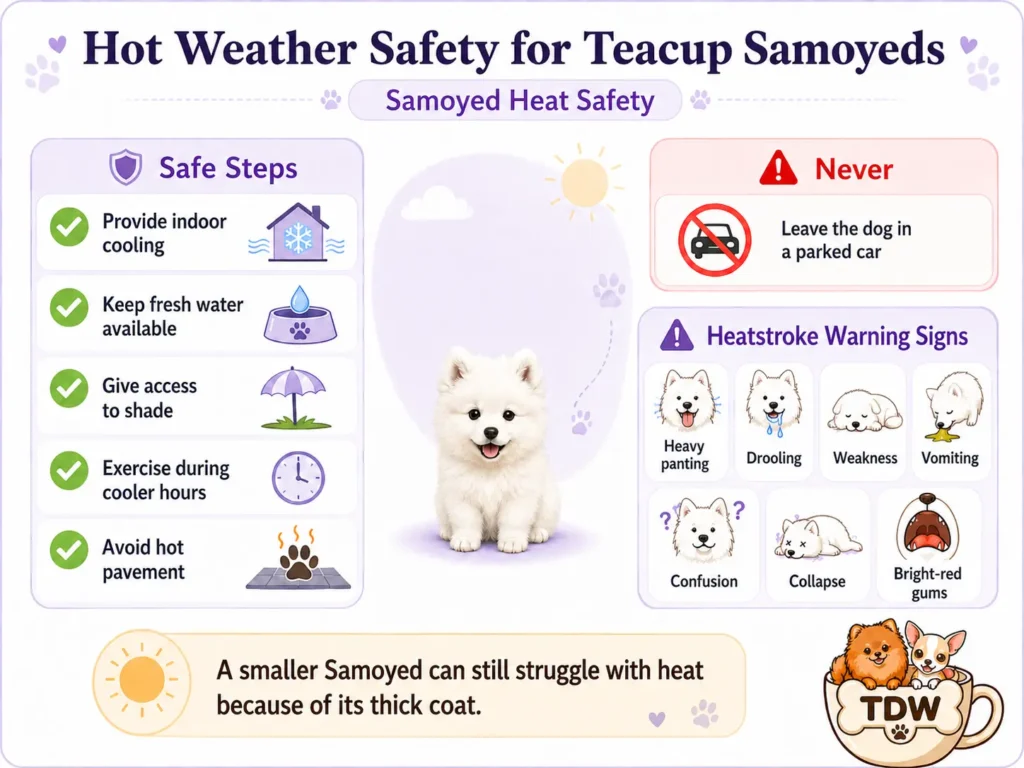
None of this rules out warm states. Plenty of Samoyeds live happily in hot parts of the country with owners who plan around it. It is a management job rather than a ban.
One last thing to sit with if a mini is tempting you. A smaller dog with Samoyed ancestry can still be vocal, still need serious daily exercise, and still hate being left alone all day. If those are the parts of the breed worrying you, a smaller label does not fix any of them.
Samoyeds and Young Children
Samoyeds are friendly and tolerant, which is a large part of why families love them. The practical issue is not temperament, it is physics.
A fifty pound dog that jumps up to say hello can knock a small child flat without a trace of bad intent. Teach a no jumping rule from day one, supervise play, and show children how to let the dog come to them rather than chasing it.
What a Teacup Samoyed Costs to Buy and to Keep
Sellers using mini or teacup wording charge a premium, often at or above what a well bred purebred Samoyed costs, for a dog with no registry behind it, no health testing and frequently no clear pedigree. You are paying extra for a word.
Either way, the purchase is the smallest part of the spend.
Grooming is the ongoing cost people forget with this breed. Either you invest in good tools and several hours a week, or you pay a professional groomer regularly, and in shedding season you may do both. Add food for a medium sized dog, routine vet care, and dental care.
One practical tip. If you want pet insurance, buy it before your dog shows any sign of a problem. Insurance does not cover a condition the dog already has.
Buying Safely: Red Flags and Questions to Ask
The Better Business Bureau’s puppy scam research found that more than half of pet scams begin on a website found through a search engine or social media, which is very likely how you reached the listing you are thinking about. The BBB also lists the word teacup in an advert as a warning sign in its own right.
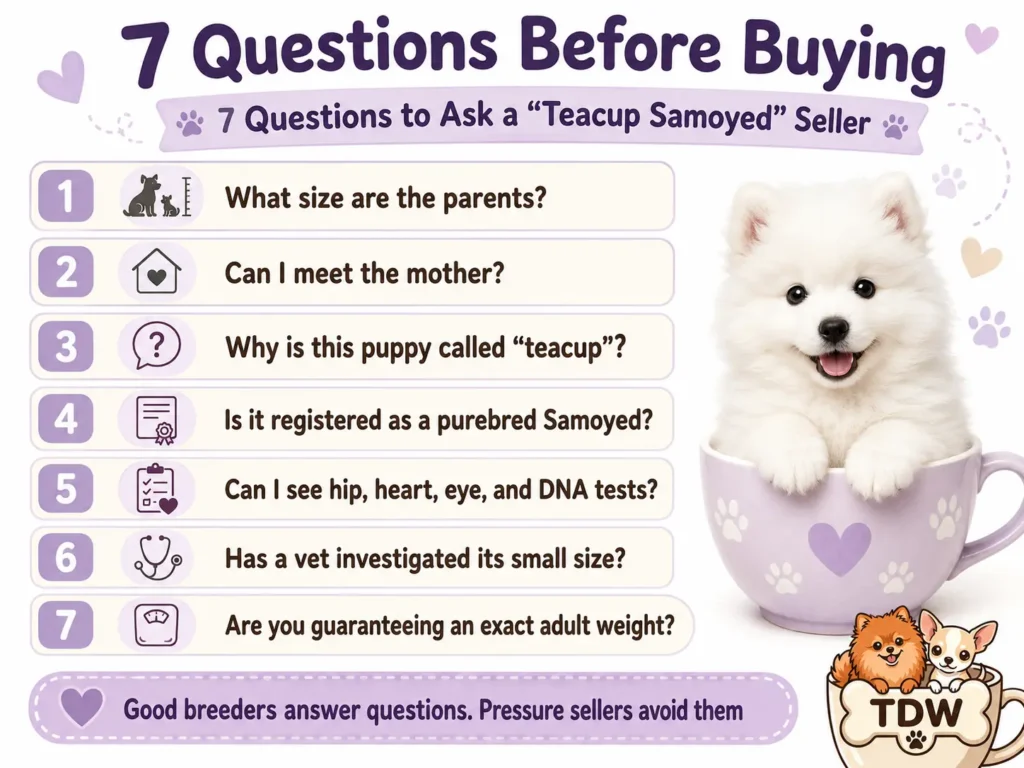
Warning Signs in a Listing
- The seller will not meet in person or do a live video call with the puppy.
- The puppy must be shipped, and shipping is arranged by somebody else.
- New fees appear after you pay a deposit.
- Payment is only by bank transfer, gift card or a payment app.
- The photos appear elsewhere in a reverse image search.
- There are no registration papers for either parent.
- The seller will not give you the parents’ registered names.
- There are no health testing records, or unsigned images instead of records.
- Puppies are offered before eight weeks old.
- The word teacup, mini or micro is the main selling point.
There is one more that is specific to this breed, and it is the fastest test you have. If you cannot see both parents, and both parents are not clearly Samoyeds, you are not buying a Samoyed.
Eight Questions to Send a Breeder
Copy these into a message. The answers tell you more than the website does.
- Can I visit and meet both parents?
- Are both parents registered Samoyeds, and what are their registered names?
- Do both parents have a CHIC number, and can I see the results?
- What did the hip, eye and heart evaluations show?
- Have both parents had the DNA tests for X linked PRA and retinal dysplasia?
- At what age do puppies go home?
- Will you take the dog back at any point in its life if I cannot keep it?
- What questions do you have for me?
Question two is the quiet one. A seller who cannot or will not give you two registered names has answered the whole thing without meaning to.
The Rescue Route
Samoyed breed rescue exists, and it takes in adults for exactly the reasons in the ownership section above. The coat, the energy, the noise.
That is not a sad note, it is useful. A rescue has lived with the dog and will tell you honestly what it is like, which is more than most sellers can offer.
Better Options If You Want a Small White Fluffy Dog
You came here wanting a particular kind of dog. Small, white, fluffy, cheerful. That dog exists. It just goes by a different name.
| Breed | Roughly how big | AKC status | What you get |
|---|---|---|---|
| American Eskimo Dog | Toy, miniature and standard sizes, up to about 19 inches | Fully recognised | The closest honest match, with real breeders and health testing |
| Japanese Spitz | About 12 to 15 inches | Foundation Stock Service | The strongest resemblance to a Samoyed at a fraction of the size |
| Pomeranian | Usually well under ten pounds | Fully recognised | Genuinely tiny, with toy breed health needs to research |
| Samoyed | 19 to 23.5 inches | Fully recognised | The real thing, if your home and schedule can take it |
Each of these has its own parent club, its own recommended health tests, and its own downsides to research before you commit. None of them is a shortcut. But all of them are real dogs you can buy from a breeder who can show you paperwork, which is more than any teacup listing can offer.
Is a Samoyed Right for Your Family?
A Samoyed is likely a good fit if you have the space and time for a medium, high energy dog, you will commit to the brushing, somebody is home for a good part of the day, you can manage a big friendly dog around small children, and you live somewhere the coat is not a year round struggle.
It is probably the wrong choice if you were specifically after a small dog, you cannot commit to the coat, the house is empty from morning to night, you are in a hot climate with no practical way to keep a heavily coated dog comfortable, or a vocal dog would cause problems with neighbours.
If you are in that second group, and many readers of this page are, go back to the alternatives above. Wanting a smaller dog is a perfectly sensible thing. The mistake is only in thinking a Samoyed can be one.
Teacup Samoyed FAQs
Are teacup Samoyed dogs real?
No registry recognises a teacup Samoyed. The breed has no small version, since even the smallest adult female stands around 19 inches at the shoulder. Dogs sold under that name are usually a different spitz breed or a cross.
Is there such a thing as a miniature Samoyed?
No. Miniature Samoyed is the same marketing word as teacup, used a little more often. There is one Samoyed size range in the breed standard, and nothing below it.
How small can a Samoyed be?
Under the breed standard, females run 19 to 21 inches at the shoulder and males 21 to 23.5 inches. The standard also says undersized dogs should be marked down, so smaller is a fault rather than a variety.
What breed is usually sold as a teacup Samoyed?
Most often a Japanese Spitz, an American Eskimo Dog, a white Pomeranian, or a cross between a Samoyed and one of those. Sometimes it is simply a Samoyed puppy that has not grown yet.
How much do teacup Samoyeds cost?
There is no standard price, because there is no standard dog. Sellers using the label often charge as much as a well bred purebred Samoyed, for a dog with no registry, no pedigree you can check and usually no health testing.
Are mini Samoyeds purebred?
Usually not. A purebred Samoyed bred to the standard is a medium sized dog. A consistently small one is normally a cross with a smaller spitz breed, and you can only confirm parentage by seeing both parents and their papers.
Can a teacup Samoyed be registered with the AKC?
Not as a teacup. A purebred puppy from two registered Samoyeds can be registered as a Samoyed, but registration says nothing about size, and no registry recognises a teacup or mini category.
Are Samoyeds good with kids?
Generally yes. They are friendly and tolerant, and families like them for it. The practical issue is size and enthusiasm rather than temperament, so supervise around toddlers and teach a no jumping rule early.
Do Samoyeds shed a lot?
Yes, a great deal. They need brushing several times a week all year, and twice a year the soft undercoat comes out in large quantities for several weeks. It is the most common reason these dogs are rehomed.
What is the closest small breed to a Samoyed?
The Japanese Spitz looks the most like a small Samoyed. The American Eskimo Dog is the closest option that is fully recognised by the AKC and comes in three sizes, including genuinely small ones.
Conclusion
A teacup Samoyed is not a small Samoyed. There is no such thing, because the breed itself is a medium sized working dog with no small version to shrink. The dog in that listing is most likely a Japanese Spitz, an American Eskimo Dog, a white Pomeranian, or a cross.
If a seller cannot give you the registered names of both parents, you are not buying a Samoyed, whatever the advert says.
The good news is that the dog you pictured does exist. Look at the alternatives above, find a breeder who can show you health results you can verify yourself, and you will get the small white fluffy dog you wanted, from someone willing to prove what they are selling.
The TeacupDogWorld Editorial Team researches and creates practical guides about small and teacup-sized dogs, including breed characteristics, grooming, nutrition, health, training, and everyday care. Our content is developed using reputable veterinary, breed-club, and animal welfare sources to help dog owners make better-informed decisions.