

Forty bags on the shelf, every one promising to be the best, and your dog weighs less than a bag of sugar. It’s a lot of pressure for a decision that should be simple.
Here’s the honest answer: there isn’t one best dog food for teacup Yorkies. There’s a short set of checks that makes almost any good food easy to identify, and a few Yorkie specific situations that change the answer entirely.Want to learn more about their size, health, temperament, and care? Read our complete Teacup Yorkshire Terrier guide.
A note on what this guide is. We haven’t run feeding trials and we don’t rank products, so you won’t find a numbered list of winners here. What you’ll get instead is the criteria that veterinary and regulatory organizations actually recommend, so you can judge any bag yourself.
Below: how to read a label in about a minute, how often and how much to feed a very small dog, wet versus dry, and the health conditions that mean you call your vet instead of shopping.

The Short Answer: What “Best” Actually Means Here
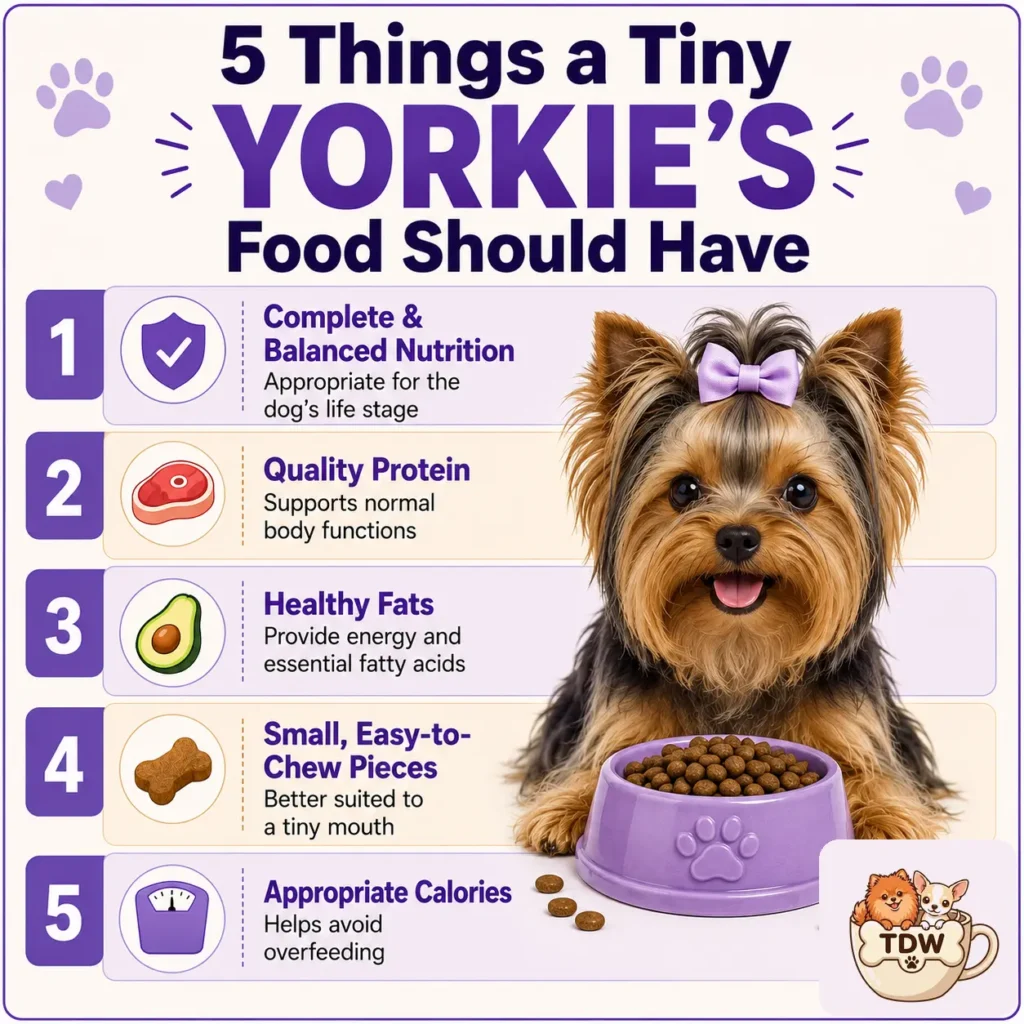
A good food for a tiny Yorkie meets four tests:
- It’s complete and balanced for your dog’s life stage. This is printed on the bag, and it’s the single most important thing there.
- It’s made by a company that can answer basic questions about who formulates their food and how they test it.
- Your dog can physically eat it. Kibble size matters more than the marketing on the front.
- It keeps your dog in good body condition. That’s the real test, and it takes a few weeks to see.
Brand matters far less than those four things. A well-made, affordable food that passes all four beats an expensive one that doesn’t.
One exception overrides everything above. If your Yorkie has a diagnosed health condition, particularly a liver shunt, the diet becomes a veterinary decision rather than a shopping decision. More on that further down.
The Three Questions That Decide the Right Food
Before you compare a single product, answer these.
1. What Life Stage Is Your Yorkie In?
Dog food is formulated for specific life stages, and AAFCO recognizes four: gestation/lactation, growth, maintenance, and all life stages. Different stages need different amounts and ratios of nutrients.
For most readers this comes down to: puppy (growth), adult (maintenance), or a food labeled for all life stages.
“All life stages” is worth understanding. Because it has to meet the requirements for growth, it’s suitable for a puppy. But it’s also more nutrient-dense than a typical adult needs, which can mean weight gain in a less active dog.
Ask your vet when to move your puppy to adult food. It varies with the individual dog, and it’s a two-minute question at a visit you’re already having.
2. Does Your Yorkie Have a Health Condition?
If your dog has a diagnosis, stop comparing retail bags and talk to your vet. Therapeutic diets exist for specific conditions and they aren’t interchangeable with over-the-counter food.
AAFCO notes that some veterinary medical foods deliberately limit certain nutrients below the levels a healthy dog needs, and may carry an “intermittent or supplemental” statement or the instruction “use only as directed by your veterinarian.” That’s not a flaw in the product. It’s the whole point of it.
We cover the specific Yorkie conditions further down.
3. Can Your Dog Physically Eat It?
This sounds obvious, and it’s the thing most owners discover after buying a 12-pound bag.
Small-breed formulas mostly differ in two ways: smaller kibble pieces, and usually more calories per cup. Neither is magic, but the first one genuinely matters for a dog with a tiny jaw.
If your puppy is struggling with kibble, you can soften it with a little warm water, switch to wet food, or mix the two. One trade-off worth knowing: softened kibble loses whatever mild abrasive benefit dry food offers for teeth.
How to Read a Dog Food Label in 60 Seconds
This is the most useful skill in this article. Learn it once and you can evaluate any bag, in any store, for the rest of your dog’s life.
Find the Nutritional Adequacy Statement
AAFCO calls this “perhaps the most important part of a label,” and describes it as the key to matching a pet’s needs to a product. It’s almost always on the back or side of the package, in small print.
You’re looking for one of these wordings:
- “[Product] is formulated to meet the nutritional levels established by the AAFCO Dog Food Nutrient Profiles for [life stage].” The recipe was built to hit established nutrient targets.
- “Animal feeding tests using AAFCO procedures substantiate that [product] provides complete and balanced nutrition for [life stage].” The food was fed to real dogs under standardized protocols.
Both mean the food is complete and balanced. “Complete” means it contains all the required nutrients; “balanced” means they’re in the right ratios. Feeding trials test the food in live animals, which some veterinary nutritionists prefer, but a formulated food isn’t disqualified.
The red flag: “This product is intended for intermittent or supplementary feeding only.” AAFCO is explicit that foods carrying this statement don’t meet the standards for complete and balanced nutrition. It’s normal on toppers and some treats. It’s a problem if you were planning to make it your dog’s whole diet.
One myth to retire while you’re here. There’s no such thing as “AAFCO approved.” AAFCO states it plainly: it does not regulate, test, approve or certify pet food. It sets model standards that states adopt. Any brand claiming AAFCO approval is telling you something about its marketing.
Check the Calorie Statement
US labels carry a calorie statement under a heading called “Calorie Content,” expressed in kilocalories per kilogram plus a familiar unit like per cup or per can.
For a 4-pound dog this matters more than you’d think. Your Yorkie eats a tiny volume of food, so the difference between a 350-kcal cup and a 480-kcal cup completely changes the portion. Two foods with identical feeding guidelines can deliver very different calories.
What the Ingredient List Does and Doesn’t Tell You
Most owners read this first. It’s the least useful panel on the bag.
The WSAVA Global Nutrition Committee puts it directly: most pet owners consider the ingredient list the most important factor in choosing a food, but it gives no information about ingredient quality and can be misleading about the overall quality of the food.
Two things worth knowing anyway:
- Ingredients are listed in descending order by weight, and that weight is measured before cooking. Fresh meat is mostly water, so a whole meat listed first can contribute less to the finished food than its position suggests.
- Product names are regulated. AAFCO’s naming rules mean “Beef Dog Food” must be mostly beef, while “Dog Food with Beef” needs only 3%. The word “with” is doing a lot of work on some bags.
Questions Worth Asking the Manufacturer
If the ingredient list won’t tell you much, what will? The company behind the food.
The WSAVA Global Nutrition Committee publishes a set of questions for owners to ask manufacturers. You can email these to any brand’s customer service:
- Do you employ a full-time qualified nutritionist? The qualifications that count are a PhD in animal nutrition or board certification through the American College of Veterinary Nutrition, ACVIM-Nutrition, or the European College of Veterinary and Comparative Nutrition.
- Who formulates your diets, and what are their credentials?
- Are your diets tested using AAFCO feeding trials, or formulated to meet AAFCO profiles?
- What quality control do you use for ingredients and finished products?
- Where are your foods manufactured?
- Can you provide a complete nutrient analysis for this product?
A second myth to retire: “WSAVA approved” isn’t a thing either. WSAVA doesn’t endorse, certify or rank brands. It publishes questions. A company advertising WSAVA approval is misrepresenting what WSAVA does.
What you’re really testing is responsiveness. A company that answers clearly has nothing to hide. A company that deflects has told you something useful.
[INTERNAL LINK OPPORTUNITY: article about how to evaluate a dog food brand]
How Often Should a Teacup Yorkie Eat?
More often than a bigger dog. Very young toy-breed puppies typically need three to four meals spread through the day and shouldn’t go long stretches without food. Most healthy adults do well on two meals a day.
| Stage | Typical meal frequency | Why |
|---|---|---|
| Very young puppy | 3–4 meals a day | Small energy reserves; low blood sugar risk |
| Older puppy | 3 meals, tapering down | Bigger appetite and stomach capacity |
| Adult | 2 meals a day | Steady energy; easier to control portions |
| Senior or unwell | As your vet advises | Depends entirely on the condition |
Confirm the schedule with your vet, especially for a puppy under a few pounds.
Here’s the part that surprises people: for a very small puppy, when they eat can matter more than what they eat.
Low Blood Sugar: Why Timing Matters More Than Brand
Hypoglycemia means blood sugar has dropped too low. Veterinary Partner explains that toy-breed puppies are particularly vulnerable, because they have very little stored energy to draw on.
Common triggers include missed or delayed meals, stress, cold, and a burst of activity on an empty stomach.
Signs to watch for:
- Weakness or unsteadiness on their feet
- Trembling
- Unusual sleepiness or difficulty waking
- Disorientation
- In severe cases, seizures or collapse
This is a call-your-vet situation, not a wait-and-see one. If you’ve just brought home a very small puppy, ask your vet what to do if you see these signs, before you need the answer.
[INTERNAL LINK OPPORTUNITY: article about low blood sugar in tiny puppies]
Scheduled Meals vs. Free Feeding
Scheduled meals make two things possible: controlling portions, and noticing when your dog goes off their food. Appetite loss is often the first sign that something’s wrong, and you’ll miss it if the bowl is always full.
Free feeding makes both harder, and kibble sitting out all day goes stale.
That said, some vets suggest keeping food available for very small puppies at risk of low blood sugar. This is a conversation to have about your specific dog rather than a rule to follow from an article.
How Much Should You Feed?
Why the Bag’s Guidelines Are Only a Starting Point
Feeding directions are required on complete and balanced foods, and AAFCO is candid about their limits: nutrition isn’t an entirely precise science, because individual animals have very different activity levels, genetics and environments. The directions are guidelines that may need modifying for a particular pet.
For a tiny Yorkie, two practical problems follow.
First, bag guidelines are averages across a weight band. A 3-pound Yorkie and a 7-pound Yorkie often fall in the same row of the table, and they don’t need the same amount.
Second, precision matters at this scale. Use a proper measuring cup or, better, a kitchen scale. Eyeballing a portion for a 4-pound dog introduces a much bigger percentage error than it would for a Labrador.
And treats count. For a dog this small, a couple of biscuits can be a meaningful share of the day’s calories. WSAVA publishes a guide to feeding treats that’s worth a look if your Yorkie is gaining weight and you can’t work out why.
Body Condition: The Check That Replaces Guessing
Rather than trusting a number on a bag, use your hands. This is what vets do.
- Ribs: you should be able to feel them easily under a thin layer of fat, without pressing hard. If you have to dig, your dog is carrying too much. If they feel sharp with no covering at all, too little.
- From above: you should see a waist behind the ribs.
- From the side: the belly should tuck up rather than running straight or sagging.
WSAVA publishes a free body condition score chart for dogs with illustrations, which is far more useful than any feeding table.
Adjust portions gradually and reassess every couple of weeks. This is the real test of whether a food and a portion are working.
Wet, Dry, Fresh, or a Mix?
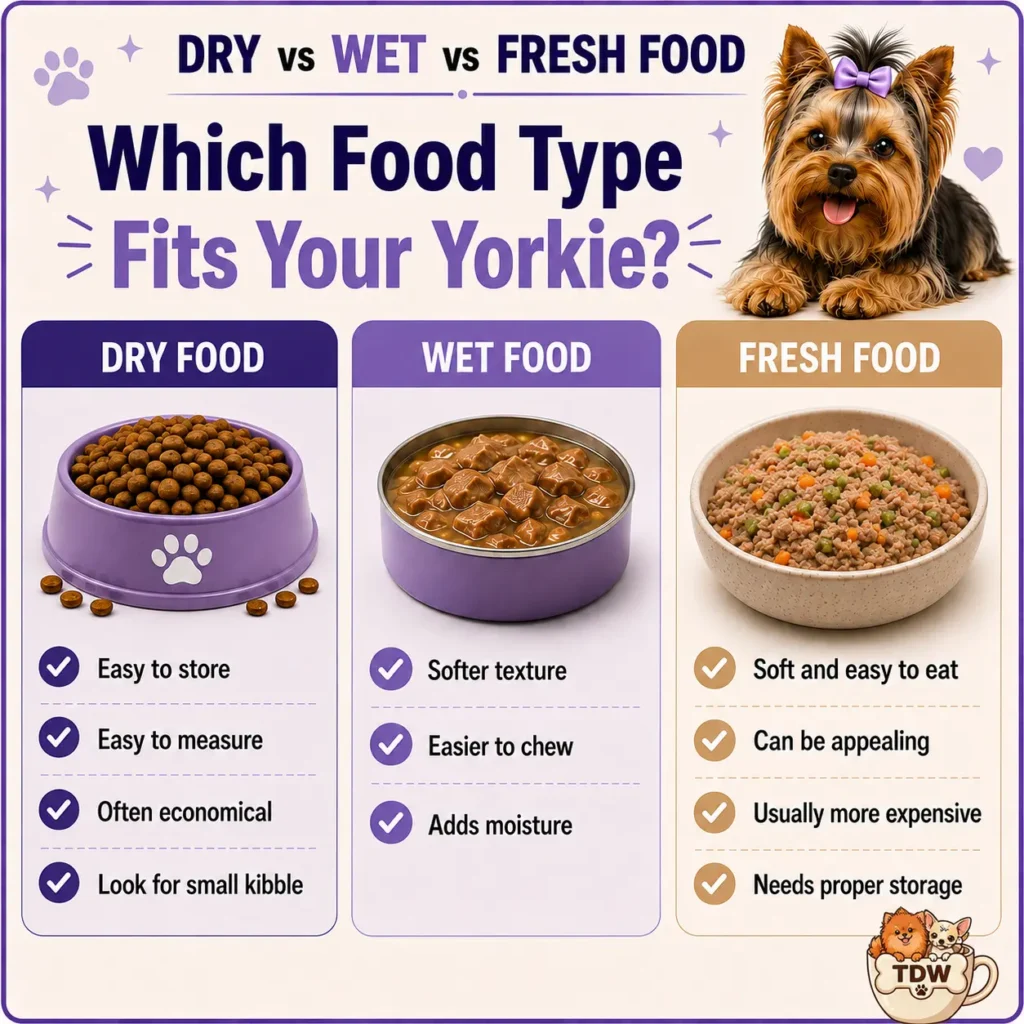
No format is inherently healthier. Each one can be complete and balanced, or not, and the adequacy statement tells you which.
| Format | Strengths | Trade-offs | Worth considering when |
|---|---|---|---|
| Dry (kibble) | Convenient, economical, easy to measure | Pieces must be small enough to chew | Most healthy adult Yorkies |
| Wet (canned) | Very palatable, adds moisture, easy to eat | Costs more; opened cans need refrigerating | Picky eaters, sore mouths, dogs needing more water |
| Fresh / gently cooked | Highly palatable; portioned for you | Most expensive; needs fridge or freezer space | Households with the budget, using a food that meets AAFCO standards |
| Mixed feeding | Palatability of wet with the economy of dry | You have to count calories across both | Picky eaters on a normal budget |
If you mix formats, remember that calories from both count toward the same daily total. This is where a lot of small dogs quietly gain weight.
Yorkie Specific Situations That Can Change the Best Dog Food for Teacup Yorkies
This is where a general “best food” list stops being useful for some readers.
Liver Shunt
A portosystemic shunt is an abnormal blood vessel that lets blood bypass the liver instead of flowing through it, so toxins the liver would normally filter stay in circulation.
It matters here because VCA Animal Hospitals lists Yorkshire Terriers among the breeds with an increased incidence of portosystemic shunts. The Merck Veterinary Manual notes that extrahepatic shunts, the type small dogs usually get, are more common in toy breeds including Yorkies.
Signs often appear in young dogs, and may include poor growth, disorientation or unusual behavior after meals, and neurological signs.
Why it belongs in a food article: Merck notes that non-surgical management of a single congenital shunt may include feeding a protein-restricted diet, with or without lactulose. That’s a therapeutic diet, prescribed and monitored by a vet, with regular rechecks.
So if your Yorkie has been diagnosed with a liver shunt, or your vet has raised the possibility, no retail “best food” recommendation applies to your dog. That includes this one. Talk to your vet.
Dental Disease
The American Animal Hospital Association identifies toy breeds, including Yorkies, as being at high risk of early periodontal disease. Small mouths mean crowded teeth, and crowded teeth trap food and plaque.
Food’s role here is real but limited. Some dental diets and treats have evidence behind them, and the Veterinary Oral Health Council maintains a list of products shown to help control plaque or tartar. Look for that rather than trusting “dental” on a package.
What food can’t do is replace brushing and veterinary dental care. AAHA recommends that small-breed dogs get their first full dental evaluation under anesthesia by around one year of age.For more on brushing, coat care, bathing, and dental hygiene, see our complete Teacup Yorkie grooming guide
One practical note: a dog with painful teeth may refuse kibble or start dropping food. That’s a symptom, not a preference. Get the mouth checked before you go shopping for a new bag.
Suspected Food Allergies
You can’t diagnose a food allergy by buying a “sensitive” formula.
A genuine food allergy is identified through an elimination diet trial: your vet selects a specific diet, you feed it and nothing else for several weeks, and then you reintroduce foods to see what triggers a reaction. Compliance has to be strict, right down to treats and flavored medications, or the result means nothing.
Switching foods repeatedly on your own can actually make a later trial harder to interpret, because it narrows the list of proteins your dog hasn’t already been exposed to.
If your Yorkie is itchy, see your vet before you see the pet store.
The Grain-Free Question
This one deserves a careful answer, because both extremes you’ll read online are wrong.
In July 2018, the FDA announced it was investigating reports of dilated cardiomyopathy (a disease of the heart muscle) in dogs eating certain foods. Many were labeled grain-free, and contained a high proportion of peas, lentils, other legume seeds or potatoes among their main ingredients. Of the products reported, more than 90% were grain-free and 93% contained peas and/or lentils.
In December 2022, the FDA added an update: the reports it had received “do not supply sufficient data to establish a causal relationship with reported product(s),” and it doesn’t intend to release further public updates until there’s meaningful new scientific information to share.
Here’s the nuance that gets lost. That isn’t a clean bill of health. The agency said the evidence wasn’t sufficient to establish cause, which is different from saying grain-free diets are safe. Many veterinary nutritionists still advise caution about legume-heavy diets, particularly for dogs with existing cardiac concerns. That’s a professional position, not a settled fact.
The practical takeaway: unless your vet has identified a specific reason your dog needs to avoid grains, there’s no particular benefit to seeking out grain-free. If you prefer it anyway, raise it at your next appointment.
Switching Foods Without Upsetting Their Stomach
The usual approach is a gradual transition over about a week, starting with mostly old food and shifting the ratio a little each day. It’s convention rather than a formal protocol, but it’s sensible and it works.
A few things specific to a tiny dog:
- Watch for loose stools, vomiting or refusal, and slow down if you see them.
- Don’t push a transition through a hunger strike. For a 4-pound dog, a day or two of barely eating is more serious than it would be for a large dog.
- Change one thing at a time. New food and new treats in the same week means you won’t know what caused a reaction.
When to Stop Guessing and Call Your Vet
Some things aren’t food problems, even when they look like one:
- Refusing food for more than a day, or any refusal in a very young puppy
- Weakness, trembling, wobbliness or unusual sleepiness
- Vomiting or diarrhea that doesn’t resolve
- Losing weight, or not gaining on a normal amount of food
- Disorientation, circling or seizures, particularly after meals
- Bad breath, bleeding gums, or dropping food while eating
- Ongoing itching or skin problems you’ve been trying to fix by changing foods
This list isn’t here to alarm you. It’s here so you know where the line is between troubleshooting at home and picking up the phone.
Teacup Yorkie Food FAQs
Should a teacup Yorkie eat puppy food or adult food?
Puppy food, or an “all life stages” food, while they’re growing. Your vet is the right person to say when to switch, since it depends on the individual dog rather than a fixed date.
Is expensive dog food better?
Not reliably. Price reflects ingredients, marketing, packaging and distribution as much as nutritional quality. Run the four checks at the top of this article instead, and you’ll find good food at several price points.
Can I feed my Yorkie human food?
Some human foods are fine in small amounts; several are genuinely dangerous for dogs. It’s worth reading a proper list rather than guessing, and remember that a 4-pound dog reaches a harmful dose far faster than a big one.
[INTERNAL LINK OPPORTUNITY: article about foods that are dangerous for small dogs]
My Yorkie is a picky eater. What should I do?
Rule out the physical causes first, especially dental pain and nausea. If your vet gives the all-clear, look at whether treats and table scraps are filling them up, try warming wet food slightly to boost the aroma, and keep meals to a set window rather than leaving food down all day.
How do I know the food is working?
Give it a few weeks and check four things: body condition, stool quality, coat condition, and energy. Those tell you more than any review.
Conclusion
There’s no single best dog food for teacup Yorkies, and any page that names one is selling something. There are four checks: complete and balanced for the life stage, a manufacturer who answers questions, kibble your dog can actually eat, and a body condition that stays where it should.
Feed a very small puppy often, measure portions properly, and judge the result with your hands rather than the bag.
And if your Yorkie has a diagnosis, especially anything involving the liver, hand the decision to your vet. That’s the one situation where the right food isn’t on a shelf.
Next time you’re in the pet aisle, flip the bag over and find the adequacy statement. It takes ten seconds and it rules out more products than you’d expect.

The TeacupDogWorld Editorial Team researches and creates practical guides about small and teacup-sized dogs, including breed characteristics, grooming, nutrition, health, training, and everyday care. Our content is developed using reputable veterinary, breed-club, and animal welfare sources to help dog owners make better-informed decisions.