
You have found tiny Papillons advertised as teacup, often at a high price. Then you open a proper breed page and the word is not there at all. That gap is confusing, and it is fair to wonder who is telling you the truth.
Here is the short answer. No major kennel club recognises a teacup Papillon. The dogs in those listings are real, and many of them are healthy, but the word itself is a seller’s choice and not a size.
This guide covers what you actually need before you pay anyone. How small these dogs really are, the two DNA tests that matter more than any weight promise, what this breed is genuinely like to live with, and the warning signs of a listing you should walk away from.
Is a Teacup Papillon a Real Breed or Size?
No. Teacup is a marketing word, not a breed and not a recognised size. The AKC breed standard describes one Papillon, measured by height, with no teacup category anywhere in it. A dog sold as a teacup is simply a small Papillon.
It is not only the AKC. The United Kennel Club standard sets the same height rules and also has no teacup size. So this is not one registry being fussy. The category does not exist.
You will meet the same dog under several names. Micro Papillon. Mini Papillon. Teacup Papillon. None of them appear in a breed standard.
One word deserves care, though. You will also see “toy Papillon”, and that one is half true. The Papillon really does belong to the AKC Toy Group, which is the group of small companion breeds. Toy is real. Teacup is not a size that follows on from it.
Here is the balanced version, and it cuts both ways. The word does not mean the puppy is sick. It does not mean the seller is a fraud either. It simply tells you nothing at all about the dog.
How Big Is a Teacup Papillon, Really?
The honest answer is that nobody can tell you, because no threshold exists. Sellers using the word usually mean an adult under about four pounds, but that figure comes from adverts, not from any rule.
What does mean something is the official measurement. A Papillon should stand 8 to 11 inches at the shoulder. Over 11 inches is a fault in the show ring, and over 12 inches disqualifies the dog completely.
Now the part almost nobody explains. The standard does not give a weight. It says only that weight should be in proportion to height. In practice, pet Papillons usually weigh somewhere around 5 to 10 pounds, but that range describes what you will meet, not what any rule requires.
That matters more than it sounds. When a seller promises you a two pound teacup, they are making a weight promise about a breed whose standard never uses weight. There is no official line for them to cross, which is exactly why the checking falls to you.
Papillon Size Chart: Standard, Small and “Teacup”
| Label | Recognised by the AKC? | Typical adult size | What it actually is |
|---|---|---|---|
| Papillon, by the breed standard | Yes | 8 to 11 inches at the shoulder, weight in proportion | The only officially described size |
| Papillon as a pet, in practice | Yes, the same dog | Commonly around 5 to 10 pounds | The normal range you will meet |
| Phalène | Yes, same breed | Same as above | The drop eared type, judged by the same standard |
| Teacup or micro Papillon | No | Often advertised under about 4 pounds | A seller’s word for a small Papillon |
Papillon or Phalène? The Two Ear Types Explained
Papillons come with two ear types, and both are the same breed. The familiar type has large upright ears with long fringing, which look like open butterfly wings. That is where the name comes from, since papillon is French for butterfly. The other type carries the same big ears folded down, and it is called the Phalène, French for moth.
The breed standard covers both, and they are judged the same way. A Phalène is not a crossbreed, not a fault, and not a lesser dog. If a seller presents drop ears as something rare and special, that is sales talk rather than fact.
Why a Tiny Puppy May Not Stay Tiny
No breeder can promise you an adult weight. They can give you a sensible estimate, and an honest one will say it is an estimate.
Your best guide is the parents. Ask what both of them weigh as adults, and ask to see them in person or on video. Puppies grow at different rates, and a very small eight week old can catch up more than you expect. If exact size genuinely matters to you, the simplest answer is an adult dog. What you see is what you get.
Where Extra Small Papillons Come From
There are three routes, and which one you are looking at matters far more than the number on the scale.
The first is normal variation. Some Papillons are simply at the small end of a breed that is already small. Two healthy parents can produce a puppy that finishes a little under the usual range. If the breeder health tests and does not sell size as the product, this is just a small dog.
The second is breeding for smallness. Some breeders keep choosing the smallest dog in each litter and pairing those dogs together, generation after generation. Narrowing a breeding pool that hard tends to concentrate whatever else those lines carry, and this approach rarely comes with health testing attached.
The third is a medical reason. A puppy can be small because something is wrong, such as poor early feeding, a heavy worm burden, or an underlying problem. A puppy that is unusually small and also unusually quiet or weak should see a vet before money changes hands.
Because the standard sets no lower weight limit, there is no official line for anyone to cross here. That is not a loophole worth worrying about on its own. It just means the buyer has to ask the questions that no rulebook asks for them.
Teacup Papillon Health Problems Worth Knowing About
Start with the good news, because it is real. Papillons are generally a sturdy little breed and they often live well into their teens. Being very small does not create brand new diseases. What it does is remove some of the margin for the problems this breed already has.
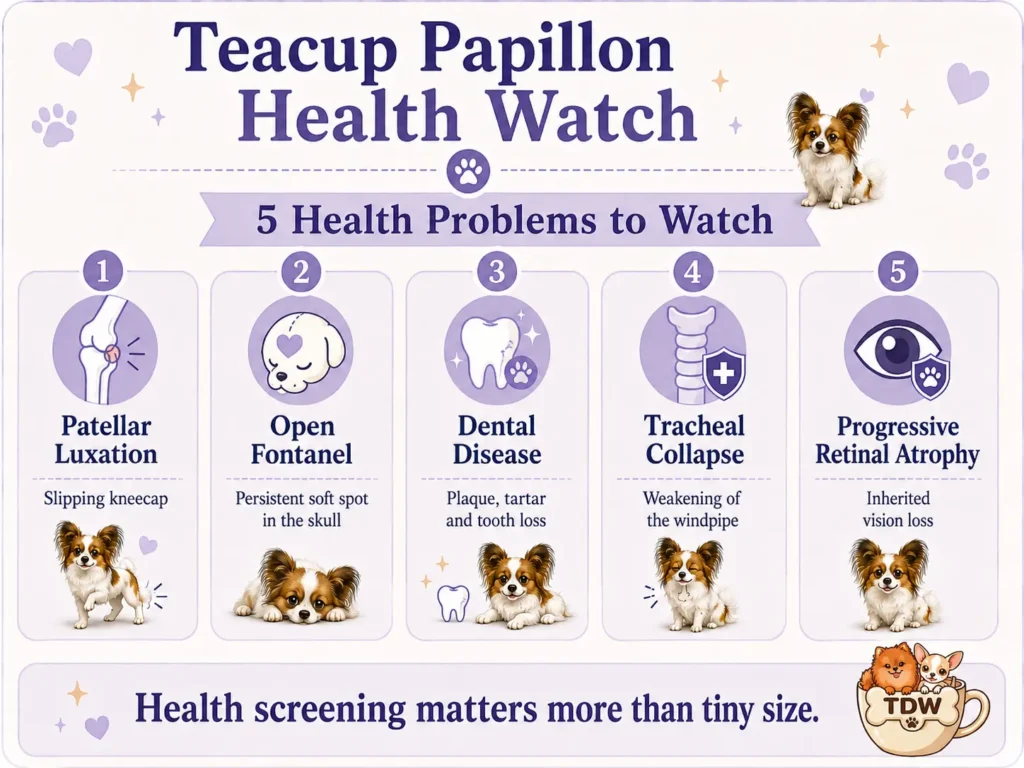
Slipping Kneecaps, the Most Common Problem in the Breed
Patellar luxation means the kneecap slips out of the groove it is meant to sit in. It is the orthopedic problem reported most often in Papillons, and in small dogs generally.
The classic sign is easy to spot once you know it. Cornell’s veterinary school describes it as a skipping walk, where the dog suddenly lifts one back leg for a few steps, shakes it, then carries on as though nothing happened. Mild cases may cause no trouble at all. More severe cases wear the joint over time and can lead to arthritis, and some need surgery.
Vets grade it from one to four by how easily the kneecap moves. It can be checked by hand during an ordinary examination, and results for breeding dogs are usually recorded from twelve months of age.
Keeping your dog lean helps, and so does putting rugs on slippery floors. Neither prevents the underlying shape of the joint, which the dog is born with.
Two Inherited Diseases a DNA Test Can Screen Out
This is the most useful thing on this page, and almost no Papillon article mentions it.
The Papillon Club of America, which is the national breed club, recommends DNA testing for two diseases that run in this breed.
The first is progressive retinal atrophy, known as PRA1. The retina at the back of the eye slowly breaks down, sight fades, and the dog eventually goes blind. It is not painful, and blind dogs often cope well, but it changes a life.
The second is neuroaxonal dystrophy. This one is harder to read about. It is an inherited nerve disease, and affected puppies show it very young, usually within the first few months, with a wobbly walk and loss of coordination that gets worse rather than better. It is not survivable.
Now the hopeful part, and it is genuinely hopeful. Both conditions are recessive, which means a puppy can only be affected if both parents carry the gene. A dog can carry one copy and be completely healthy. So a breeder who tests both parents can avoid producing an affected puppy at all.
That turns a frightening subject into one simple question. Ask the breeder for both parents’ DNA results for PRA1 and neuroaxonal dystrophy. A breeder who tests will have the paperwork ready and will be glad you asked. A breeder who has never heard of either one has just told you something important.
The club lists a few further DNA tests as well, including von Willebrand disease type 1 and Factor VII deficiency, both of which affect blood clotting.
Low Blood Sugar in Very Small Puppies
Low blood sugar, called hypoglycaemia, is the urgent risk in the first months of a very small puppy’s life.
Veterinary guidance on toy breed puppies explains why it happens. Tiny puppies get their baby teeth late and struggle with hard food, they lose body heat quickly, and they store almost no spare energy. A missed meal matters far more than it would in a bigger dog.
Know the signs. A puppy that goes floppy, wobbly, cold or unresponsive may have dangerously low blood sugar. Offer food straight away. If the puppy will not eat, or does not perk up, treat it as an emergency and get to a vet. Fits or collapse mean go now, not in the morning.
In practice this means small meals several times a day through the early months, and somebody at home to notice if one gets skipped.
Other Risks Worth Knowing About
A few more to keep on your radar. Some belong to this breed and some come from what we know about very small dogs in general, and it is worth being clear which is which.
Crowded teeth and gum disease are common, because a small jaw still holds a full set of teeth. This is one of the strongest reasons to start brushing early.
Some puppies are born with a soft spot on the skull, called an open fontanelle, much like a human baby has. It usually closes during the first few months. If it stays open, it does not normally trouble the dog, but it does make a knock to the head more serious.
- A weak windpipe can cause a honking cough in small dogs. It is a good reason to walk your dog on a harness instead of a collar.
- Short falls cause more damage than people expect. A jump off the sofa is a long way down for a four pound dog.
- Anaesthetic and medicine doses need extra care in very small patients, even for routine work like a dental cleaning.
Teacup Papillon Temperament: A Busy Dog in a Small Body
If you take one thing from this article besides the DNA tests, take this. A Papillon is not a decorative lap dog.
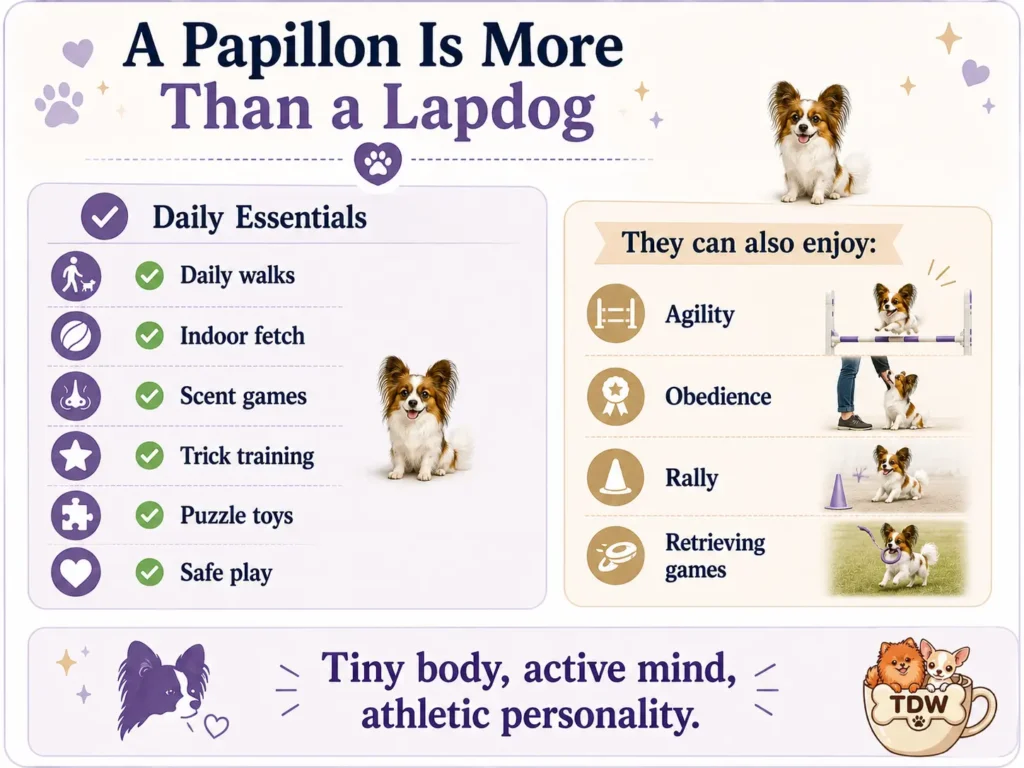
This is one of the brightest, busiest toy breeds there is. Papillons do extremely well in agility and obedience, competing happily against dogs many times their size. They are alert, curious, quick to learn, and quick to bark at anything new outside the window.
They want something to do. A Papillon with nothing to think about will invent a job, and the job it usually picks is barking. That is worth knowing before you bring one into an apartment.
Making the dog smaller does not make it calmer. It makes the same lively dog easier to injure.
The upside is considerable. They train beautifully with rewards, they enjoy learning tricks, and they are generally friendly with people and other dogs when socialised early. They do not enjoy being left alone all day, so a house that is empty from morning to evening is a poor match.
Plan on a daily walk plus a short training or puzzle session. Ten focused minutes does more for this breed than an hour of being carried around.
Living With Bigger Dogs and Other Pets
Papillons usually get along well with other animals, and they are rarely the ones starting trouble. The risk is size, not temper.
A large dog can badly hurt a four pound dog without meaning any harm at all, simply by stepping on it, knocking into it, or playing the way a big dog plays. The breed club raises this directly, and it is worth thinking about before you bring a very small Papillon into a house with a boisterous larger dog.
That does not rule it out. It does mean you need to be able to supervise them together, and to separate them easily when nobody is watching. Cats are usually fine, with the same sensible introductions.
Living With a Teacup Papillon and Young Children
- A very small dog and an excited young child need rules that everybody follows from the first day.
- Petting happens sitting on the floor. Young children do not carry the dog at all.
- Adults lift with two hands, supporting the chest and the back end together.
- No jumping on or off sofas and beds, and put rugs down on slippery floors, which helps those knees.
- The dog gets a bed or crate that children are not allowed to touch, and that rule is kept.
- Teach children what “leave me alone” looks like in a dog. Turning the head away, going stiff, or walking off.
- These dogs usually suit school age children better than toddlers. In the end, how the child behaves matters more than the child’s age.
What a Teacup Papillon Costs to Buy and to Keep
Sellers who use the teacup word charge more than breeders selling an ordinary small Papillon. You are paying extra for the word. It does not buy health testing, and it does not buy a healthier puppy.
The purchase is also the smallest part of what you will spend.
In the first year, plan for vet visits and vaccines, neutering, a microchip, food, a crate and harness, non slip mats, and a puppy class. After that you keep paying every year for check ups, food, and dental care, which in this breed matters more than most.
Then there is the cost people do not plan for. Knee surgery is not rare in toy breeds. Ask a vet near you what it usually runs in your area, so you know the number before you need it rather than after.
Here is the most useful money tip in this guide. If you want pet insurance, buy it before your dog shows any sign of a problem. Insurance does not cover a condition your dog already has, and the first time your dog skips on a back leg, that clock has started.
Buying a Teacup Papillon Safely: Red Flags and Questions to Ask
This is the section to read twice. The Better Business Bureau’s puppy scam research reports that more than half of pet scams begin on a website found through a search engine or social media, which is very likely how you found the listing you are considering.
And there is an uncomfortable detail in there. The BBB lists the word teacup in an advert as a warning sign in its own right. Not proof of fraud, but it appears often enough in fake listings to be worth naming.
Warning Signs in a Listing
- The seller will not meet in person or do a live video call with the puppy.
- The puppy has to be shipped, and shipping is handled by somebody else.
- New fees appear after you pay a deposit, for a crate, insurance or a delay.
- Payment is only by bank transfer, gift card or a payment app.
- The photos turn up elsewhere in a reverse image search.
- The price sits far below or far above the market with no explanation.
- There are no vet records, or the records are unsigned images.
- Puppies are offered before eight weeks old.
- The guarantees are about size rather than health.
Pay by credit card where you can, and never send money for a dog you have not at least seen alive on a video call.
The Health Tests to Ask About by Name
“Vet checked” describes the puppy in front of you. It says nothing about the parents, and inherited disease comes from the parents.
The AKC’s toy group health testing requirements, which follow the Papillon Club of America’s advice, list three checks for Papillon breeding dogs.
- An eye examination by a board certified veterinary eye specialist
- A patella evaluation, meaning the knees
- A cardiac evaluation, meaning the heart
Add the two DNA tests from the health section, PRA1 and neuroaxonal dystrophy, and you have the full list.
One point causes a lot of confusion, so it is worth being clear. The eye examination and the PRA1 DNA test are not the same thing and neither replaces the other. The DNA test says whether the dog carries one known genetic fault. The eye specialist looks at the actual eyes and can spot problems the DNA test was never designed to find. A good breeder does both.
That also explains why “both parents were DNA tested” is a weaker answer than it sounds. A DNA panel cannot feel whether a kneecap slips, listen to a heart, or look inside an eye. Those need hands and instruments. So a breeder who has run a panel and nothing else has done part of the job, not all of it.
Here is the part most buyers never learn. These results are not private. Breeders record them with the Orthopedic Foundation for Animals, and you can search a dog by its registered name yourself. A dog with a CHIC number has been screened for everything the breed club recommends, with the results open to the public.
So you do not have to take anyone’s word for it. Ask for the registered names of both parents, then go and look.
Eight Questions to Send a Breeder
Copy these into a message. The answers tell you more than the website does.
- Can I visit and meet the puppy’s mother?
- What do both parents weigh as adults?
- Have the parents had eye, knee and heart checks, and can I see the results?
- Have both parents been DNA tested for PRA1 and neuroaxonal dystrophy?
- At what age do your puppies go home?
- What does your health guarantee cover, and for how long?
- Will you take the dog back at any point in its life if I cannot keep it?
- What questions do you have for me?
A good breeder answers directly and asks you plenty in return. A poor answer sounds like deflection. The mother “is not available right now”, testing is “not needed in our lines”, or the guarantee turns out to be about size rather than health. Silence on that last question tells you a great deal on its own.
The Rescue Route
Breed specific Papillon rescues and local shelters do take in small adults, usually already seen by a vet, neutered, and assessed around children. It costs a fraction of a teacup listing.
You may not get a young puppy that way. You do get a dog whose size, health and personality are already known.
Already Have a Teacup Papillon? Start Here
If the deposit is paid, or the dog is already asleep on your lap, none of this is a criticism. Here is what actually helps from today.
Protect the knees. Keep your dog lean, put rugs or runners on hard floors, and use pet steps at the sofa and bed so there is no jumping down.
Feed small meals often while the puppy is tiny, then move to a normal schedule as they grow.
Brush the teeth from the start. Small mouths crowd, and a dog that accepts a toothbrush at twelve weeks is far easier than one you start at four years.
Give the brain a job every day. Short training sessions, food puzzles, and new places to sniff. This is the single best thing you can do about barking.
Brush the coat weekly. It is easier than it looks, because there is no thick undercoat, but the long fringing behind the legs and ears does tangle. They do still shed, and the breed club states plainly that Papillons are not hypoallergenic, so spend time around one first if allergies are a concern in your home.
Learn the early signs of a knee problem. Skipping, hopping on three legs for a few steps, or a new reluctance to jump up. Mention it at the next check up rather than waiting.
Find your nearest emergency clinic now, while nothing is wrong.
Is a Teacup Papillon Right for Your Family?
A small Papillon is likely a good fit if you want a clever, lively companion and enjoy training, you are flexible about the exact adult size, somebody is home for a good part of the day, your household can manage careful handling around children, and you will buy from a breeder who health tests and lets you visit.
It is probably the wrong choice if you want a quiet ornamental lap dog, you are set on a specific tiny weight, you are buying without seeing the dog, the house is empty from morning to night, or a barky dog would cause trouble with neighbours.
If you are in the first group, here is the honest alternative. A well bred Papillon from a breeder who tests is already a very small dog, usually smaller than families expect when they meet one. You give up the word teacup. You give up nothing else.
Teacup Papillon FAQs
Do teacup Papillons really exist?
The dogs exist, the category does not. No major registry recognises a teacup size. What is being sold is a small Papillon, or occasionally a puppy that is small because of a health problem.
How big do teacup Papillons get?
Sellers usually mean an adult under about four pounds, but no definition exists. The breed standard measures height, 8 to 11 inches at the shoulder, and pet Papillons commonly weigh around 5 to 10 pounds.
How much does a teacup Papillon cost?
There is no standard price, because there is no standard size. Sellers using the label charge more than they would for a comparable small Papillon, and that extra reflects demand for the word rather than extra health testing.
How long do teacup Papillons live?
Papillons are a long lived breed and commonly reach their teens. There is no separate published lifespan for teacup marketed dogs, since they are not a defined group.
Are teacup Papillons healthy?
It depends entirely on how the dog was bred. A small Papillon from tested parents can be perfectly healthy. One produced by breeding for smallness without testing carries more risk. The label predicts nothing.
Are teacup Papillons good with kids?
They can be, with rules in place. They are friendly and playful but physically fragile, so they suit households that supervise handling. Generally a better match for school age children than for toddlers.
Can I register a teacup Papillon with the AKC?
Not as a teacup. A purebred puppy from registered parents can be registered as a Papillon, but registration says nothing about size, and no registry recognises the teacup label.
Is a Phalène the same as a teacup Papillon?
No. The Phalène is the drop eared type of the same breed, judged by the same standard. It has nothing to do with size, and it is not rarer or more valuable.
Do teacup Papillons bark a lot?
They can. Papillons are alert little watchdogs and they bark at what they notice. Daily exercise, mental work and early training make a real difference, but a bored Papillon in a quiet building will be noticed.
Is it wrong to buy a teacup Papillon?
Wanting a small dog is not wrong. What is worth avoiding is paying extra for extreme smallness, because that is what encourages breeders to keep pushing size down. Buy the breeder and the dog, not the adjective.
Conclusion
A teacup Papillon is not a breed, not a size, and not a promise. It is a word in an advert, attached to a breed that is already one of the smallest there is.
So judge the breeder instead. Ask for the eye, knee and heart results, ask for both parents’ DNA results for PRA1 and neuroaxonal dystrophy, and look those results up yourself in the public database. Those two DNA tests are the most useful thing in this article, because they can prevent real suffering with one question.
Then ask yourself the other question honestly. Do you want a busy, clever little dog who needs a job? If yes, this breed is a joy. If you wanted something quiet and ornamental, it is worth knowing that now.
This article is general information and is not a substitute for veterinary advice. If you are worried about a specific dog, speak to your vet.

The TeacupDogWorld Editorial Team researches and creates practical guides about small and teacup-sized dogs, including breed characteristics, grooming, nutrition, health, training, and everyday care. Our content is developed using reputable veterinary, breed-club, and animal welfare sources to help dog owners make better-informed decisions.