

You have read that teacup dogs live short lives, and the numbers you have found do not agree with each other. If you already own one, that is an unsettling thing to be reading.
Here is the honest starting point. Nobody has ever measured the life expectancy of teacup dogs, because teacup is not a breed and no study has ever looked at such a group. What has been measured, in datasets running past half a million dogs, is size. And the finding points somewhere better than you expect.
This guide covers what two large studies found about size and lifespan, real figures for the breeds usually sold under the teacup label, what genuinely shortens a small dog’s life, and the single best evidenced thing an owner can do about it.
How Long Do Teacup Dogs Live?
There is no published figure, and you should be suspicious of any site that gives you one.
Teacup is a seller’s word rather than a breed, so no dataset contains a group called teacup dogs. What can be answered is the breed underneath the label, and those breeds are mostly small ones. Small dogs, as a group, sit at the long lived end of the range.
You will see it stated in several places that teacup dogs live five to seven years. No study supports that. None of the pages repeating it cites one, and I could not find a source behind it anywhere.
The realistic version is this. A well bred small dog from a long lived breed can reasonably be expected to reach its teens, and most of the things likely to cut that short are preventable. The rest of this article is about those things.
If you want the wider picture on the label itself, our guide to teacup dog sizes, health risks and care covers it.
Why Small Dogs Outlive Big Ones
What the Research Found
This is the part that surprises people, so it is worth the detail.
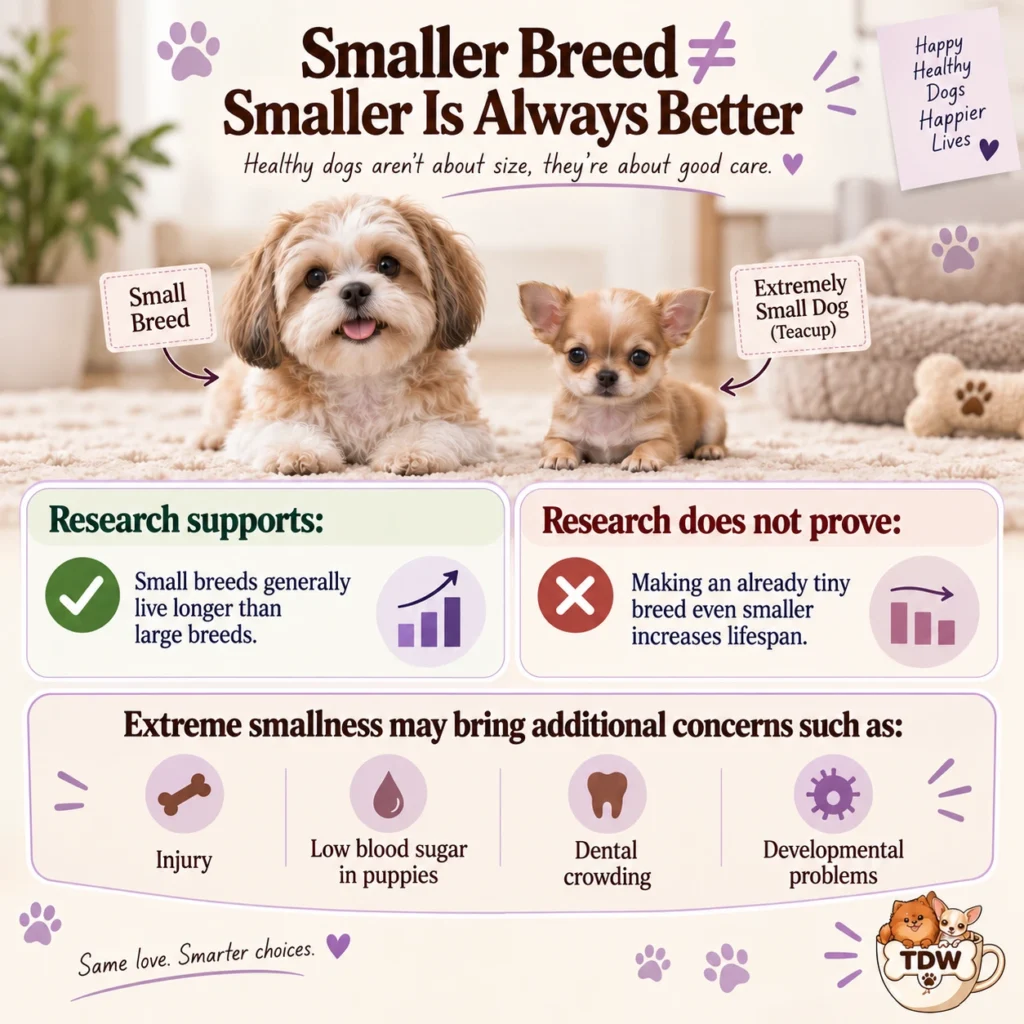
In 2024, researchers published an analysis of 584,734 dogs across 155 breeds in the journal Scientific Reports. They looked at size, face shape and sex together. Small breeds with longer noses came out on top, with a median life expectancy of 13.3 years. Medium sized flat faced breeds came out at the bottom, at roughly 9.1 years for males and 9.6 for females.
So the pattern is consistent and it runs in your favour. The breeds sold under the teacup label are small breeds, which means they start from the better end of the scale, not the worse one.
It is not only a British pattern either. A study of 20,970 dogs at three independent primary care clinics in the United States found the same thing, with body size negatively correlated with lifespan.
One honest note about the figures themselves. The breed numbers later in this article come from the UK studies, because that is where the largest breed level datasets exist. The direction of the size effect holds up in US data too, but treat the exact years as a good guide rather than a local measurement.
Why a Median Is Not a Prediction
A median life expectancy is the middle point of a group. It is the age by which half the dogs had died, which also means half of them were still alive.
It is a description of thousands of dogs, not a countdown for yours. Plenty of dogs in every one of these breeds live several years past the figure.
So if you read 13.3 years and felt your stomach drop, that is a misreading of what the number is doing. It tells you where the middle of the range sits. It does not tell you anything about your dog on your sofa.
Smaller Than Normal Is a Different Question
There is a leap people make here that the research does not support, and it is worth spotting.
What the studies show is that small breeds outlive large breeds. That comparison is between a Chihuahua and a Great Dane, or between a group of toy breeds and a group of mastiffs.
What they do not show is that taking a breed which is already tiny and producing an even tinier version keeps pushing the lifespan up. Nobody has measured that, so nobody can tell you the answer.
If anything, the logic points the other way. The general small dog advantage comes from being a small breed, not from being unusually small for your breed. Extreme smallness brings its own problems, and those are covered in the next section.
Life Expectancy by Breed
Below are the figures from that 2024 study for the breeds most often sold as teacups. These describe the breed. There is no teacup version of any of these numbers, because no teacup version has ever been measured.
| Breed | Median life expectancy | Dogs in the dataset |
|---|---|---|
| Papillon | 14.5 years | 1,115 |
| Miniature Dachshund | 14.0 years | 7,342 |
| Poodle | 14.0 years | 6,427 |
| Chinese Crested | 13.4 years | 928 |
| Yorkshire Terrier | 13.3 years | 14,579 |
| Maltese | 13.1 years | 2,021 |
| Shih Tzu | 12.8 years | 12,007 |
| Pomeranian | 12.2 years | 2,941 |
| Chihuahua | 11.8 years | 10,788 |
Figures from the Dogs Trust breed table accompanying the 2024 study.
Two things in that table are worth pausing on.
The Chihuahua sits lower than you would expect. You will find plenty of websites claiming Chihuahuas live fifteen to twenty years. In this dataset, with nearly eleven thousand dogs in it, the median was 11.8. Small does not automatically mean top of the table, and that is exactly why the label on the advert tells you so little.
And look at the spread. From 11.8 to 14.5 is under three years between the shortest and longest lived breeds here. The gap between two individual dogs of the same breed is often bigger than that, which is why the rest of this article is about your dog rather than about breeds.
If you want the full picture on any of these, we have guides to the Yorkshire Terrier, the Maltese, the Pomeranian and the Chihuahua, each covering size, health and what the breed is like to live with.
What Actually Shortens a Small Dog’s Life
Two different things get mixed together here, and separating them helps.
Some risks come from a dog simply being very small. Others come from a dog being bred badly. They are different problems with different answers. This section covers the first kind.

Accidents and Falls
For a four pound dog, an ordinary house is a hazardous place. A jump down from the sofa. A slip out of someone’s arms. Being stepped on in a busy kitchen. A door swinging shut. A bigger dog playing a bit too hard.
None of these are freak events, and almost all of them are preventable.
What helps: pet steps at the sofa and bed so there is no jumping down, lifting with two hands under the chest and back end, no carrying by young children, supervision around larger dogs, and a household habit of knowing where the little one is before you move your feet.
Low Blood Sugar in the First Months
This one is time limited but serious, and it catches new owners off guard.
Very small puppies have almost no energy stored, get their baby teeth late, and lose body heat easily. Veterinary guidance on toy breed puppies explains why a missed meal matters far more for them than it would for a bigger puppy.
Know the signs. A puppy that goes floppy, wobbly, cold or unresponsive may have dangerously low blood sugar. Offer food straight away, and if the puppy will not eat or does not perk up, get to a vet. Fits or collapse mean go immediately.
What helps: small meals several times a day through the early months, and somebody around to notice if one gets skipped. Most puppies grow out of this window without incident.
Teeth
Dental care gets treated as a cosmetic issue, and it is not one.
A small jaw still holds a full set of teeth, so crowding is common and gum disease often starts early. Left alone it becomes painful, affects eating, and eventually needs treatment under anaesthetic in an older dog who would rather avoid it.
What helps: brushing a few times a week starting in puppyhood, when the dog is still easy to persuade, plus dental checks at the annual vet visit. It is the least glamorous item on this page and one of the most useful.
Heart and Windpipe Problems
Two conditions are common enough in small breeds to be worth recognising by their signs.
The first is a heart valve problem that usually shows up first as a murmur your vet hears at a routine check up, often years before the dog seems unwell. That head start is the whole argument for annual visits.
The second is a weakening windpipe, which causes a distinctive honking cough, often when the dog pulls on a lead or gets excited.
What helps: keep up the check ups, walk your dog on a harness rather than a collar, and mention any new cough to your vet rather than waiting for the next visit. Your vet is the one to say what it is and what to do about it.
How Breeding Changes the Odds
Now the second category, and this one only applies before you buy.
A dog produced by somebody selecting hard for extreme smallness, generation after generation, with no health testing behind the parents, starts life with worse odds than a dog from the small end of an ordinary litter whose parents were screened.
Be clear about what that claim is and is not. Nobody has measured a lifespan difference between undersized dogs and normal sized dogs of the same breed, so no figure exists. It is a statement about risk, and a fair one.
What it means in practice if you are still choosing. Ask what both parents weigh as adults. Ask what health testing was done and to see the results. Meet the mother. And treat extreme smallness advertised as the main selling point as a warning rather than a feature, because it tells you what the breeder optimised for.
If you already own the dog, none of this is aimed at you. That part of the decision is behind you, and the section below is the one that still matters.
You can compare what is normal for each breed in our teacup dog breed guides.
What You Can Actually Do to Add Years
Keep the Dog Lean
This is the best evidenced advice on the page, and it is almost never mentioned in articles about tiny dogs.
In a study that ran for the dogs’ entire lives, 48 Labrador Retrievers were paired with their own littermates, and one of each pair was fed 25 percent less than the other. The lean fed dogs lived a median of 13 years against 11.2, a difference of 1.8 years, and they developed chronic disease later in life.
Two honest caveats. It was a Labrador study, so the exact figure does not transfer to a Chihuahua. And it was about feeding to a lean body condition from puppyhood, not about putting an adult dog on a crash diet.
What it establishes is that body condition changes how long a dog lives, and that is about as solid as canine longevity evidence gets.
Now the small dog version, which is the useful part. On a four pound dog, two extra treats is a significant share of the day’s calories. That is why small dogs slide into being overweight so easily and why their owners often do not notice.
What helps: feed by how the dog looks and feels rather than by the chart on the bag, and ask your vet to show you how to assess body condition once. It takes about a minute, and most owners are surprised by the answer.
The Rest of the List
- Nothing here is exotic. It is just the stuff that reliably works.
- Annual vet check ups, moving to twice yearly once the dog is older, because early detection is where small dogs gain the most.
- Dental care from puppyhood, as above.
- Vaccinations and parasite prevention kept current.
- Daily walks and something to think about. Fitness matters, and a small dog that is carried everywhere loses muscle it will need later.
- A harness rather than a collar.
- Know where your nearest emergency clinic is before you need it, not while you are panicking.
- If you want pet insurance, buy it before any symptom appears, because insurance does not cover a condition the dog already has.
What You Can and Cannot Control
One more thought, because it matters for how you carry all of this.
It is worth thinking about healthspan as well as lifespan. Lifespan is how long a dog lives. Healthspan is how much of that time is spent comfortable, active and enjoying itself. Thirteen good years is a better outcome than fifteen difficult ones, and most of the advice above improves both at once.
You can influence body condition, dental health, safety at home, exercise, and how early a problem gets found. Those are real levers and they are worth pulling.
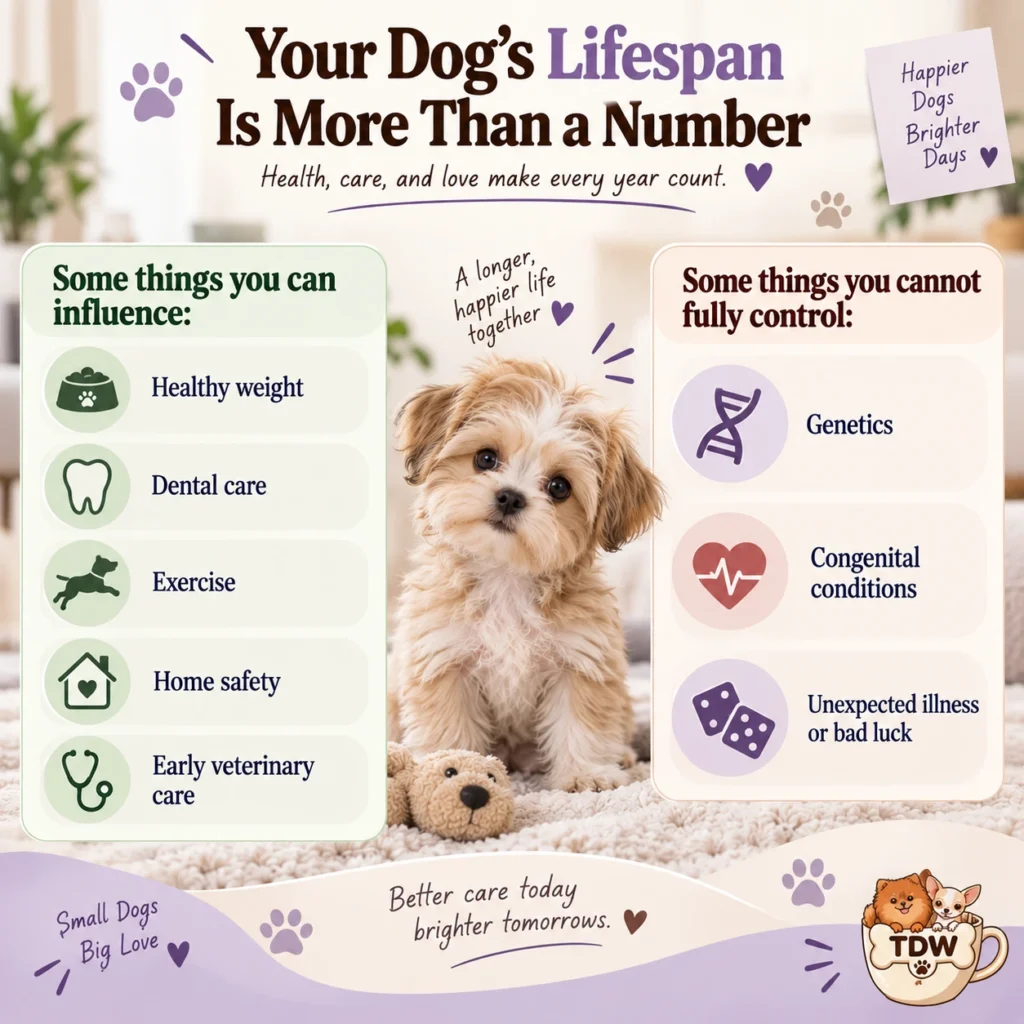
You cannot control inherited disease, a congenital problem the dog was born with, or plain bad luck. No owner can, and no breeder can promise otherwise. If something goes wrong despite your doing everything right, that is not a failure on your part.
Signs Worth a Vet Visit
None of this is a diagnosis. It is a list of changes that are worth a phone call rather than a wait and see.
A cough, especially a honking one. A change in appetite or a sudden shift in weight. New reluctance to jump up or climb stairs. Bad breath, or chewing on one side. Getting tired on walks that used to be easy. Any collapse or fainting, which is an emergency and needs a vet the same day.
Your vet is the person who can tell you what any of it means for your particular dog.
Teacup Dog Life Expectancy FAQs
What is the life expectancy of teacup dogs?
There is no published figure, because teacup is not a breed and no study has measured such a group. The useful number is the breed’s, and most of the breeds involved have median life expectancies between about twelve and fourteen and a half years.
Do teacup dogs really only live five to seven years?
No study supports that claim. It circulates widely without a source attached. The research that does exist on small breeds points to median life expectancies well into the teens for several of them.
Do smaller dogs live longer than bigger dogs?
Generally yes, and it is one of the most consistent patterns in canine longevity research. In a 2024 study of more than 580,000 dogs, small long nosed breeds had the highest median life expectancy and large or flat faced breeds the lowest.
Can a small dog live 20 years?
It happens, but it is rare enough that you should not plan around it. No breed has a median life expectancy anywhere close to 20 years. The highest in the 2024 UK data was the Lancashire Heeler at 15.4 years. A dog reaching 20 is an outlier, not a target.
Which teacup breed lives the longest?
Of the breeds commonly sold under the label, the Papillon had the highest median in the 2024 UK data at 14.5 years, with the Miniature Dachshund and Poodle close behind at 14.0. Individual dogs vary more than these breed differences do.
Does being a runt shorten a dog’s life?
No study has measured this, so nobody can give you a figure. A runt is simply the smallest puppy in a litter, and many grow to ordinary size. What matters more is whether the parents were healthy and screened.
Do teacup dogs get sick more often?
Not because of the label. Very small dogs face particular risks, including injury from falls and low blood sugar as puppies, and small mouths tend toward dental problems. How the dog was bred affects the odds more than its size does.
How can I help my teacup dog live longer?
Keep the dog lean, which has the strongest evidence behind it. Then annual vet visits, dental care from puppyhood, protection from falls, daily exercise, and a harness rather than a collar. None of it is complicated.
At what age is a teacup dog considered senior?
Small breeds are usually considered senior later than large ones, often around ten to twelve years. Ask your vet when to switch to twice yearly check ups, because it depends on the individual dog rather than a fixed birthday.
Is my tiny puppy at risk right now?
The main early risk is low blood sugar in the first months, which is why frequent small meals matter. If your puppy is eating well, active and gaining weight, that is the picture you want. Anything else is worth a call to your vet.
Can a vet tell me how long my dog will live?
Not exactly, and anyone who gives you a number is guessing. What a vet can do is examine your dog, find problems early, and tell you what is within your control. That is a far more useful conversation than any figure on a website.
Conclusion
There is no life expectancy figure for teacup dogs, because they are not a group anyone has measured. What the research does show is that small breeds sit at the long lived end of the scale, with medians for the breeds involved running from roughly twelve to fourteen and a half years.
What changes the outcome is mostly what happens in your house. Keep the dog lean, protect it from falls, look after its teeth, and keep up the vet visits so problems get caught early.
If you are worried about your own dog today, book a check up and ask your vet to show you how to assess body condition. That is a better use of an afternoon than reading one more lifespan chart.

The TeacupDogWorld Editorial Team researches and creates practical guides about small and teacup-sized dogs, including breed characteristics, grooming, nutrition, health, training, and everyday care. Our content is developed using reputable veterinary, breed-club, and animal welfare sources to help dog owners make better-informed decisions.