

Dogs sold as teacups are often advertised to finish at very small adult weights and heights. Those figures come from sellers, not from any kennel club, and there is no universal standard behind them.
So the real answer depends on which breed your puppy actually is. A teacup Chihuahua and a teacup Shih Tzu are two very different dogs, and each one is measured against its own breed’s published standard.
This guide gives you those standards, breed by breed, so you can hold a listing up against a number somebody official actually wrote down. You will also find out when a tiny puppy stops growing, how to estimate your own dog’s adult size, how to weigh and measure a dog this small, and the situations where the number on the scale is telling you to call a vet.
How Big Is a Full-Grown Teacup Dog?
Some adult dogs sold as teacups are advertised to finish under four pounds, but others finish heavier than the listing suggested. There is no single height or weight range that applies to every dog marketed this way.
That range is worth exactly what it costs to print. It is a rough convention among people selling puppies, and no registry, club or veterinary body publishes it.
Here is the part that actually helps you. A dog sold as a teacup still belongs to an underlying breed or breed mix. A teacup Yorkie is a Yorkshire Terrier. A teacup Pom is a Pomeranian.
So the question “how big do teacup dogs get” only becomes answerable when you swap it for a better one. How big does that breed get, and how far below its standard is the seller promising to go? A large gap is a question worth asking out loud.
The next section gives you those numbers.
Why There Is No Official Teacup Size
Because no organization ever created one. An official size comes from a breed standard, which is a written description of the breed maintained by its parent club and adopted by a registry. Those documents list the sizes a breed comes in. None of them lists a teacup.
With no standard there is nothing to enforce, so different breeders can use different cutoffs for the label.
That is not a reason to ignore size claims. It is a reason to check them against something real, which is what the breed standards let you do.
Full-Grown Teacup Dog Size by Breed
The official numbers below come from the American Kennel Club’s toy group breed standards.
| Breed | Official adult size (AKC breed standard) |
|---|---|
| Chihuahua | Not to exceed 6 pounds. No height given in the standard |
| Yorkshire Terrier | Must not exceed 7 pounds. No height given |
| Maltese | Under 7 pounds, with 4 to 6 pounds preferred |
| Pomeranian | 3 to 7 pounds, with 4 to 6 pounds the ideal show weight. No height given |
| Toy Poodle | 10 inches or under at the shoulder. No weight given in the breed standard |
| Shih Tzu | 9 to 16 pounds, 9 to 10.5 inches at the withers |
Notice something odd in the second column. Most of these standards give a weight and no height, while the Poodle gives a height and no weight.
That is why height figures for Toy breeds are hard to pin down. When you see a height quoted for a Chihuahua or a Yorkie, it may come from general breed guides rather than from the standard, so treat it as a typical range rather than a rule.
One more term before the breed notes. The withers are the top of the shoulder blades, and that is where dog height is measured from. Not the top of the head.
Adult size can vary a lot between different types of teacup dogs, so the underlying breed is the best place to start when estimating how big a puppy may become.
Teacup Chihuahua
The Chihuahua standard caps the breed at six pounds, and that already makes it one of the smallest purebred dogs.
So here is the most useful sentence in this whole section. A Chihuahua sold as a teacup may simply be a Chihuahua at the small end of normal. That does not make it a separate type of Chihuahua.
A higher price attached to the teacup label does not necessarily mean the dog belongs to a distinct size category. Ask what the parents weigh, and you will usually learn more than the listing tells you.
Teacup Pomeranian
The Pomeranian standard gives 3 to 7 pounds, with 4 to 6 pounds considered ideal for the show ring. Like the Chihuahua, the breed is small to begin with, so a 4 pound Pom is well inside the standard.
One quirk of this breed is worth knowing. That thick double coat makes a Pomeranian look considerably bigger than it is. A photograph tells you almost nothing about the body underneath, and a freshly groomed Pom can look like it lost half its size overnight.
If you are judging size from pictures, you are judging fur. Ask for a weight.
Teacup Yorkshire Terrier
The Yorkshire Terrier standard sets a ceiling of seven pounds and no minimum weight.
That detail matters. On weight alone, a three pound Yorkie does not exceed the standard’s maximum. It is still a Yorkshire Terrier, not a different type of dog, and calling it a teacup adds a word rather than an official category.
As with the Pomeranian, the long coat can disguise a very light frame. Weigh, do not eyeball.
Teacup Maltese and Other White Teacup Breeds
The Maltese standard calls for a dog under seven pounds, with four to six pounds preferred, and the breed is white by standard rather than by chance.
That makes the Maltese the breed people often picture when they think of a small white dog. Several other breeds sold as teacups can also come in white, including the Pomeranian, Chihuahua and Poodle.
One thing to be clear about. Coat color does not determine adult size or growth rate. A white coat does not make a dog finish smaller or larger.
What a white coat can change is upkeep, because tear stains and dirt show up more clearly on a pale coat.
Teacup Poodle
The Poodle is the odd one out here, because its standard measures height rather than weight. The Poodle Club of America breed standard puts the Toy Poodle at 10 inches or under at the shoulder, with the Miniature above that and the Standard above 15 inches.
So a Poodle advertised as a teacup is being described against a height limit, not an official teacup weight limit, even though a listing may quote you pounds.
If you want a like for like comparison with the other breeds on this page, ask the breeder for both. The height tells you where the dog sits against the standard, and the weight tells you what you will actually be carrying around.
Teacup Shih Tzu
The Shih Tzu standard is 9 to 16 pounds and 9 to 10.5 inches at the withers. That makes it by far the largest breed on this list.
Which means a Shih Tzu sold as a teacup and promised at, say, four or five pounds is being advertised to finish at roughly half the bottom of its own standard. That is a much bigger gap than a four pound Chihuahua, where the breed was tiny to start with.
It does not make every small Shih Tzu unhealthy. It does mean the gap between the dog and its breed is wide, and a wide gap is worth more questions about how the breeder is estimating that size and what health testing the parents had.
[INTERNAL LINK OPPORTUNITY: individual breed guides for teacup Chihuahua, Pomeranian, Yorkie, Maltese, Poodle and Shih Tzu]
Teacup Size Compared With Toy and Small Breeds
Toy is a recognized category in several contexts. Teacup is a description.
The Toy Group is a recognized set of breeds, and some breeds also have officially recognized Toy varieties. If someone tells you a dog is a Toy Poodle, you know it should measure 10 inches or under because a breed standard says so.
If someone tells you a dog is a teacup, you mainly know that the person using the term considers it unusually small.
Many dogs marketed as teacups come from Toy or already-small breeds and may sit near or below the smaller end of their breed’s usual size. So the useful comparison is not simply teacup versus Toy. It is this particular dog versus the standard for its breed, which is the comparison the table above lets you make.
When Do Teacup Dogs Stop Growing?
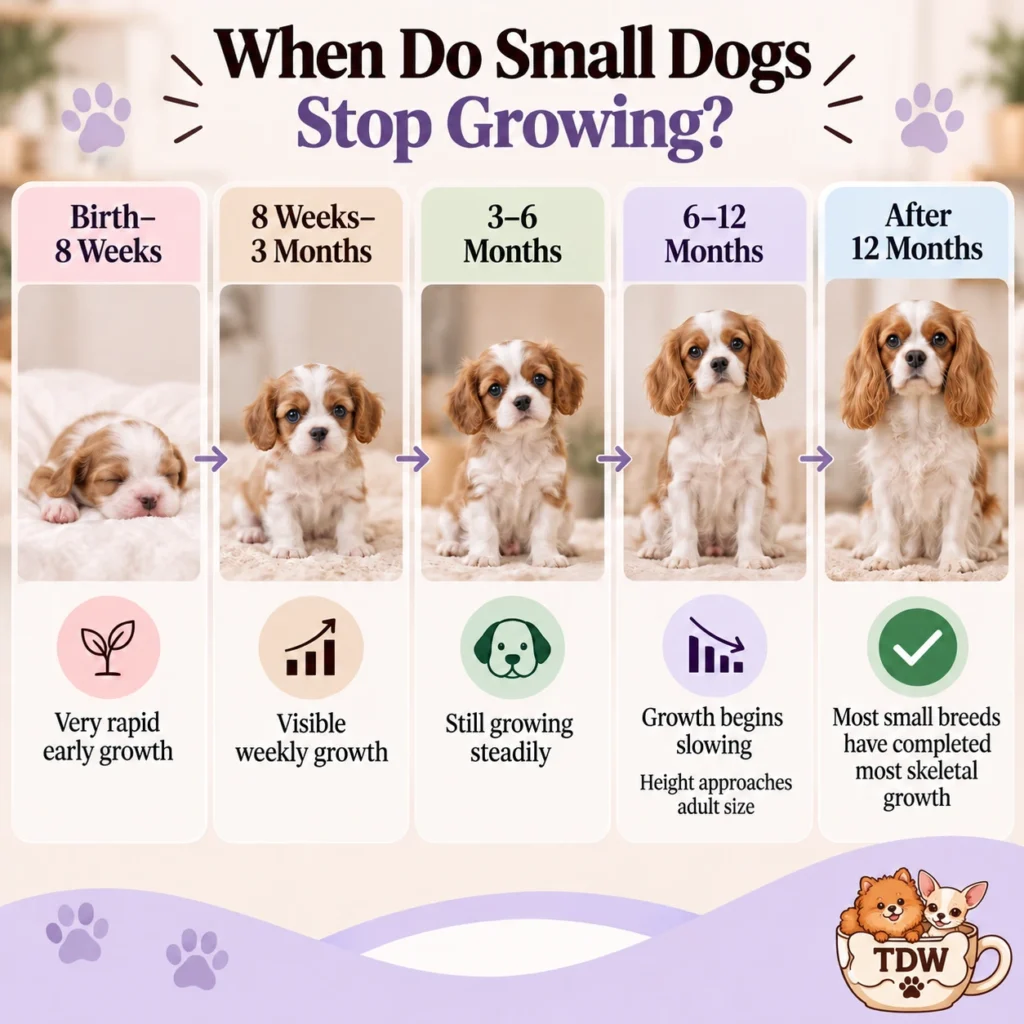
Most small and Toy breed puppies finish most of their physical growth somewhere between six and twelve months old. Some are close to their adult height earlier.
Tiny dogs grow up fast. According to the American Kennel Club, small breeds generally finish growing earlier than large breeds, while giant breeds can continue developing much longer. Purina places the small breed window at six to twelve months.
Height often arrives before the dog has completely filled out. A puppy may reach close to its adult height and then spend the following months developing muscle and adult body condition rather than getting much taller.
That explains a common worry. A puppy can look leggy and unfinished at six months while already being close to its adult height.
Growth Stage by Stage
We are not going to give you a week by week chart, and here is why. A chart like that has to pick one number per week, but a Chihuahua and a Shih Tzu do not share a growth curve, and neither do two puppies from the same litter. A single weekly figure looks precise and tells you very little.
Stages are more honest and just as useful:
| Stage | Roughly what is happening |
|---|---|
| Birth to 8 weeks | Very rapid early growth. Many puppies are still with the breeder during this stage |
| 8 weeks to 3 months | Rapid, visible growth. Weekly change can be obvious |
| 3 to 6 months | Still growing steadily. Adult height may be getting closer |
| 6 to 12 months | Growth tapers. Height often approaches its adult point while the body continues filling out |
| After 12 months | Most small breeds have completed most skeletal growth. Later changes may reflect muscle, body condition or diet rather than additional height |
Use this as a shape, not a schedule. Your own puppy is allowed to be ahead of it or behind it.
What Growth Plates Have to Do With It
Growth plates are soft areas of cartilage near the ends of the long bones, and they are where new bone is added while a puppy grows.
When they close, the bones have reached their final length and the dog has stopped getting taller. The AKC explains that this closing is what marks the end of skeletal growth, and that the timing varies by size, which is why small dogs generally finish sooner than large ones.
Muscle and body condition keep developing for a while afterward, so a dog can still change shape after it stops growing in height.
If there is a medical reason to know whether growth plates are still open, a veterinarian can assess the dog and, when appropriate, imaging such as an X-ray can provide more information.
How to Estimate Your Puppy’s Full-Grown Size
You can estimate. You cannot know for certain.
That is the honest starting point. Here are three useful methods and how much weight to give them.
Start With the Parents
This is one of the most useful clues available to you, and it costs nothing.
Ask the breeder what both parents weigh as adults, and ask to see the mother in person or on a live video call. A puppy may finish somewhere within the general family range, so two four pound parents give you a different expectation from two seven pound parents.
Two caveats keep this honest. Littermates can finish at different weights, and a breeder who cannot or will not tell you the parents’ adult weights has answered a more important question than the one you asked.
The Small Breed Weight Rule of Thumb
There is a widely used shortcut for small dogs. PetMD describes it as multiplying the puppy’s weight at six weeks by four, or the weight at eight weeks by three, to get a rough idea of adult weight.
So a puppy weighing one pound at eight weeks points to somewhere around three pounds grown.
Now the caveat, and it matters more here than it would for a Labrador. This is a rule of thumb, not a measurement. The estimate can be off by a meaningful amount, and a one pound difference matters much more when the expected adult weight is only a few pounds.
Use it to sanity check a claim, not to plan around a number. If a seller promises a two pound adult and the rough estimate points closer to five, that gap is worth raising before you pay a deposit.
How to Weigh and Measure a Tiny Dog Properly
This sounds obvious and most people get it slightly wrong.
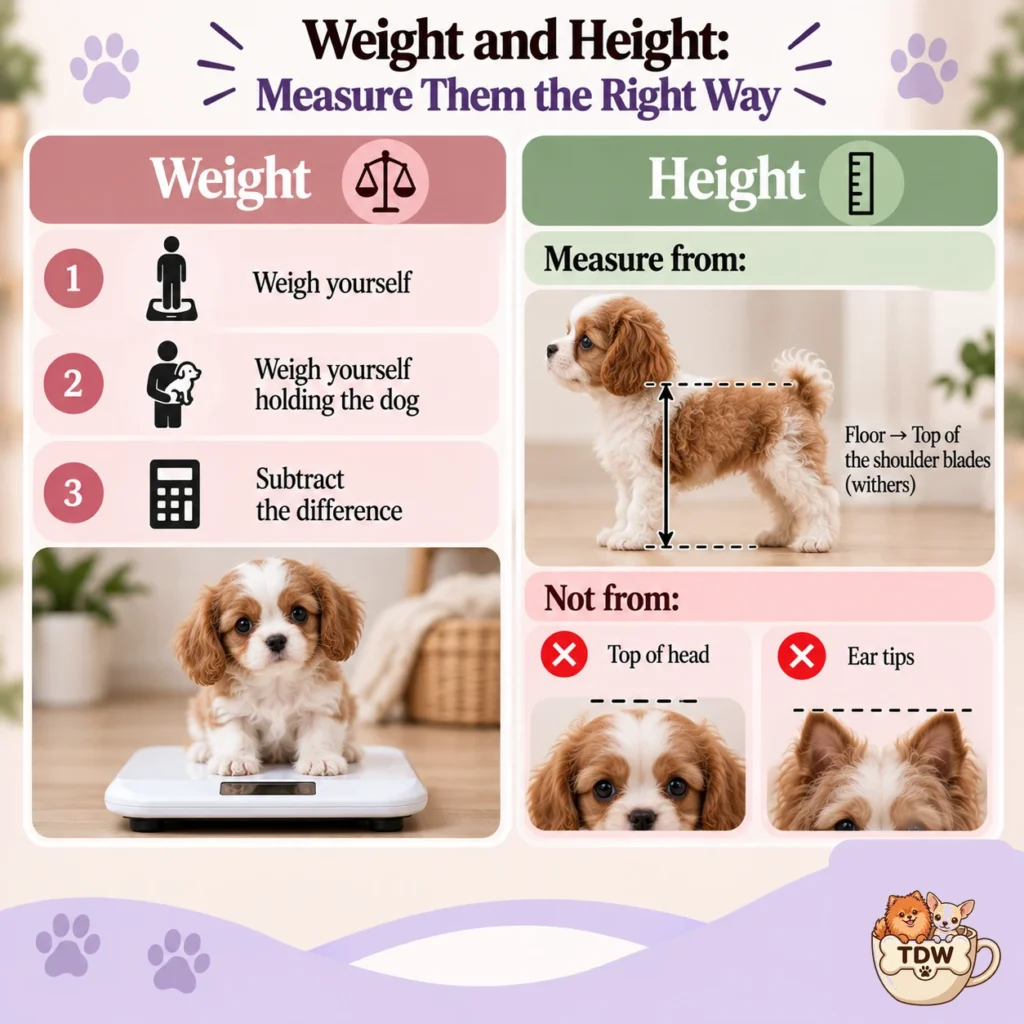
To weigh a small dog: step on a bathroom scale alone and note the number, then step on again holding the dog and subtract. For a very young puppy, a suitable small scale may give a more useful reading, but make sure it is stable and the puppy cannot fall or slide off.
To measure height: measure from the floor to the withers, which is the ridge between the shoulder blades. Not the top of the head and not the tips of the ears. Have the dog standing square on a flat, non-slip surface, and run a book or ruler flat across the withers to the wall if that makes it easier.
To track growth: write down each weight with the date while the puppy is young. A series of measurements can show the growth curve beginning to flatten out.
That record is also genuinely useful at the vet, and far better than trying to remember.
Why Teacup Size Claims Vary So Much
A few reasons stack together.
- First, there is no shared definition. With no registry setting a cutoff, different sellers can draw different lines around what they call teacup.
- Second, adult size is genuinely hard to predict. Even an experienced breeder is giving you an estimate based on factors such as the parents, previous litters and the puppy’s current development. Puppies from the same litter can finish at different weights.
So what do you do with that?
Treat the word teacup as a description, not a specification. Ask for the parents’ adult weights, ask to see the mother, and ask what previous puppies from the same parents grew to if that information is available. A breeder who keeps records may have useful answers.
And if a seller offers a written guarantee of an exact adult weight, remember that an exact future weight cannot be predicted with certainty.
When Size Is a Warning Sign
Most of the time, a size surprise is simply normal biological variation. There are also situations where unusual growth deserves attention.
My Puppy Is Not Growing
If your puppy is not gaining weight as expected, contact your veterinarian rather than assuming staying tiny is simply part of being a teacup dog.
A puppy that stays tiny is not automatically a teacup. Poor growth can have several causes, and a veterinarian is the right person to work out what is happening.
Things worth mentioning to your vet include:
- Not gaining weight as expected
- Noticeably behind its littermates, if you can compare
- Looking unusually thin
- Dull, sleepy or unsteady behavior
- Poor appetite, vomiting or diarrhea
- Weakness, wobbliness or difficulty staying alert
There are several possible causes, and only a veterinarian can sort between them. Inadequate nutrition, intestinal parasites and medical conditions can all interfere with normal growth.
The Merck Veterinary Manual also describes puppy hypoglycemia, or low blood sugar, as a syndrome that can occur in Toy breeds during the first six months of life.
Weakness, trembling, disorientation, seizures or collapse in a tiny puppy should prompt urgent veterinary care.
None of this is a diagnosis. It is a list of reasons to make the appointment.
My Dog Grew Bigger Than the Seller Promised
This can happen, and growing larger than predicted does not by itself mean something is wrong.
Adult size cannot be guaranteed with complete certainty. A puppy that finishes at six pounds after being sold as a three pound teacup may simply have grown normally. The problem may have been the prediction, not the dog.
It is still frustrating, especially if you paid a premium for the smaller number.
Check whatever paperwork you signed and see exactly what the seller stated about expected adult size. If a specific size was put in writing, raise it directly with the seller and keep copies of the listing, contract and related messages.
Then remember the most important part: your dog’s health and normal development matter more than whether the final number matches an informal teacup label.
What a Very Small Adult Size Means for Health
Size is not just a number on this page. It can change what daily life with the dog looks like.
Very small dogs can be more vulnerable to accidental injury. A fall from a sofa, a foot in the wrong place, a door swinging shut or a bigger dog bouncing into them during play can cause more serious harm to a tiny body.

A few health concerns are also particularly relevant in small and Toy breeds.
Low blood sugar is one concern in young Toy breed puppies. Crowded teeth are another concern because a small jaw still has to accommodate a full set of teeth, which makes regular dental care important.
Two more are worth knowing by name. A slipping kneecap, or patellar luxation, is when the kneecap slides out of its groove, and Cornell University’s veterinary college notes that it is common in small breed dogs.
A collapsing windpipe, or tracheal collapse, is a weakening of the airway that Cornell lists as common in Toy and small breed dogs. A veterinarian may recommend reducing pressure on the neck, including the use of an appropriate harness, for susceptible dogs.
None of this means a small dog is doomed to be sick. It means extreme smallness can add practical and health considerations that are worth understanding before choosing a puppy.
Teacup Size Myths, Corrected
Myth: teacup is an official size. No major breed standard defines it as a universal size category. The breeds themselves have official standards. The label does not.
Myth: a growth chart can tell you the exact adult weight. It can give you a rough guide. It cannot guarantee a number because breeds, litters and individuals grow differently. A precise universal weekly chart for all teacup puppies can give a false sense of accuracy.
Myth: feeding less keeps a dog small. This is the dangerous one, so it needs saying plainly. Restricting food does not produce a healthy small dog. It can cause malnutrition and interfere with normal growth. A dog’s adult frame is strongly influenced by genetics. Underfeeding does not safely create a teacup dog.
Myth: the runt will definitely be the smallest adult. Being the smallest puppy at birth does not guarantee that the dog will remain the smallest as an adult.
Myth: smaller means healthier or longer lived. Small dog breeds often live longer than larger breeds as a broad population pattern, but that does not mean pushing an already-small breed toward extreme miniaturization improves health or lifespan.
Myth: two dogs advertised as teacups will finish about the same size. They may not, especially across breeds. A Shih Tzu marketed as teacup and a Chihuahua marketed the same way can still have very different adult sizes.
What Adult Size Suits Your Family?
A three pound adult and an eight pound adult are not the same pet, even though both fit on your lap.
Very small dogs may require more careful handling around young children, larger dogs, furniture, stairs and busy household spaces. A few extra pounds can make a noticeable difference in physical sturdiness, although breed, health, temperament and supervision still matter.
If you have toddlers or much larger pets, think carefully about accidental injury risk before choosing an extremely small dog.
And if your heart is set on something very small, many of these breeds are already tiny within their official standards. A Chihuahua or Yorkie within the recognized breed size can still fit comfortably in your lap, in a carrier and in an apartment without relying on an informal teacup label.
Teacup Dog Size FAQs
How big do teacup dogs get when full grown?
There is no official universal size. Some dogs are marketed as adults under four pounds, but the final size depends heavily on the underlying breed and individual genetics. Check the breed’s official standard in the table above, then treat any seller’s number as an estimate rather than a specification.
Do teacup dogs keep growing after a year?
Many small breeds have completed most of their height growth by around a year, although muscle, body condition and overall shape can continue changing afterward. Exact timing varies by breed and individual dog.
Can a vet tell how big my puppy will get?
A vet can help you form a better informed estimate based on the puppy’s breed, age, current weight, body condition and development. What they cannot provide is a guaranteed final number.
Is a teacup dog the same as a Toy breed?
No. Toy can refer to an officially recognized group or variety, depending on the breed. Teacup is an informal word with no universal size definition. Many dogs marketed as teacup come from Toy or already-small breeds.
Why is my teacup puppy bigger than its littermates?
Littermates can grow at different rates and finish at different adult sizes. Being the biggest puppy in the litter does not automatically mean something is wrong.
How small is too small for an adult dog?
There is no official universal cutoff. A dog that is substantially below the typical size for its breed deserves closer attention to health, structure and handling needs rather than being judged only by how tiny it is.
Conclusion
Some full grown dogs marketed as teacups are advertised to stay under about four pounds, but that number comes from sellers, not from an official universal standard. The numbers that mean something are the breed standards, and the table above lets you hold any listing against them.
Your puppy will often complete most of its growth during the first year. You can estimate adult size from the parents and use a puppy weight rule of thumb as a rough check, but nobody, including you, the breeder or your vet, can guarantee an exact final figure.
So do three things. Ask what both parents weigh as adults. Start a simple record of your puppy’s weight with dates. And if the puppy is not growing as expected, contact your veterinarian rather than waiting to see.
If you are still choosing, take the breed standard numbers into the conversation with you. A responsible seller should be willing to discuss those numbers openly.
The TeacupDogWorld Editorial Team researches and creates practical guides about small and teacup-sized dogs, including breed characteristics, grooming, nutrition, health, training, and everyday care. Our content is developed using reputable veterinary, breed-club, and animal welfare sources to help dog owners make better-informed decisions.