
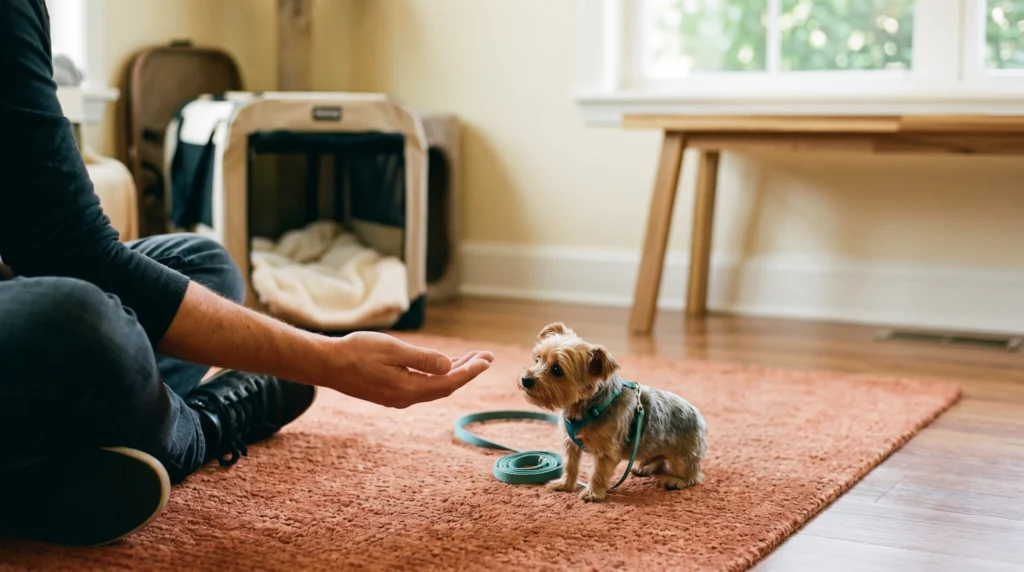
You want a tiny dog your whole family can love. But when you search for teacup dogs for adoption, many results turn out to be puppies for sale, often with a deposit and a shipping fee attached. That can feel confusing, and a little scary.
Here is the good news. You can adopt a very small dog from a real shelter or rescue. You just need to know where to look, how to check who you are dealing with, and which questions to ask before you say yes.
Below, you will find the best places to search first. After that, we cover what “teacup” really means, how to check a rescue before you pay, which health questions to ask, and whether a tiny dog is a safe fit for a home with kids.
Where to Find Teacup Dogs for Adoption
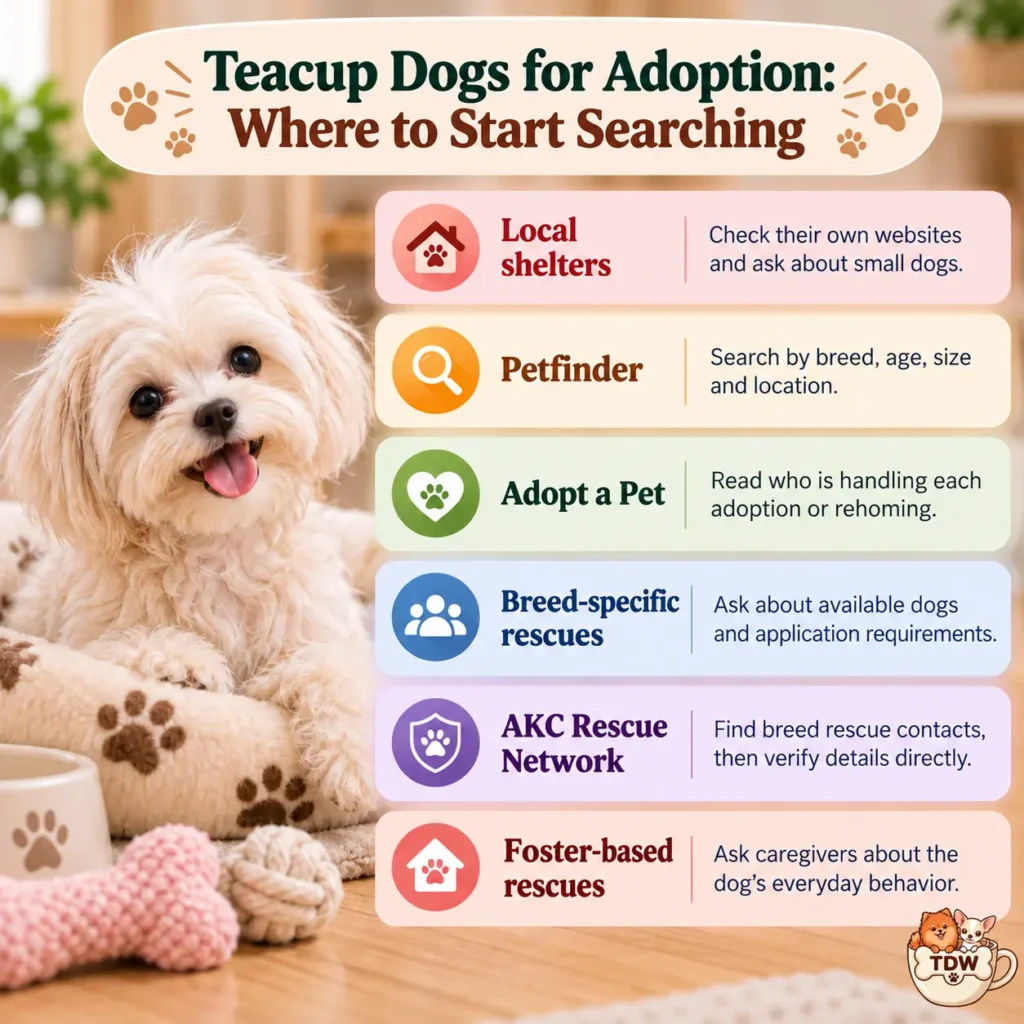
Yes, you can adopt a very small dog, but real listings rarely use the word “teacup.” Shelters and rescues list tiny Chihuahuas, Yorkshire Terriers, Maltese, Pomeranians, Toy Poodles, and small mixes by breed, age, and weight. These are good places to start.
| Where to look | What you will find | Location rules |
|---|---|---|
| Petfinder | Dogs from shelters and rescue groups, searchable by breed, size, and age | Covers the US, Canada, and Mexico. Each group sets its own adoption area. |
| Adopt a Pet | Dogs from shelters and rescues, plus some owners rehoming their own pets | Covers the US and Canada. Each shelter, rescue, or owner sets who can adopt. |
| Your local shelter or animal control | Dogs in your area, including some that never appear on national sites | Usually your city or county. Check the shelter’s own website for its rules. |
| AKC Rescue Network | Breed club rescue contacts, organized by breed | A national directory. Each rescue listed serves its own area. |
| Northcentral Maltese Rescue | Maltese and other small dogs living in foster homes | Based in Wisconsin and takes in dogs nationwide. Placement depends on travel arrangements, so you may need to drive or fly to the dog. |
| Metropolitan Maltese Rescue | Maltese | New York City and its New York, New Jersey, and Connecticut suburbs only. Does not adopt to families with children under 10. |
| Yorkshire Terrier National Rescue | Yorkshire Terriers and mixes in volunteer foster homes | A national volunteer network. Tries to place dogs locally first, but accepts inquiries from other states. |
Rescue rules change, and small dogs are often adopted quickly. Before you apply or plan a trip, check each group’s current requirements and confirm the dog is still available. A group’s place in this table is not an endorsement.
Local Shelters and Breed Rescues
Do not skip the shelters near you. Humane World for Animals points out that not every shelter or pet appears on national adoption sites, so check your local shelters’ own websites, too. It also helps to visit in person and ask whether staff keep a call list for small dogs.
Breed rescues are worth contacting even when they have no dogs listed. Many keep their dogs in volunteer foster homes, and a foster parent can tell you how a dog acts with children, other pets, and strangers. Many also keep waiting lists.
Search Tips for Petfinder and Adopt a Pet
A few simple habits will help you find tiny dogs faster.
- Search by breed, not “teacup.” Type Chihuahua, Maltese, Pomeranian, Toy Poodle, or Yorkshire Terrier.
- Include mixes. Try “Chihuahua mix,” “Poodle mix,” or “Maltese mix.”
- Use the size filter with care. The “Small” filter covers many dogs much bigger than a toy breed, so pair it with a breed search.
- Look at adults and seniors. You will see more choices.
- Save your searches and turn on alerts. New small dogs can be adopted within days.
- Check location rules first. Read each listing’s adoption area before you apply, so you do not wait on a group that cannot place a dog with you.
- Get your answers ready. Keep a note with your vet’s contact, references, and home details so you can apply quickly.
- Plan to meet the dog. If a dog is far away, ask how a meeting can happen. Be very careful with anyone who only offers to ship a dog to you.
What “Teacup” Really Means, and Why Shelters Rarely Use It
“Teacup” is a marketing word, not a breed. It describes a dog that is smaller than normal for its breed. There is no official teacup size, and major breed registries like the American Kennel Club (AKC) do not recognize it.
As veterinarian Dr. Jennifer Coates explains on PetMD, there is no set weight for a teacup dog, but adult teacup dogs often weigh well under 4 pounds. She also notes that people who breed for tiny size tend to pair the smallest dogs together, and health can fall to second place.
Breed experts agree. The Chihuahua breed guide hosted by the AKC explains that an unusually small puppy in a litter is simply a small Chihuahua, and any other label for it is not correct. Poodles work the same way: the AKC recognizes Toy, Miniature, and Standard Poodles, and nothing called a Teacup Poodle.
The breeds sold as “teacup” are already small at a normal adult size. PetMD, for example, lists a typical adult Chihuahua at about 3 to 6 pounds and a typical adult Maltese at about 4 to 6 pounds. Keep in mind that weight alone does not tell you whether a dog is healthy. For breed details, read what to know about tiny Pomeranians or our Teacup Maltese guide.
There is one more surprise. The Better Business Bureau warns that many puppies sold as “teacup” are just small at birth and grow to full size later.
This is also why your shelter search for “teacup” may come up empty. Real shelters and rescues describe a dog by its breed, age, weight, health, and personality, so search for those instead. If a listing leans heavily on words like “teacup” or “micro,” slow down and check it carefully, as the next section explains.
You may wonder why a site called Teacup Dog World is telling you this. We use the word because it is what families search for. Our job is to tell you what it really means, so you can choose a healthy dog instead of a label.
How to Check a Teacup Dog Rescue Before You Pay
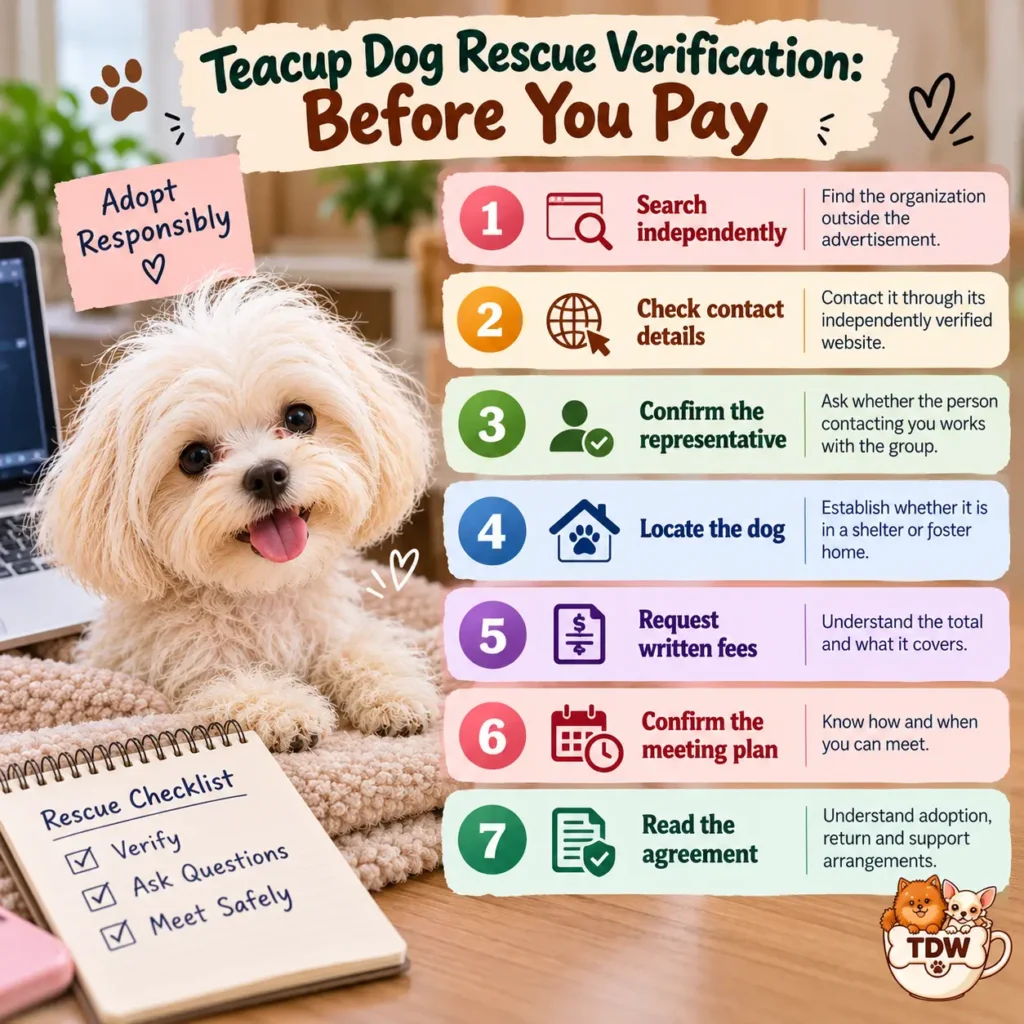
Before paying, independently verify the organization, confirm who has the dog, and request written fee and meeting arrangements. Pressure to pay and unexplained additional charges are warning signs.
This matters because fake sellers can look very real. BBB’s 2025 update reports that more than half of pet scams reported through BBB Scam Tracker originated on websites found through search engines or social media. Fake sites can also show up near the top of search results. Chihuahuas and Pomeranians were among the breeds named in scam reports.
The BBB also found that some scammers run a fake screening process, with forms and questions, so they look like a careful rescue. Some are even experimenting with AI in video calls. So an application form, or a quick video chat, does not prove a group is real on its own.
Here is how to verify a group independently:
- Look it up yourself. Search for the group’s name separately, instead of trusting links or phone numbers in an ad.
- Check where else it appears. See whether the group is listed on Petfinder, Adopt a Pet, or the AKC Rescue Network.
- Contact it through its official website. Some rescues warn about this directly. Yorkshire Terrier National Rescue, for example, says it never places dogs through private individuals and asks people to contact it through its own site to confirm they are dealing with a real member.
- Ask who has the dog right now. A real group can tell you whether the dog is in a shelter or a foster home, and roughly where.
- Get it in writing. Ask for the fee, what it covers, how and when you will meet the dog, and the adoption agreement before you pay.
Even when a seller is real, the dog’s background may not be. Humane World for Animals warns that dogs sold by online sellers and pet stores very often come from puppy mills, breeding operations that put profit ahead of the dogs’ welfare.
Rescue, Seller, or Scam?
Use this table to check any listing before you send money.
| What to check | What a real shelter or rescue usually does | Warning signs |
|---|---|---|
| How the dog is described | Breed, age, weight, health notes, and personality | “Teacup” or “micro” labels and promises the dog will stay tiny |
| Who has the dog | Can tell you if the dog is at a shelter or with a foster family | Vague answers, or the dog is said to be with a shipper |
| Meeting the dog | Explains how and when you can meet the dog | Refuses any visit or live video call |
| Screening | Application, references, often a home visit | A form alone, which scammers can copy |
| Money | States the fee and what it covers, in writing | Pressure to pay now, or new charges for shipping, crates, or vaccines |
| Paperwork | A written adoption agreement, including what happens if the dog must be returned | No agreement, or promised papers that never arrive |
Warning Signs to Investigate Before Paying
The BBB points to these warning signs. A warning sign alone does not prove fraud; check the organization and the full circumstances.
- The ad uses the word “teacup” or “micro.”
- The seller will not let you visit in person or meet on a live video call.
- After a deposit, new fees appear for shipping, a special crate, vaccines, or airline charges.
- You hear a sad or urgent story, such as the puppy being stuck at the airport or sick, and you are pressured to pay right away.
- The seller wants payment through an app like Zelle or Venmo, or by wire transfer.
- A popular breed is offered at a very low price.
- The same photos appear under conflicting names, locations, or unrelated sellers.
If you think you have been scammed, stop sending money and contact your bank or payment app. Then report it to BBB Scam Tracker and the Federal Trade Commission at ReportFraud.ftc.gov.
The Teacup Dog Adoption Process, Step by Step
Most adoptions follow the same basic steps. According to Petfinder’s adoption FAQ, the whole process can take a few days or a few weeks, especially when a home visit is needed.
- Find a dog and read the full listing. Note the age, weight, health notes, location rules, and anything said about kids or other pets.
- Confirm you can apply. Check that the group places dogs in your area, and that the dog is still available.
- Fill out the application. Every group has its own form. Expect questions about your home, your schedule, and past pets, plus personal and vet references.
- Talk with the shelter or rescue. This is often a phone call or short interview. Ask your own questions too.
- Complete a home visit if required. Some rescues visit your home or ask for a video walkthrough. If you rent, they may ask for your landlord’s approval.
- Meet the dog as a family. Bring the kids and watch how the dog reacts. Ask whether your current dog can meet the new one.
- Sign the adoption agreement and pay the fee. Bring a government photo ID and proof of address.
- Bring your new dog home. Have your supplies and a vet appointment ready before this day.
What the Adoption Fee Usually Covers
Adoption fees vary from group to group, and puppies usually cost more than adult dogs. Petfinder explains that the fee often covers care the dog has already received, such as vaccines, spaying or neutering, a microchip, and basic vet care.
Because every group is different, ask for the current fee in writing and exactly what it includes. While you are at it, ask about the return policy and what support the group offers after adoption. Northcentral Maltese Rescue, for example, requires a signed contract stating that the dog must come back to the rescue if you cannot keep it.
Plan for what comes after, too. Tiny dogs can need extra dental care and careful vet handling, so many families set aside an emergency fund or look into pet insurance.
Are Teacup Dogs Good for Families With Kids?
A tiny dog can be a wonderful fit for a family with older, calm children. With toddlers and young kids, it is usually the riskiest match. A very small dog can be badly hurt by a fall or a squeeze, and a dog that is scared or in pain may bite.
The experts are clear about this. The AKC notes that Chihuahuas are not recommended for homes with children because they are too small for roughhousing. PetMD adds that a tiny dog’s bones are so fragile that even jumping off a bed can cause a break.
The American Veterinary Medical Association advises that children should never be left alone with a dog, even a familiar family pet. It also says pain or illness can make a bite more likely, which matters with a fragile dog that is easy to hurt by accident.
On its dog bite prevention page, the AVMA suggests families think about waiting until children are older than 4 before bringing home a new dog. Some rescues set their own limits too, like the Maltese rescue in our table that does not adopt to families with children under 10.
If your kids are little right now, waiting a couple of years is not saying no forever. It is giving You want a tiny dog your whole family can love. But when you search for teacup dogs for adoption, many results turn out to be puppies for sale, often with a deposit and a shipping fee attached. That can feel confusing, and a little scary.both your children and your future dog a safer start. And for the right home, tiny dogs have real strengths: many are affectionate lap dogs, easy to carry to the vet, and happy in a calm apartment.
Which Homes Suit a Tiny Dog Best
| Usually a good fit | Think twice |
|---|---|
| Older children who are calm and gentle | Toddlers or very young children |
| An adult is home for much of the day | The dog would be alone for long hours |
| A quiet, steady household | A busy home with lots of visitors and noise |
| No pets, or calm pets of a similar size | Large, playful dogs in the home |
| A budget for extra vet care | No room in the budget for surprise vet bills |
Safety Rules for Kids and Tiny Dogs
If you do bring a tiny dog into a home with children, set a few simple rules from day one.
- An adult watches every time. No child and dog alone together, even for a minute.
- Sit on the floor to hold the dog. A drop from a standing child’s arms can break a tiny dog’s leg.
- Never walk around carrying the dog. Kids can trip.
- Let the dog come to you. No chasing, grabbing, or picking the dog up when it walks away.
- Leave the dog alone when it eats or sleeps. The AVMA lists this as a key bite prevention rule.
- Give the dog a safe space. A crate, pen, or gated corner that kids know is off limits.
Health Questions to Ask Before You Adopt
Not every tiny dog will have health problems, and many issues seen in teacup dogs also show up in small breeds in general. PetMD notes that research is still ongoing on whether these problems become more common as dogs are bred smaller, though poor breeding raises the risk. Slipping kneecaps, for example, are one of the most common joint problems in small dogs, according to the American College of Veterinary Surgeons.
You do not need to diagnose anything yourself. Your job is to ask for records and let a veterinarian guide you. Ask your veterinarian for a feeding schedule and preventive care plan based on the dog’s age, weight, and medical history.
One issue deserves a quick warning. Very young toy puppies can develop dangerously low blood sugar, and the AKC lists signs like extreme tiredness, wobbliness, and seizures. If you see these, call a vet right away.
The checklist below includes the key health questions to ask any shelter or rescue.
Questions to Ask Before Adopting a Teacup Dog
A good shelter or rescue will be happy to answer these. If a group dodges simple questions, that tells you something too. Print this list or keep it on your phone.
About the adoption
- Do you place dogs in my state or area?
- Is this dog still available?
- Where is the dog now, and how can we meet it?
- What is the current adoption fee, and exactly what does it include?
- What is your return policy if things do not work out?
- What support do you offer after adoption?
About the dog
- How old is the dog, and what does it weigh today?
- If it is a puppy, what adult size do you expect, and why?
- May I see the full vet records? Is any of the history unknown?
- Has the dog ever had low blood sugar? What is it eating now, and how often?
- Has a vet checked its knees, heart, and teeth?
- Has it had any coughing, seizures, or breathing trouble?
- What preventive medicines is it on now?
- How does it act with children? With other dogs or cats?
- What have its foster family or shelter staff noticed about its behavior?
- Is it house trained?
Why a Small Adult Dog Can Be the Smarter Choice
For many families, an adult toy breed dog can be a better match than the tiniest puppy available. An adult dog’s current size is easier to assess, and caregivers may have useful observations about its behavior. Its earlier medical history may still be incomplete.
That still takes a lot of guessing out of the decision. You will not be waiting to see whether a “teacup” puppy grows bigger, and you can ask how the dog has behaved around kids in its foster home or shelter.
It can also lower one of the biggest early worries. The AKC notes that dangerous low blood sugar is often seen in very young toy puppies, especially those under 12 weeks old.
PetMD’s advice points the same way: if you want a small dog, a healthy dog of its breed’s normal size is usually a better choice than one bred to be as tiny as possible. Senior toy dogs deserve a look too. Many are calm, gentle, and simply want a warm lap.
Bringing Your New Dog Home: The First Week
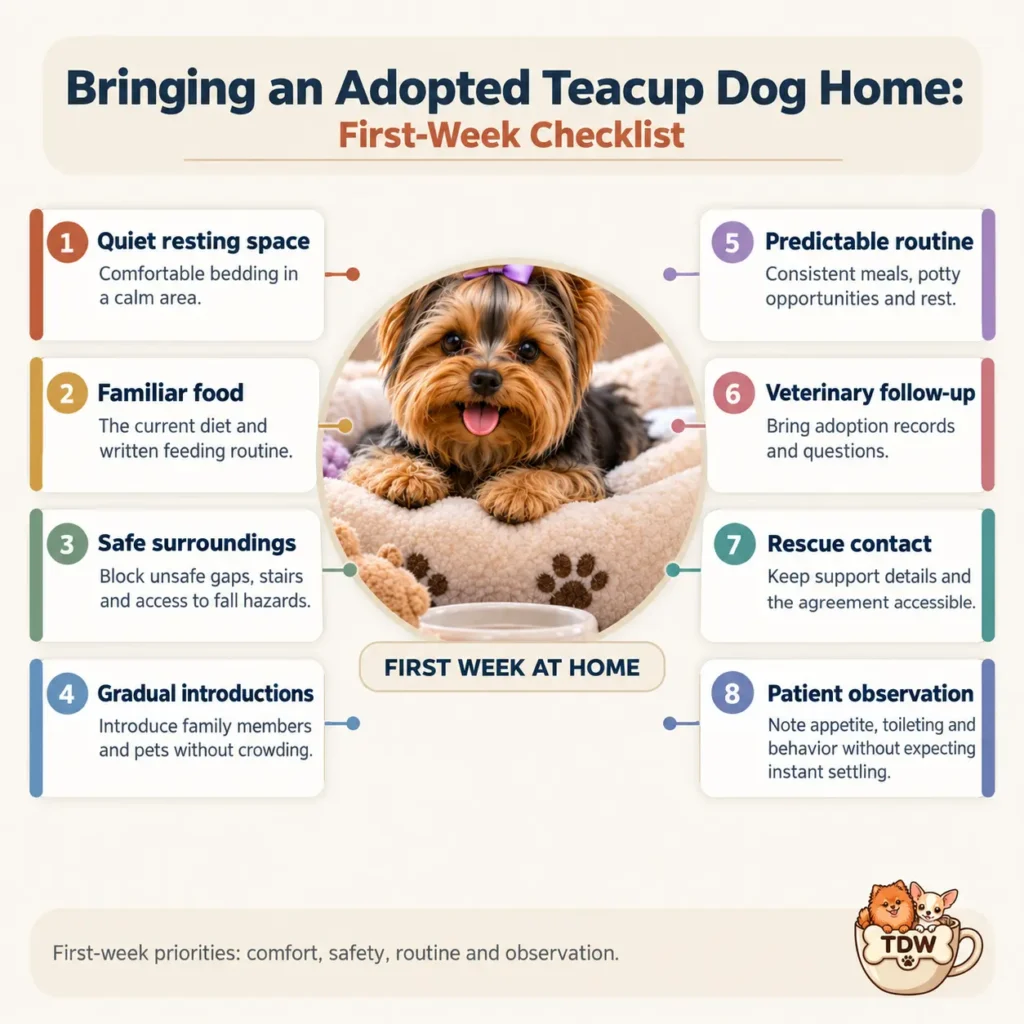
The first few days set the tone for everything that follows. A little planning goes a long way with a tiny dog.
- Book a vet visit in the first few days. Bring the adoption records, and ask for a feeding schedule and preventive care plan that fits your dog.
- Keep your dog warm. Small dogs lose heat quickly, so offer soft bedding away from drafts.
- Make your home tiny dog safe. Block stairs, and help your dog on and off couches and beds so it does not jump.
- Set up a safe space. A crate or small pen gives your dog a quiet place to rest. Teach kids that this space is off limits.
- Go slowly with introductions. Keep the first days calm, and introduce children and other pets one at a time, with an adult watching.
- Ask your vet about a harness. Your vet can tell you whether a harness or a collar is the better choice for your dog.
Teacup Dogs for Adoption FAQs
Do teacup puppies stay tiny?
Not always. The Better Business Bureau warns that many puppies sold as “teacup” are simply small at birth and grow to a normal size later. A puppy’s current weight alone cannot guarantee its adult size, especially in mixed breeds. If size matters to you, an adult dog is easier to judge.
Why do some teacup puppies for adoption sites ask for a deposit?
Some are sellers rather than rescues, and some are scams. A deposit request alone does not tell you which. Before paying anything, verify the group on your own, confirm who has the dog, and get the fee and meeting plan in writing.
Should we wait until our kids are older?
It is worth considering. The AVMA suggests families think about waiting until children are older than 4 before adopting a new dog. Very small dogs are safest with kids who can sit calmly, follow simple rules, and handle a pet gently.
Are tiny dogs cheaper to care for?
Not always. They eat less, but other care can cost more. Tiny dogs may need extra dental care and careful handling during surgery or anesthesia. Savings or pet insurance can help you handle surprise vet bills.
Can we adopt a tiny dog if we live in an apartment?
Often, yes. Small dogs can do well in apartments with the right care. If you rent, many rescues will ask for your landlord’s approval, so check your building’s pet rules before you apply.
Final Thoughts
Finding teacup dogs for adoption really comes down to finding a healthy small dog that fits your family. Search by breed, not by label. Check each group’s location rules, verify the organization on your own, and get the fee and meeting plan in writing before you pay. Then ask the health questions, and be honest about how young and how gentle your kids are.
A good next step is to set up saved searches today for the breeds you like. When you find a dog you love, bring your vet into the conversation early.

The TeacupDogWorld Editorial Team researches and creates practical guides about small and teacup-sized dogs, including breed characteristics, grooming, nutrition, health, training, and everyday care. Our content is developed using reputable veterinary, breed-club, and animal welfare sources to help dog owners make better-informed decisions.