
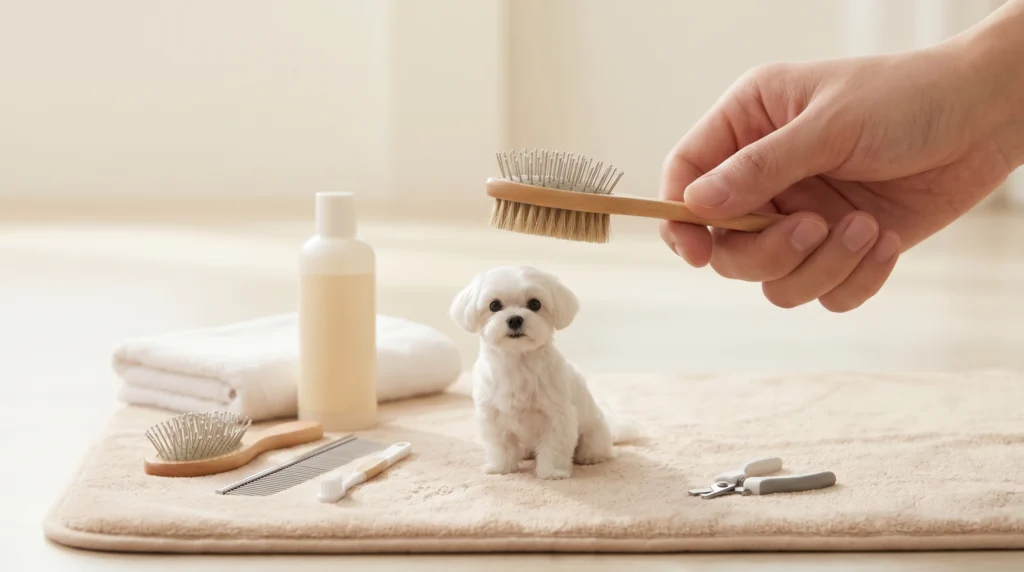
That soft white coat looks effortless in photos. In real life, it tangles fast, shows every stain, and needs a gentle hand on a dog that may weigh only a few pounds. If you feel nervous holding a brush over something so small, that is a good instinct.
Good teacup Maltese grooming comes down to a few calm habits: brushing all the way to the skin, keeping the face clean and dry, brushing teeth, and handling your dog in a way that keeps it safe and warm.
This guide shows you how to groom a teacup Maltese step by step and how often to do each job. You will also learn which tools you really need, how to bathe and dry a tiny dog without chilling it, how to handle tear stains safely, and when a grooming problem is really a job for your vet.
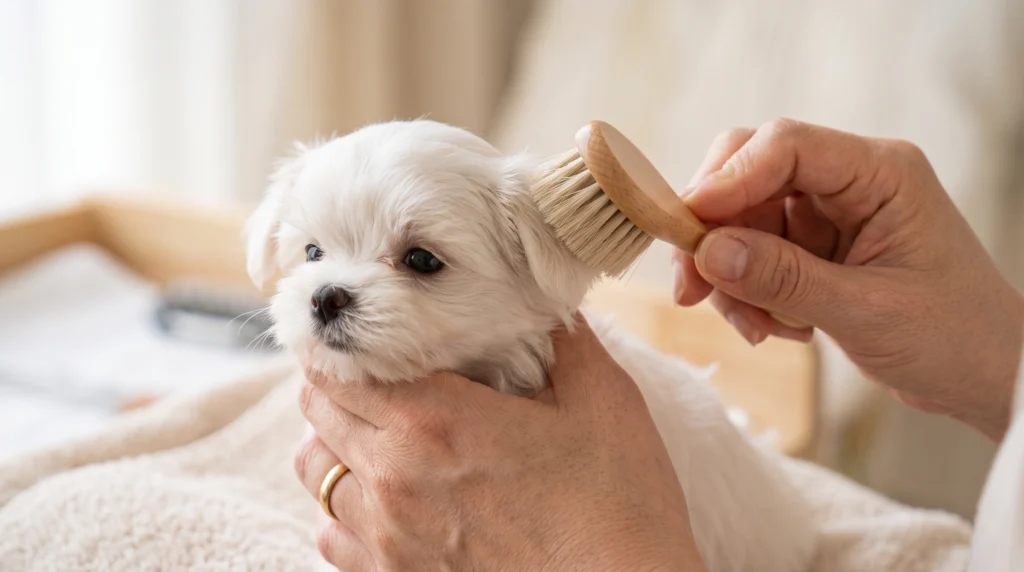
How Teacup Maltese Grooming Differs From a Standard Maltese
The basic coat-care principles are the same. What changes is how carefully you handle the dog. Any health or skin condition your dog has can also change the routine, so your vet’s advice comes first.
First, a quick truth about the name. “Teacup” is an informal marketing label sometimes used for unusually small Maltese. It has no standard weight range and is not a separate recognized breed. The Maltese itself is one breed in the American Kennel Club’s Toy Group, and the official Maltese breed standard calls for a dog under 7 pounds, with 4 to 6 pounds preferred.
Every Maltese has a single coat. There is no fluffy undercoat underneath, only long, silky hair. Maltese shed relatively little, and some of the hair that does come loose stays caught in the coat. If nobody brushes it out, it wraps around other hairs and slowly forms mats.
A very small body changes the safety side of grooming. A veterinarian writing for PetMD on teacup dogs explains that tiny dogs struggle to stay warm, can break a bone from something as ordinary as jumping off a bed, and can get sick faster when they are stressed. Grooming involves water, handling and new sounds, so those risks matter here.
or size, health and what to know before bringing one home, see our teacup Maltese breed guide.
| Same for every Maltese | Extra care for a very small Maltese | |
|---|---|---|
| Coat | Single, silky coat that tangles easily | Gets cold quickly while wet |
| Handling | Gentle brushing and combing | Secure support at all times, because a short fall can cause an injury |
| Sessions | A steady routine | Shorter sessions, with breaks and close watching for tiredness |
Teacup Maltese Grooming Schedule (Quick Reference)
Most families do best with a few minutes of care each day and a few bigger jobs spread across the month. Check the coat and wipe the face daily, brush a long coat every day, and brush teeth every day. Treat the other timings below as starting points, then adjust them to your dog’s coat, lifestyle and your vet’s advice.
| Task | Puppy cut | Long coat | Notes |
|---|---|---|---|
| Coat check | Daily | Daily | Feel behind the ears, under the legs and along the harness line |
| Brushing and combing | Several times a week, more if the cut is longer | Every day | Brush any day you find tangles |
| Face and eye wipe | Daily | Daily | Dry the hair afterward |
| Teeth | Daily | Daily | Veterinary groups recommend daily brushing |
| Bath | Every few weeks, or when dirty | Every few weeks, or when dirty | A smell that returns soon after a bath, or red, itchy skin, needs a vet visit |
| Nails | Check every 2 weeks | Check every 2 weeks | Trim when they touch the floor or click |
| Ears | Look and sniff weekly | Look and sniff weekly | Ask your vet whether routine cleaning is needed |
| Professional groom | Every 4 to 8 weeks as a starting point | Tidy ups as needed | Your groomer can adjust this to your dog’s coat |
The groomer range is a common starting point, not a fixed rule. VCA Animal Hospitals, for example, suggests grooming every four to six weeks for some long-haired breeds.
Puppy Cut or Long Coat: Which Is Easier for Your Family?
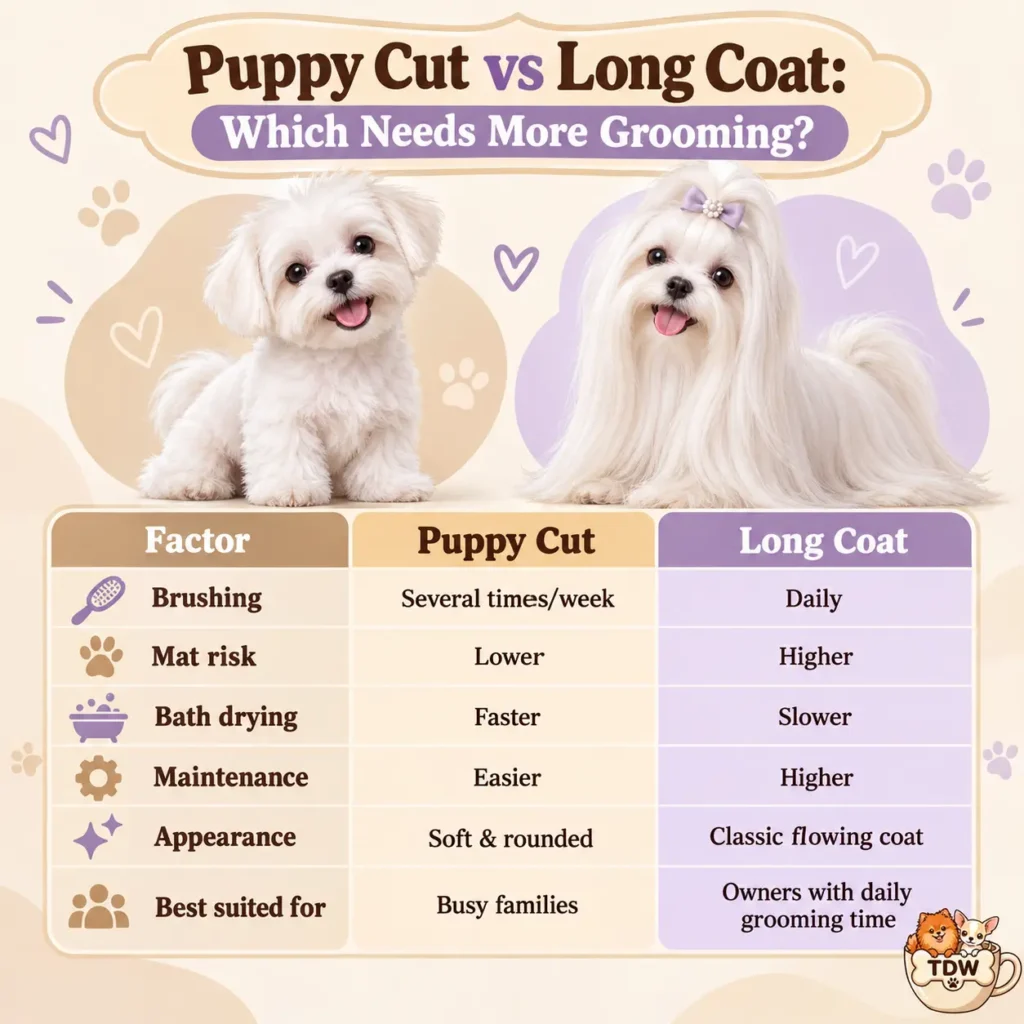
For most busy families, a puppy cut is easier to look after. It usually means less brushing, fewer mats and a shorter drying time after baths.
| Puppy cut | Long coat | |
|---|---|---|
| Brushing | Several times a week | Every day, in thin layers |
| Mat risk | Lower | High, especially behind the ears and under the legs |
| Drying after a bath | Generally faster | Slower |
| Look | Soft, rounded, playful | Flowing, classic show style |
| Best for | Families with kids, active dogs, busy weeks | Owners with time to brush daily |
“Puppy cut” is not one fixed length. One groomer’s puppy cut can be much shorter than another’s. Bring a photo to the appointment and agree on how much length to leave on the body, legs and face.
A long coat is beautiful, but it is a daily commitment. If it gets badly matted, a groomer may need to clip it very short to keep your dog comfortable. Choosing a style you can keep up with is the kinder choice.
One caution: short is fine, but avoid shaving down to the skin. A white dog has pale skin underneath, and the hair helps shield it from sunburn and scrapes.
Grooming Tools for a Tiny Maltese
You do not need a cupboard full of products. A small, good set of basic tools covers almost everything, and it can mean fewer trips to the groomer between trims.
| Tool | What it does | Best for | Watch out for |
|---|---|---|---|
| Pin brush | Gently separates long, silky hair | Long coats and medium trims | Pick one with smooth, rounded tips |
| Metal comb (fine and wide teeth) | Finds hidden tangles; tidies the face and feet | Every coat length | If it snags, stop rather than pulling |
| Small soft slicker brush | Lifts loose hair from short coats | Puppy cuts | Use a very light touch; pressing hard scratches skin |
| Dog grooming spray (detangler) | Adds slip so hair does not break | Every brushing session | Choose one made for dogs and use it as the label directs |
| Small nail clipper or quiet grinder | Shortens nails | All dogs | Take off tiny bits at a time |
| Styptic powder | Stops bleeding if you nick a nail | Nail trims | Keep it within reach before you start |
| Finger brush or tiny toothbrush, plus dog toothpaste | Cleans teeth | Daily dental care | Never use human toothpaste |
| Soft towels and a non-slip mat | Keeps your dog steady and warm | Baths and drying | Keep extra towels ready |
Only after hands-on instruction: small round-tip scissors. Rounded tips do not make trimming near the eyes, paws or bottom safe on a wriggling dog. Leave those areas to a trained groomer, or ask one to show you in person before you try.
You may hear that slicker brushes should never touch a Maltese. You may also see groomers use them every day. Both sides have a point. The fine wire pins can scratch skin and snap fine hair when pushed hard, especially through a long coat. Used gently on a short cut, a small soft slicker can be helpful. If you are unsure, a pin brush and a metal comb will do most of the work safely.
Safety Rules for Grooming a Very Small Dog
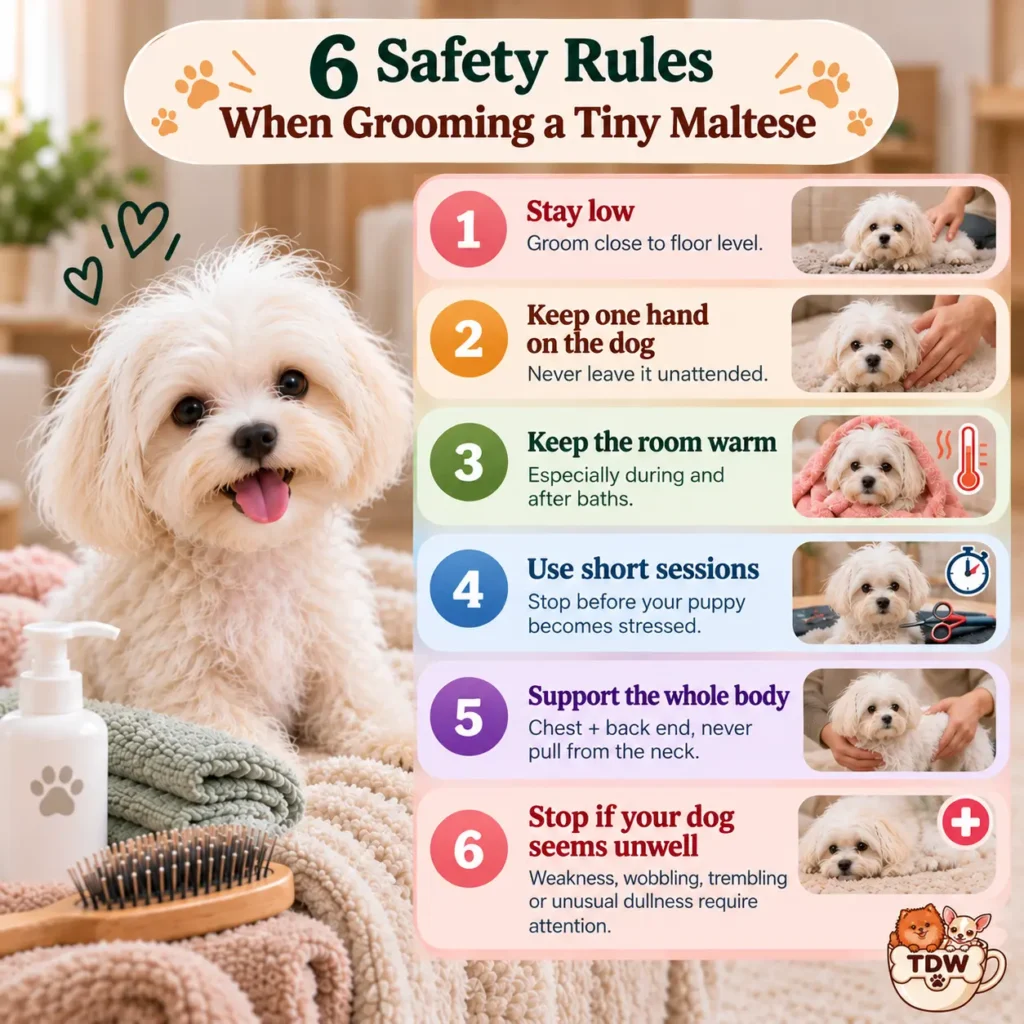
The safest way to groom a tiny Maltese is low, warm, short and gentle. Read these rules before you pick up a brush. They matter more than any tool you buy.
- Groom close to the floor. Sit on the floor or use your lap with a towel or non-slip mat. A fall from a counter or table can seriously hurt a dog this small.
- Keep one hand on your dog at all times. If you must reach for something, pick your dog up first or set it on the floor. Never walk away, even for a few seconds.
- Keep the room warm and free of drafts, especially on bath days.
- Keep sessions short. For a puppy, that might mean five to ten minutes, or only a minute or two at first. Follow your puppy’s comfort, not the clock. Split bigger jobs, like a full brush out and a nail trim, across different times of day.
- Skip grooming if your dog seems hungry, very tired or unwell.
- Never hold or pull your dog by the neck. Support the chest and back end instead, and use a harness rather than a collar for leading.
Two health problems explain rules 5 and 6. Very small puppies can get low blood sugar, called hypoglycemia. PetMD’s guidance on teacup dogs lists weakness, dullness, muscle tremors and seizures as warning signs. If you see any of these during grooming, stop and call your vet right away.
Tiny dogs are also more likely to develop a collapsing trachea, where the windpipe weakens and narrows. It often causes a cough that sounds like a goose honk. Avoiding pressure on the neck is a sensible precaution, though it will not prevent the condition on its own.
Getting a Teacup Maltese Puppy Used to Grooming
Start gentle handling the week your puppy comes home. The goal is not a perfect groom. It is a puppy that feels calm when you touch its paws, ears and mouth.
- Pick a quiet time, when your puppy is relaxed but not sleepy.
- Touch one area, such as a paw, for a second or two. Give a tiny, soft treat.
- Add one new step at a time: holding a paw a bit longer, lifting a lip, letting the brush touch the back.
- Stop while your puppy is still happy. Ending early teaches more than pushing through.
- Repeat daily for a minute or two.
If your puppy pulls away, cries or tries to bite, go back a step and slow down. A puppy that learns grooming is safe will be much easier to care for, and safer, for the rest of its life.
Grooming Jobs Kids Can Help With
Children can be wonderful grooming helpers, as long as the jobs match their age and an adult is right there. The main rule: kids sit on the floor whenever they hold or brush the dog, so a wriggle never turns into a fall.
| Kid-friendly jobs (with an adult watching) | Adult-only jobs |
|---|---|
| Handing out treats for calm behavior | Using scissors near the face or paws |
| Gently brushing the back with a soft brush | Trimming nails |
| Holding the towel or handing over tools | Bathing and drying |
| Praising the dog in a calm voice | Lifting and carrying the dog |
| Wiping paws with a soft damp cloth | Brushing teeth |
How to Brush a Teacup Maltese Without Pulling
The key is to work through the coat in thin layers, reaching the hair close to the roots. That does not mean pressing the brush into the skin. Let it glide lightly, and never scrape or force it through resistance. Brushing only the top layer makes your dog look neat while tangles quietly grow underneath.
- Settle your dog on your lap or on a towel on the floor.
- Lightly mist one section with plain water or a grooming spray made for dogs, used as the label directs. Dry, fine hair breaks more easily.
- Start low on the body, near the legs. With one hand, lift the hair above the spot you are working on. With the other, brush a thin layer downward, starting near the roots and moving out to the tips. Groomers call this line brushing.
- Let a new thin layer fall down and repeat, working your way up the body.
- Do the comb test. Ease the metal comb through the same area, from near the roots outward. If it glides, that part is done. If it catches, stop there rather than pulling. You have found a tangle.
- Finish the face with the fine teeth of the comb, moving slowly and keeping the comb pointed away from the eyes.
Always brush the whole coat before a bath. Water makes small tangles shrink and tighten, so a knot that was easy to fix when dry can turn into a solid mat once wet.
Where Mats Hide
Mats grow fastest wherever hair rubs, gets damp or gets touched a lot. Check these spots every time, even if the coat looks perfect from above:
- Under the front legs, where the legs rub the chest
- Along the harness or collar line
- Behind and just under the ears
- The inside of the back legs and around the bottom
- The beard and the hair under the eyes
- Between the paw pads
How to Remove a Mat Safely
Only try small, loose tangles at home. Leave tight mats, mats close to the skin and larger matted areas to a groomer.
Work a little dog detangling spray into the tangle, following the label. Hold the hair between the tangle and the skin so the skin is not tugged. Then gently tease small strands away from the edge with your fingers, and follow with the end teeth of the comb. Stop if your dog flinches, cries or pulls away, or if the tangle does not loosen easily.
Do not cut mats out with scissors. Skin can get pulled up inside a mat, and on a tiny dog it is very easy to cut it by mistake. If a mat will not loosen, or there are many of them, a groomer can safely clip them out.
How to Bathe a Teacup Maltese
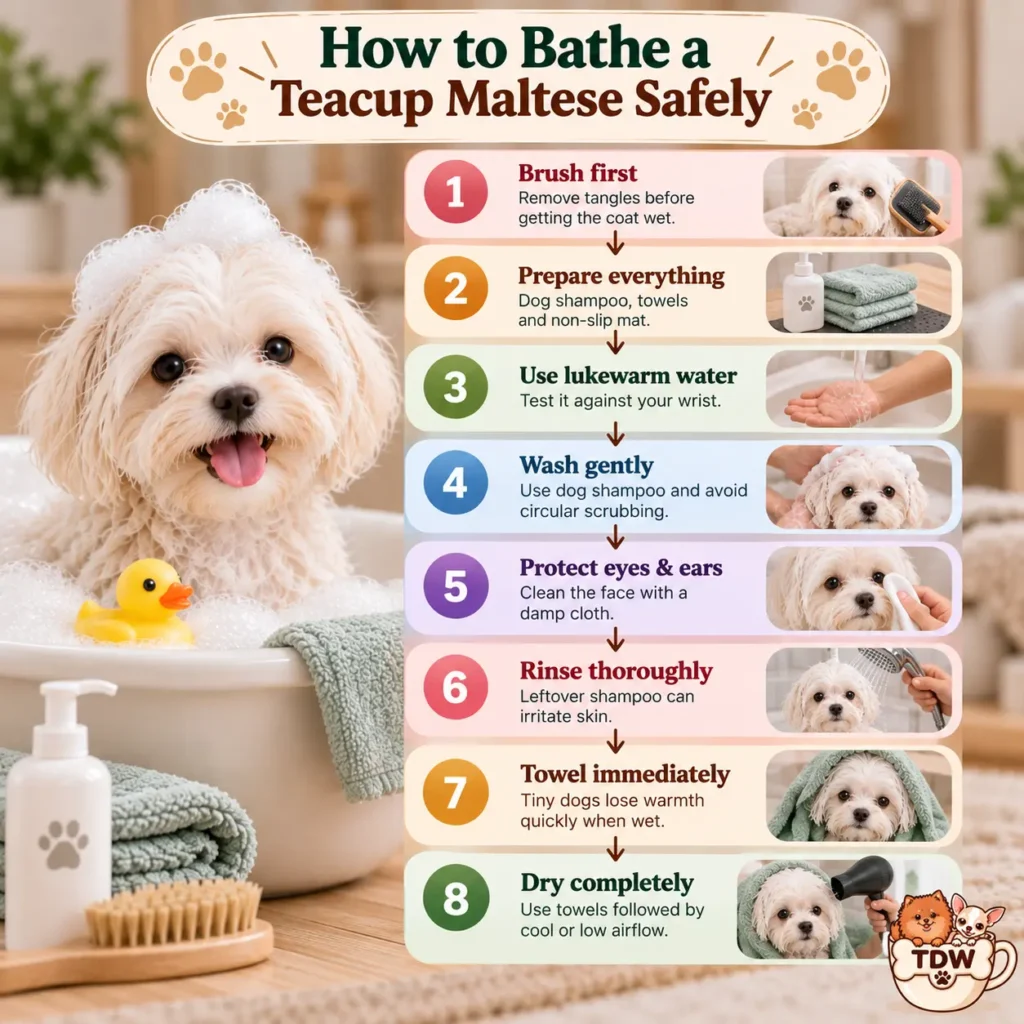
A bath every few weeks keeps most Maltese clean, with extra baths when your dog gets muddy. Ordinary dirt washes out. A smell that comes back soon after a bath, or skin that looks red, itchy or flaky, is a reason to see your vet rather than to bathe more often.
- Brush and comb out the whole coat first.
- Warm the room and gather everything before your dog gets wet: shampoo, a cup, two or three towels and a non-slip mat.
- Pick a spot where you can hold your dog securely and it cannot jump or fall, with the mat in the bottom. A sink works for many owners, and so does a small basin set inside a bathtub. Keep one hand on your dog the whole time.
- Test the water on the inside of your wrist. It should feel lukewarm, never hot.
- Wet the body with a cup or a gentle sprayer. Leave the head for last.
- Use a shampoo made for dogs. Gently squeeze it through the coat instead of scrubbing in circles, which creates tangles.
- Clean the face with a damp washcloth rather than pouring water over the head. Keep water and suds out of the eyes and ears.
- Rinse, then rinse again, until the water runs clear. Leftover shampoo can irritate the skin.
- Wrap your dog in a towel right away.
Why dog shampoo? Dog skin has a different pH than ours and is easily dried out. The American Kennel Club explains that human shampoo can leave a dog’s skin dry, flaky and itchy. Gentle formulas for white or sensitive coats are a good fit for a Maltese.
Drying a Teacup Maltese Without Chilling It
Dry your Maltese completely, down to the skin, in a warm room, using towels first and only cool or low heat from a dryer.
- Blot the coat with towels. Press and squeeze rather than rubbing, which tangles silky hair.
- Swap to a dry towel as soon as the first one gets damp.
- If you use a hair dryer, set it to low or cool and hold it well away from the body. Test the airflow on your own wrist often. Keep moving it so no spot gets hot.
- Brush gently while you dry, lifting small sections so air reaches the skin.
- Check by feel. Part the hair in a few places. If the skin feels damp, keep going.
- Never leave a small dog alone in a heated drying cage or near a running dryer.
Teacup Maltese Tear Stains: Daily Care and What to Avoid
Daily care keeps the hair around the eyes clean and dry, which helps your dog stay comfortable. It will not always make stains lighter, and it cannot fix the reason a dog tears too much. VCA Animal Hospitals recommends a vet visit to rule out an eye problem before you focus on the stains themselves.
The reddish brown color comes from natural pigments in tears called porphyrins. Every dog has them. On a white Maltese, they simply show. According to Veterinary Partner, a vet information service, constant moisture under the eyes can also lead to skin irritation, infection and odor. That is why drying matters as much as cleaning.
A simple daily routine:
- Wipe under each eye with a soft cloth dampened with warm water, or an eye-area wipe your vet approves. Use a fresh corner for each eye.
- Dry the hair gently with a clean, soft cloth.
- If there is dried residue, hold the damp cloth on it for a moment to soften it, then wipe gently. Do not pick or pull. If it is stuck right at the eye, or your dog seems uncomfortable, ask your vet.
- Keep hair out of the eyes with a small topknot, or have a groomer trim it short.
One rule matters more than any wipe: do not use tear-stain products that contain an antibiotic, such as tylosin, unless your vet prescribes it. The FDA has warned makers of these products in the past (2014, 2017), so read labels and check with your vet before trying anything new.
Skip these:
- Any tear-stain product that lists an antibiotic, such as tylosin, on the label
- Bleach, hydrogen peroxide or makeup remover anywhere near the eyes
- Home remedies placed in or on the eye
- Products that promise to cure stains for good
When Tear Stains Mean a Vet Visit
Most tear staining is cosmetic. But watery eyes, which vets call epiphora, can also come from blocked tear ducts, eyelashes rubbing the eye, allergies or infection, as PetMD explains. Call your vet if you notice:
- Staining that appears or gets worse suddenly
- Staining or watering in only one eye
- A red, cloudy or swollen eye
- Squinting, blinking a lot or pawing at the face
- Thick, yellow or green discharge
- A bad smell from the eye area
Face, Ears, Paws and Sanitary Trims
These small jobs take only a few minutes, but they prevent a lot of bigger problems.
Face. Choose either a small topknot that keeps hair out of the eyes or a short face trim that needs no daily styling. Food and water can turn the hair around the mouth yellow, so wipe the muzzle with a damp cloth after meals and dry it.
Ears. The Maltese has drop ears covered in long hair, which can trap moisture. Once a week, lift each ear, look inside and give it a sniff. Healthy ears look pale pink and have little smell. Ask your vet whether your dog needs routine ear cleaning, and which cleaner to use if so. Never push cotton swabs or anything else down into the ear canal. Some groomers pluck hair from inside the ear and some do not, so ask your vet what is right for your dog.
Paws. Hair growing between the pads can make a tiny dog slip on hard floors and can trap dirt. Trimming it means working right next to the pads, so leave it to a trained groomer unless one has shown you how in person.
Sanitary area. Keeping the hair short around the bottom and belly helps your Maltese stay clean between baths. This is a sensitive area, so leave the trimming to your groomer.
Teeth: The Grooming Job You Should Never Skip
Brush your Maltese’s teeth every day if you can. The AVMA’s pet dental care guide calls regular brushing the single most effective thing you can do at home, with daily brushing being best and a few times a week still helpful.
Use a finger brush or a very small toothbrush and toothpaste made for dogs. Human toothpaste is not made to be swallowed, and some kinds contain ingredients that are harmful to dogs. Start by letting your dog lick a little toothpaste from your finger. Then rub a few front teeth for a second or two. Slowly build up to brushing along the gumline on all the teeth. Pair it with a yearly dental check at your vet.
Why Small Maltese Need Extra Dental Care
A tiny mouth has to fit a full set of teeth, so they are often crowded. Baby teeth can also stay in place after the adult teeth come in. Both trap food and plaque, which leads to gum disease (the medical name is periodontal disease).
Research on large groups of dogs points the same way. A study of over 3 million records from US veterinary hospitals, published in The Veterinary Journal in 2021, found that extra-small breeds were up to 5 times more likely to be diagnosed with gum disease than giant breeds. A 2024 study of the same kind found retained baby teeth in about 15 percent of extra-small breed dogs, compared with 7 percent of all dogs studied. “Extra-small” in these studies meant breeds under about 14 pounds. These are findings about breed-size groups, not a prediction for any one Maltese, but they are a good reason to take tooth care seriously.
Ask your vet to check for leftover baby teeth during puppy visits. They are much easier to deal with early.
Are Anesthesia-Free Dental Cleanings Safe?
No, not as a replacement for a proper dental cleaning. Some groomers and pet stores scrape tartar off an awake dog’s teeth. The American Veterinary Dental College says this cannot clean below the gumline, where most gum disease happens, and does not prevent dental disease. If anesthesia worries you in a dog this small, talk it through with your vet.
Trimming Tiny Nails Without Hitting the Quick
Trim just a tiny bit at a time, about every few weeks, whenever you hear clicking on the floor. A light dog that spends lots of time on carpets or in laps does not wear its nails down much.
Inside each nail is the quick, a soft core with blood vessels and nerves. Cutting into it hurts and bleeds. As the American Kennel Club’s nail guide notes, trimming nails regularly helps the quick move back over time.
- On white or clear nails, you can see the pink quick. Stay well in front of it.
- On dark nails, the quick is hidden. Ask your vet or groomer to show you how much to take off before you trim dark nails alone.
- A quiet nail grinder lets you shorten nails gradually, which some dogs accept more easily than clippers.
- Do not forget the dewclaws on the inner side of the legs. They never touch the ground.
- If you nick the quick, press a pinch of styptic powder onto the tip until the bleeding stops.
If your dog is very wriggly, or you feel unsure, your vet or groomer can trim nails quickly while you build confidence.
Choosing a Groomer for Your Teacup Maltese
Look for a groomer who handles very small dogs often and can tell you exactly how they keep them safe. Most families combine home care with a professional trim every several weeks, so this choice matters.
Questions worth asking before you book:
- How often do you groom dogs that weigh only a few pounds?
- How do you dry small dogs? Do you use heated drying cages, and is someone always watching?
- Is a dog ever left alone on the grooming table?
- What do you do if a dog gets scared, shaky or tired?
- How long will my dog stay, and can I pick it up as soon as it is done?
- Which vaccinations do you require?
- Do you offer teeth scraping without anesthesia? (If so, remember the dental advice above.)
Things to tell the groomer:
- Your dog’s weight and any health problems, such as a cough, heart murmur or past injury
- Your dog’s feeding times, and whether it needs a small snack during a long visit
- The haircut you want, with a photo if you have one
- Any spots your dog dislikes having touched
A good groomer will welcome these questions. If someone brushes them off, keep looking.
Grooming Red Flags: When to Call Your Vet
Grooming is the perfect weekly health check, because your hands touch every part of your dog. Call your vet if you notice any of the following:
- Skin: new lumps or bumps, red patches, sores, flaky skin, fleas or tiny black flea specks
- Ears: a bad smell, redness, dark discharge, frequent head shaking or scratching
- Eyes: any of the warning signs listed in the tear stain section
- Mouth: bad breath, red or bleeding gums, brown buildup on the teeth, loose or broken teeth, or chewing on one side
- Legs and body: limping, or crying out when a leg or the back is touched
- Breathing: a honking cough, especially when excited or pulling on a leash
Call right away if your dog becomes weak, wobbly, trembly or unusually dull during or after grooming. See the safety rules above for why this matters in a very small dog.
Teacup Maltese Grooming FAQs
How often should a teacup Maltese be groomed?
Some care every day, with bigger jobs spread out. The schedule table above lays out each task. Use it as a starting point and adjust it with your groomer and vet.
Do teacup Maltese shed, and are they hypoallergenic?
A Maltese sheds relatively little, and some loose hair stays caught in the single coat. But no dog is truly hypoallergenic. A 2012 study found that breeds sold as hypoallergenic had similar or even higher levels of the main dog allergen in their coats, and similar levels in their homes. If someone in your family has allergies, spend time around a Maltese before you commit.
Can I use human or baby shampoo on my Maltese?
Use dog shampoo for regular baths. Human shampoo can dry out a dog’s skin, as covered in the bathing section. In a pinch, the American Kennel Club notes that baby shampoo is gentle enough for an occasional bath, but it is not the best everyday choice.
Should I shave my Maltese in summer?
No. A short puppy cut is easier to look after, but shaving to the skin removes protection, as explained in the haircut section. In hot weather, shade, fresh water and a cool room matter far more for a tiny dog than how short the coat is.
When can a teacup Maltese puppy see a groomer?
Start gentle handling at home right away, and ask your vet when your puppy’s vaccinations are far enough along for a first salon visit. Most groomers ask for vaccine records. Keep the first visit short and simple, such as a bath, face tidy and nail trim, so your puppy learns that grooming is safe.
Final Thoughts
Teacup Maltese grooming does not have to feel scary. Work through the coat to the roots in thin layers, keep the face clean and dry, brush teeth every day, and handle your dog low, warm and gently. Choose a haircut your family can keep up with, and let your vet guide anything that looks like more than a grooming problem.
Save the schedule table and start with a few short sessions this week. Some dogs settle into grooming quickly, while others need weeks of short, gentle practice. Go at your dog’s pace.
If your family is still deciding whether this little dog is the right fit, our complete guide to the teacup Maltese covers the rest.

The TeacupDogWorld Editorial Team researches and creates practical guides about small and teacup-sized dogs, including breed characteristics, grooming, nutrition, health, training, and everyday care. Our content is developed using reputable veterinary, breed-club, and animal welfare sources to help dog owners make better-informed decisions.