
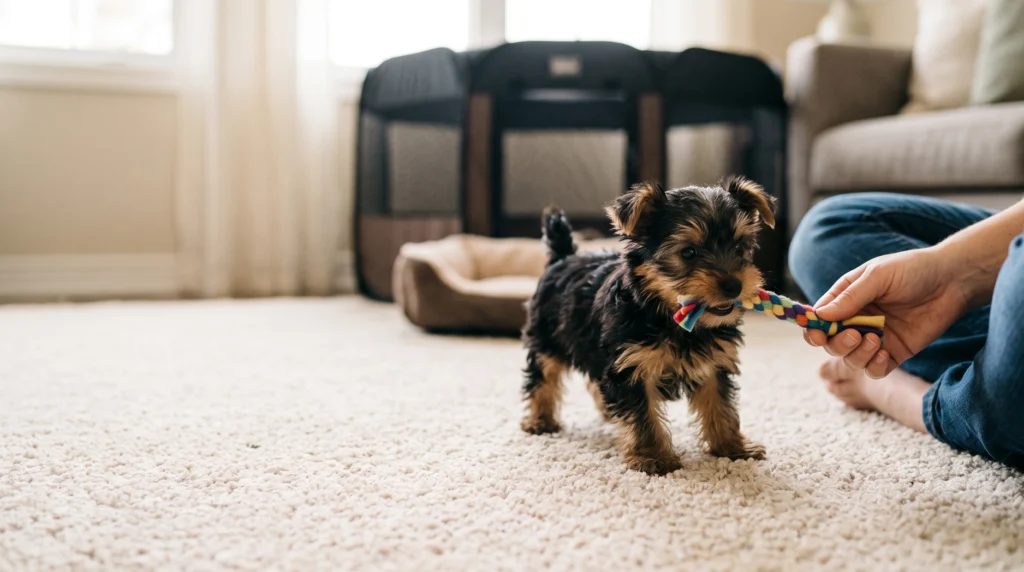
Those tiny needle teeth hurt. And when the biter is small enough to fit in your hands, it can be hard to know what to do. Push the puppy away too hard and you worry about hurting it. Ignore it and your kids end up with scratched fingers.
Play biting is common in puppies, and consistent, reward-based training can help. Biting during handling, around possessions, or with increasing intensity needs a different assessment.
For ordinary play biting, learning how to stop a teacup puppy from biting mostly means using the same gentle training every puppy needs, plus extra care because your dog is so small. Below, you will find a quick plan, the signs that call for a closer look, why puppies bite, step-by-step training, a simple progress log, house rules for kids, and what not to do.
How to Stop a Teacup Puppy From Biting: The Quick Plan
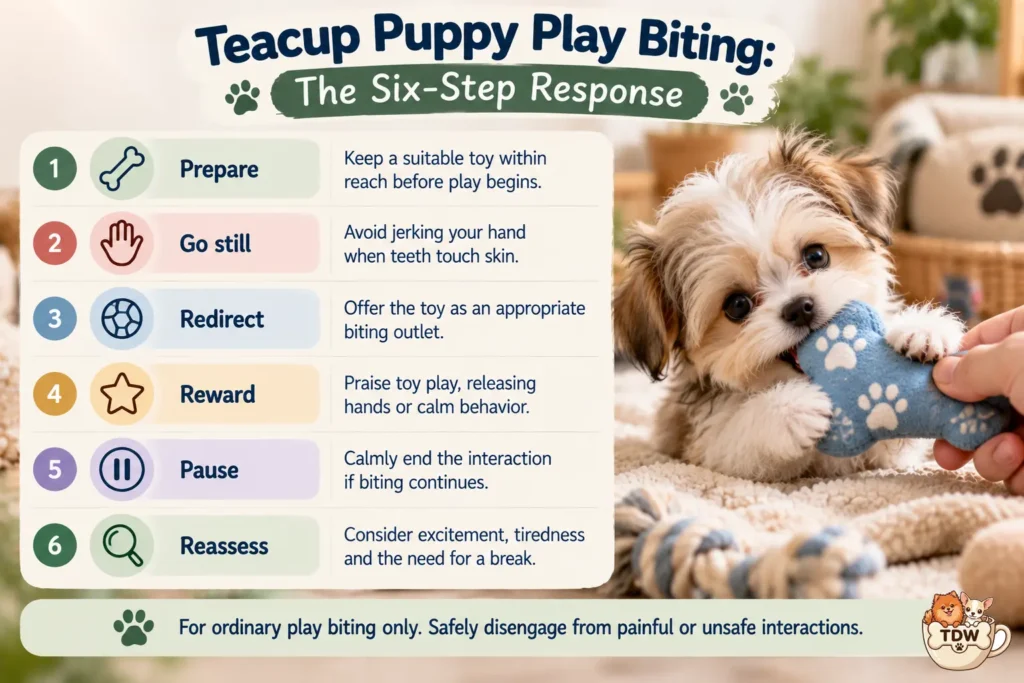
For ordinary play biting, an adult should lead these steps, and everyone in the family should follow them the same way:
- Keep a toy within reach whenever you play, and offer it before your puppy reaches for hands.
- Go still if teeth land on skin. Keep your hand calm instead of pulling it away.
- Redirect to the toy and let your puppy bite that instead.
- Reward the behavior you want, such as gentle play, sitting or chewing the toy, with calm praise or a tiny treat.
- Pause the interaction if biting continues. Calmly stand up, turn away or step behind a baby gate for a short break. Then look at what was going on before you start again.
- Build in rest. A tired or overexcited puppy may bite more, so plan quiet time after play.
Do not remain in a painful or unsafe interaction to complete these steps. Prioritize safe separation and seek help if you cannot disengage safely.
Consistency helps your puppy understand what to expect. The veterinary behaviorists at VCA Animal Hospitals say everyone in the home should follow the same rules.
When Teacup Puppy Biting Needs a Closer Look
The plan above is for playful nipping. Some biting has a different cause and needs a different response. Talk to your vet or a qualified behavior professional if you notice any of these:
- Biting that starts suddenly or changes quickly
- Biting when you touch a certain spot, pick the puppy up, or groom it, which can point to pain or fear
- Biting or stiffening around food, toys, chews or a resting spot (often called guarding)
- Bites that are getting harder or more frequent over time
- A stiff or frozen body, lips pulled back, or growling, which the ASPCA lists as warning signs
- Bites that break skin or leave anyone in the family scared to handle the puppy
A growl or single body-language signal does not establish the cause; consider the situation and the puppy’s overall behavior.
You do not need to wait for a certain age. If biting is getting worse, causing injury, or feels hard to manage, it is a good time to ask for help. The ASPCA notes that biting from frustration is not something puppies outgrow.
Who to Call for Help
Start with your vet. Pain or another health problem can cause biting, and your vet can check for that first.
If your puppy is healthy, look for one of these:
- Veterinary behaviorist (Dip ACVB): a vet with advanced training in animal behavior
- Certified Applied Animal Behaviorist (CAAB): an animal behavior expert with advanced university training
- Certified Professional Dog Trainer (CPDT): a trainer who has earned a professional certification
Choose someone who uses reward-based methods. If your puppy shows fear or aggression, ask about their experience with it. The ASPCA points out that CPDT certification does not require that experience.
Why Teacup Puppies Bite
Biting is one way puppies play and explore. They have no hands, so they use their mouths to grab, test and figure out the world, including fingers, toes and sleeves. Puppies also play with each other using their mouths, so to your puppy, a moving hand can look like a playmate.
In the litter, puppies start learning how hard is too hard. When one bites a littermate too roughly, the other puppy yelps and stops playing. This early lesson in bite control is often called bite inhibition. At home, the goal is to build on it by teaching your puppy that toys are for biting and people are not.
It also helps to know what play biting is not. The behaviorists who wrote VCA’s guide to play biting in puppies say plainly that a play-biting puppy is not trying to dominate you. It is a young dog that has not learned the rules yet.
What Might Be Behind the Biting
Several things can make biting more likely, and they often overlap. A puppy can be teething, overexcited and tired all at once. Use this table as a starting point, not a diagnosis.
| Possible contributor | What you might notice | What to consider |
|---|---|---|
| Play and excitement | Nipping during games, or when the puppy wants attention | Redirect to a toy, reward calm play, keep games short |
| Teething | Lots of chewing on objects, often while adult teeth come in | Offer suitable chew toys and supervise chewing |
| Needing rest | Biting that builds after a long or busy stretch of activity | Try a calm break and a chance to nap |
| Pain, fear or discomfort | Biting during handling, or around a certain body part | Pause training and talk to your vet |
The American Kennel Club’s puppy teething guide explains that puppies usually lose their baby teeth and grow adult teeth between about 3 and 6 months. Still, VCA’s behaviorists note that most nipping at people is play rather than teething, which is why a chew toy alone often does not stop it.
Does a Teacup Puppy Need Different Training?
Not really. The same reward-based principles apply, but the setup and pace should suit your puppy’s size, health, and behavior. “Teacup” is a word sellers use for very small puppies, often Chihuahuas, Pomeranians, Yorkshire Terriers or Maltese. It is not a breed or an official size. The “teacup” label alone does not explain why an individual puppy bites.
What changes is safety. A very small puppy has a fragile body. It can be hurt by a fall from a child’s arms, a hard tug on a toy, or rough handling. Training treats also need to be tiny. If you have one of these breeds, our teacup Pomeranian guide and teacup Maltese guide cover temperament and daily care in more detail, and our teacup dog breed guides include other small breeds.
Teaching Your Teacup Puppy Gentle Play, Step by Step
The aim is simple: your puppy learns that toys are for biting, and that gentle, calm behavior gets attention and rewards. You do this by redirecting, rewarding, and calmly pausing when biting continues.
What to Do When Your Puppy Bites
When teeth land on skin, go still. Do not snatch your hand away. Quick movement makes your hand look like a toy worth chasing, and the AKC’s advice on puppy nipping warns that pulling away while teeth are on you can tear your skin.
Next, offer a toy and let your puppy bite that instead. When it takes the toy, lets go of you, or settles down, praise it calmly and keep playing gently.
If your puppy goes right back to your hands, calmly pause the interaction. The ASPCA’s advice on puppy mouthing explains that brief time-outs from attention teach a puppy that gentle play continues and rough play stops. If biting keeps happening, follow the steps in “When a Toy Does Not Help” below.
What About Yelping?
You may read that you should yelp or say a high “ouch” when your puppy bites. Advice on this varies. Some puppies pause when they hear it, while others get even more excited.
If you try it and your puppy gets wilder, stop using it and stick with going still, redirecting and pausing. Try not to scoop your puppy up and carry it off mid-bite, either. VCA notes that being picked up can feel like more play, and a tiny, wriggling puppy can slip and fall.
Give That Little Mouth Something Better to Do
Puppies need to chew, so give them good options. Good choices for a small mouth include:
- Soft toys sized for your puppy’s mouth
- Rope or fleece toys long enough to keep hands away from teeth
- Teething toys used the way the maker’s instructions describe
- Food puzzle toys for quiet time
Choose a toy your puppy can comfortably use but cannot swallow. Check for loose pieces, excessive hardness, and damage; supervise chewing. The AKC also advises throwing out any toy your puppy can bite pieces off or pull stuffing out of. Ask your vet which chews and teething toys suit a puppy this size.
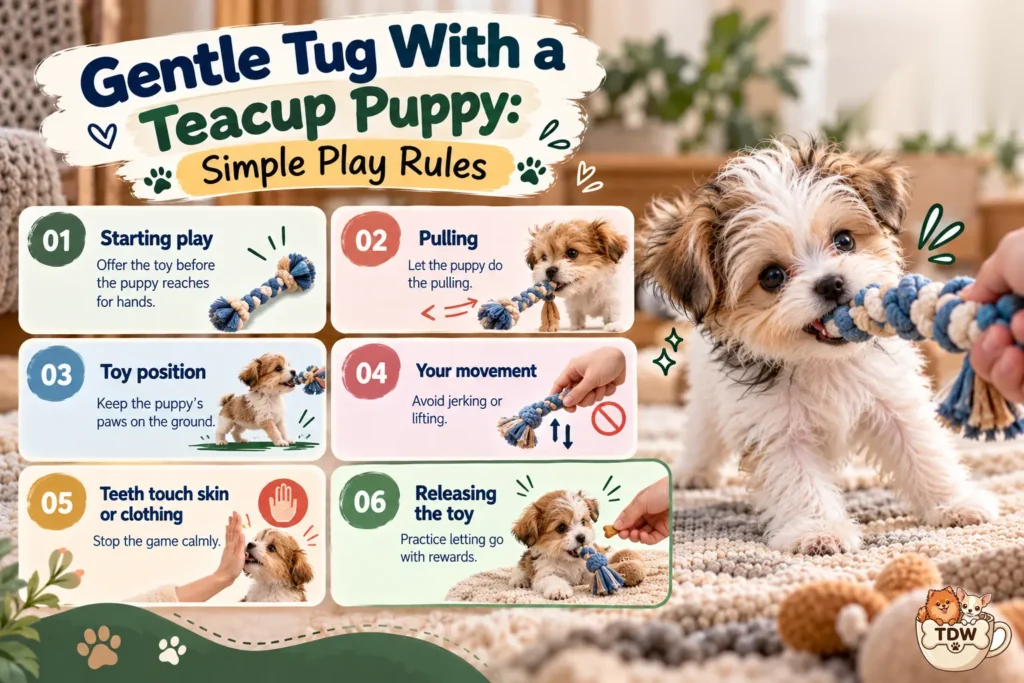
Tug can be fine if it stays gentle and has rules. VCA recommends stopping the game the moment teeth touch skin or clothes, and teaching your puppy to let go of the toy when asked. With a tiny dog, let the puppy do the pulling. Never lift it off the ground or jerk the toy, because its neck is small and delicate.
When a Toy Does Not Help
Sometimes your puppy drops the toy and goes straight back to your hands. When that happens, the adult should calmly end the game rather than keep offering the toy over and over.
- Stand up, fold your arms or step away, without scolding.
- If your puppy follows and keeps biting, step behind a baby gate or door for a short break. With a tiny puppy, moving yourself is safer than grabbing it.
- When you come back, offer something calmer than the game you stopped, such as a food puzzle or a chew in its pen.
- Think about what came before. Was the game too wild? Has your puppy been awake and busy for a long time? Could it need a potty break?
- If the same thing keeps happening, shorten play sessions, change the game, and note it in your progress log.
Reward Calm, Gentle Behavior
Notice the good moments, not just the bites. Praise your puppy when it sits, chews its toy, or plays softly.
Food rewards work well, but a tiny dog needs tiny rewards. Break treats into crumb-size pieces, or set aside part of each meal and use that kibble during the day. Over time, your puppy learns that toys and calm behavior bring play and praise, while biting skin makes the fun stop.
Track Your Teacup Puppy’s Biting With a Simple Log
A short log helps you spot patterns you might miss day to day, such as biting that always happens after a long play session or when a certain person arrives home. Jot down a line each time biting is a problem:
| Situation | What happened just before | How you responded | What happened next | What to try next time |
|---|---|---|---|---|
| Hypothetical example: evening play with the kids | Long, fast chasing game | Adult paused play and offered a toy | Puppy went back to biting hands | End play sooner and offer a chew in the pen |
Review it every few days. Compare similar play sessions: look for fewer biting episodes, easier redirection, and more comfortable interaction. Fewer bites simply because there was less interaction do not necessarily show learning. If you see progress, keep going. If biting stays the same or gets worse, the log gives your vet or trainer useful details to work with.
A Daily Routine That Helps Prevent Teacup Puppy Biting
A lot of biting happens when a puppy is overexcited or worn out. A steady routine gives your puppy regular chances to rest, which can make play calmer.
In its guide on how to stop puppy biting, the AKC notes that a biting puppy may simply be overtired and need a nap in a quiet space. Keep play sessions short, then offer a potty break and a calm rest with a chew toy.
Give your puppy a quiet spot of its own, such as a pen or a crate behind a baby gate. That space should feel safe and cozy, and never like a punishment.
For meals, follow the feeding plan your vet recommends for a puppy this small, and try to keep it steady on busy days.
Teacup Puppy Biting and Kids: House Rules
Children’s quick movements and excited voices can encourage chasing and nipping. A tiny puppy can also be badly hurt if a child drops it.
Managing biting is an adult’s job, not a child’s. These rules help reduce risks for children and the puppy:
- Kids sit on the floor to hold or play with the puppy.
- An adult supervises every play session.
- If the puppy nips, the child stops playing, stands still or moves away, and calls the adult.
- The adult decides what happens next, such as redirecting, pausing play or giving the puppy a rest.
- No chasing the puppy, and no running to make it chase.
- The puppy’s rest area is off limits. When it goes there, everyone leaves it alone.
What Not to Do When a Teacup Puppy Bites
You may hear plenty of advice from friends and relatives. Some of it can scare a puppy, hurt it, or make biting worse. The American Veterinary Society of Animal Behavior (AVSAB), a group of veterinarians and scientists who study animal behavior, recommends reward-based training only. It warns that harsh methods can lead to fear and aggression.
Avoid these:
- Tapping the nose, slapping or hitting. The ASPCA warns that physical punishment can make biting worse or make a puppy fearful. A tiny puppy can also be injured.
- Holding the mouth shut or shouting in its face. The San Francisco SPCA says these raise the chance of aggression.
- Scruffing, shaking or pinning it down. Pinning is sometimes called an “alpha roll.” AVSAB lists it as a method to avoid, and a small puppy’s body is easily hurt.
- Squirt bottles and shaker cans. Some older guides still suggest these. AVSAB groups them with methods that work by scaring the dog.
- Hand wrestling or wiggling fingers in its face. This teaches your puppy that hands are toys.
- Pulling your hand away fast. Quick movement invites chasing and grabbing.
FAQs
When Do Teacup Puppies Stop Biting?
There is no set age. Progress depends on the puppy, the cause of the biting, and how consistent the family is. Your progress log is a better guide than the calendar. If biting is getting worse, causing injury, or feels hard to manage at any age, reach out to your vet or a qualified trainer.
Should We Try Puppy Classes?
They can help. A well-run class gives your puppy safe practice around other puppies and gives you hands-on coaching. AVSAB encourages early puppy socialization. Ask your vet when your puppy is ready to start, and look for a reward-based class that keeps tiny puppies safe from much bigger ones.
Final Thoughts
Many puppies mouth during play, but the circumstances matter. Sudden changes, painful handling, or escalating bites are reasons to seek professional help.
For ordinary play biting, the steps are simple: keep a toy handy, go still when teeth land on skin, redirect, reward gentle behavior, pause calmly when biting continues, and build in rest. Keep an adult in charge, especially around kids, and use your log to see what is working. Before your next play session, prepare a suitable toy, arrange a safe way to pause interaction, and agree on which adult will supervise.
The TeacupDogWorld Editorial Team researches and creates practical guides about small and teacup sized dogs, including breed characteristics, grooming, nutrition, health, training, and everyday care. Our content is developed using reputable veterinary, breed club, and animal welfare sources to help dog owners make better informed decisions.