

Your mom lives alone now, and her home feels too quiet. A tiny dog seems like the perfect answer. It’s light enough to lift, happy on a lap, and small enough for an apartment. Then you see the teacup puppy photos, and the decision feels made.
Before you say yes, it helps to know what those listings leave out. Some tiny dogs make wonderful companions for older adults. Others come with health and safety problems that land hardest on an older owner.
This guide to teacup dog breeds for seniors gives you the honest version. You’ll learn what “teacup” really means, which small breeds may fit a senior’s life, and which risks to plan for. You’ll also get a care worksheet and a checklist so your family can decide together.
Are Teacup Dog Breeds Good for Seniors? The Short Answer
In most cases, a healthy toy breed dog at its normal breed size is a better choice than a true teacup. Toy breeds like the Maltese and Havanese can be loving companions. Dogs bred to be extra small face more health problems and injuries, which makes them harder for many older adults to care for.
Even though this site is all about tiny dogs, we’d rather give you the honest answer than the cute one. The good news is that you don’t have to give up on a small dog. You just need to choose health over smallness.
What “Teacup” Really Means for Older Owners
“Teacup” is not a breed. It’s a word sellers use for dogs that are smaller than normal for their breed. Britannica describes a teacup dog as an unofficial name for dogs bred to weigh less than about 4 to 6 pounds, often by pairing the smallest dogs in a litter.
The American Kennel Club (AKC) doesn’t recognize the label. In its guide to finding a responsible breeder, the AKC warns that puppies sold as “teacup” can have many health problems, starting with trouble keeping their blood sugar steady. It also notes that teacup is not an official size for any breed it recognizes.
Breed clubs agree. The Chihuahua Club of America says every Chihuahua registered with the AKC is simply a toy breed dog, no matter how much it weighs.
Without an official standard, anyone can call a puppy “teacup.” That makes it hard to know what you’re really getting.
| Feature | Official toy breed standard | “Teacup” label |
|---|---|---|
| Who sets it | The breed’s parent club and the AKC | Individual sellers |
| Size | A set size limit or range for each breed | Whatever the seller says |
| Recognized by the AKC | Yes | No |
| Main focus | Healthy, sound dogs | Smallness |
Teacup Breeds for Seniors Compared Side by Side
Here are seven small breeds that often appear in “teacup” listings, at their normal breed size. Sizes come from AKC breed standards. Grooming and barking levels are general editorial summaries, not measured rankings, and individual dogs vary.
| Breed | Breed standard size | Grooming | Barking | Health concern to discuss with a vet |
|---|---|---|---|---|
| Maltese | Under 7 lb | High | Moderate | Liver shunt |
| Yorkshire Terrier | 7 lb or less | High | Higher | Liver shunt |
| Pomeranian | 3 to 7 lb | Moderate | Higher | Windpipe, knees |
| Toy Poodle | 10 in or under | High | Moderate | Windpipe, knees |
| Shih Tzu | Up to 16 lb | Moderate with trim | Lower | Windpipe, heat |
| Havanese | 8.5 to 11.5 in tall | Moderate to high | Lower | Liver shunt |
| Chihuahua | 6 lb or less | Low | Higher | Windpipe, knees |
VCA Animal Hospitals lists Chihuahuas, Pomeranians, Shih Tzus, Toy Poodles, and Yorkshire Terriers among the breeds often affected by a collapsing windpipe. Cornell’s veterinary college notes that slipping kneecaps are more common in small breeds such as Toy Poodles, Yorkshire Terriers, Chihuahuas, and Pomeranians. We explain these health issues in plain terms further down.
Best Teacup Dog Breeds for Seniors (Choose the Healthy Toy Size)
We suggest each of these breeds only at its normal breed size, not as an undersized version. No breed is right for every senior. The best choice depends on the individual dog, your parent’s routine, and the help available.
Maltese

The AKC breed standard says a Maltese should weigh under 7 pounds, with 4 to 6 pounds preferred. It also describes the breed as one of the gentlest mannered of all little dogs, while still lively and playful.
The long white coat needs regular brushing. Many owners choose a short trim to make care easier.
May suit: a calm home where someone enjoys daily brushing or can budget for regular grooming visits.
Ask about this dog: How does it handle brushing, and how does it act when left alone?
Yorkshire Terrier

The AKC breed standard says a Yorkshire Terrier should weigh 7 pounds or less. The AKC describes the breed as a small dog that acts like a big one. It can be stubborn, so some training experience helps.
Yorkshire Terriers are loving and bright, but they can be quick to bark. VCA notes that the breed has a higher rate of liver shunts.
May suit: owners with some dog experience who don’t mind a little attitude.
Ask about this dog: What sets off its barking, and how quickly does it settle down?
Pomeranian
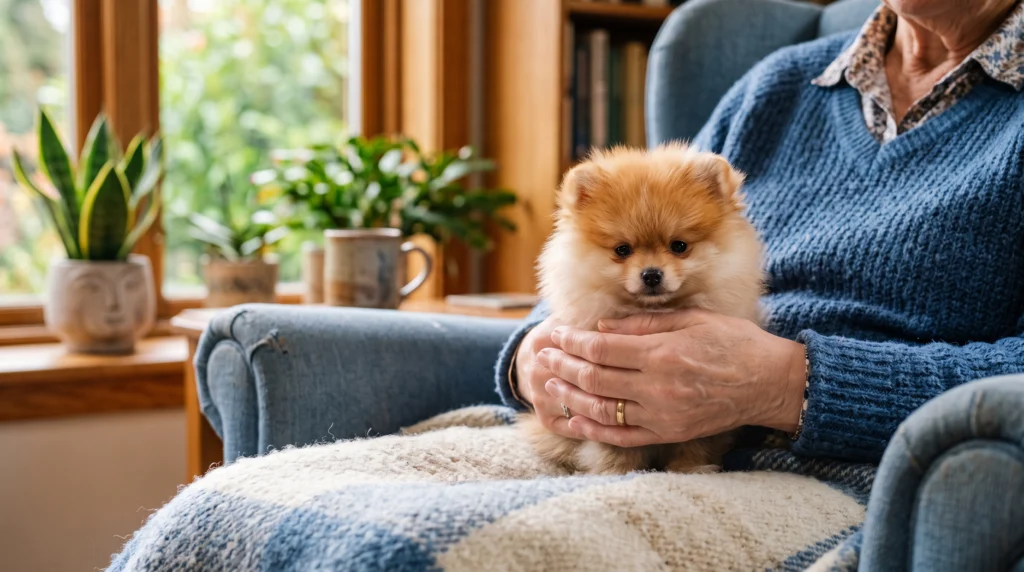
The AKC standard puts the Pomeranian at 3 to 7 pounds. The AKC describes Pomeranians as smart and easy to train, happy with indoor games or short walks, and fond of lap time.
The fluffy double coat needs brushing a few times a week. Pomeranians can be vocal, and they are one of several breeds prone to a weak windpipe. For more detail, see our teacup Pomeranian guide.
May suit: lively seniors who enjoy play and won’t mind a watchful little barker.
Ask about this dog: What is its potty routine, and have there been recent accidents?
Toy Poodle

The AKC standard sets the Toy Poodle at 10 inches or under at the shoulder. It’s a clever breed that learns quickly and enjoys play and training.
The curly coat sheds less, but it needs professional grooming on a regular schedule. Toy Poodle puppies also need frequent meals to prevent low blood sugar.
May suit: active seniors who enjoy teaching tricks and can manage regular grooming appointments.
Ask about this dog: What does a normal day of play and exercise look like for it?
Shih Tzu

The AKC describes the Shih Tzu as a solid little dog of up to 16 pounds that needs little exercise and is happy in an apartment. Owners call the breed happy, even tempered, and eager to please. A short “puppy trim” makes the coat easier to care for.
That extra weight makes the Shih Tzu sturdier than most breeds on this list. Its short face means it can struggle in hot weather, so it needs to be kept cool in summer.
May suit: a relaxed, home centered routine with regular grooming help.
Ask about this dog: What grooming and vet care does it need right now?
Havanese

The AKC breed standard gives the Havanese an acceptable height of 8.5 to 11.5 inches and says the breed should never look coarse or fragile. The breed is known for being cheerful, friendly, and affectionate. Havanese need regular exercise, such as walks and play, alongside ongoing coat care.
May suit: older adults who want a gentle, slightly sturdier small dog and can keep up with daily walks and grooming.
Ask about this dog: How does it react to visitors and new places?
Chihuahua

The AKC standard says a Chihuahua should weigh no more than 6 pounds. Chihuahuas are often loyal and protective, and many are quite vocal around visitors.
They feel the cold quickly, so a sweater helps in winter. Their small size also makes them easy to miss underfoot.
May suit: a calm home with few visitors and an owner who is careful about where the dog is.
Ask about this dog: How does it react when someone knocks, comes in, or reaches to pick it up?
Sturdier Small Breeds Worth Considering
If every toy breed feels too delicate, look slightly bigger. The AKC describes the Cavalier King Charles Spaniel as gentle and comforting, and able to adapt to an active or a relaxed owner.
There’s an important tradeoff, though. Cornell’s veterinary college notes that the Cavalier is at especially high risk for mitral valve disease, a common heart condition in aging small dogs. If you consider this breed, ask the breeder about heart screening on both parents.
The Bichon Frise is another cheerful option with a low shedding coat that needs regular grooming.
Pros and Cons of a Teacup Dog for Seniors
Why Tiny Dogs Appeal to Older Adults
It’s easy to see why small dogs are popular with older owners. They’re easier to lift, carry to the vet, and keep in a smaller home. Size alone doesn’t make a dog safe to live with, though. Consider the individual dog’s pulling, jumping, and underfoot behavior alongside the owner’s handling abilities.
The companionship part is real. The University of Michigan’s National Poll on Healthy Aging (2026) surveyed adults 50 and older. Among pet owners, 83% said their pet gives them a sense of purpose, 71% said it helps them enjoy life, and 70% said it connects them with other people.
Research also hints at benefits for the mind. A 2023 study in JAMA Network Open of 7,945 adults aged 50 and older found that owning a pet was linked to slower decline in verbal memory and word fluency for people living alone, but not for those living with others. A 2025 study in Scientific Reports that followed European adults for 18 years found that dog and cat owners had slower cognitive decline than people without pets.
These studies show a link, not proof that dogs protect the brain. Still, they suggest a dog may add something meaningful to an older person’s day.
Risks Families Should Know First
Here’s the part most lists skip. Very small dogs can be fragile, and older owners may find it harder to spot problems or handle emergencies.
Low blood sugar in tiny puppies. Veterinary Partner explains that very small puppies often get their baby teeth late, struggle to chew dry food, and have trouble staying warm. Together, these make them eat less and struggle to keep their blood sugar normal. VCA lists signs such as weakness, collapse, confusion, trembling, and sometimes seizures.
Fragile bones. Tiny dogs have delicate bones. A jump off the couch or a slip from someone’s arms can lead to a break.
Liver shunts. A liver shunt is a blood vessel problem where blood skips the liver instead of being cleaned by it. The Merck Veterinary Manual notes that this type of shunt is more common in toy breeds such as the Yorkshire Terrier, Havanese, and Maltese.
Knee problems. Patellar luxation means the kneecap can slip out of place. A large study of dogs seen at vet clinics in England found that dogs weighing less than average for their breed were more likely to be diagnosed with it.
Tripping and falls. This risk affects the owner, not just the dog. The CDC reports that over 14 million adults aged 65 and older, about one in four, report falling each year. In an older CDC report covering 2001 to 2006, 31.3% of falls involving dogs happened when someone tripped over the dog, and 21.2% happened when someone was pulled or pushed over.
That report has an important limit. Details about the size or breed of the dogs were rarely recorded, so this study cannot establish whether tiny dogs cause more falls. Still, a small, quiet dog underfoot is easy to miss, especially at night.
Vet bills. More health problems usually mean more vet visits, so plan for that before bringing any dog home.
How to Choose the Right Tiny Dog for an Older Adult
Match the Dog to Mobility and Daily Routine
The AKC points out that what matters most isn’t age but lifestyle and the physical ability to care for a dog. It also says small dogs aren’t always better for older adults, because some small breeds have a lot of energy.
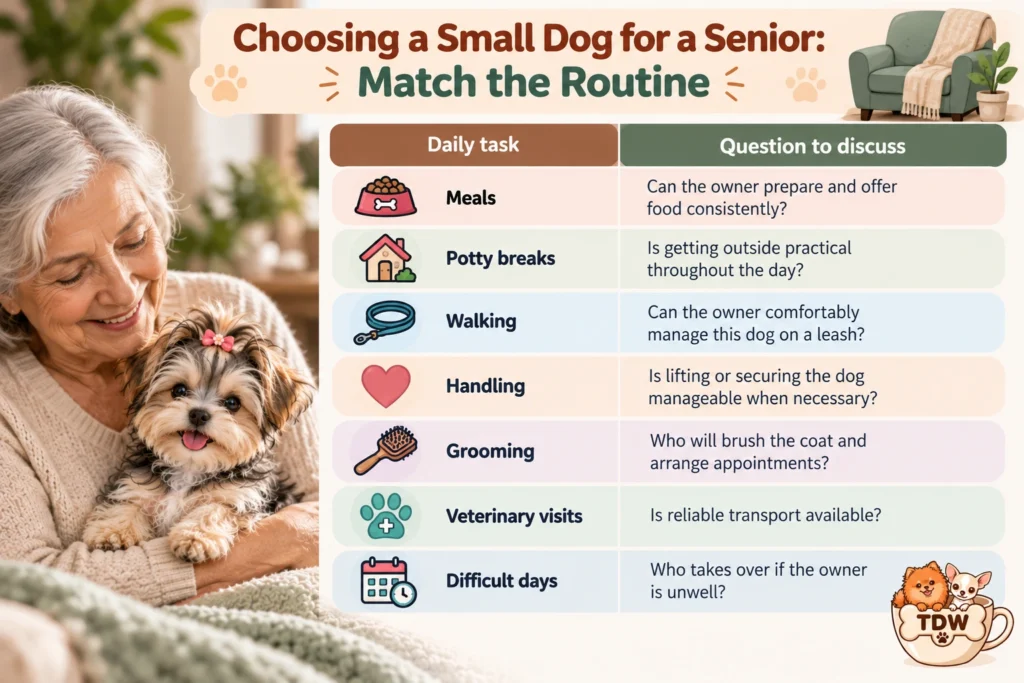
So walk through a normal day with your parent. Who feeds the dog, brushes it, takes it outside, and clips on the leash? Can your parent bend down comfortably and see the dog in dim light?
Then picture a harder day. If your parent feels unwell or an appointment runs late, who covers the dog’s care?
Puppy or Adult Dog?
An adult dog is often simpler for an older owner. Puppies need frequent meals, potty training, and close supervision, and very small puppies carry the blood sugar risk described above. With an adult, you can usually see its personality and routine before you commit.
Still, no age guarantees easy care. An adult dog may need time and training to settle into a new home. Low blood sugar can also happen in adult dogs for other reasons, such as liver problems, so review any adult dog’s health history with a vet.
Plan for the Dog’s Whole Life
Small breeds often live many years, so plan ahead. The University of Michigan poll suggests older adults think about how life might change in 5, 10, or even 15 years, and whether that could affect their ability to care for a pet.
The same report notes that some older adults hesitate to have surgery when no one can care for their pet while they recover. A clear care plan helps prevent that.
Use this worksheet with your family. Fill in a real name for each job, and only once that person has agreed.
| Care job | Questions to agree on | Example of a clear plan |
|---|---|---|
| Meals and potty breaks | Who covers these if your parent feels unwell? Does that person have a spare key? | A neighbor has a key and checks in if Mom doesn’t answer by 10 a.m. |
| Walks and play | Which days can each helper come? What happens in bad weather? | A grandchild walks the dog on weekends, and indoor games cover rainy days. |
| Grooming | What brushing happens at home? Who books and drives to salon visits? | Mom brushes daily, and her son drives to the groomer every six weeks. |
| Vet visits | Who drives to appointments? Who can talk to the vet and see records? | Her daughter handles vet visits and is listed on the dog’s file. |
| Short term care | Where does the dog stay if your parent is in the hospital or traveling? | A family friend who knows the dog takes it for up to two weeks. |
| Long term home | Who takes the dog if your parent can no longer care for it? | Her son has agreed to give the dog a permanent home if needed. |
Keep the vet’s details and care notes where every helper can find them. If your parent might move to assisted living later, check pet policies early, since they vary a lot.
Budget for Ongoing Care
A dog’s costs don’t stop after the first month. The poll found that 31% of pet owners aged 50 and older said having a pet strains their budget. It lists food, medicine, vet care, dog walking, and boarding as costs to consider.
Grooming adds up too, especially for long coated breeds. Talk openly as a family about who will help if a large vet bill comes along.
Making a Senior’s Home Safe for a Small Dog
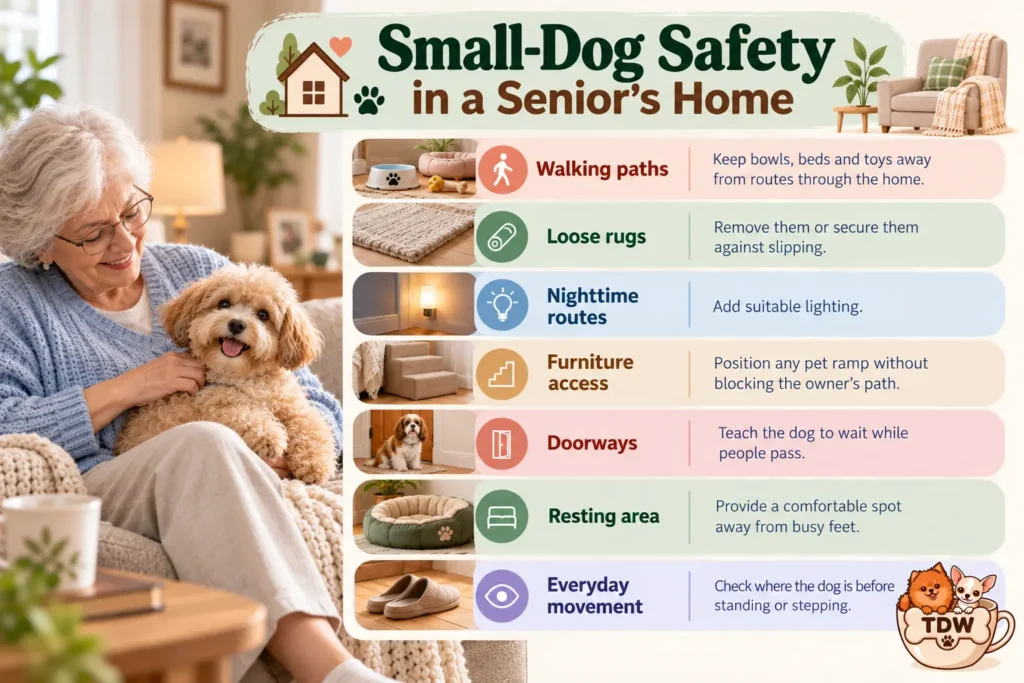
Every home and every dog is different, so pick the changes that fit your parent’s space and the dog’s habits. Depending on the situation, these ideas may help:
- Keep bowls, beds, and toys out of main walking paths.
- Remove loose rugs, or secure them so they can’t slip. This is standard CDC fall prevention advice.
- Use night lights in hallways, bedrooms, and the bathroom.
- Consider a bell on the collar if your parent finds it hard to track where a small dog is.
- Consider pet steps or a ramp if the dog likes to jump on and off the bed or couch.
- If bending is hard, a raised feeding spot may help your parent.
- Use a harness for walks if the dog has windpipe problems. PetMD recommends a harness instead of a collar for these dogs.
- A short, fixed leash usually gives better control than a retractable one.
- Sign up for basic training with reward based methods. The CDC report on pet related falls supported obedience training for dogs as a way to prevent these injuries.
Walks deserve extra care. A Penn Medicine study in JAMA Surgery found that fractures in adults 65 and older linked to walking leashed dogs rose from 1,671 cases in 2004 to 4,396 in 2017. The researchers also noted that dog walking causes fewer than 1% of fractures in older adults, and that injuries usually happen when a dog pulls and the walker loses balance.
If balance is already a concern, talk with your parent’s doctor before choosing a dog.
How to Find a Healthy Small Dog and Avoid Teacup Scams
Teacup listings attract scammers and careless breeders. The AKC’s advice on responsible breeders gives families a clear way to sort good sellers from bad ones.
Red flags to watch for:
- “Teacup,” “micro,” or “pocket” is the main selling point.
- The seller’s first questions are about how soon you can pay a cash deposit.
- You can’t meet the puppy’s mother, even on a video call.
- There are no health records or parent health tests.
- Puppies go home before eight weeks old. The AKC notes that toy breed breeders often keep puppies until about 12 weeks because they mature slowly.
Questions to ask any breeder or rescue:
- For puppies, how much did each parent weigh as an adult?
- Which health tests were done, and can I see the vet records?
- How does the dog respond to brushing, handling, and a leash?
- What is its potty routine?
- Has anyone seen how it behaves when left alone?
- Is there a written contract? The AKC says reputable breeders include a return to breeder clause, so a dog they bred can always come back to them.
Ask what the return clause covers and how it works in practice. Keep a separate backup care plan rather than assuming the breeder can immediately take the dog. Adoption is another great path. Many rescues and shelters have adult small dogs whose health and personality are already known.
Bring your parent to every meeting. It’s their dog, so their comfort matters most.
Is a Teacup Dog Right for Your Parent? A Quick Checklist
Sit down with your parent and go through these questions together. Discuss each answer and identify who will cover any task the owner cannot comfortably manage.
- Does your parent truly want a dog, not just the idea of one?
- Can they bend, lift, and groom a small dog comfortably?
- Is their eyesight good enough to spot a small dog on the floor, even at night?
- Is their balance steady on walks?
- Will you choose a dog at its normal breed size?
- Is every job on the care worksheet covered, including a backup?
- Does the budget cover food, grooming, and vet care, including emergencies?
- If they rent or may move, are pets allowed now and later?
If your parent has frequent falls, balance difficulties, or low vision, discuss the proposed care arrangement with their healthcare professional. Assess the individual dog and available support before deciding. A larger dog or an adult rescue is not automatically a safer alternative.
FAQs About Teacup Dog Breeds for Seniors
Which size of dog is safest for a senior?
There’s no single safe size. A dog light enough for your parent to lift is a sensible start, but behavior matters just as much. A calm dog that doesn’t pull, jump, or stay constantly underfoot is easier for anyone to manage.
Are teacup dogs hypoallergenic?
No. The American Academy of Allergy, Asthma and Immunology explains that there are no truly hypoallergenic dog breeds. Allergens are found in a dog’s dander, saliva, and urine, not just its hair. If allergies are a concern, talk with an allergist before choosing a dog.
Should I surprise my parent with a dog?
Please don’t. A dog is a daily commitment that lasts for years. Let your parent choose the dog and meet it first, so it feels like their decision.
Can seniors in assisted living keep a teacup dog?
Sometimes. Every community sets its own rules on size, breed, and number of pets. Ask for the written pet policy before choosing a dog.
What if owning a dog full time isn’t a good fit?
There are other ways to enjoy dogs. Regular visits with a friend’s or neighbor’s dog can bring much of the joy without the daily care. Fostering is another option, but it still means daily responsibility.
Final Thoughts
Picture your mom a year from now. A small dog is curled up on her lap in the evening, greeting her at the door, and giving her a reason to step outside each morning. That’s the real goal, and it has very little to do with finding the tiniest puppy online.
When families look into teacup dog breeds for seniors, the happiest stories usually share one thing. They chose a healthy dog over the smallest one. A well bred toy breed at its normal size can bring all the cuddles and company, without the constant worry that comes with a fragile dog.
The rest is teamwork. The right dog fits your parent’s energy, their home, and the help around them. A care plan with real names on it keeps that dog safe on the hard days, not just the easy ones.
So start with a conversation, not a purchase. Sit down with your parent, fill in the care worksheet, and meet a few dogs together. When the right one comes along, you’ll both know it.

The TeacupDogWorld Editorial Team researches and creates practical guides about small and teacup-sized dogs, including breed characteristics, grooming, nutrition, health, training, and everyday care. Our content is developed using reputable veterinary, breed-club, and animal welfare sources to help dog owners make better-informed decisions.