
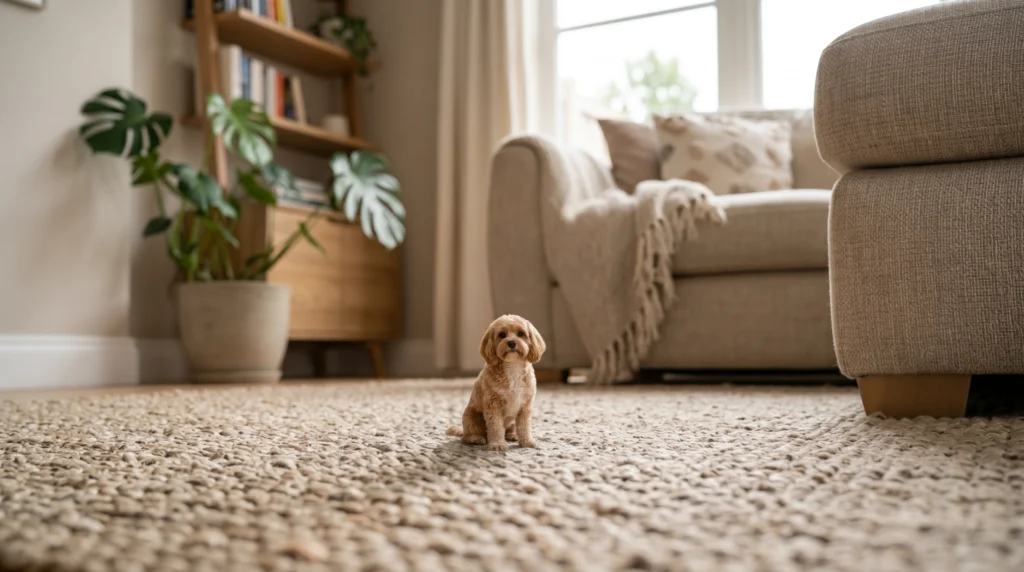
A teacup Cavapoo is a very small Cavapoo, which is a mix of the Cavalier King Charles Spaniel and the Poodle. “Teacup” is a word sellers use to describe a tiny puppy. It is not an official size, and it can’t promise how big the dog will grow.
If you’ve seen one of these puppies online, it’s easy to understand the appeal. But a sweet photo and a promised weight aren’t enough to choose a family dog.
This guide explains how small these dogs really get and how breeders try to make them small. It also covers the health questions to ask, and whether this dog suits a home with kids. At the end, you’ll find a checklist for choosing a healthy small Cavapoo and avoiding scams.
What Is a Teacup Cavapoo?
A teacup Cavapoo is a Cavapoo that is bred or advertised to be smaller than usual. Cavapoos come from the Cavalier King Charles Spaniel and the Poodle. “Teacup” is a seller’s label, not a separate breed, and no kennel club treats it as an official size.
The Cavapoo, sometimes called a Cavoodle, is a designer dog. That means it’s a planned mix of two purebred breeds. PetMD’s Cavapoo profile describes it as a cross between a Cavalier King Charles Spaniel and either a Miniature Poodle or a Toy Poodle.
Some puppies have one parent from each breed. Others come from later crosses, such as two Cavapoos bred together, or a Cavapoo bred back to a Poodle.
Sellers who advertise teacups often mention Toy Poodle lines, since the Toy Poodle is the smallest Poodle. But a label in an ad can’t tell you a puppy’s real family tree. Always ask about the actual parents.
Is “Teacup” an Official Cavapoo Size?
No. A veterinarian writing for PetMD’s guide to teacup dogs explains that there is no official weight for a teacup dog of any kind. On top of that, the Cavapoo itself is not a purebred breed recognized by the American Kennel Club (AKC). So there is no breed standard for the Cavapoo, and none for a teacup version either.
That’s why sellers don’t agree on what “teacup” means. Some use it for Cavapoos expected to stay under 7 pounds. Others use it for dogs as big as 15 pounds, which is simply a normal small Cavapoo.
So when you see “teacup” in an ad, read it as the seller’s hope for the puppy’s size, not a promise.
How Big Does a Teacup Cavapoo Get?
There is no agreed adult weight or height for a teacup Cavapoo, and no one can promise a puppy’s final size. Sellers usually aim for the very smallest end of the Cavapoo range.
It helps to compare the label with numbers that are real. The table below uses the official AKC standards for the two parent breeds and PetMD’s typical range for Cavapoos.
| Dog | Height at the shoulder | Adult weight | Is this official? |
|---|---|---|---|
| Cavalier King Charles Spaniel | 12 to 13 inches | 13 to 18 pounds | Yes, AKC breed standard |
| Toy Poodle | 10 inches or under | Not set by the standard (typically about 4 to 6 pounds) | Height is official; weight is only typical |
| Cavapoo | About 9 to 14 inches | About 8 to 25 pounds | No, a typical range only |
| “Teacup” Cavapoo | Varies by seller | Seller claims range from under 7 pounds to about 15 pounds | No |
The Cavalier King Charles Spaniel figures come from the AKC Cavalier King Charles Spaniel standard. The AKC Poodle standard sets the Toy Poodle’s height limit but no weight. The typical Toy Poodle weight and the Cavapoo range come from PetMD.
Here’s the important part. The same word, “teacup,” is used both for dogs smaller than many Toy Poodles and for dogs that are just normal small Cavapoos.
Teacup vs Toy vs Mini Cavapoo
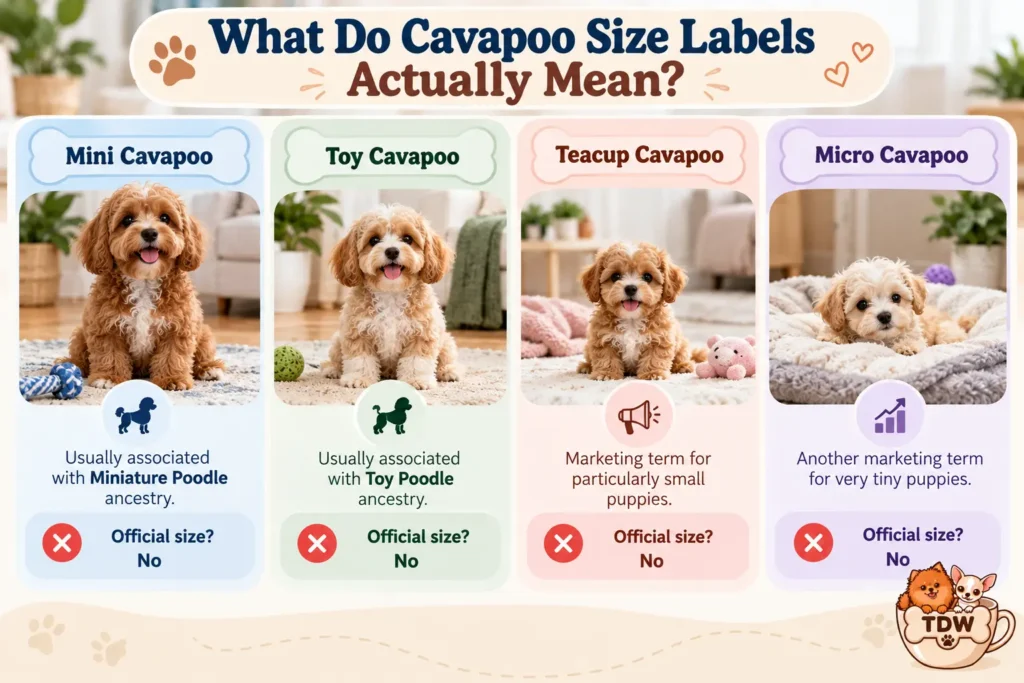
Sellers use several size names. None of them are official, and each seller defines them a little differently.
| Label | What sellers usually mean | Official? |
|---|---|---|
| Mini Cavapoo | Often a Cavapoo with a Miniature Poodle parent, so usually the larger size | No |
| Toy Cavapoo | Usually a Cavapoo with Toy Poodle ancestry | No |
| Teacup Cavapoo | A seller’s word for the smallest puppies | No |
| Micro Cavapoo | Another seller word for very tiny puppies, often used like “teacup” | No |
Two sellers may use different names for dogs of the same size. Compare their evidence, not their labels.
Why a Puppy’s Adult Size Is Hard to Predict
Mixed breed puppies don’t all grow the same way. Two puppies from the same litter can end up at quite different sizes.
A puppy’s “generation” also plays a part:
- F1 means a first cross. One parent is a Cavalier King Charles Spaniel and the other is a Poodle.
- F1b means an F1 dog was bred back to one of the parent breeds. This is called a backcross. In Cavapoo breeding, that parent breed is usually a Poodle. The label alone doesn’t guarantee a smaller dog or a curlier coat.
Before you trust a size estimate, ask the seller for:
- the puppy’s birth date and dated weight records
- the adult weight and height of both parents
- the adult sizes of puppies from earlier litters of the same parents
- an explanation of how they estimated the adult size
These records help, but they still don’t turn a guess into a guarantee. If knowing the final size matters a lot to your family, consider an adult dog, whose size you can see for yourself.
How Breeders Make a Teacup Cavapoo
There’s no single method, and an ad won’t tell you which one was used. Sellers who aim for very small puppies may:
- use a very small Toy Poodle as a parent
- breed Cavapoos back to Toy Poodles
- pair the smallest dogs they have
Animal welfare groups and vets have raised concerns about teacup breeding in general. The UK charity Blue Cross explains that teacup breeders often pair the smallest dogs from litters, and some of those runts are small because of birth defects or other health problems. PetMD’s veterinary writer adds that when breeders focus mainly on size, health can fall by the wayside. That makes it easier for health problems to pass from parent to puppy.
These warnings are about teacup breeding as a whole. They don’t prove anything about one particular breeder. Smaller than normal puppies are sometimes born naturally in regular litters, too.
What matters is whether the breeder puts health ahead of size. The health testing section below shows you how to check.
Teacup Cavapoo Temperament
Teacup Cavapoos usually share the friendly, people focused personality of regular Cavapoos. A dog trainer interviewed by PetMD describes Cavapoos as gentle and calm, and says they tend to get along well with people and other animals.
The same article names separation anxiety as the biggest behavior concern. Cavapoos bond closely with their families, so they may get upset when left alone.
New research adds a reality check. In March 2026, a Royal Veterinary College (RVC) team published a study in PLOS One. It compared owner survey reports on the behavior of Cavapoos, Cockapoos and Labradoodles with reports on their purebred parent breeds.
Overall, the crossbreeds showed more unwanted behavior than a parent breed in about 44% of the comparisons. Cockapoos had the most problems.
For Cavapoos, the results were mixed:
- Owners reported Cavapoos as easier to train than Cavalier King Charles Spaniels.
- Compared with Poodles, Cavapoos were reported as harder to train.
- Compared with Poodles, Cavapoos also showed more fear of unfamiliar things and of other dogs.
These are survey findings about groups of UK dogs, not fixed traits of every Cavapoo. The study didn’t look at teacup Cavapoos separately, and it can’t predict how your puppy will behave. The helpful takeaway is to plan early socialization and gentle, reward based training from day one.
Are Teacup Cavapoos Good With Kids?
Teacup Cavapoos can be loving with children. But their very small bodies make them a better fit for homes with older, calm kids and an adult who supervises.
Cavapoos generally do well with children who know how to play gently. Very small dogs have fragile bones, though, and even jumping off a bed can cause a fracture. A dropped puppy or a trip in a busy hallway can lead to a serious injury.
The RVC study’s senior author, Dr. Rowena Packer, also warned families not to assume too much. She said that believing designer crossbreeds are naturally easy to train or safe with children can have serious consequences when that belief isn’t backed by evidence.
If you have toddlers, a slightly larger, sturdier dog is usually a safer choice. With older kids, set a few simple rules:
- Sit on the floor when holding the dog.
- Never carry the dog around the house.
- Let the dog walk away when it wants space.
Teacup Cavapoo Health Problems to Know
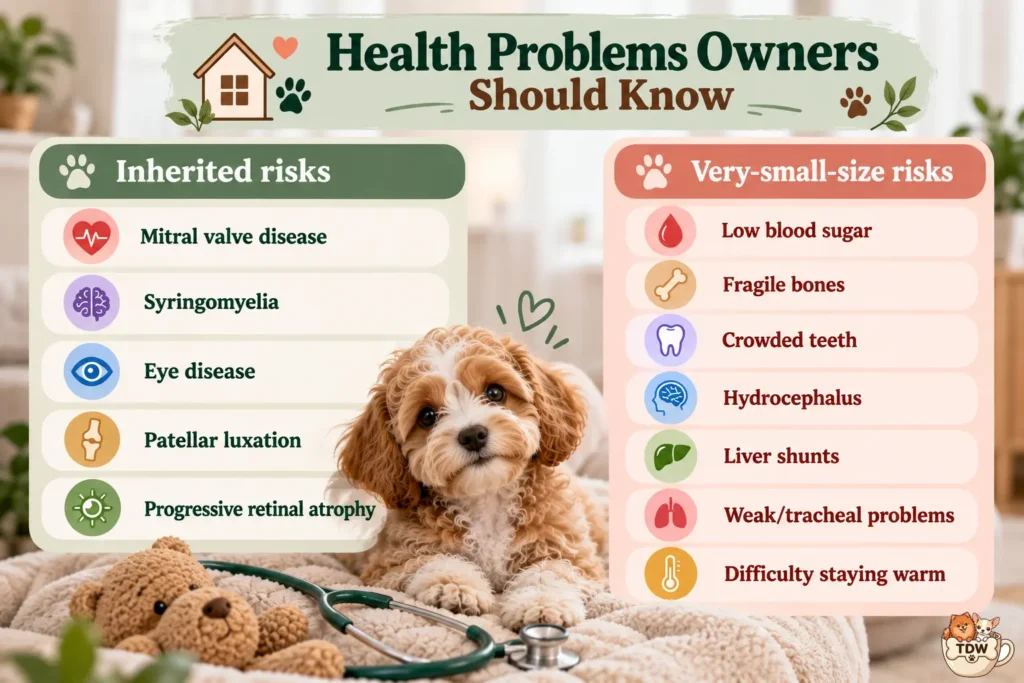
A teacup Cavapoo faces two different kinds of health risk:
- Inherited risks come from the parent breeds’ genes. They can affect a Cavapoo of any size.
- Size-linked risks come from having a very small body.
Not every dog will develop these problems. Knowing about them helps you ask better questions and notice changes early.
Health Risks From the Cavalier King Charles Spaniel Side
Heart disease. Mitral valve disease is when a valve inside the heart slowly wears out and starts to leak. It is very common in purebred Cavalier King Charles Spaniels. Research in the Journal of Veterinary Internal Medicine notes that about half are affected by age 6 or 7. A 2020 study reports that as many as 90% have it by age 10.
PetMD notes that Poodles also have a higher risk of this disease, and that responsible breeders should show proof that both parents have healthy hearts. Dogs with this disease usually have a heart murmur, and some later develop coughing or trouble breathing.
Syringomyelia. This means pockets of fluid form inside the spinal cord. It usually happens because of a Chiari-like malformation, which is a problem with how the skull forms. Signs can include pain, scratching at the neck area, and a wobbly walk. A 2024 study in Frontiers in Veterinary Science notes that it has been found in roughly 39 to 46% of Cavalier King Charles Spaniels in the populations studied. The Merck Veterinary Manual explains the condition in more detail.
Eye problems. The Cavalier King Charles Spaniel can develop several eye conditions, including dry eye and cataracts.
One important limit: these figures come from studies of purebred Cavalier King Charles Spaniels. We don’t have matching figures for Cavapoos. They show what a puppy could inherit, not what it will get.
Health Risks From the Poodle Side
Slipping kneecaps. Patellar luxation means the kneecap can slip out of its normal place. It’s common in small dogs and may show up as limping or a skip in the dog’s step. In the RVC’s 2024 health research, owners reported this problem in Cavapoos at about the same rate as in both parent breeds.
Eye disease. Poodles can inherit progressive retinal atrophy, a disease that slowly damages the back of the eye and affects vision.
Extra Risks That Come With Very Small Size
PetMD notes that many of these problems also show up in regular small breeds. Research is still ongoing into whether they happen more often the tinier a dog is bred to be. Poor breeding raises the odds either way.
Risks linked to very small size include:
- low blood sugar, especially in young puppies
- fragile bones that break easily
- crowded teeth and baby teeth that don’t fall out on their own, which trap plaque and raise the risk of gum disease
- hydrocephalus, a buildup of fluid around the brain
- liver shunts, where blood vessels skip the liver
- a weak windpipe that causes a honking cough
- getting cold quickly
There are practical challenges too. Many medicines have minimum age and weight limits, and these limits vary by product. Your vet will need to choose medicines and doses that are safe for your dog’s age and weight. Anesthesia and surgery are also harder on very small bodies. Regular tooth brushing and vet dental checks matter a lot for a dog this small.
You’ll see the same size-related risks in other tiny breeds, like the Teacup Pomeranian.
Are Mixed Breed Cavapoos Healthier?
Not automatically. Many sellers say mixed breeds are healthier than purebreds, but recent research doesn’t support that as a general rule.
In a 2024 health study, the RVC surveyed UK owners of Cavapoos, Cockapoos, Labradoodles and their parent breeds. Across all three crossbreeds, the researchers compared the odds of 57 common health problems with each parent breed. In 86.6% of those comparisons, no statistically significant difference was detected.
A few differences did show up. Cavapoos were more likely to get ear infections than Cavalier King Charles Spaniels. All three crossbreeds had more vomiting and diarrhea than Poodles.
Keep the limits in mind:
- The study relied on owner reports.
- It looked at young dogs, so it can’t tell us about health across a whole lifetime.
- It didn’t assess teacup Cavapoos separately.
What it does tell us is that being a mix doesn’t guarantee better health. That’s why the parents’ health tests matter so much.
How Long Does a Teacup Cavapoo Live?
PetMD says a Cavapoo usually lives about 12 to 15 years. There is no reliable research on how long teacup Cavapoos live.
Some websites give much shorter lifespans for teacups, but we couldn’t find research behind those numbers. A puppy from health tested parents, raised with good care, gives your dog the best chance at a long life.
Is a Teacup Cavapoo Hypoallergenic?
No. No dog is truly hypoallergenic, and that includes the teacup Cavapoo.
Many Cavapoos shed less than other dogs because of their Poodle side. But low shedding is not the same as allergen free. Dog allergens come from skin flakes, saliva and urine, not just loose hair.
A well known study from Utrecht University found that so-called hypoallergenic breeds, including Poodles, actually had higher levels of the main dog allergen in their coats than other dogs. The researchers concluded there is no evidence for calling any breed hypoallergenic. That study is from 2012, but PetMD’s 2026 Cavapoo guide agrees that no dog is truly hypoallergenic.
If someone in your family has allergies, talk with an allergist first. Then spend real time around adult Cavapoos before you commit. Be wary of any seller who promises an allergy-free puppy.
Caring for a Teacup Cavapoo at Home
Caring for a teacup Cavapoo is a lot like caring for any Cavapoo, with extra attention to feeding and safety.
Feeding a Tiny Cavapoo Puppy
Tiny puppies need small meals, often. This is about safety as much as nutrition.
The AKC explains that very young toy puppies have little body fat and muscle and an immature liver, so they can’t store much energy. That makes their blood sugar drop easily.
PetMD says regular Cavapoo puppies usually need three to four small meals a day. Very small puppies may need to eat more often. Ask your vet to set a feeding plan that fits your puppy.
Learn the warning signs of low blood sugar:
- weakness or unusual tiredness
- trembling
- wobbly walking
- in serious cases, seizures or collapse
If you see these signs, call your vet or an emergency vet right away. The AKC’s chief veterinarian notes that the puppies he treated for low blood sugar were often very young toy breeds, newly brought home. Their owners usually didn’t know the risk.
One more rule: never cut back food to keep a puppy small. If a seller suggests this, treat it as a serious red flag and talk to your vet.
Keeping a Tiny Dog Safe at Home
A few simple habits can reduce the risk of injury:
- Use pet steps or ramps so your dog doesn’t jump off beds and couches.
- Teach kids to sit on the floor when holding the puppy.
- Look down before you step or sit, especially in the first few months.
- Check doors, recliners and folding chairs before closing them.
- Keep the puppy away from bigger dogs until they are properly introduced.
- Have a sweater or coat ready for cold days.
- Use a secure carrier in busy places instead of carrying the dog loose in your arms.
Grooming and Exercise Basics
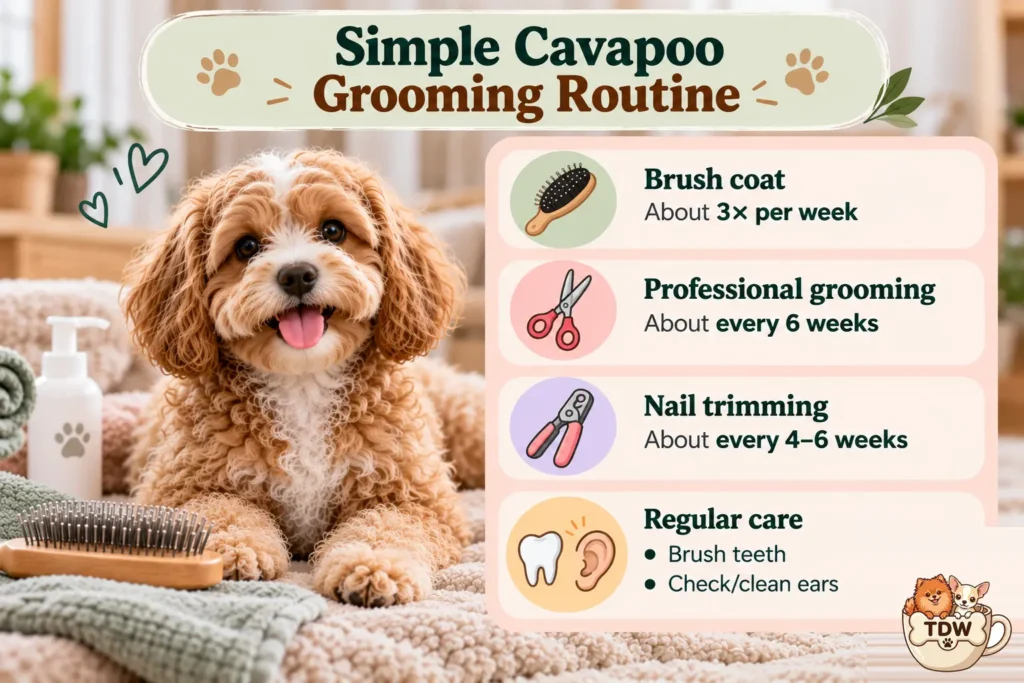
That soft, curly coat needs regular care. PetMD suggests:
- brushing a Cavapoo about three times a week
- booking a groomer about every six weeks
- trimming nails every four to six weeks
Clean the ears and brush the teeth regularly too.
Exercise is easy to fit in. Cavapoos don’t need hard exercise. Short walks, indoor play, food puzzles and trick training keep them happy. A tiny dog tires out quickly, so keep outings short and gentle.
The Real Cost of Owning a Teacup Cavapoo
Purchase prices vary a lot from seller to seller, and the “teacup” label doesn’t tell you anything about a puppy’s health. Whatever you pay up front, plan for the ongoing costs of any Cavapoo:
- Grooming. Professional grooming every few weeks adds up over the years.
- Vet visits. Routine checkups, vaccines and dental care. A very small puppy may need extra visits in its first months.
- Specialists. Heart, eye or surgery specialists are sometimes needed.
- Emergencies. Injuries like a broken leg can be expensive.
Get local quotes for vet care and grooming before you commit. Look into pet insurance early, before any health problems appear, and keep an emergency fund for your dog.
How to Find a Healthy Small Cavapoo
If your heart is set on a small Cavapoo, choose the parents carefully. A healthy puppy starts with healthy, tested parents.
Health Tests to Ask For on Both Parents
Ask the breeder for health test results for both the mother and the father. The AKC health testing page lists these tests, recommended by each national breed club:
| Parent breed | Recommended tests |
|---|---|
| Cavalier King Charles Spaniel | Kneecap exam, hip exam, heart exam, eye exam by a veterinary eye specialist |
| Toy Poodle | Kneecap exam, eye exam by a veterinary eye specialist, and a DNA test for an inherited eye disease called PRA-prcd |
The Cavalier King Charles Spaniel Club, USA, advises buyers to look for breeders who have parents cleared by board certified specialists for heart, eyes and hips. It also advises a vet check for kneecaps, and copies of all the results.
You can look up many results in the Orthopedic Foundation for Animals database. You may see a CHIC number there. A CHIC number means all the required tests were done and the results were made public. It does not mean every result was normal. Always read the actual results, the test dates, and the dog’s ID, such as a microchip number.
Parent tests and puppy records are two different things. Parent tests show what the puppy might inherit. The puppy’s own records show how it has been cared for. Ask for both, including the puppy’s vet exam, vaccination and deworming records.
Red Flags in Teacup Cavapoo Ads
Be careful if a seller:
- promises a “guaranteed” teacup or micro size
- says the puppy is hypoallergenic or allergy free
- can’t show real health test results for both parents
- won’t let you meet the parents, visit, or have a live video call
- pressures you to pay before you’ve seen the records
- wants payment by wire transfer, gift card or a payment app
- keeps adding new fees for shipping, crates or insurance
- suggests limiting food to keep the puppy small
- gets the breed name wrong
That last point is a useful test. The Cavalier King Charles Spaniel Club, USA advises against buying from anyone who doesn’t use the breed’s correct name, Cavalier King Charles Spaniel. Also watch for mix-ups with the King Charles Spaniel, which is a separate breed known in America as the English Toy Spaniel.
Puppy scams are common, and fake sellers often use stolen photos. The Better Business Bureau recommends:
- seeing the pet in person or on a live video call
- running a reverse image search on the photos
- avoiding payment methods that give you no way to get your money back
Before you pay, read the seller’s written terms on health problems and returns. If something feels wrong, you can report it to BBB Scam Tracker.
Other Small Dog Options to Consider
If you want a small, sweet, curly dog, you have other options besides a teacup:
- A small Cavapoo from health tested parents. A dog at the lower end of the normal size range is still small and easy to carry, but sturdier.
- A small adult dog from a rescue. An adult’s size is already known. Its behavior may change as it settles into a new home, so ask the rescue what they’ve seen, and plan a vet check soon after adoption.
- A smaller puppy from a regular litter. PetMD’s veterinary advice is to talk with a breeder of regular size dogs who does all the recommended health tests. Smaller than normal puppies are sometimes born in these litters, and good breeders look for homes for them, often on the condition that they are never bred. A very small puppy still needs the extra care described above, whatever litter it comes from.
Is a Teacup Cavapoo Right for Your Family?
A teacup Cavapoo can be a loving companion in the right home, but it isn’t right for every family. This table can help you decide.
| A teacup Cavapoo may fit if… | A teacup Cavapoo may not fit if… |
|---|---|
| Your children are older and calm | You have toddlers or very young kids |
| Someone is home for most of the day | The dog would often be alone for long hours |
| You can manage frequent meals in the puppy months | Your schedule makes regular feeding hard |
| You can budget for grooming and possible specialist care | You need a dog with low, predictable costs |
| You’re willing to check health records carefully | You want to buy quickly from an online ad |
| Your home is calm, even if it’s an apartment | Your home is busy with lots of foot traffic or big dogs |
| Nobody in the family has a serious dog allergy | You need a dog that won’t trigger allergies |
If most of your answers land in the right column, a slightly larger Cavapoo or an adult rescue may be a better fit.
Teacup Cavapoo FAQs
When is a teacup Cavapoo full grown?
Small dogs often reach close to their adult size within their first year, but every puppy grows at its own pace. Your vet can track your puppy’s growth at each checkup.
Do teacup Cavapoos bark a lot?
Cavapoos aren’t generally known as big barkers. However, separation anxiety can lead to barking and chewing when they’re left alone. Early training and short practice absences can help.
Is a teacup Cavapoo good for an apartment?
It can be. PetMD notes that Cavapoos adapt to homes from small apartments to big houses, and they don’t need hard exercise. Plan for regular potty breaks and short daily walks.
Is a teacup Cavapoo a good first dog?
Regular Cavapoos are often recommended for first time owners because they’re friendly and easygoing. A very small puppy asks more of you, though: frequent feeding, careful handling and closer health monitoring. First time owners may find a slightly larger Cavapoo easier.
Conclusion
A teacup Cavapoo is a very small Cavapoo, but “teacup” is a seller’s label, not an official size or a promise. These dogs can be affectionate family pets.
They also carry two kinds of health risk to plan for:
- inherited risks, such as heart disease from the Cavalier King Charles Spaniel side
- concerns linked to very small size, such as low blood sugar in puppies and fragile bones
If you want a small Cavapoo, choose a puppy from health tested parents rather than chasing the smallest size. Check the records yourself, and talk with your vet before you commit. A little extra research now is the best way to bring home a dog your family can enjoy for many years.

The TeacupDogWorld Editorial Team researches and creates practical guides about small and teacup-sized dogs, including breed characteristics, grooming, nutrition, health, training, and everyday care. Our content is developed using reputable veterinary, breed-club, and animal welfare sources to help dog owners make better-informed decisions.