

You saw a photo of a tiny white Morkie online, and now you can’t stop thinking about it. The listing says “teacup,” “hypoallergenic” and “healthy.” It sounds perfect. But before you pay a deposit, you deserve the full story.
A teacup Morkie can be a sweet, loving little dog. But the word “teacup” hides a lot, and very small dogs can come with real health risks.
In this guide, you’ll learn what a teacup Morkie really is, how big it gets and which health problems to watch for. We’ll also cover lifespan, allergies and daily care. Finally, you’ll get a simple checklist to decide if one fits your family, plus tips to find a healthy puppy and avoid scams.
What Is a Teacup Morkie?
A teacup Morkie is a very small mix of a Maltese and a Yorkshire Terrier. “Teacup” is a sales word, not a breed or an official size. Each seller decides for themselves what “teacup” means.
The Morkie is called a designer dog, which means it’s a planned mix of two purebred breeds. You may also see it called a Morkshire Terrier.
Is the Teacup Morkie a Real Breed?
No. The American Kennel Club (AKC) does not recognize the Morkie as a breed, and “teacup” isn’t an official size.
The Royal Kennel Club in the UK says “teacup” simply means a dog is smaller than average. It also warns that teacup breeders often breed from the very smallest dogs, sometimes the runts of the litter, and those dogs may not be the healthiest. The Chihuahua Club of America says it does not support using the word at all.
Here’s what the common labels really mean:
| Label | What it tells you | What it does not tell you |
|---|---|---|
| Morkie | The dog is said to be a Maltese and Yorkshire Terrier mix | A set adult size or personality |
| Toy | Both parent breeds belong to the AKC’s Toy Group | That there is an official “toy Morkie” size |
| Teacup, micro or mini | How the seller describes the size | A standardized adult weight, a health promise or a separate breed |
Teacup Morkie vs Regular Morkie
Both parent breeds are already tiny.
| Dog | Size guide | Who sets it |
|---|---|---|
| Yorkshire Terrier | Must not be more than 7 pounds | AKC breed standard |
| Maltese | Under 7 pounds, with 4 to 6 pounds preferred | AKC breed standard |
| Morkie (general estimate) | Usually up to about 7 pounds | PetMD vet-reviewed guide |
| “Teacup” Morkie | No official size | Each seller decides |
So a “teacup” label promises a dog smaller than two breeds that are already among the smallest in the world.
How Big Does a Teacup Morkie Get?
The vet-reviewed PetMD Morkie guide says Morkies usually top out around 7 pounds and about 9 inches tall. That’s an estimate for Morkies in general. There is no official size for a “teacup” Morkie. A puppy sold with that label may end up smaller, or it may grow into a typical Morkie size. A puppy photo can’t tell you.
The best clues come from real records. Ask the seller for:
- The puppy’s birth date
- The puppy’s weight on different dates, written down
- How much the mother and father weigh as adults
- The puppy’s vet records
Then ask your vet to check how the puppy is growing. If the exact size really matters to you, think about adopting an adult dog, whose size you can see for yourself.
One very important rule: never cut back a puppy’s food to keep it small. A growing puppy needs full, healthy meals.
Teacup Morkie Looks and Coat Colors
Morkies have soft, silky hair that keeps growing, a round face and dark eyes. Their ears may stand up like a Yorkshire Terrier’s or fold down like a Maltese’s.
Common colors include black, brown, tan, gold, cream and white, often mixed together. Online photos can fool you, because lighting, grooming and camera angles all change how a puppy looks. Ask for a live video call, or better yet, meet the puppy in person.
White and Cream Teacup Morkies
Because a Morkie is a mix, no one can promise what color a puppy will be as an adult. Keep these points in mind:
- A light puppy may not stay the same shade.
- A white coat doesn’t prove a puppy has a Maltese parent. Ask to see records for both parents.
- Don’t pay extra because a seller calls a color “rare.”
White coats also show tear stains easily. These are reddish-brown marks under the eyes. Wipe the face daily with a soft, damp cloth and keep it dry.
Teacup Morkie Personality
Morkies are usually loving, lively and very attached to their people. Many love to sit in laps and follow their family from room to room.
They also have a bold side from the Yorkshire Terrier. Many Morkies are alert and quick to bark at new sounds or visitors. Early training, and meeting lots of people and places as a puppy, helps them grow into calm, friendly adults.
Because they love company so much, Morkies can struggle when left alone for long hours. If your dog seems very upset every time you leave, talk to your vet or a trained behavior expert.
Teacup Morkie Health Problems
The Morkie can inherit health problems from both parent breeds, and very small dogs may face some of these risks even more. That doesn’t mean every Morkie will get them. Here are the main ones to know.
Low Blood Sugar
Tiny puppies can have low blood sugar, called hypoglycemia. Veterinary Partner, a vet-written resource, explains that very small toy puppies have little energy stored and can run low between meals, especially when they get cold or stressed.
Watch for sleepiness, weakness, wobbling, shaking or seizures. Never assume weakness is normal for a tiny puppy. Call your vet right away.
Liver Shunt
A congenital liver shunt, also called a congenital portosystemic shunt, is a blood vessel problem a puppy is born with. Blood goes around the liver instead of through it, so the body doesn’t get cleaned the way it should. Liver shunts can also develop later in life because of liver disease, but the kind linked to these breeds is the one puppies are born with.
The American College of Veterinary Surgeons (ACVS) lists both Yorkshire Terriers and Maltese among the breeds more likely to have congenital shunts.
This matters for teacup buyers because the ACVS lists small body size as one possible sign. So a puppy sold as extra tiny could, in some cases, be small because it’s sick. Other signs include poor growth, strange behavior after eating, vomiting, and drinking or peeing a lot. A vet can check with blood tests, such as a bile acid test.
Windpipe Problems
Toy breeds can have a weak windpipe, called tracheal collapse. The rings that keep the windpipe open get soft and flatten, which causes a dry, honking cough. VCA Animal Hospitals advises using a harness instead of a collar, because pressure on the neck can make coughing worse.
Kneecap Problems
Patellar luxation means the kneecap slips out of its normal place. You may notice your dog skipping or hopping on three legs for a few steps. Some cases are mild, and others need surgery. Your vet can check the knees at every visit.
Tooth and Gum Disease
Tiny mouths mean crowded teeth, and crowded teeth trap food and plaque. Small dogs like the Morkie often get gum disease, which can cause pain, bad breath and tooth loss. Brush your dog’s teeth daily if you can, and ask your vet about professional cleanings.
Shaker Syndrome in White Dogs
VCA Animal Hospitals says shaker syndrome is most common in small white dogs like the Maltese, but dogs of any color can get it. It causes shaking of the head or whole body, and it usually starts when a dog is 1 to 2 years old.
But shaking can have many causes, including cold, fear, pain and low blood sugar. If your dog starts shaking and you don’t know why, see your vet.
Are Mixed Breeds Healthier?
Many sellers say mixed breeds are healthier because of “hybrid vigor.” The truth isn’t that simple. A large UC Davis study found that whether purebred or mixed-breed dogs have more genetic problems depends on the specific condition. A Morkie can still inherit problems from both parents.
When It’s an Emergency
Get to a vet right away if your Morkie:
- Collapses or can’t stand
- Has a seizure
- Struggles to breathe
- Has pale, gray or blue gums
How Long Do Teacup Morkies Live?
PetMD estimates that Morkies generally live 11 to 15 years. That estimate is for Morkies in general.
There is no official lifespan estimate for dogs sold as “teacup” Morkies. Claims you’ll find online vary widely, so treat any specific number with caution. What we do know is that very small dogs can face more health risks. A healthy puppy from healthy parents, good food, dental care and regular vet visits give any Morkie the best chance at a long life.
Are Teacup Morkies Hypoallergenic?
No. No dog is truly hypoallergenic. The American Kennel Club says this plainly, and it includes designer dogs.
Morkies shed very little, which may help some people with mild allergies. But allergies come from dander, saliva and urine, not just hair, and every dog makes these.
If someone in your family has allergies, talk to an allergist before you commit. Then spend real time with a Morkie and see how that person feels.
How to Care for a Teacup Morkie
A teacup Morkie is small, but its care needs are big. Before your dog comes home, decide who in the family will handle each job.
Feeding
Puppies: Feed a complete and balanced puppy food made for small or toy breeds. Check the small nutrition statement on the bag to make sure it’s complete and balanced for growth. The words “small breed” on the front aren’t enough. Tiny puppies need small meals many times a day to keep their blood sugar steady, and your vet will set the right schedule. Watch every meal so you know your puppy is eating.
Adults: When your vet says the time is right, switch to a complete and balanced adult food. Measure each meal, and ask your vet how much to feed and how many meals a day suit your dog.
Grooming
That silky hair tangles easily, so plan to brush every day. Many owners keep their Morkie in a short “puppy cut” to make brushing easier.
Also wipe the face daily, brush the teeth, trim the nails when they click on the floor and check the ears every week.
Exercise and Home Safety
Morkies need daily play, but short walks and indoor games are usually enough. Keep them on a leash outdoors, and let them walk and sniff instead of carrying them everywhere.
Before your puppy arrives, get down on the floor and look at your home from a dog’s height. Look for stairs, gaps under gates, cords and spots where someone could step on a tiny dog. Then:
- Use a harness, not a collar.
- Stop your puppy from jumping off beds and couches. Pet steps or ramps can help.
- Keep them warm in cold weather.
Training and Potty Training
Morkies learn well with treats and praise. Keep training short and positive, and never yell or punish.
Make sure the whole family uses the same rules. For example, pick one calm way to say hello, so the puppy isn’t allowed to jump up on one person and scolded for it by another.
A tiny dog has a tiny bladder, so potty training takes patience. Take your puppy out after meals, naps and play. Many owners also use pee pads.
Is a Teacup Morkie Right for Your Family?
A teacup Morkie can be a wonderful companion, but only in the right home. Think about a normal weekday, not just the fun of bringing a puppy home.
| A good fit if you… | Maybe not the best fit if you… |
|---|---|
| Have someone home much of the day | Are gone for long hours every day |
| Have older, gentle kids or no kids | Have toddlers or kids who play rough |
| Have no pets, or calm pets you can manage | Have big, bouncy dogs you can’t always watch |
| Can brush every day and pay for grooming | Want a low-care dog |
| Can budget for vet visits and emergencies | Can’t cover surprise vet bills |
A dog this small can be hurt by a fall, a squeeze or being stepped on. If you have kids or other pets, these house rules help:
- Kids sit on the floor to play with the dog instead of carrying it.
- An adult watches whenever young children or bigger pets are with the dog.
- The dog has its own quiet resting spot where no one bothers it.
- Introduce pets slowly, and keep them apart when you can’t watch.
If you love the Morkie but worry about the risks of a very tiny dog, a Morkie from healthy, typical-size parents may be worth considering. If you’re comparing tiny breeds, our guide to the teacup Pomeranian covers another small dog many families consider.
How to Find a Healthy Teacup Morkie
Many families look for puppies online, so it pays to be careful. According to the Better Business Bureau’s 2025 puppy scam study update, over half of pet scams start on a website found through a search engine or social media. Scam reports also peak in December and January.
Red Flags When Buying
Walk away if you see these warning signs:
- The seller won’t let you visit or do a live video call.
- You can’t meet the puppy’s mother.
- Prices go up for “teacup,” “micro” or “rare color” puppies.
- The seller asks you to pay with a payment app, gift cards or a wire transfer.
- New fees keep popping up for shipping, special crates or “insurance.”
- The seller pushes you to decide fast.
- The ad photos show up on other websites. Try a reverse image search.
- The sales pitch is all about how tiny the puppy is, and not about its health.
If you think you’ve been scammed, report it to BBB Scam Tracker and the Federal Trade Commission.
Questions to Ask a Breeder
A caring breeder will be happy to answer these:
- How much do the mother and father weigh as adults?
- Can I meet the mother and see where the puppies live?
- What is the puppy’s birth date, and can I see its weight records?
- What health tests have the parents had?
- Can I see the puppy’s vet records?
- Has the puppy been checked for liver problems?
- What happens if the puppy gets sick or I can’t keep it?
About question 4: the AKC lists the health tests each parent breed club recommends. For the Maltese, that includes a kneecap check, a heart exam and a bile acid blood test, which checks the liver. Ask to see results for the Yorkshire Terrier parent too.
Take any results to your vet and ask what they mean. Health tests lower the risk, but they can’t promise a puppy will never get sick. Ask for everything in writing.
Adopting a Morkie
Adoption is a great option too. Check local shelters, small dog rescues and rescues for Maltese and Yorkshire Terriers. A rescue may not know a dog’s exact parents, but it can tell you about the dog’s health and behavior. With an adult dog, you also know the full-grown size.
Teacup Morkie Cost
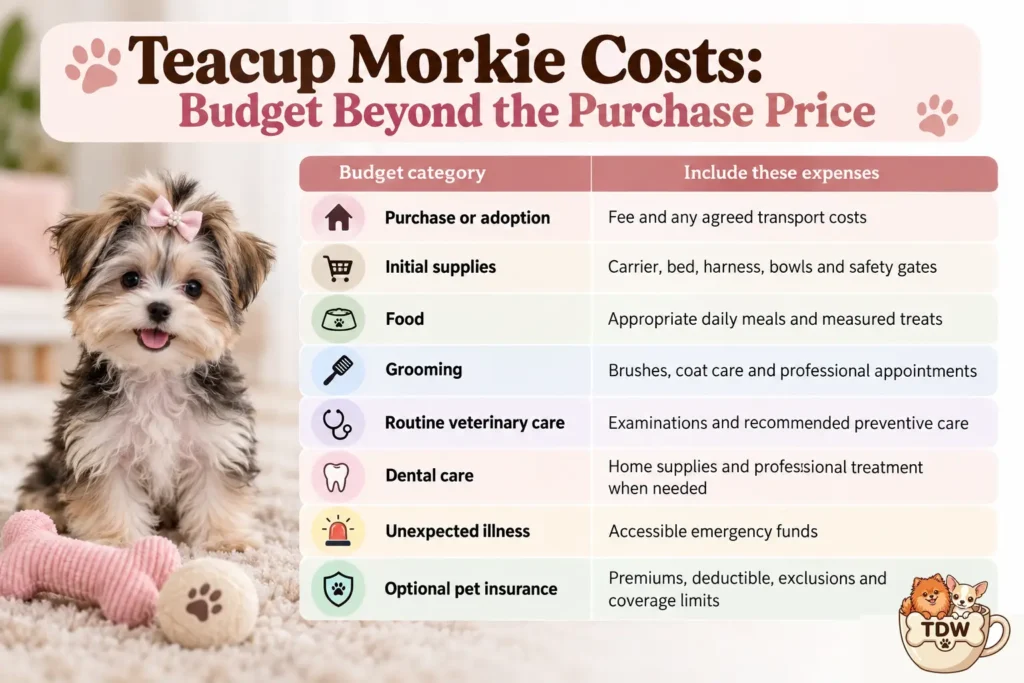
A dog sold as a “teacup” Morkie usually costs more upfront than a regular Morkie. But a higher price doesn’t mean a healthier dog. The bigger cost is what comes after, so find out local prices for each of these:
| Cost | What to find out |
|---|---|
| Puppy or adoption fee and supplies | What’s included, plus a carrier, bed, gates and harness |
| Food | The cost of a good small breed food at the amount your vet suggests |
| Grooming | The price of a groom and how often your dog will need one |
| Vet care | Checkups, vaccines and dental cleanings |
| Emergencies | How much you can set aside, and where the nearest emergency vet is |
| Pet insurance | Monthly cost, deductible and what it won’t cover |
A seller’s health guarantee doesn’t replace this budget. Read exactly what it covers before you sign.
Teacup Morkie FAQs
Can a tiny adult Morkie be healthy?
Yes. Plenty of small adult dogs are healthy. A vet exam and the dog’s health history tell you much more than its size.
What’s the difference between a Morkie and a Maltipoo?
Both have a Maltese parent. A Morkie’s other parent is a Yorkshire Terrier. A Maltipoo’s other parent is a Toy or Miniature Poodle.
Is a Morkie the same as a Morkshire Terrier?
Yes. “Morkshire Terrier” is just another name for the Morkie.
Final Thoughts
A teacup Morkie can bring a lot of love into your home, but a tiny puppy isn’t always a healthy one, and no dog is truly hypoallergenic. Knowing this before you buy protects both your family and the puppy.
If you decide a Morkie is right for you, focus on health, not size. Meet the mother, ask for weight records and health test results, and never pay a stranger online before seeing the puppy. If the risks of a very tiny dog worry you, ask your vet whether a Morkie from typical-size parents or an adult rescue dog might suit your family better.
Once your Morkie comes home, plan for daily brushing, the right food and meal schedule for your dog’s age, a harness and regular vet visits. Take the puppy’s records to your first vet appointment, and keep reading our guides on caring for tiny breeds.

The TeacupDogWorld Editorial Team researches and creates practical guides about small and teacup-sized dogs, including breed characteristics, grooming, nutrition, health, training, and everyday care. Our content is developed using reputable veterinary, breed-club, and animal welfare sources to help dog owners make better-informed decisions.