
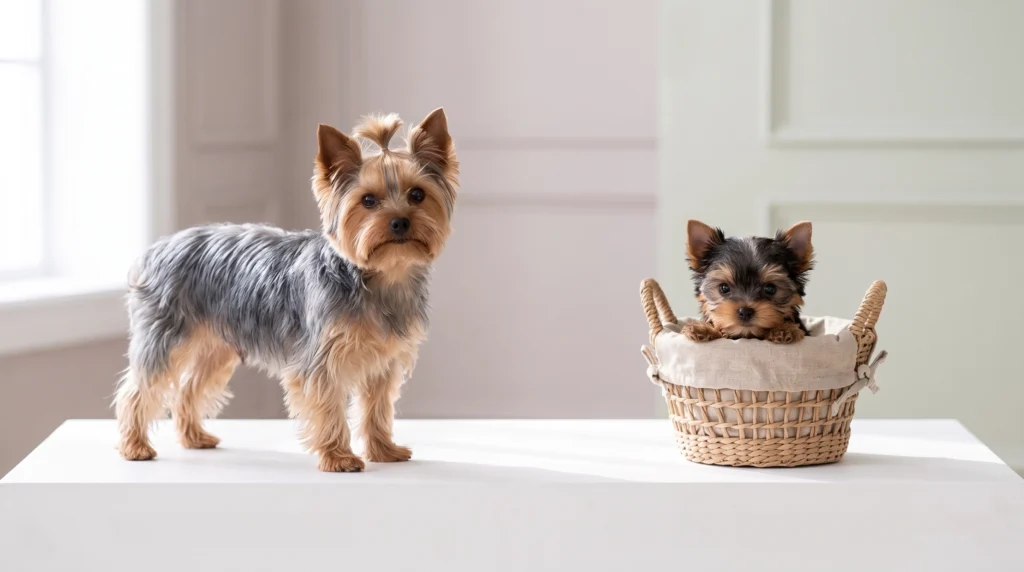
You spot a puppy ad that says “teacup Pomeranian.” Then a different breeder simply says “toy.” Are these the same dog? Is one smaller, or a better fit for your kids? It’s easy to feel lost, because sellers often use both words as if they mean the same thing. They don’t.
The good news is that the difference is simple once you see it. In this guide to teacup vs toy dogs, you’ll learn what each label really means, how sizes compare across real breeds, and what neither word can promise you. You’ll also find a quick comparison table, practical tips for homes with kids, and the questions worth asking before you bring a small dog home.
Teacup vs Toy Dogs: The Short Answer
“Toy” is an official term. It names the American Kennel Club (AKC) Toy Group, and in a few breeds it also names a recognized size variety, such as the Toy Poodle. “Teacup” is an informal label that sellers apply to very small dogs. The label alone tells you nothing certain about how a dog was bred or how big it will grow.
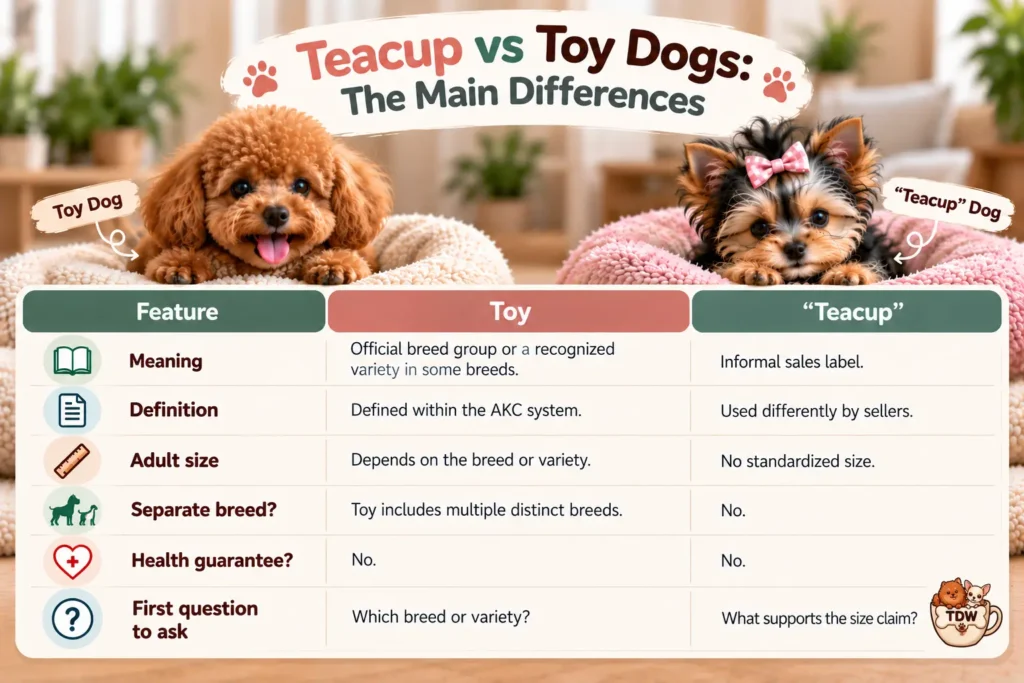
So a teacup dog is not a separate breed. A “teacup Chihuahua” is still a Chihuahua, just one that is being sold as extra small.
| Feature | Toy | “Teacup” |
|---|---|---|
| What it is | An official AKC breed group, or a recognized size variety in some breeds | An informal sales label |
| Who defines it | The AKC, through each breed’s written standard | No one; each seller uses it their own way |
| Size | Set by each breed or variety’s standard | No set size; often used for dogs smaller than their breed standard |
| What the label tells you | Which group or variety a dog belongs to | Only that the seller considers the dog very small |
| What it cannot tell you | Exact adult size, temperament, or health | Breeding history, adult size, temperament, or health |
| What to ask | Which breed is it, and what do the parents weigh? | What supports the size estimate, and what is uncertain? |
What Is a Toy Dog?
In the AKC system, “toy” can refer to a breed group or a recognized size variety. Neither use sets a single size for every dog.
The AKC Toy Group
The AKC sorts the breeds it recognizes into groups, such as Sporting, Herding, and Toy. The AKC Toy Group includes breeds like the Chihuahua, Pomeranian, Maltese, Yorkshire Terrier, Shih Tzu, Pug, and Cavalier King Charles Spaniel. The AKC describes these breeds as affectionate, sociable, and adaptable dogs that are smart and full of energy.
Toy as a Size Variety
Some breeds come in more than one recognized size. The Poodle is the best known example, with Standard, Miniature, and Toy varieties. Under the AKC’s official Poodle standard, a Toy Poodle measures 10 inches or under at the highest point of the shoulders, while a Miniature Poodle measures over 10 inches and up to 15 inches. The Manchester Terrier also comes in Standard and Toy varieties.
A few breed names include the word too, like the Toy Fox Terrier and the English Toy Spaniel. These are full breed names, not a smaller version of another dog.
Toy Breeds Come in Many Sizes
Here’s a myth worth clearing up. Many websites claim all toy dogs weigh under a certain number of pounds. The AKC does not set one weight for the whole Toy Group. Each breed’s own standard decides its size.
The adult weight references below come from veterinarian Jennifer Coates on PetMD. They show how wide the range is across real breeds. The right weight for an individual dog depends on its frame and health, so ask your vet to assess your own dog.
| Toy breed | Adult weight |
|---|---|
| Chihuahua | 3 to 6 pounds |
| Pomeranian | 3 to 7 pounds |
| Maltese | 4 to 6 pounds |
| Toy Poodle | 4 to 6 pounds |
| Yorkshire Terrier | 4 to 7 pounds |
| Shih Tzu | 9 to 16 pounds |
| Pug | 14 to 18 pounds |
A Chihuahua and a Pug are both toy breeds, yet a grown Pug can weigh several times more than a grown Chihuahua. So when someone says “toy,” the next question is always: which breed?
What Is a Teacup Dog?
You will see the “teacup” label attached to many breeds, such as the teacup Pomeranian and the teacup Maltese. Sellers also use similar words like “micro,” “pocket,” and “imperial.” For a wider look at how the label is used, see our guide to teacup dogs.
Why “Teacup” Is a Label, Not a Breed
The American Kennel Club says “teacup” is not an accepted size in any breed it recognizes. It also tells buyers to ask more questions when a breeder markets puppies that differ from the breed standard, including toy breeders who sell puppies as teacups.
There is no official teacup weight, so two puppies with the same label can grow into very different sizes.
Where Very Small Dogs Come From
The label doesn’t tell you a dog’s backstory. A dog sold as a teacup could come from any of these:
- A breeding program that pairs the smallest dogs it can find to get tinier puppies. Dr. Coates notes that when size becomes the main goal, health can fall by the wayside.
- A naturally small puppy born in an ordinary litter.
- A puppy whose growth has been slowed by a health problem.
That’s why the questions later in this guide matter more than the word in the ad.
What Toy and Teacup Labels Cannot Promise
Here’s the important part: neither label is a guarantee. Words in a puppy ad tell you what a seller expects. They can’t tell you exactly what you will get.
Adult Size
No one can promise how big a puppy will be when it grows up. A puppy sold as a teacup may end up larger than expected. A puppy can also stay very small for a worrying reason. Dr. Coates notes that a liver shunt, a problem with blood flow to the liver, can cause poor growth.
Information about both parents is one of the most useful clues. Ask for their adult weights and health records. You can often meet the mother, but the father may live somewhere else, so records may be all you get for him.
Temperament
Personality comes from the breed, the parents, and how the puppy is raised and socialized. The size label doesn’t change it. A small Yorkshire Terrier may show typical terrier traits, but assess the individual dog’s behavior.
Health
“Toy” doesn’t mean a dog will be healthy, and “teacup” doesn’t mean a dog will be sick. Health depends on the parents, health testing, and daily care. Still, very small dogs carry some extra risks worth knowing about.
Teacup vs Toy Dog Health: The Short Version
Many health problems seen in very small dogs also appear in regular toy breeds. Veterinarians worry that breeding for smaller and smaller size may make some of them more likely, though Dr. Coates notes researchers are still studying how much size alone adds.
One important concern in very small puppies is low blood sugar, also called hypoglycemia. The AKC names it first among the problems puppies marketed as teacups may face. Signs include weakness, trembling, wobbly walking, and seizures. If you see them, call your vet or an emergency clinic right away, and ask your vet for a feeding plan that fits your puppy.
Tiny bodies are also more fragile. Dr. Coates notes that even a jump off a bed can break a very small dog’s bone. Medicines need care too. Whether a product suits your dog depends on that product’s label and on your dog’s age, weight, and health, so check with your vet first.
For the full picture on each condition, see our guide to teacup dog health problems.
Teacup or Toy Dog: Which Fits a Family With Kids?
For families with young children, a sturdier dog is often easier to keep safe than a very tiny one. But size is only one consideration; temperament, health, care needs, and adult supervision also matter.
Little kids love to carry puppies around. But a very small dog can be badly hurt if a child squeezes it, drops it, or steps on it by accident. Even a toy breed needs an adult watching whenever toddlers are nearby.
A few simple house rules go a long way:
- Kids sit on the floor when they hold the puppy.
- An adult stays close whenever kids and the dog play.
- The dog has a quiet bed or crate where children leave it alone.
Families with older kids, or adults only, have more options. Still, a very small puppy needs someone home to feed it on schedule and keep a close eye on it, so be honest about whether your routine allows that.
Questions to Ask Before Choosing a Small Dog
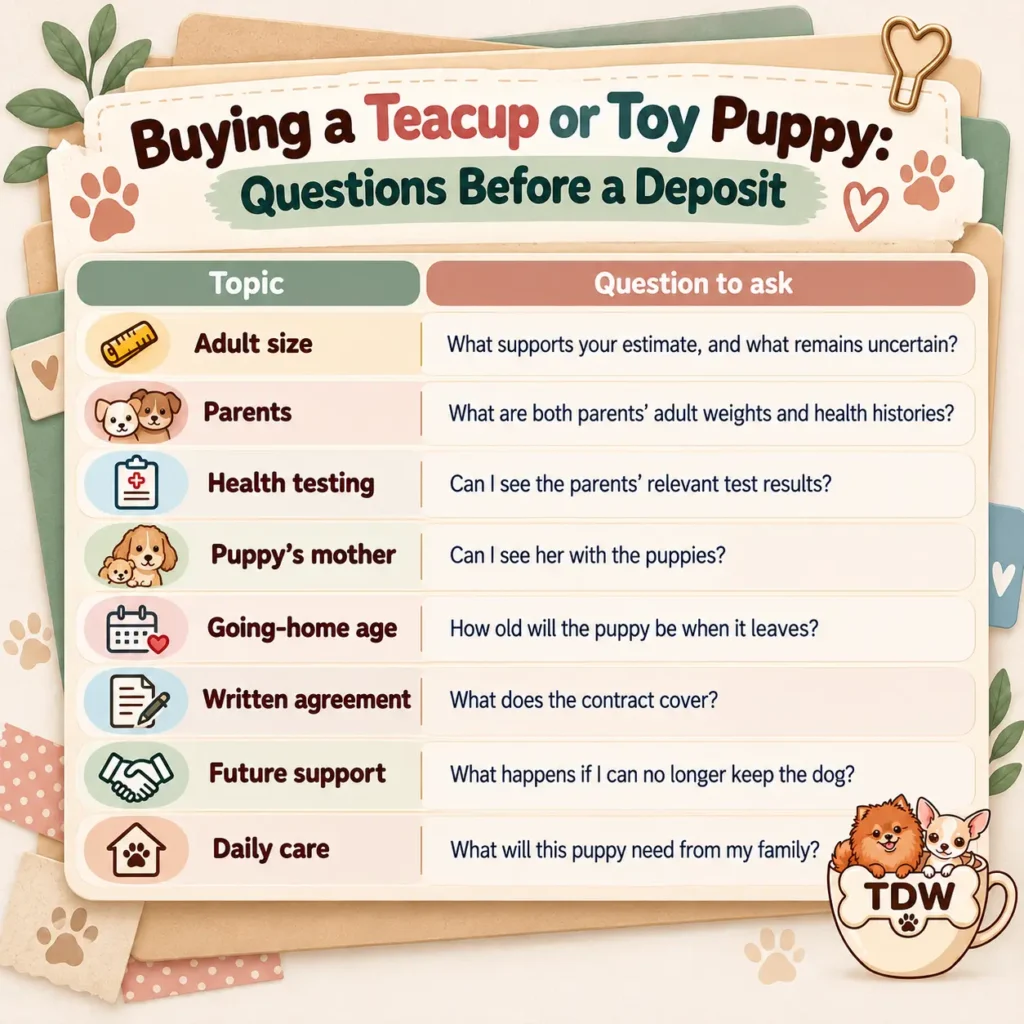
Before you pay a deposit, ask these questions. A good breeder will be happy to answer every one.
- What supports your adult size estimate, and what remains uncertain? A careful breeder will explain how they made the guess and admit what they can’t know.
- What can you tell me about both parents? Ask for their adult weights and health records. The AKC notes that the mother should be with her puppies, while the father often lives somewhere else.
- What health tests were done on the parents? Ask to see the results. Many breeders record them with the Orthopedic Foundation for Animals.
- How old will the puppy be when it comes home? The AKC warns against breeders who send puppies home before 8 weeks. It also says toy breeders often keep puppies until about 12 weeks because they mature slowly.
- Is there a written contract? Responsible breeders usually promise to take the dog back if you ever can’t keep it.
- What will this puppy need from my family? Ask about feeding, keeping warm, and vet care for a dog this size.
Adopting from a rescue? Rescues often have no records on a dog’s parents. Ask instead about the vet records they do have, what foster caregivers have observed, and which parts of the dog’s history are unknown.
Watch for warning signs too. Be careful if a seller charges more for a smaller promised size, uses words like “micro” or “pocket” as a selling point, or asks about your deposit before asking about your home. The AKC points out that a breeder whose first questions are about your deposit is showing you their priorities. Our guide to teacup puppy scams covers more red flags.
Other Ways to Find a Small Companion
If your heart is set on a tiny companion, you still have great choices.
- Choose a toy breed that fits its standard, from a breeder who health tests.
- Adopt an adult toy dog from a shelter or rescue. Its adult size is already clear, and you can watch how it behaves, though behavior can change once a dog settles into a new home. Our safe adoption steps can help.
- Ask breeders of dogs within their breed’s usual size range about naturally small puppies. Dr. Coates notes that smaller puppies are sometimes born in healthy litters, and good breeders look for pet homes for them, on the condition that they are never bred.
Teacup vs Toy Dogs FAQ
What is the difference between toy and miniature dogs?
Both words can be official, depending on the breed. “Miniature” can name a size variety, like the Miniature Poodle, or be part of a breed name, like the Miniature Pinscher, which is actually in the AKC Toy Group. “Teacup” never appears as an official breed name or variety.
Are all teacup dogs unhealthy?
No. Some very small dogs live good lives with careful owners and regular vet care. Breeding primarily for extreme smallness can raise health concerns, so assess the individual dog and its records. Dr. Coates suggests choosing a small dog that meets its breed standard instead.
Choosing Between a Teacup and a Toy Dog
The key difference between teacup and toy dogs comes down to who defines the word. “Toy” has an official meaning in the AKC system; “teacup” does not.
Neither word can promise adult size, personality, or health. So start with the breed, not the label. Ask what supports the size estimate, look at the parents’ records, and talk with your vet before you decide. Your future best friend is worth that extra care.
The TeacupDogWorld Editorial Team researches and creates practical guides about small and teacup-sized dogs, including breed characteristics, grooming, nutrition, health, training, and everyday care. Our content is developed using reputable veterinary, breed-club, and animal welfare sources to help dog owners make better-informed decisions.