
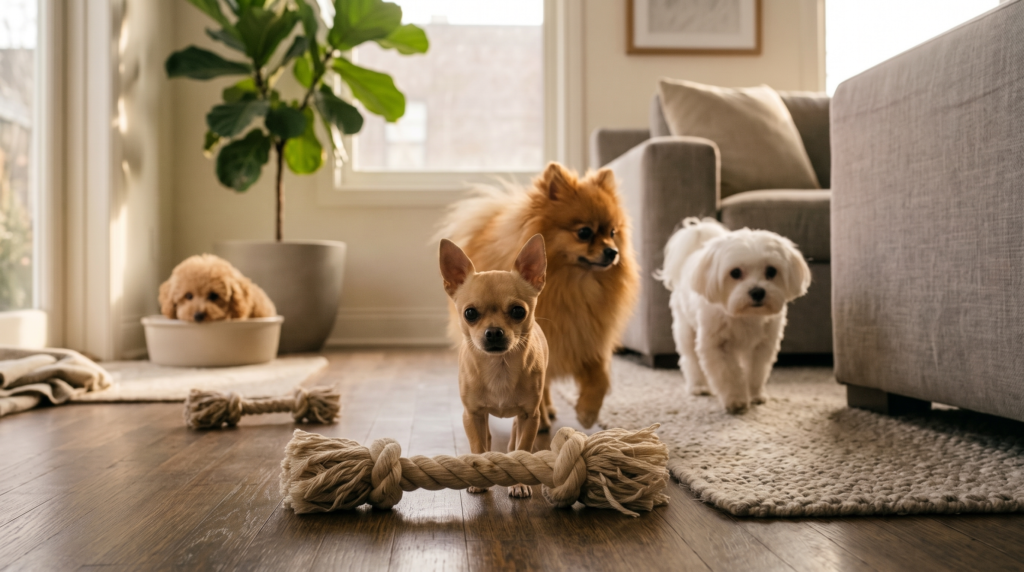
Search for teacup dogs and you get a dozen lists that do not agree with each other. One has Chihuahuas and Maltese. The next adds a Beagle and a French Bulldog. A third throws in a Pomsky.
They cannot all be right, and sorting out which ones are is more useful than another gallery of photos.
Here is how this page is organised. Not by which dog is cutest, but by what each one actually is. Some are genuinely tiny recognised breeds. Some belong to breeds that have a real smaller size, like the Toy Poodle. And some keep appearing on these lists despite not being small at all.
Below you will find all three groups, real adult sizes, how long each breed tends to live, and a short way to narrow the choice down.
Are There Really Different Types of Teacup Dogs?
Not officially. No kennel club recognises teacup as a size, so there is no such thing as a teacup breed or a teacup category with types inside it.
What does exist is a group of small breeds that sellers attach the word to. A puppy advertised as a teacup Yorkie is a Yorkshire Terrier. A teacup Pom is a Pomeranian.
So the honest version of your question is this: which small breeds am I actually choosing between? That has a real answer, and it falls into three groups.
Group one is breeds that are genuinely tiny by their own written standard. Group two is breeds that come in more than one official size, where a smaller version really does exist but is not called teacup. Group three is the breeds that end up on these lists by mistake.
If you want the background on the label itself, our guide to teacup dog sizes, health risks and care covers it in full.
Group One: Teacup Dog Breeds That Are Genuinely Tiny
These are recognised breeds that really are small as adults. Most belong to the AKC Toy Group, which is the actual category that teacup gets confused with. A dog from any of these sold as a teacup is just a small example of an already small breed.
The Ones You Will See Most Often
Chihuahua. The smallest by the official rules. The breed standard says not to exceed six pounds, and anything over that is disqualified in the show ring. Short coat or long coat, minimal grooming either way. Bold, bonded to one person, and far more dog than the size suggests.
The breed’s own parent club is blunt about the label. The Chihuahua Club of America says terms like teacup, pocket size and tiny toy are incorrect and misleading, and that they are used to make a puppy sound rare or more valuable. A small puppy in a litter, it says, is simply a small Chihuahua.
Yorkshire Terrier. Capped at seven pounds by the standard. The coat is fine hair that grows continuously rather than shedding in clumps, so it needs regular brushing or a short clip. This is a terrier, so expect opinions, confidence and a decent amount of noise.
Maltese. Under seven pounds, with four to six preferred. The long white coat is the whole commitment here. Left full length it needs daily attention, which is why many owners keep it short. Gentle, people focused, and happiest close to you.
Pomeranian. Three to seven pounds. A thick double coat that sheds and needs real brushing, despite the small package. Alert, chatty, and one of the more vocal breeds on this page.
Papillon. Eight to eleven inches at the shoulder, with weight in proportion. The single coat sheds little and is easier than it looks. Bright, athletic and one of the most trainable small dogs there is, which means it needs something to do.
Toy Poodle. Ten inches or under, which is a real recognised size rather than a marketing one. Curly coat that barely sheds but needs clipping every few weeks. Clever, busy, and easily bored.
Shih Tzu. Worth a closer look, because this one surprises people. The standard puts the Shih Tzu at nine to sixteen pounds, which is roughly double a Chihuahua’s maximum. It is a Toy Group breed and a small dog, but it is the heaviest on this list by a wide margin. Long double coat, high grooming load, and a calm affectionate character that suits families well.
You will also see this breed advertised as Imperial, which sounds like a royal bloodline and is not one. The American Shih Tzu Club calls Imperial and tiny teacup a myth used to create a market for dogs that do not meet the standard, and notes there is no evidence of any Imperial gene. Those dogs are produced the ordinary way, by breeding the smallest puppy in one litter to the smallest in another.
You can read more on the Maltese, the Yorkshire Terrier, the Pomeranian, the Chihuahua, the Shih Tzu and the Papillon in our breed guides.
The Less Common Tiny Breeds
These are just as small but harder to find, and you may face a waiting list.
Havanese. Silky coated, cheerful, and one of the friendliest small breeds. Needs regular grooming.
Japanese Chin. Quiet, cat like, and content with less exercise than most on this page.
Brussels Griffon. Big personality in a tiny frame. Comes in a rough coat and a smooth coat, and only the rough one is low shedding.
Chinese Crested. Hairless or coated. The hairless variety drops almost no hair but the skin needs sun protection and care.
Toy Fox Terrier. Quick, smart and busier than its size suggests.
Russian Toy. Fine boned and rare in the United States. Smooth or long coated.
Affenpinscher. Wiry, comic and stubborn in a way owners find funny.
Italian Greyhound. Slim, fast, and sensitive to cold. Needs a coat in winter.
One thing every dog in this group shares. Very small puppies can suffer dangerous drops in blood sugar in their first months, so they need small meals several times a day. Veterinary guidance on toy breed puppies explains the warning signs. All of them also need protecting from falls and from being stepped on, which matters more than the breed you choose.

Group Two: Breeds With a Real Smaller Size
This is where most of the confusion lives, and it is easy to clear up.
Some breeds genuinely do come in more than one size, and those size names are official. The Poodle comes in Standard, Miniature and Toy. The Dachshund comes in Standard and Miniature in the United States. The American Eskimo Dog comes in Toy, Miniature and Standard.
Here is the useful part. Teacup is never one of those names. There is no fourth Poodle size below Toy, and no Dachshund size below Miniature.
So if you have been searching for a teacup Poodle, the dog you actually want is a Toy Poodle, and it already exists with a written standard behind it. If you have been searching for a teacup Dachshund, you want a Miniature Dachshund.
That swap gets you a recognised size, a breed club, and breeders who can be held to something. The teacup version gets you a word.
Group Three: Breeds That Should Not Be on These Lists
Every dog in this section is a fine dog. The problem is that they turn up on teacup lists where they do not belong, and anyone choosing from those lists deserves to know why.
Flat Faced Breeds
Pugs and French Bulldogs appear on teacup lists regularly. They are small, and they are lovely company. But the face changes the picture in a way a list of tiny dogs really ought to mention.
A 2024 study of 584,734 dogs looked at how long different breeds live. As the university team behind it reported, flat faced breeds had a median life expectancy of 11.2 years and around a 40 percent higher risk of a shorter life than breeds with medium length muzzles. The French Bulldog’s median in that study was 9.8 years and the Pug’s was 11.6.
Compare that with the small long nosed breeds, which came out top of the whole table at 13.3 years. The gap is several years.
None of that makes them bad dogs. It does mean that putting them on a list aimed at people who want a small companion, without mentioning any of it, is not much help.
Breeds That Are Simply Not Small
The Beagle turns up on teacup lists surprisingly often. It is a medium sized hound, not a toy breed, and no standard suggests otherwise.
The Bichon Frise and Coton de Tulear also appear. Both are genuinely small and both are delightful, but both sit well above teacup weight and neither has a smaller official size.
And occasionally you will see a Samoyed. That is a different problem altogether, since a Samoyed is a medium sized working dog and puppies sold as mini Samoyeds are usually a different breed entirely.
Crossbreeds Sold as Types
Maltipoo, Pomsky, Chiweenie, Morkie, Yorkipoo. These are crosses between two breeds, not types of dog.
Because there is no standard, adult size and coat vary far more than they would in a purebred litter. Two Maltipoo puppies from the same cross can grow up quite differently. There is also no parent club behind them, so no agreed list of health tests for a breeder to complete.
To be clear, a crossbred dog can be a brilliant pet and many are. The issue is being sold a cross as though it were a rare type, usually at purebred prices, with no way to check what you are actually getting.
Teacup Dog Breeds Compared
Here are the group one and group two breeds side by side. Sizes come from the official breed standards, so they describe the breed rather than a teacup version of it.
| Breed | Official adult size | Grooming | Noise level | With young children |
|---|---|---|---|---|
| Chihuahua | Not over 6 lb | Low | Vocal | Better with school age children |
| Yorkshire Terrier | Not over 7 lb | High, or clip short | Vocal | Better with school age children |
| Maltese | Under 7 lb | High | Moderate | Better with school age children |
| Pomeranian | 3 to 7 lb | High, sheds | Vocal | Better with school age children |
| Papillon | 8 to 11 in tall | Moderate, low shedding | Alert barker | Needs close supervision |
| Toy Poodle | 10 in or under | High, regular clipping | Moderate | Needs close supervision |
| Shih Tzu | 9 to 16 lb, 9 to 10.5 in | High | Quiet to moderate | Often the sturdiest choice here |
| Miniature Dachshund | Under 11 lb at 12 months | Low to moderate | Vocal | Supervise, and protect the back |
Two things to take from that table. The Shih Tzu is the sturdiest of the group and the least likely to be hurt by ordinary family life. And the quietest breeds are not the smallest ones, which surprises most people.
How Long Each Type Tends to Live
This is the part no other list brings, and it matters more than coat colour or cuteness.
In that 2024 study, small breeds with longer muzzles had the highest median life expectancy of any group at 13.3 years. The breeds on this page mostly sit in that band. Among them, the Papillon came out highest at 14.5 years, the Yorkshire Terrier at 13.3, the Maltese at 13.1, the Shih Tzu at 12.8 and the Pomeranian at 12.2.
One figure surprises people. The Chihuahua’s median was 11.8 years, the lowest of the group, despite being the smallest breed here. Websites routinely claim Chihuahuas live fifteen to twenty years. That is not what the data showed across nearly eleven thousand of them.
Remember what these numbers are. They describe the breed, not a teacup version, because no teacup version has ever been measured. And the gap between the top and bottom of that list is under three years, which is smaller than the gap you often see between two individual dogs of the same breed.
How to Narrow the List Down
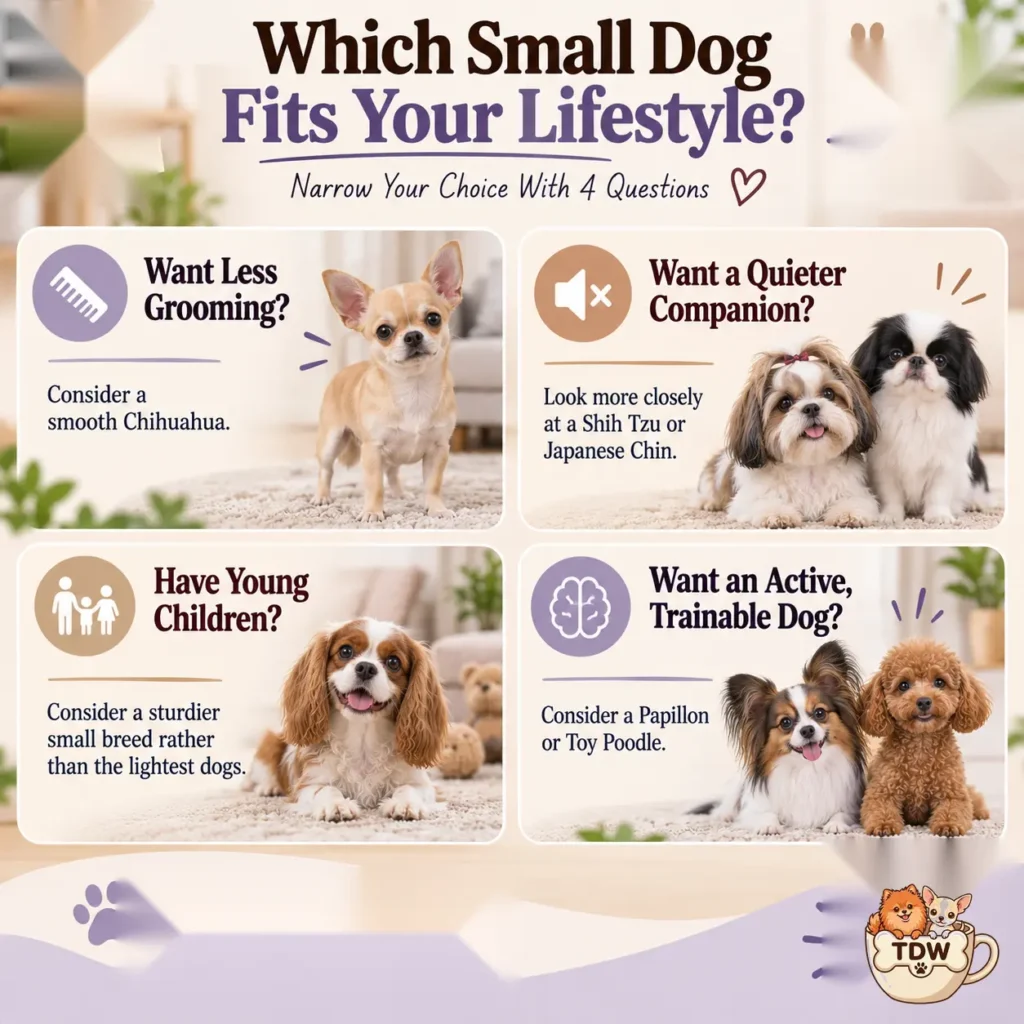
A dozen breeds is too many to choose from without a filter. Four questions do most of the work.
How much grooming will you actually do? Be honest rather than optimistic. The Maltese, Pomeranian, Shih Tzu and Toy Poodle all need serious regular attention or professional grooming. The Chihuahua and the smooth coated breeds need very little.
How much noise can your home take? Several of these are alert barkers, and in an apartment that matters. The Shih Tzu and the Japanese Chin are usually at the quieter end. The Chihuahua, Pomeranian and Yorkshire Terrier are not.
How old are your children? The very smallest breeds suit school age children better than toddlers, simply because a four pound dog is easy to injure by accident. If you have a toddler, the sturdier end of this list is worth looking at first.
Do you want a lap dog or a busy one? A Japanese Chin is happy with a short walk and a sofa. A Papillon or a Toy Poodle wants training, puzzles and something to think about. Both are lovely. They are not the same choice.
Then one last thing, and it outranks all four. Pick the breed that suits your home, then find a breeder who health tests the parents. The size label should be the last item on your list, not the first.
Buying Safely Whichever Type You Choose
The Better Business Bureau’s puppy scam research found that more than half of pet scams start on a website found through a search engine or social media. It also lists the word teacup in an advert as a warning sign in its own right.
A few quick checks before you send anybody money.
Insist on seeing the puppy live, either in person or on a video call, with the mother in the picture.
Be wary if the puppy must be shipped by a third party, if payment is only by bank transfer or gift card, or if new fees appear after your deposit.
Ask what health testing the parents had, and ask to see the results rather than a yes.
No breeder should be offering puppies before eight weeks old.
And if a seller tells you a puppy is a special recognised variety, check with the breed’s national club. Several of them publish a statement on exactly this, and those pages settle the question in about a minute.
You can also browse our teacup dog breed guides for what to expect from each breed before you contact anybody.
Types of Teacup Dogs FAQs
What are the types of teacup dogs?
There are no official types, because teacup is not a recognised size. What exists is a set of small breeds that sellers use the word for, including the Chihuahua, Yorkshire Terrier, Maltese, Pomeranian, Papillon, Toy Poodle and Shih Tzu.
Is teacup an official type or size?
No. No major kennel club recognises it. The real category people are thinking of is the Toy Group, which is an official grouping of small companion breeds with written standards behind each one.
What is the smallest teacup dog breed?
By the official rules, the Chihuahua. Its breed standard caps adult weight at six pounds and disqualifies anything heavier. The Yorkshire Terrier and Maltese are close behind, both capped at seven pounds.
Which type of teacup dog is best for families?
There is no single best, but sturdiness helps with young children. The Shih Tzu is the heaviest and most solidly built of the small breeds here. The very lightest breeds generally suit school age children better than toddlers.
Are teacup Poodles and Toy Poodles the same thing?
Effectively yes. Toy is a real recognised Poodle size at ten inches or under. Teacup is not a size at all, so a teacup Poodle is simply a Toy Poodle being advertised with an extra word attached.
Is a Maltipoo a type of teacup dog?
No. A Maltipoo is a cross between a Maltese and a Poodle, not a breed or a type. Without a standard, adult size and coat vary a lot, and there is no parent club health testing scheme behind it.
Which teacup breed is healthiest?
No honest answer exists to that question. The research shows differences between individual dogs of the same breed are larger than differences between these breeds, so any ranking would be invented. Look at the parents’ health testing instead.
Do all teacup dogs have health problems?
No. All very small dogs share some risks, particularly low blood sugar as puppies and injury from falls. But a small dog from health tested parents can be perfectly healthy, and small breeds live longer than large ones on average.
Which teacup dog barks the least?
Generally the Shih Tzu and the Japanese Chin. The Chihuahua, Pomeranian and Yorkshire Terrier are alert watchdogs and tend to be the most vocal, which is worth knowing if you live in an apartment.
Which type of teacup dog needs the least grooming?
The smooth coated Chihuahua, by a wide margin. The Papillon is easier than its coat suggests. The Maltese, Pomeranian, Shih Tzu and Toy Poodle all need frequent brushing or regular professional grooming.
Conclusion
There are no types of teacup dogs, only small breeds with a label attached. Sorting them into the three groups above is what makes the choice manageable.
Group one is where most families should be looking. Group two is worth knowing about, because a Toy Poodle or a Miniature Dachshund is a real size you can hold a breeder to. Group three is the list of dogs that keep appearing where they do not belong.
Pick the one that suits your home, read the full guide on it, and then spend your energy on finding a breeder who tests. That matters far more than the word in the advert.
The TeacupDogWorld Editorial Team researches and creates practical guides about small and teacup-sized dogs, including breed characteristics, grooming, nutrition, health, training, and everyday care. Our content is developed using reputable veterinary, breed-club, and animal welfare sources to help dog owners make better-informed decisions.